Tempur Pedic Mattress Cooling Explained for Hot Sleepers


A humid Connecticut summer night can expose the tension in memory foam. A sleeper may love the deep, pressure-relieving cradle of a Tempur-Pedic mattress, then wake at 2 a.m. feeling warm, restless, and ready to throw off the covers. The same close contouring that helps support the body can also hold heat near the sleep surface.
That doesn't mean every Tempur-Pedic mattress sleeps hot, and it doesn't mean every Breeze claim will feel identical in every bedroom. Tempur pedic mattress cooling depends on the model, its layered materials, the bedding, the base, the room, and the sleeper. This guide separates a cool first touch from overnight heat management, explains the advertised temperature figures, weighs cooling against support and value, and shows how a hands-on test at a Norwich Sleep Gallery can add context that a specification sheet can't.
Why Hot Sleepers Ask About Tempur Pedic Mattress Cooling
A sleeper who runs warm usually isn't asking whether a mattress feels cool for a few seconds. The practical question is whether the surface will still feel comfortable after the body has been resting in one position, the bedding has settled, and the bedroom has reached its warmest point.
Tempur-Pedic says its TEMPUR-Breeze mattresses are designed specifically for hot sleepers. The brand describes ProBreeze as feeling up to 5 degrees cooler and LuxeBreeze as feeling up to 10 degrees cooler, with the claims comparing average heat index results against ProAdapt models over an eight-hour period (Tempur-Pedic's hot-sleeper guidance). Those figures offer a useful benchmark, but they aren't a promise that every sleeper will experience the same result.
The comfort question behind the cooling question
Memory foam's appeal is easy to understand. It cushions pressure points, follows the body's shape, and reduces the feeling of movement travelling across the bed. For many couples and side sleepers, that enveloping feel is the reason to choose foam in the first place.
The complication is that close contouring can reduce the amount of open space around the body. A sleeper who enjoys a snug, cradling feel may also notice more warmth than someone who prefers a responsive, airy surface. The issue isn't just whether the foam is “good” or “bad.” It's whether the mattress manages heat in a way that suits that sleeper's needs.
Practical rule: A cool cover is a starting point, not a complete overnight performance test.
A useful decision guide therefore needs to answer more than “Does Tempur-Pedic feel cool?” It needs to clarify how the cooling layers work, what the advertised figures measure, when a more advanced system may justify its added investment, and how bedding and bedroom conditions affect the result. A local try-before-you-buy visit can then help a sleeper judge the most personal variable of all, comfort by feel.
Why Memory Foam Traps Heat in the First Place
Dense memory foam is designed to respond to pressure and body warmth. It softens and molds around the sleeper, spreading support across the body rather than leaving pressure concentrated at a few contact points. That design helps explain the familiar Tempur-Pedic sensation, but it also creates a thermal challenge.
A simple analogy is a thick winter coat. The coat feels comfortable because it holds warmth close to the body. If the sleeper stays inside it on a humid summer evening, the same insulation becomes uncomfortable. Body-conforming foam can create a similar pocket of warmth when the sleeper sinks into the surface and the material has limited airflow.
The problem isn't unique to one manufacturer. It comes from the relationship between density, contouring, body contact, and air movement. A mattress that hugs the body closely has fewer exposed pathways for warm air to move away, so cooling designers need to address the surface, the middle layers, and the core rather than relying on one treatment.
A short history of the material
Tempur-Pedic's original material story began with NASA-inspired aerospace research developed in the late 1960s. The company's first mattress reached consumers in 1992, well before dedicated cooling models became a central part of the product conversation (Tempur-Pedic's material history).
That timeline matters because it places cooling in context. The original priority was adaptive support and pressure distribution. As more sleepers raised concerns about warmth, the brand expanded the design beyond the original foam platform and introduced cooling-focused constructions.
Readers looking for a plain-language explanation of the underlying material can also review what a memory foam mattress is. The important takeaway is straightforward: heat retention is a design problem created by close body contact and limited ventilation. The cooling response must therefore manage heat as it enters, moves through, and leaves the sleep surface.
How the Tempur Breeze Cooling System Actually Works
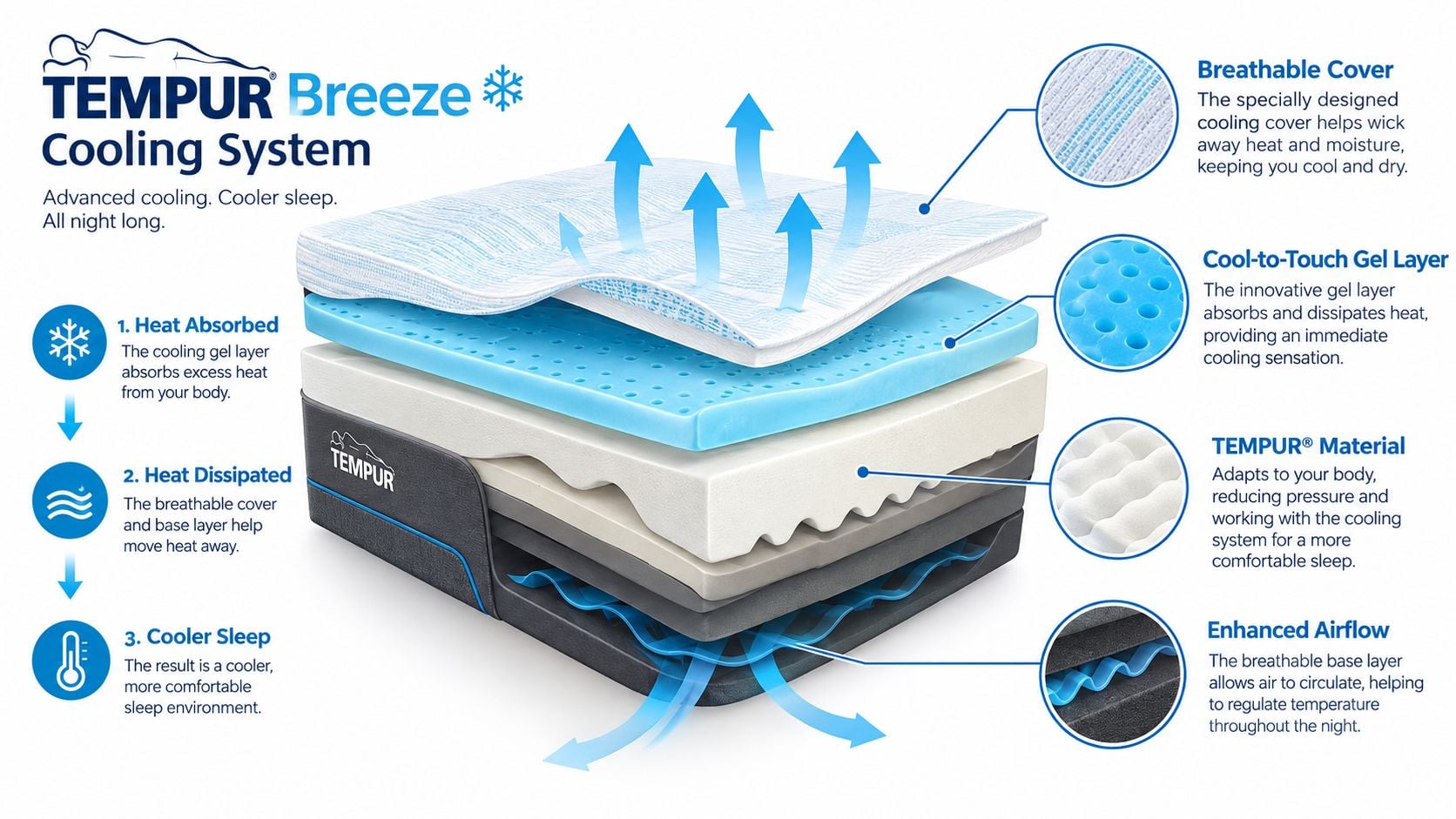
TEMPUR-Breeze isn't built around one “cooling ingredient.” It uses several layers, each assigned a different job. The arrangement is easier to understand by moving from the fabric touching the sleeper toward the ventilated material beneath it.
Starting at the cover
The SmartClimate cover is described as cool to the touch and infused with heat-absorbing fibers. Tempur-Pedic product descriptions also identify it as removable and machine-washable, which gives the design a practical care benefit as well as a sensory one (Tempur-Pedic's material toolbox).
That first-contact sensation matters because the cover is the part a sleeper notices immediately. It can help the bed feel less warm when someone first lies down, but the cover can't manage every part of overnight heat by itself.
Moving heat through the middle
Beneath the cover, a Heat-Diffusing Layer helps spread warmth instead of allowing it to remain concentrated directly under the sleeper. The system also uses Pure Cool or Pure Cool Plus phase-change material, often abbreviated as PCM.
PCM can be understood through the example of an ice-filled cooler. As the material changes state, it absorbs thermal energy, helping buffer a rise in temperature at the contact area. In a mattress, that effect works best as part of a larger pathway. Absorbing heat without giving it somewhere to move would only postpone the problem.
Opening a route for air
The deeper stage uses ventilated Advanced Relief material to encourage air movement through the construction. Tempur-Pedic states that TEMPUR-CM+ open-cell foam allows 10 times more air movement than closed-cell polyurethane foam (TEMPUR-Breeze construction details).
The sequence is the key idea. The cover manages first contact, the diffusing layer spreads heat, PCM buffers thermal energy, and ventilated material supports movement through the mattress. Shoppers comparing materials can also read Tempur-Pedic versus memory foam to place the Breeze construction alongside the broader foam category.
Comparing ProBreeze LuxeBreeze and ActiveBreeze Models
A sleeper who enjoys the dense, pressure-relieving feel of Tempur-Pedic foam may still wake warm. The Breeze range separates two approaches: ProBreeze and LuxeBreeze use passive layers that manage heat within the mattress, while ActiveBreeze adds powered controls. That changes the decision from choosing a cooler-feeling surface to choosing how much control you want over the sleep environment.
Tempur-Pedic describes ProBreeze as up to 5°F cooler and LuxeBreeze as up to 10°F cooler than ProAdapt models during an eight-hour comparison (Tempur-Pedic's Breeze overview). ActiveBreeze uses fans in the base and app-controlled cooling or warming. It is marketed as up to 30 degrees cooler or warmer all night.
At-a-glance comparison
| Model | Cooling Approach | Advertised Cooling | Best For |
|---|---|---|---|
| ProBreeze | Passive, layered cooling with cover, heat diffusion, phase-change material, and ventilation | Up to 5°F cooler over an eight-hour comparison | Sleepers who want a cooling-focused foam design without powered climate control |
| LuxeBreeze | More advanced passive cooling construction | Up to 10°F cooler over an eight-hour comparison | Sleepers prioritizing the strongest passive cooling claim in the Breeze range |
| ActiveBreeze | Base fans with app-controlled cooling or warming | Marketed as up to 30 degrees cooler or warmer all night | Sleepers who want adjustable climate control |
The cooling premium should be judged alongside support and feel. A person who loves Tempur-Pedic's close contouring and regularly wakes hot may value the upgrade. Someone who struggles to turn, wants stronger edge support, or prefers a springier surface may gain more from changing the mattress feel than from adding cooling technology.
Independent reviewers gave ProBreeze a 4.5 out of 5 cooling rating and reported a queen price of over $4,000. Those details frame the practical question: does the cooler construction provide enough overnight comfort and pressure relief to fit the household budget?
Before visiting, review the cost of a Tempur-Pedic queen mattress. At our family-owned Norwich showroom, try the mattress long enough to notice both the first-touch sensation and the support beneath it. A cooling claim matters only if the model also suits your sleeping position, movement, and comfort preferences.
What Cooling Claims Really Mean for Your Bedroom
A cover that feels cool when a hand touches it has achieved surface cooling. That is useful, but it isn't the same as controlling temperature throughout the night. The body continues to release heat after the initial contact, and the result depends on how the mattress, bedding, room, and sleeper interact.
Independent reviewers note that SmartClimate and phase-change covers can feel cool at first. They also caution that passive cooling may provide an initial sensation rather than actively controlling body temperature for the entire night.
Reading the 5 to 10 degree figures accurately
The advertised 5°F and 10°F differences are brand claims based on average heat index comparisons over an eight-hour period against ProAdapt models. They are useful for comparing the stated position of ProBreeze and LuxeBreeze within the product line, but they aren't a guarantee for every bedroom.
A sleeper's experience can vary with:
- Body size and shape, which change how much surface area contacts the bed.
- Room temperature, particularly during a warm Connecticut summer.
- Bedding, since dense layers can hold heat above the cover.
- Humidity, which affects how comfortable warmth feels.
- Sleep position and movement, both of which change contact with the mattress.
The honest question isn't “Will this mattress feel cool in a showroom?” It's “Will this sleep system remain comfortable after the body, bedding, and room have had time to warm up?”
That question can lead to different answers. One sleeper may benefit most from a Breeze mattress. Another may need lighter bedding, better air circulation, or a cooler bedroom routine. Someone who needs direct control over the microclimate may consider an active system instead of relying entirely on passive layers.
The choice also depends on the desired feel. A sleeper who values deep contouring may accept a premium for a cooling version of that sensation. Someone who dislikes sinking may find that temperature management can't compensate for a mismatch in support or movement response. Cooling bedding for hot sleepers can help complete the picture without treating the mattress as the only temperature variable.
Practical Ways to Sleep Cooler on Any Tempur Pedic Mattress
You go to bed comfortable, then wake because the sheets feel warm and heavy. The mattress may be part of that experience, but the rest of the sleep setup matters too. Tempur-Pedic links cooler sleep with falling asleep faster and staying asleep longer, while its Breeze range is described as keeping sleepers 5 to 10 degrees cooler all night. Treat that as a product claim, not a promise for every bedroom. The practical approach is to reduce heat from several sources at once.
Start with the layers above the mattress
Sheets and blankets act like clothing for the bed. Lightweight, moisture-wicking sheets and a less dense comforter usually let heat and moisture move away more easily than heavy synthetic layers. If the mattress feels cool at first but the bedding holds warmth, changing those upper layers may help more than changing the bed itself.
Care matters as well. The SmartClimate cover is described as removable and machine-washable, so following its care instructions can help maintain a clean, comfortable contact surface. A cover that is dirty, compressed, or poorly maintained may feel different from one that has been cared for properly.
Use a cooling topper cautiously. It may suit an otherwise comfortable mattress when the sleeper wants a modest surface change. It can also alter the intended feel, interfere with the mattress's engineered layers, or make the bed feel less stable. Warmth alone is not a reason to add one automatically.
Check what supports the mattress
A compatible adjustable base or slatted foundation affects the space beneath the mattress and the setup as a whole. The base must suit the mattress, frame, and intended use. A professional can help check that combination before purchase, especially when changing the foundation as part of a cooling strategy.
Room habits can make the surface more comfortable. Lower the temperature before bed, keep air moving, and choose lighter sleepwear. Households seeking a fresh-feeling room can also evaluate cooling mist for clean air alongside ordinary ventilation and temperature control.
For a routine covering bedding, room preparation, and mattress setup, these ways to sleep cooler at night offer a useful checklist. Several small changes often work better than relying on one cooling feature, particularly when the first-touch sensation fades after the body settles in.
Testing Tempur Pedic Mattress Cooling at Gorins in Norwich
Online specifications can explain the construction, but they can't tell a sleeper whether the surface feels too enveloping, whether the body sinks too far, or whether the first cool sensation remains comfortable after settling into a preferred sleep position. Those judgments belong in person.
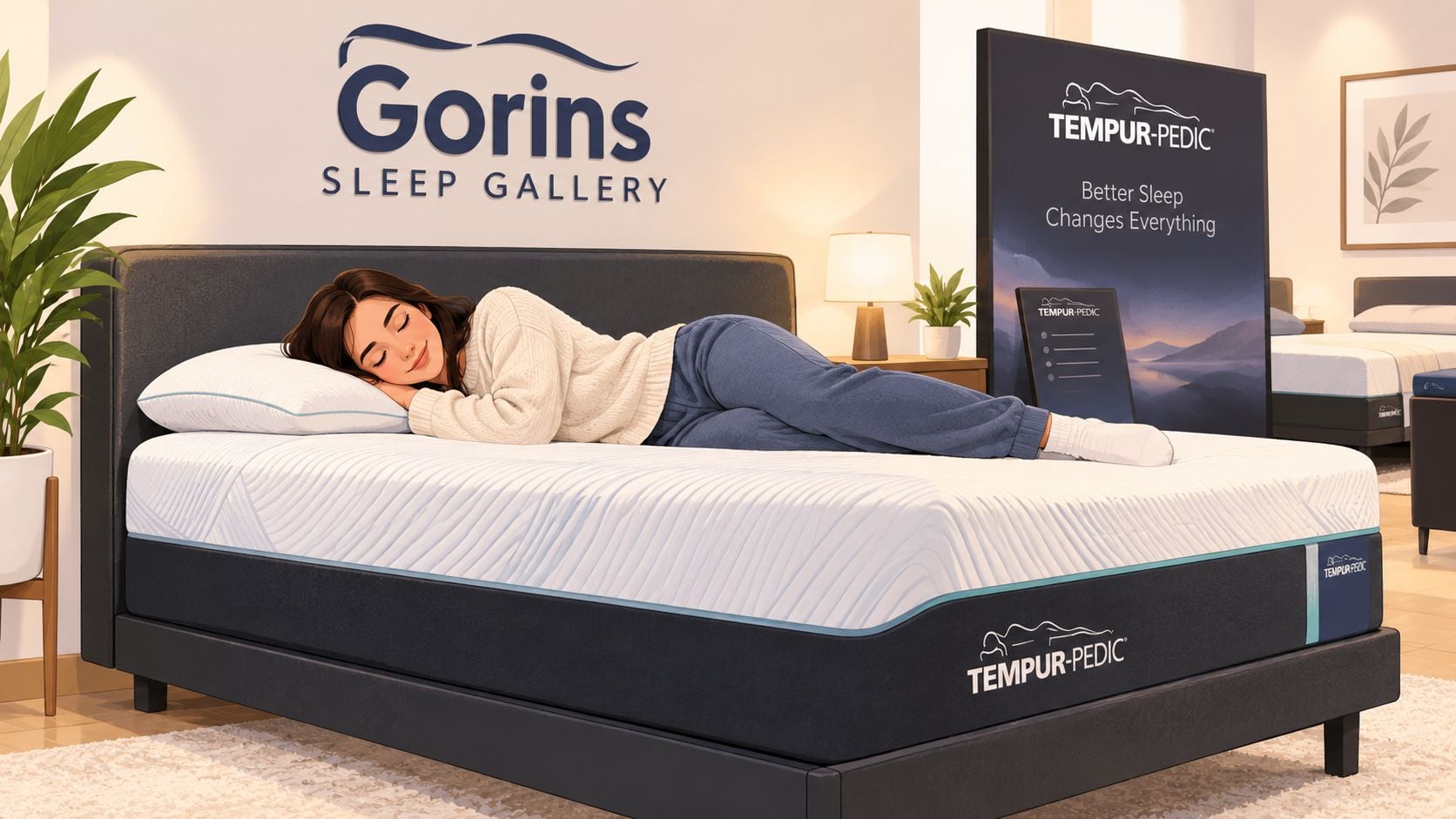
A visit to the Sleep Gallery at Gorins Furniture & Mattress allows shoppers to lie on Tempur-Pedic models alongside Serta, Beautyrest, Stearns & Foster, Sealy, and King Koil. That side-by-side setting matters because cooling can't be separated from comfort by feel. A mattress that feels cooler but doesn't support the sleeper's shoulders, hips, or preferred position may not be the healthier sleep choice.
How to make a showroom test useful
A short rest test should be deliberate rather than rushed. Shoppers can bring the questions that usually reveal a mismatch:
- Does the body feel supported? The surface should cushion pressure without leaving the sleeper feeling stuck.
- Does the temperature change after settling? Initial coolness is easy to notice. The more useful observation is how the surface feels after the sleeper has settled.
- Can the sleeper change position? Slow-response foam may suit some bodies and frustrate others.
- Does the edge feel stable enough? Edge support matters when sitting down, getting up, or using the full width of the bed.
- Does the partner's movement remain manageable? Couples should test the bed together when possible rather than relying on separate impressions.
The showroom also gives families a chance to compare a cooling-focused mattress with other comfort constructions. That can reveal whether the underlying need is temperature management, a different firmness, easier movement, stronger perimeter support, or a combination of those features.

A local approach to a significant purchase
Gorins has served Norwich and Eastern Connecticut families since 1936 as a locally owned, family-operated business. The showroom's local-expert approach is built around simplifying the furnishing process, whether a household is choosing a mattress, planning custom dining, or updating a living room.
For larger sleep purchases, Promotional Financing with equal monthly payments, subject to approval and program terms, can make investment-grade quality easier to evaluate within a household budget. The focus should remain on value and fit, not on choosing a mattress merely because it carries the highest specification.
The same store also supports broader home decisions. Canadel Custom Dining offers thousands of combinations of sizes, shapes, finishes, and fabrics, while the F9 Custom Sofa series offers thousands of combinations for a personalized living-room design. Those options reflect the same principle used in the Sleep Gallery: the right choice starts with how a product fits a household's lifestyle.
Since 1936, Gorins Furniture & Mattress has helped Norwich and Eastern CT families create homes they love. From custom-designed Canadel dining sets to the latest in Tempur-Pedic sleep technology, we combine a massive selection with the personalized care only a local, family-owned business can provide. Visit us today to experience quality, value, and our 5-Star Delivery service.
Visit the Norwich showroom to compare Tempur-Pedic cooling models by comfort, support, and feel, with guidance from a local Sleep Gallery team. Shoppers can also take the online Style Quiz for a personalized starting point or browse the Clearance section for value-driven savings before visiting Gorins Furniture & Mattress.