Best Mattress Cooling System: A Buyer’s Guide


The popular advice is to buy the coolest-feeling mattress available. That's usually the wrong starting point. A mattress can't compensate for a warm bedroom, humid air, heavy bedding, or a partner who changes the bed's microclimate every night.
The best mattress cooling system is the one that solves the actual source of discomfort. For some sleepers, that means breathable bedding and a conductive mattress. For others, it means programmable cooling on one side of the bed. The right choice depends less on a dramatic “cool to the touch” sensation and more on how consistently the system manages heat and moisture through the night.
| Cooling approach | Best match | Main advantage | Main limitation |
|---|---|---|---|
| Breathable covers and bedding | Mildly warm sleepers | Silent and simple | Limited control |
| Gel-infused or ventilated foam | Sleepers who need cushioning | Can reduce heat retention compared with dense foam | Still warms with prolonged contact |
| Phase-change materials | Sleepers who want passive temperature buffering | Absorbs and releases heat without power | Capacity is finite |
| High-heat-capacity materials | Sleepers who prefer passive cooling | Direct conductive heat transfer | Depends on contact and room conditions |
| Active cooling cover or topper | Persistent overheating | Adjustable temperature control | Requires power, setup, and maintenance |
| Airflow-based system | Sweaty sleepers and couples with different needs | Moves air across a selected area | Airflow depends on room conditions |
Why the Mattress Is Not Always the Problem
Most shoppers in Norwich start with one question: which mattress stays coolest? A better question is, what is making the sleeper hot? Bedroom temperature, humidity, sheets, blankets, mattress insulation, body size, and sleep position all shape the small layer of air trapped around the body.
Large-scale sleep data examined more than 3.75 million nights from 34,096 U.S. adults. Bedroom temperatures exceeded 70°F on 69% of nights, and average bedroom temperatures across participants ranged from 68.8°F to 76.2°F. Between 60°F and 85°F, every 1°F increase in bedroom temperature was associated with a 0.06% decline in sleep efficiency, along with less total sleep and more time awake after initially falling asleep. All reported associations were statistically significant at p<0.001. (Sleep temperature analysis)
That doesn't mean a mattress is irrelevant. It means the mattress is only one part of a closed system. A dense comfort layer may hold body heat, but heavy bedding can trap even more warmth above it. Humid air can also make sweat evaporate less effectively, so the sleeper feels clammy even when the mattress surface itself seems reasonable.
Start with the room
A shopper who sleeps hot should first check the bedroom at bedtime and again during the night. The useful questions are practical:
- Room temperature: Does the bedroom remain warm after midnight?
- Humidity: Does the air feel damp, or does bedding feel clammy?
- Air movement: Can air circulate around the bed without blowing directly on the sleeper?
- Bedding weight: Does the duvet or blanket retain more warmth than needed?
- Partner impact: Does one person's body heat make the shared surface uncomfortable?
A surface that feels cold for a few seconds may only be drawing heat from the skin temporarily. The meaningful test is whether the sleeper remains comfortable after hours of contact. Readers looking at the wider relationship between sleep comfort, breathing, and nighttime symptoms may also find the Pain and Sleep Therapy Center's sleep technology resource useful.
The showroom lesson
A mattress test should include the sleeper's normal position, a few minutes of stillness, and attention to pressure as well as temperature. A very soft topper may feel pleasant initially but surround the body with insulating material. A firmer, more conductive surface may feel less dramatic at first and remain more stable later.
For practical bedroom changes, Gorins' guidance on how to sleep cooler at night belongs near the beginning of the decision, not after an expensive cooling purchase. Fix the room and bedding first. Then decide whether the mattress needs help.
How Heat Actually Moves Through a Bed
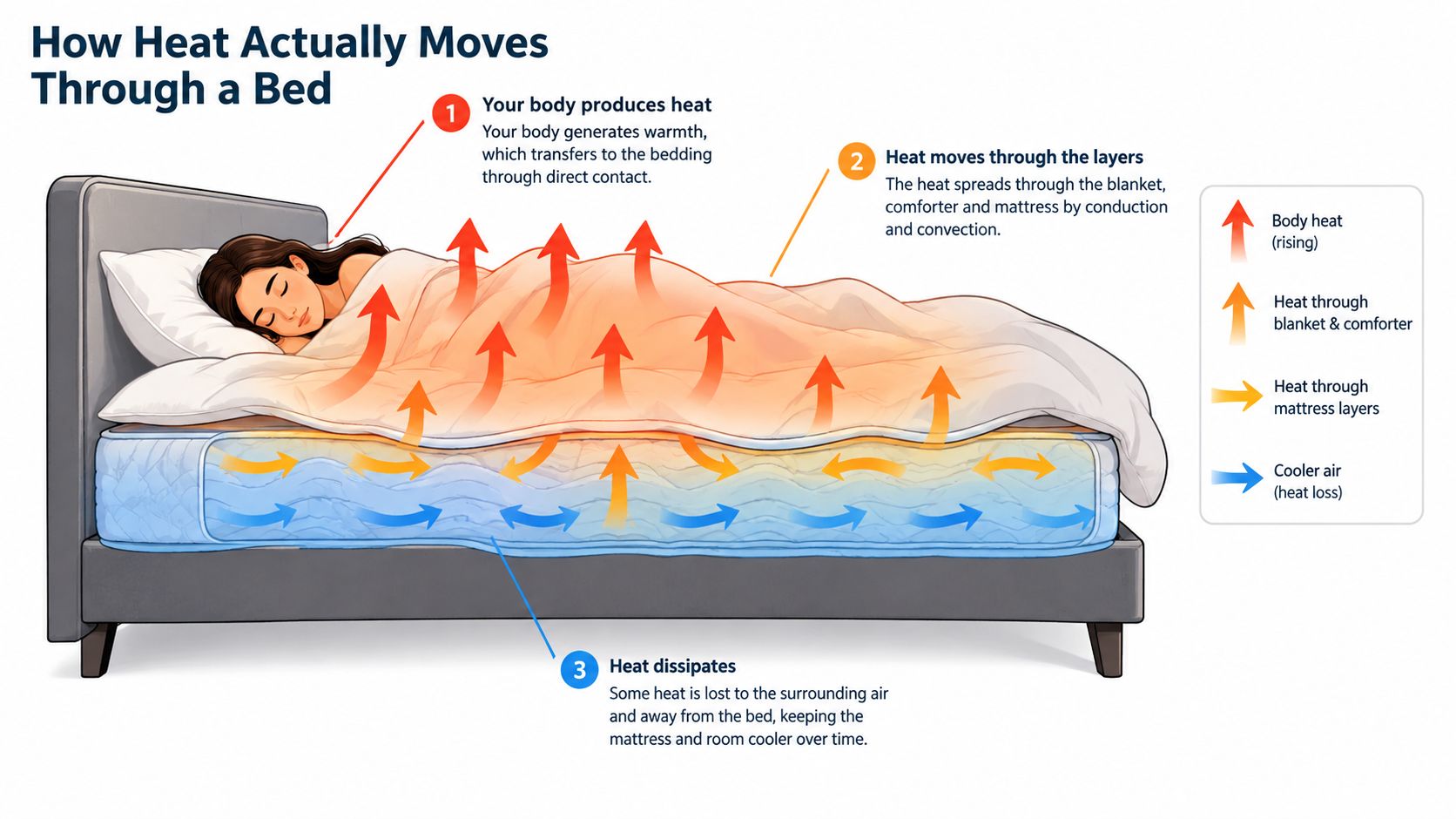
Heat leaves the body through several routes, and a bed can either help or interrupt those routes. The sleeper's body, mattress, sheet, blanket, and bedroom air create a bed microclimate. A cooling product works only if it improves that microclimate under the conditions that exist at home.
Conduction moves heat through contact
Conductive cooling transfers heat from the warmer body into a cooler material. A high-heat-capacity mattress can absorb heat from the contact area, especially beneath the shoulders, hips, and back. That approach feels steady rather than breezy, and it doesn't need a pump, fan, or app.
The trade-off is finite capacity. Once the material has absorbed substantial heat, its cooling effect depends on the room, the sleeper's mass, the contact area, and the bedding above the body. A breathable cover can help the process, while a thick insulating layer can block it.
Convection moves heat through air
Convective cooling relies on air movement. Open-cell structures, ventilated foams, coil spaces, fans, and airflow systems can help replace warm air near the sleeper with cooler room air. This works best when the bedroom air is cooler than the bed surface.
Airflow won't perform miracles in a hot, stagnant room. It can also disturb sleepers who dislike sound or drafts. A fan-based approach may suit someone who wakes sweaty, while a conductive surface may suit someone who dislikes moving air.
Evaporation depends on moisture and humidity
Sweat cools the body only when it evaporates. Heavy, non-breathable bedding can trap moisture against the skin, while high humidity slows evaporation. That's why a mattress can feel hot even when the room temperature seems acceptable.
A nighttime routine that addresses moisture can matter as much as the mattress. For readers exploring non-device approaches to sweating, natural remedies for night sweats provide additional context, although persistent or unexplained symptoms warrant professional medical advice.
A community-based study found that sleep was most efficient when nighttime ambient temperature ranged from 68°F to 77°F. As temperature rose from 77°F to 86°F, sleep efficiency fell by a clinically relevant 5% to 10%. (Community sleep temperature study)
That gives shoppers a useful target. The aim isn't to create the coldest possible mattress. It's to stop the bed from adding sustained heat to an already warm microclimate. Gorins' information on TEMPUR-Pedic mattress cooling can help shoppers compare cooling construction with the feel and support they need.
Practical rule: Move heat away from the body, give moisture somewhere to go, and avoid adding insulation that the bedroom doesn't require.
Passive Cooling Technologies Compared
Passive systems operate without active refrigeration, pumps, or electronic temperature control. They're the right starting point for shoppers who want a quieter bed, fewer maintenance tasks, and a cooling effect that doesn't depend on remembering to charge or program anything.
| Technology | Heat transfer method | Best for | Limitation |
|---|---|---|---|
| Gel-infused foam | Conductive absorption with modified foam structure | Sleepers who like pressure relief | May still retain heat after prolonged contact |
| Phase-change materials | Absorbs and releases heat as conditions change | Mild to moderate overheating | Has limited heat-storage capacity |
| Airflow and coil designs | Convection through ventilation and open space | Sleepers who benefit from moving air | Depends on room air and bedding |
| Cooling cover fabrics | Conductive contact and moisture management | Sleepers who need a simpler upgrade | A cover can't overcome a hot room or insulating core |
Gel-infused foam
Gel can change how foam receives and distributes heat, and ventilation channels can create more opportunity for air movement. That makes gel-infused foam a reasonable choice for a sleeper who wants cushioning but finds a dense foam slab too warm.
It shouldn't be treated as an active cooling system. The body still contacts the same surface for hours, and the foam can warm as the night progresses. The best use case is a sleeper with modest temperature concerns who prioritizes pressure relief and doesn't need precise overnight control.
Gel's differentiator: It can moderate heat retention, but it doesn't actively remove heat from the bed.
Phase-change materials
Phase-change materials absorb heat as the sleeper warms the surface and release it as conditions shift. They can make a cover feel more balanced at the start of the night and reduce the sharp contrast between a cool bedroom and a warm body.
Their capacity is finite. Once the material has absorbed the available heat, it can't keep performing as if it were connected to a refrigeration system. Phase-change bedding works best when paired with a reasonably cool room and breathable layers.
Phase-change's differentiator: It buffers temperature rather than delivering a chosen temperature.
Airflow and coil designs
Coil spaces and ventilated constructions can help warm air move through the mattress. They're especially useful for sleepers who dislike the close, enveloping feel of dense foam. The effect depends on whether sheets and blankets allow air to circulate.
A coil design can feel cooler without feeling cold. That's often preferable for a sleeper who wants stable comfort rather than a chilly surface. It won't solve high humidity or heavy bedding by itself.
Airflow's differentiator: It improves ventilation, but room conditions still set the ceiling.
Cooling cover fabrics
Cooling covers influence the first contact between the body and the bed. They may feel smoother, drier, or cooler than a standard fabric, and moisture management can make a meaningful difference for sleepers who feel clammy.
A cover is also easy to overlook when evaluating a whole mattress. It shouldn't be judged in isolation. A breathable cover over a heat-retaining comfort system may offer only a modest improvement, while the same cover over a well-ventilated construction can support more consistent comfort.
For shoppers comparing layers rather than marketing labels, Gorins' guide to cooling bedding for hot sleepers offers a useful place to assess the cover, protector, sheets, and blanket as one setup.
A double-blind polysomnographic study of healthy middle-aged men found that a high-heat-capacity mattress produced a greater decline in core body temperature, lower mattress and body temperatures, reduced heart rate, and significantly more N3 slow-wave sleep than a conventional low-heat-capacity mattress. (High-heat-capacity mattress study)
That evidence supports a clear recommendation: passive cooling should prioritize heat-transfer performance, not the word “cooling” on the label.
Active Cooling Systems and When Adjustable Control Pays Off
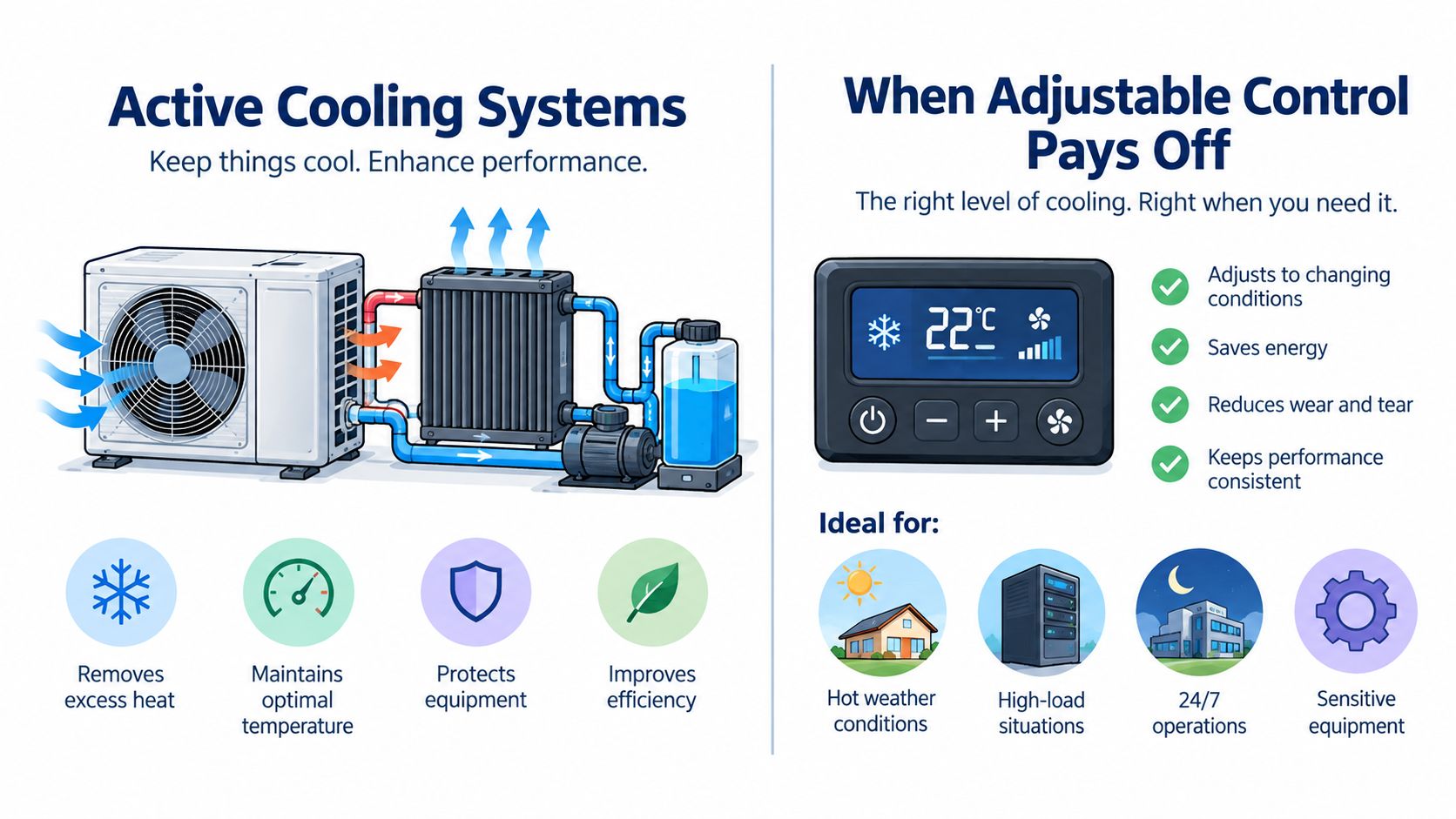
Active cooling earns its place only after the bedroom, bedding, and mattress have been addressed. It adds a powered method of moving heat, such as cooled fluid in a topper, air movement across the sleeper, or temperature regulation through a cover. That control can improve comfort, but it also adds equipment and upkeep. Buy it for a recurring heat problem, not because “cooling” appears on the label.
A randomized crossover study of 34 adults using a temperature-controlled cover for 14 nights found a substantial improvement in perceived sleep quality, with Cohen's d = 0.92 and p = 0.001. Objective sleep measures and biometric outcomes did not differ significantly. A separate one-week study of 54 participants associated cooler temperatures during the first half of the night with 14 additional minutes of deep sleep in men and 9 additional minutes of REM sleep in women. (Temperature-controlled cover research)
Programmability matters more than maximum cold
The useful feature is not the coldest possible surface. It is the ability to change the setting as comfort changes through the night. A cooler setting may suit sleep onset, while a less aggressive setting can feel better later.
A fixed temperature suits fewer sleepers. Look for:
- Independent zones: Give partners separate settings when their thermal preferences differ.
- Night phases: Change the temperature between early sleep and later sleep.
- Manual controls: Let a hot sleeper adjust the bed without reaching for a phone.
- Adjustable-base compatibility: Check this before pairing cooling with a raised head or feet.
- Reliable fit: The cover or topper should stay in place as the base moves.
An adjustable bed base can work well with active cooling when positional support is also needed. Check the moving sections, hose routing, cords, and control-unit position in the showroom. A system that bends, pulls, or shifts when the base rises will frustrate you every night.
The hidden cost is attention
Powered cooling brings noise, cleaning, water management, setup, and storage demands. It may also require a convenient place for the control unit. Choose a system the household will maintain and use.
A six-week cooling-bedding study tracked 924 nights among 30 women aged 40 to 60 who reported sleeping hot, night sweats, or hot flashes. Participants reported a 51% reduction in perceived sleeping-hot intensity and a 61% reduction in night sweats. Objective sleep measures did not improve, so perceived comfort and measured sleep outcomes should be judged separately. (Cooling bedding study)
Active cooling makes sense for persistent overheating, difficult night sweats, or opposing temperature needs in a shared bed. It is overkill when lighter bedding, a better cover, or a more breathable mattress already solves the problem. The right buying sequence is simple: fix the room, bedding, and mattress first, then pay for adjustable cooling only if heat remains.
Matching Cooling Systems to Real Sleeper Profiles
A cooling system should match the sleeper, the room, and the mattress already in place. The right recommendation for one household can become unnecessary equipment for another.
The couple with one hot partner
One partner wakes sweaty while the other wants another blanket. A shared mattress with one temperature setting forces both sleepers into the same compromise.
Start with a breathable mattress and lighter bedding. If the hot partner still overheats, choose a dual-zone active cover or topper. Separate controls let one side cool while the other stays neutral or warmer. This is a better fit than cooling the entire bed to the same setting.
A full-bed system with one control zone misses the problem. Two sleepers have different thermal needs, so the cooling should be adjustable by side.
The sleeper dealing with hot flashes
Hot flashes call for quick adjustments, moisture control, and bedding that can be changed without rebuilding the bed. Passive materials can improve baseline comfort, but they cannot respond to a sudden episode.
As the 2025 cooling-bedding study cited earlier showed, perceived comfort gains did not translate into measured sleep improvements, so set expectations accordingly. For frequent symptoms, active or targeted cooling can still make sense as a comfort purchase, provided the sleeper will maintain it.
Controls should be easy to reach and quick to adjust. Removable, washable layers matter when moisture is part of the problem. The system should also fit the existing mattress, so the sleeper can add targeted support without replacing a comfortable bed.
The warm New England summer bedroom
A homeowner in Eastern Connecticut may sleep comfortably for much of the year, then struggle when the bedroom stays hot overnight. Begin with lighter bedding, breathable sheets, better airflow, and a mattress that does not trap heat. Those changes may solve a seasonal problem without adding powered equipment.
If the room remains uncomfortable, a cooling topper can provide relief during the hottest period. Adjustable cooling becomes a better choice when the sleeper needs repeatable control night after night.
Avoid paying for dramatic cooling performance if the system will sit unused most of the year. Choose a mattress that feels comfortable in ordinary conditions, then add seasonal cooling support only when the bedroom requires it.
The occasional-use guest room
Guest rooms need broad comfort, simple operation, and low maintenance. Choose a breathable mattress, a washable cover, and bedding guests can adjust without assistance.
Active cooling is usually unnecessary unless the room has a persistent temperature problem or regularly hosts heat-sensitive visitors. If you do add it, the controls must be obvious to someone unfamiliar with the setup. Complicated equipment turns a hospitality feature into a troubleshooting task.
For shoppers comparing mattress construction and feel, Gorins' best cooling mattress for hot sleepers resource can help create a focused shortlist. The decision should follow the same order: correct the room first, then the bedding, then the mattress, and add active cooling only when those changes leave a clear problem.
A Store-Friendly Decision Framework
A useful showroom conversation should follow the same order as a sensible home trial. It starts with conditions, not brand names.
Step one, check the bedroom
Record whether the bedroom feels warm, humid, still, or comfortable at bedtime and after waking. A mattress can't correct a room that keeps the entire bed above a comfortable range.
Step two, audit the bedding
Remove unnecessary insulation before replacing the mattress. Check the protector, sheets, duvet, blanket, and any topper. A thick waterproof protector can undermine a breathable mattress, while heavy bedding can make a well-designed bed feel hot.
Step three, test mattress construction
Lie in the normal sleep position. Compare the feel of foam, hybrid, and more open constructions, paying attention to pressure relief, sink, and heat around the torso. In Gorins' Sleep Gallery, shoppers can compare Tempur-Pedic, Stearns & Foster, Sealy, Serta, Beautyrest, and King Koil by feel, support, and cooling construction.
Gorins Furniture & Mattress also offers a local Sleep Gallery experience for shoppers considering mattresses and sleep accessories in Norwich. The aim should be comfort by feel and healthier sleep, not a specification contest.
Step four, add active cooling only when needed
A 2026 Loughborough University study recruited 17 adults in a bedroom heated to 30°C, or 86°F. A cooling mattress topper increased average total sleep time by 19 minutes and reduced the average time required to fall asleep by 10 minutes. (Loughborough bed-cooling study)
That result supports active cooling in an overheated room, but it doesn't mean every sleeper needs a powered topper. Ask whether the benefit justifies noise, cleaning, power, control-unit placement, and compatibility with the bed base.
Promotional Financing through the Nest Credit Card and TD Bank, subject to credit approval and applicable terms, can make equal monthly payments available for a higher-value mattress or cooling setup. The right financial choice still starts with solving the actual sleep problem rather than adding technology for its own sake.
Cooling Questions Shoppers Still Ask
Is a cooling system worth buying if the bedroom is too hot?
Sometimes. Targeted bed cooling can improve comfort even in an overheated room, but it won't lower room humidity or make stagnant air disappear. Improve airflow and bedding first, then consider active cooling if the sleeper still overheats.
A 2025 randomized crossover study found that two rooms held at 26°C produced different sleep outcomes depending on the cooling method. Radiant cooling produced lower humidity and airflow, while participants experienced better refreshment, higher sleep efficiency, and shorter sleep latency than with conventional convection cooling. (Cooling-method study)
How should a shopper test cooling in a showroom?
The sleeper should lie down in the usual position, remain still, and compare the feel after several minutes. The test should include pressure, support, sink, fabric feel, and heat around the shoulders and hips. “Cool to the touch” is only the opening sensation.
What should one hot partner buy?
Choose a breathable shared mattress first, then use independent bedding or dual-zone active cooling if the problem continues. Cooling the entire bed for one person is usually wasteful.
How can cooling performance last?
Wash removable covers as directed, keep protectors breathable, avoid blocking ventilation, and follow the maintenance schedule for powered systems. General climate-control principles, including attention to airflow and equipment placement, are also discussed in Airtight Spray Foam's warehouse tips. The practical lesson is simple: protect the airflow path and don't bury control equipment under clutter.
For value-conscious shoppers, an active system isn't automatically the best purchase. Sometimes the strongest result comes from a breathable mattress, lighter bedding, and a bedroom that stays within a comfortable range.
Since 1936, Gorins Furniture & Mattress has helped Norwich and Eastern CT families choose mattresses, cooling bedding, and comfort solutions through personalized local guidance. Visit the Norwich showroom to compare Sleep Gallery options by feel, take the online Style Quiz for a personalized starting point, or browse the Clearance section for value-driven savings.