Best Cooling Mattress for Hot Sleepers: Norwich Guide 2026

You flip the pillow. You kick one leg out from under the blanket. You turn the thermostat down. Then you wake up again, warm and irritated, wondering whether the mattress is the actual problem.
That’s a common conversation in Norwich. Many of our neighbors aren’t just looking for a softer bed or a firmer one. They want sleep that feels steady, dry, and comfortable through the night. If you’re searching for the best cooling mattress for hot sleepers, the good news is that this problem is often solvable once you know what causes heat buildup and which materials help.
A mattress isn’t just a comfort purchase. It’s part of your sleep health. Since 1936, Gorins has helped local families make investment-grade choices for their homes, and cooling sleep is one of those areas where good guidance matters. The right bed can support deeper rest in your Norwich home. The wrong one can trap heat night after night.
Tired of Waking Up Hot? You Are Not Alone
Sleeping hot can make a full night of rest feel out of reach. You settle in tired, fall asleep, then wake up uncomfortable, damp, or restless. By morning, you may not even remember every wake-up, but you feel it.
Hot sleeping shows up in different ways:
- Surface heat: The mattress feels warm under your shoulders, hips, or back.
- Stuffy bedding: Your sheets and protector seem to hold heat close to your body.
- Repeated wake-ups: You keep shifting around to find a cooler spot.
- Seasonal frustration: Summer humidity makes the problem worse, but winter heating can do it too.
Some people assume this is just how they sleep. It isn’t always. Often, the mattress is working against the body instead of helping it cool down naturally.
That matters because restful sleep usually feels calm, not overheated. If your bed traps warmth, comfort and recovery both take a hit. This is why finding the best cooling mattress for hot sleepers is less about chasing a trendy feature and more about choosing the right construction.
At a local showroom, this gets easier to sort out. You can lie down, notice whether a surface feels airy or dense, and compare coil support against deep foam sink. Those differences are hard to judge from a product photo.
Practical rule: If you regularly wake up hot in the same spots on the mattress, don’t only blame the room. Start looking at the bed’s materials and how much airflow they allow.
Why You Overheat at Night and How a Mattress Can Help
Your body doesn’t sleep well when it feels trapped in heat. That sounds simple, but many shoppers still treat a mattress like a passive surface. In reality, it plays an active role in how your body handles warmth, airflow, and moisture over the course of the night.
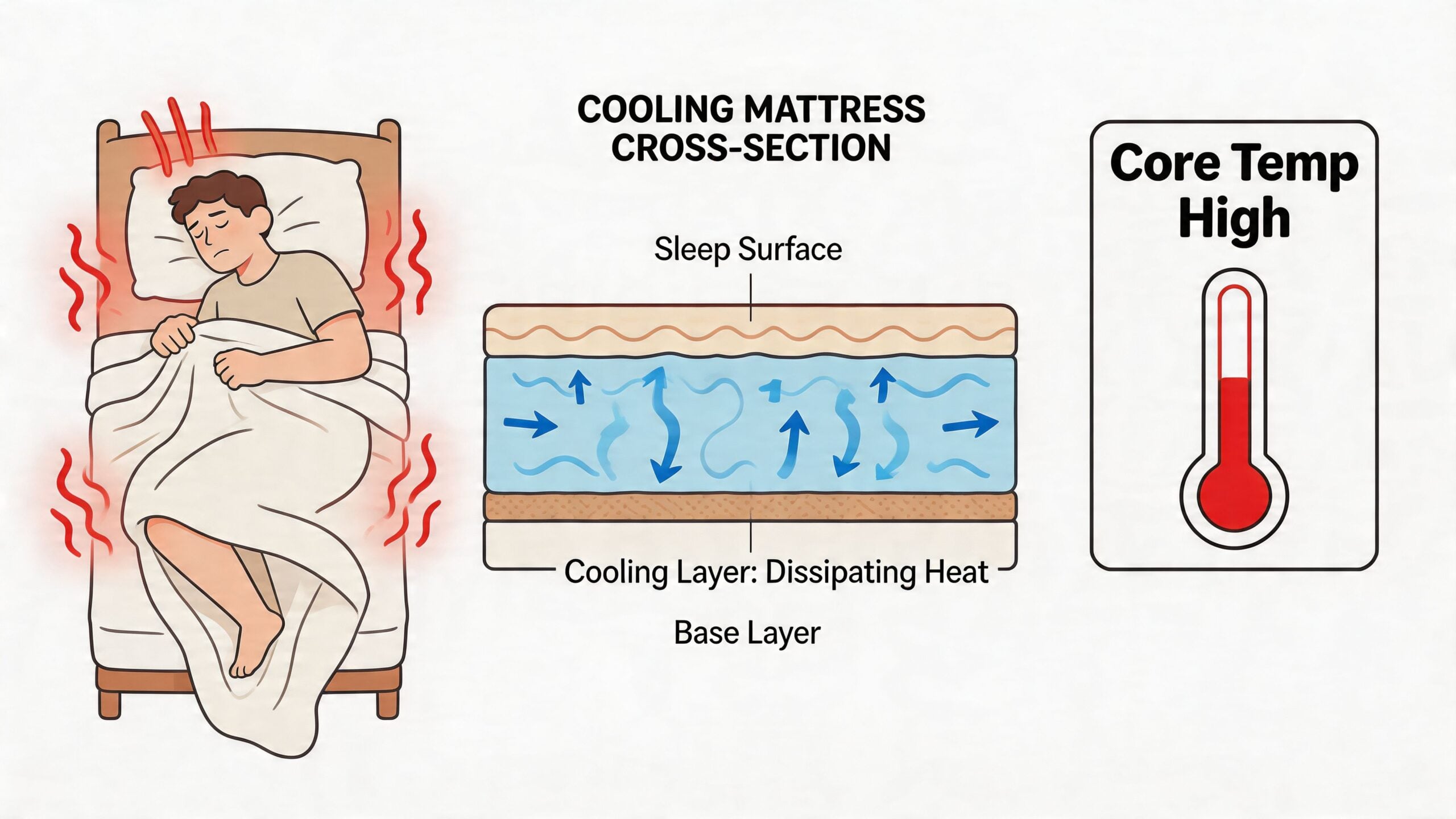
Your body needs help releasing heat
To fall asleep comfortably, your body has to let go of heat. If the mattress hugs too tightly, uses dense foam, or has a less breathable cover, that warmth can build up where your body meets the bed.
This is why some mattresses feel fine for a few minutes in a showroom, then feel stuffy at home over a full night. The issue isn’t always softness. It’s heat retention.
Traditional memory foam is often where people notice this most. It can contour closely, which many sleepers love for pressure relief, but close contouring can also reduce airflow around the body. That “held” feeling may be comfortable for support, yet uncomfortable for temperature.
Cooling features don’t all last the same way
A lot of cooling marketing focuses on the first touch. A cover may feel cool when your hand lands on it. That’s pleasant, but it doesn’t tell you how the mattress will perform months later.
Long-term durability matters. Data from mattress testing experts shows that the cooling efficiency of some technologies, including phase-change materials, can degrade 20-30% after 18 months due to foam compression and cover wear, as noted by Sleepworld’s cooling mattress analysis.
That’s an important point for value-conscious shoppers in Eastern CT. A mattress should do more than impress you on day one. It should keep doing its job.
Heat problems can have more than one cause
Sometimes the mattress is the main issue. Sometimes it’s part of a bigger picture that includes hormones, medications, bedding, room temperature, or moisture retention. If menopause is part of what’s disrupting your sleep, this guide to menopause night sweats natural remedies may help you think through the non-mattress side of the problem too.
You can also improve results by looking at the whole sleep setup. If you want practical room and bedding changes to pair with a cooler mattress, this guide on how to sleep cooler at night is useful: https://www.gorinsfurniture.com/how-to-sleep-cooler-at-night/
A mattress that only feels cool at first touch can still sleep warm by midnight.
Decoding the Tech Behind Cooling Mattresses
Cooling language can get confusing fast. Gel. PCM. Hybrid. Open-cell foam. Cool-touch cover. Most shoppers don’t need more jargon. They need to know what each feature does once they’re lying in bed.
One of the clearest findings in current testing is that hybrid models featuring a breathable Tencel cover, gel-infused foams, and pocketed coils consistently offer optimal heat dissipation and airflow across over 249 mattresses in Sleep Foundation’s temperature-neutrality analysis of cooling mattresses: https://www.sleepfoundation.org/best-mattress/best-cooling-mattress
Hybrid construction
If you sleep hot, hybrid construction is often the first thing to understand.
A hybrid mattress combines foam comfort layers with a coil support core. The coils create open space inside the bed, and that space gives heat more room to move instead of collecting around your body. This is one reason hybrids show up so often in cooling conversations.
Many shoppers ask whether a hybrid is just another word for innerspring. Not quite. A hybrid usually adds more cushioning and contouring on top, while still keeping the airflow benefits of coils. If you want a simple breakdown, this overview of what a hybrid mattress is can help: https://www.gorinsfurniture.com/what-is-a-hybrid-mattress/
Gel-infused and open-cell foams
Foam by itself isn’t automatically bad for hot sleepers. The question is what kind of foam you’re dealing with and how much of it sits between you and the support core.
Gel-infused foams are designed to manage warmth better than older, denser foam constructions. Open-cell foams also matter because they allow more air movement within the material itself.
Think of it this way:
- Dense, closed-feeling foam tends to act more like insulation.
- More breathable foam is less likely to create that “stuck in the bed” sensation.
- Thinner comfort layers often feel less heat-trapping than very deep foam builds.
Shoppers in our area often get mixed up. They hear “memory foam” and assume every foam bed sleeps hot. That’s too broad. Some foam layers can work well, especially when paired with breathable covers and coils underneath.
Phase-change materials
Phase-change materials, often called PCM, are used in some covers and surface layers to create that cool-to-the-touch sensation when you first lie down.
They can be helpful. But they’re usually best understood as a surface assist, not the whole cooling story. A PCM cover can make a mattress feel refreshingly cool at first contact, yet the deeper support system still has to manage airflow and heat release over the night.
For shoppers comparing brands such as Sealy or Serta, this is a useful question to ask in the showroom: “Is this mattress cool because of the cover, the comfort layers, the support core, or all three?”
That one question often clears up a lot of marketing noise.
Breathable covers and fabrics
The cover is the part your sheets touch, and it can shape the whole first impression of the mattress.
Breathable covers made from materials such as Tencel can help wick moisture and allow better surface ventilation. They don’t replace the need for good internal airflow, but they support it.
A good way to think about covers is this:
- A breathable cover helps the top of the mattress stay more temperature-neutral.
- A less breathable cover can hold warmth at the surface, even if the inside layers are better designed.
- Your protector and sheets can either preserve that benefit or cancel it out.
Cooling Technology Comparison
| Technology | How It Works | Best For |
|---|---|---|
| Pocketed coils | Create open space for airflow inside the mattress | Sleepers who run warm all night |
| Gel-infused foam | Helps move heat away from the body better than older foam styles | People who want pressure relief without as much heat buildup |
| Open-cell foam | Allows more air movement within the foam structure | Sleepers who like contouring but dislike a stuffy feel |
| Phase-change material | Adds an initial cool-touch feel at the surface | People who notice heat right when they lie down |
| Tencel or breathable cover | Improves surface ventilation and moisture handling | Anyone building a cooler overall sleep setup |
What this means in the showroom
When you test a mattress, don’t just ask whether it’s labeled cooling. Ask how it cools.
A better conversation sounds like this:
- “Does it rely mostly on the cover?”
- “How much coil airflow is under the comfort layers?”
- “Will I sink significantly into the foam?”
- “What happens after the first few minutes?”
That’s how you narrow down the best cooling mattress for hot sleepers in a way that matches your body, not just the product tag.
How to Match a Mattress to Your Sleep Style and Heat Level
The right cooling mattress isn’t the same for everyone. Two people can both sleep hot and still need very different beds. Your sleep position changes where you build pressure, how much you sink, and how much air can move around your body.
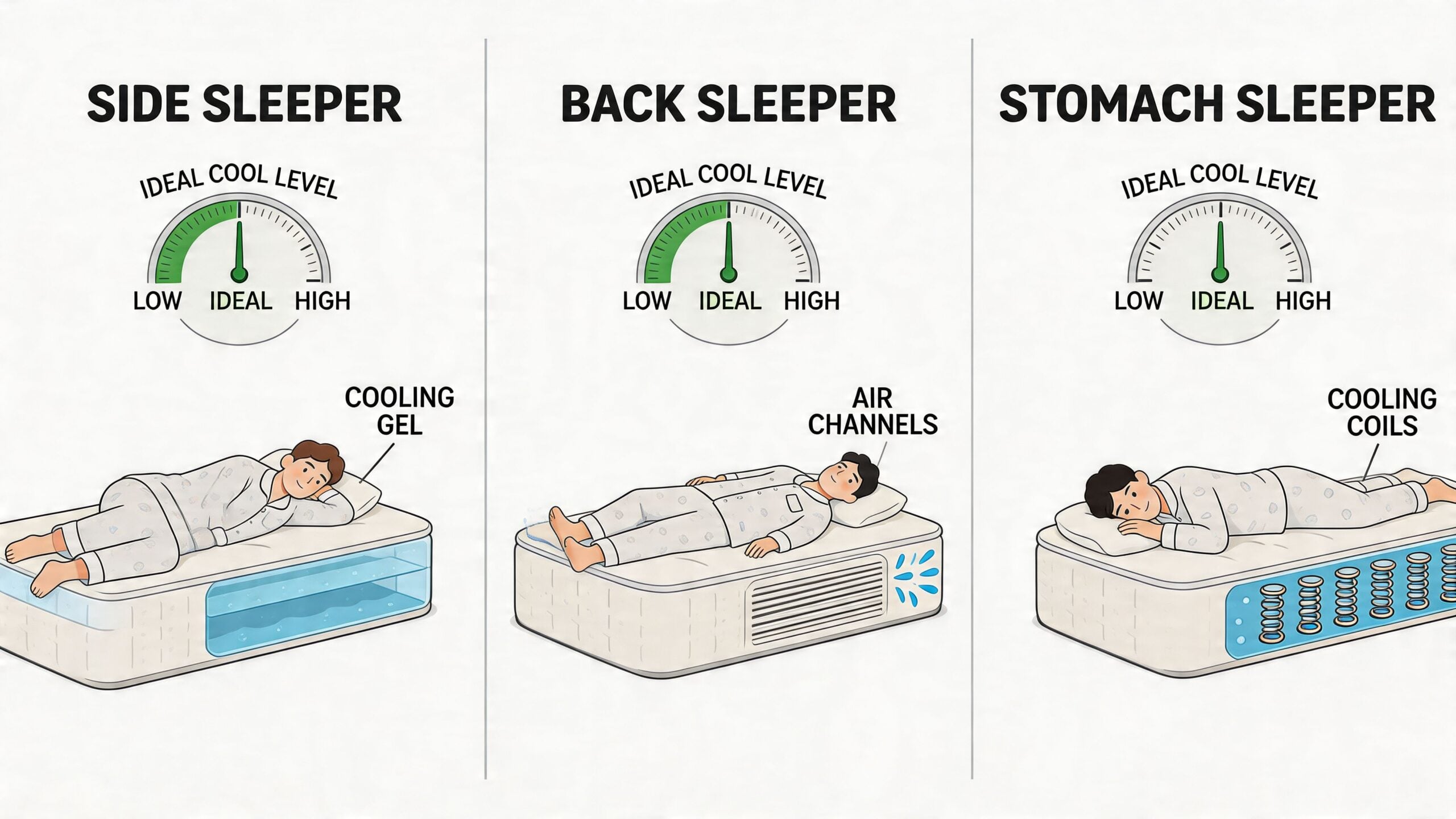
Side sleepers usually need pressure relief plus airflow
If you sleep on your side, your shoulder and hip press further into the mattress. That means heat can build up at those contact points if the comfort layers are too dense.
Hybrids often shine, as demonstrated by rigorous lab tests where hybrid mattresses such as the Saatva Classic and DreamCloud Hybrid limited temperature increases to between 6 and 10 degrees Fahrenheit after five minutes because their breathable designs and coil systems promoted air circulation, according to the NCOA cooling mattress review.
For side sleepers, look for:
- Responsive cushioning: Enough pressure relief for shoulders and hips.
- Coil support underneath: Better airflow than deep all-foam builds.
- Moderate contouring: Relief without too much sink.
Back sleepers often do best with a flatter, more lifted feel
Back sleepers usually need a mattress that keeps the torso from settling too far into the bed. Too much sink can create a heat pocket around the lower back and hips.
A supportive hybrid or a firmer cooling model often works well here. This is one reason many back sleepers compare options like Tempur-Pedic cooling lines against firmer hybrid constructions and then decide by feel in the showroom.
If you’re a back sleeper who also has heat concerns, pay attention to whether the mattress feels buoyant or enveloping. That difference matters.
Stomach sleepers need less sink, not more
Stomach sleepers usually sleep coolest on surfaces that keep the body lifted. Excess plushness can pull the midsection down, reduce airflow around the front of the body, and create discomfort at the same time.
Look for:
- A firmer support profile
- Breathable surface materials
- A design that keeps you more on the mattress than in it
This is also why some shoppers land on firmer options from Stearns & Foster or hybrid builds with a steadier top surface.
Match the bed to your heat level
Not all hot sleeping is equally intense. A simple way to shop is to think in levels.
Slightly warm
You don’t sweat much, but the bed gets stuffy.
A breathable cover and a hybrid construction may be enough. You may not need the most advanced cooling package if your issue is mild and occasional.
Regularly hot
You wake warm several nights a week and move around for cooler spots.
Focus on coil airflow, less heat-trapping foam, and a mattress that doesn’t let you sink too much. Many shoppers begin to feel a real difference in person thanks to these features.
Intense heat or night sweats
You wake up overheated and your sleep gets disrupted often.
At this level, surface coolness alone usually won’t cut it. You’ll want stronger airflow, more durable materials, and a full sleep system that includes breathable bedding and a protector that doesn’t trap heat.
If you’d like a position-based guide before you shop, this article on how to choose the right mattress for your sleeping style is a helpful next read: https://www.gorinsfurniture.com/how-to-choose-the-right-mattress-for-your-sleeping-style/
The best cooling mattress for hot sleepers is the one that controls heat without creating new pressure points.
Building Your Complete Cooling Sleep System
Even a well-designed cooling mattress can underperform if the rest of the bed traps heat. As a result, many people accidentally cancel out the benefits they paid for.
A cooling sleep setup works best when every layer supports airflow.
Start with the pillow and sheets
Your head and neck hold a lot of heat. If your pillow stays warm, it can make the whole bed feel hotter even if the mattress is doing its job.
Good cooling setups often include:
- Breathable pillows: Look for materials designed to release heat instead of holding it.
- Lightweight sheets: Crisp, breathable fabrics help air move around the body.
- Layered bedding: Easier to adjust than one heavy blanket.
Some shoppers focus so much on the mattress that they keep old sheets and a heavy comforter. Then they’re disappointed. The mattress matters most, but bedding still changes the outcome.
Don’t let the protector work against you
A mattress protector is smart. It helps guard your investment. But some protectors feel plasticky or less breathable, and that can trap warmth at the exact place where your body meets the bed.
That doesn’t mean you should skip one. It means you should choose carefully. This guide on the hidden benefits of a mattress protector explains why the right protector helps with both longevity and comfort: https://www.gorinsfurniture.com/unlocking-the-hidden-benefits-of-a-mattress-protector/
Make the room easier to sleep in
The mattress is only part of the environment. Your bedroom should make it easier for your body to settle down, not harder.
A few habits can help:
- Use moving air: A ceiling fan or room fan can support evaporation and comfort.
- Keep bedding adjustable: It’s easier to regulate warmth with layers.
- Pay attention to humidity: A room can feel warmer than the thermostat suggests if the air is heavy.
Think in systems, not single products
This is the shift that helps most. Instead of asking, “What’s the coolest mattress?” ask, “What setup gives me the steadiest sleep?”
That usually includes the mattress, the pillow, the protector, the sheets, and the room itself. When those pieces work together, sleep tends to feel less interrupted and more restorative.
The Gorins Advantage Your Norwich Mattress Showroom Guide
Cooling performance is one category where shopping in person still makes a real difference. You can read specs online, but you can’t feel contour, airflow, surface temperature, or ease of movement through a screen.
That’s why a showroom visit matters for a purchase this personal.
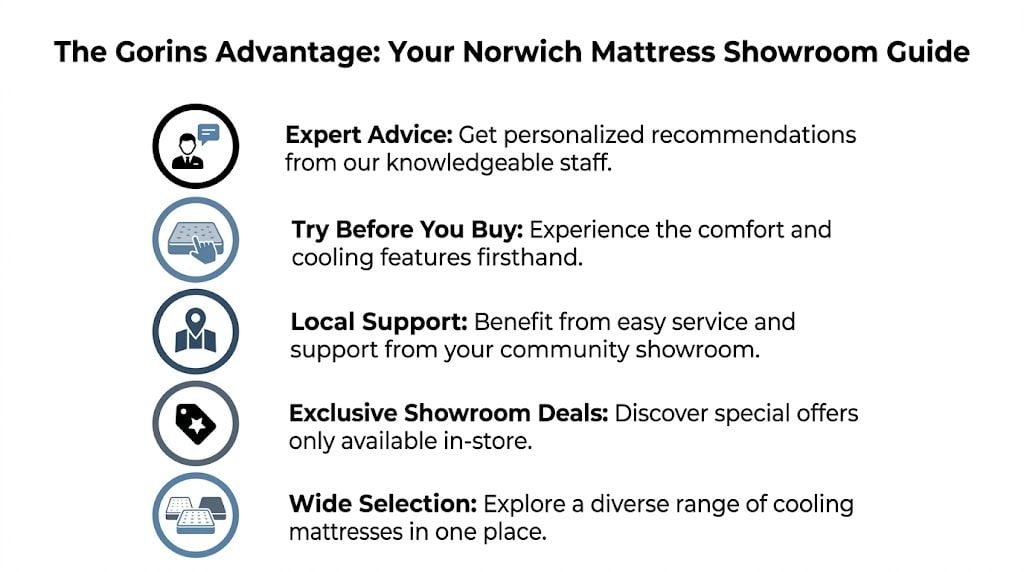
What you learn faster in person
A cooling mattress can fail for you in ways that don’t show up on a spec sheet. Maybe it feels cool at first but lets your hips sink too far. Maybe the cover feels nice, but the support underneath feels dense. Maybe your partner likes it and you don’t.
In a showroom, you can test all of that directly.
High-performance hybrid mattresses can contain over 1,000 individually wrapped coils, which support airflow along with zoned support, according to NapLab’s cooling mattress testing: https://naplab.com/best-mattress/best-mattress-for-cooling/
That number matters less than what you feel, but it helps explain why some hybrids seem noticeably more breathable when you lie on them.
A practical shopping checklist
Bring these questions with you when you test mattresses:
- How much do I sink? More sink can mean more heat retention.
- Can I move easily? If it takes effort to change position, the mattress may feel warmer over time.
- Does the surface stay comfortable after several minutes? Initial coolness and sustained comfort aren’t always the same.
- What does my partner notice? Shared beds need shared comfort.
- Which layer is doing the cooling? Cover, foam, coils, or all of them?
If you want another simple mattress buying framework before coming in, this guide can help: https://www.gorinsfurniture.com/how-to-choose-mattress/
Why local support matters
Since 1936, Gorins has served Norwich, New London, Plainfield, Waterford, and surrounding Eastern CT and Rhode Island communities as a family-owned business. For mattress shoppers, local support matters after the sale too. Service questions, comfort concerns, and product guidance are easier when there’s a nearby team involved.
The showroom experience also lets you compare trusted names side by side. In the Sleep Gallery, shoppers can physically test brands such as Tempur-Pedic, Serta, Beautyrest, Sealy, Stearns & Foster, and King Koil and judge comfort by feel rather than by marketing language alone.
Promotional Financing with equal monthly payment options can also make an investment-grade mattress more manageable if you’re upgrading for healthier sleep rather than replacing a bed in a rush.
Try the mattress the way you actually sleep. Lie still for a few minutes. Roll once or twice. Notice what happens after the first impression fades.
Your Cooling Mattress Questions Answered
A few questions come up in nearly every mattress conversation. These are the ones worth settling before you buy.
Can a cooling topper replace a cooling mattress
Sometimes, but not always.
A topper can improve the surface feel of a mattress that’s only slightly too warm. It usually won’t fix a support core that traps heat. If the underlying issue is the mattress itself, a topper may only mask the problem for a while.
Will a cooling mattress feel too cold in winter
Usually no. Most cooling mattresses are designed for temperature neutrality, not an icy feel all night. They aim to reduce heat buildup, not make you shiver.
In New England winters, bedding does most of the seasonal adjustment. A balanced mattress plus layers you can add or remove is often the more comfortable setup.
How long does the cool-to-the-touch feel last each night
That depends on the technology. Surface cooling can fade as your body warms the top of the mattress. That’s why airflow inside the mattress matters so much.
A bed that depends only on a chilly cover may feel different at bedtime than it does in the middle of the night.
Are all cooling technologies basically the same
Not at all.
For example, mattresses using a Gel-Flex Grid, a hyper-elastic polymer in a waffle structure, can promote constant airflow through open channels and channel heat away instead of absorbing it, according to RTINGS’ cooling mattress evaluations: https://www.rtings.com/mattress/reviews/best/cooling
That’s a very different approach from dense foam with a cooling label on the cover.
Should I trust online roundups
They can be helpful if you use them as one piece of the decision.
If you want broader comparison reading before visiting a showroom, these detailed reviews of the best cooling mattresses for hot sleepers can help you see how different constructions are discussed across brands and categories.
What matters most if I sleep hot and share a bed
Look for three things:
- Consistent airflow
- A comfort level both partners can tolerate
- Ease of movement across the surface
Couples often focus on firmness first. Temperature control deserves equal attention because one partner’s heat buildup can affect the other’s sleep too.
Your Journey to Healthier Sleep Starts Today
If you’ve been waking up hot, the mattress may be more important than you realized. Cooling sleep usually comes down to construction, airflow, materials, and how well the whole bed works together.
The best cooling mattress for hot sleepers isn’t just the one with the coldest marketing claim. It’s the one that fits your sleep style, manages heat in a lasting way, and feels right when you test it in person.
Since 1936, Gorins has helped Norwich and Eastern CT families make thoughtful home decisions with helpful service, quality products, and real local guidance. Beyond sleep, that same approach carries through the showroom, from Canadel custom dining with thousands of combinations to the F9 Custom Sofa series built around your lifestyle.
Visit Gorins Furniture & Mattress in Norwich to try cooling mattresses in person, compare comfort by feel, and talk with a knowledgeable team about healthier sleep. If you’re still narrowing down your style, take the online Style Quiz. If value is top of mind, browse the Clearance section for affordable luxury and ask about Promotional Financing with equal monthly payments. Since 1936, Gorins has helped Norwich and Eastern CT families create homes they love with quality, value, and personalized local service.