How to Pick Mattress Firmness for Better Sleep

You’re probably here because mattress shopping got confusing fast.
One bed feels soft for five minutes and then somehow “too soft” in your head. Another feels supportive in the store, but you’re worried you’ll wake up with a sore back. Maybe you’ve already had a few mornings where your shoulders feel jammed, your hips ache, or you climb out of bed feeling like you never really rested.
That’s common. Around Norwich and across Eastern CT, a lot of people assume the problem is stress, age, or “just sleeping wrong.” Sometimes those things matter. But very often, the mattress is pushing your body out of alignment night after night.
Picking the right firmness isn’t about chasing the firmest bed or the plushest one. It’s about matching the bed to how you sleep. That means your position, your body weight, your pressure points, and whether you share the bed with someone who sleeps completely differently.
Since 1936, local families have leaned on experienced guidance when buying long-term home pieces. A mattress belongs in that category. It’s not an impulse item. It’s an investment in healthier sleep, better mornings, and a bedroom that works for your real life.
Why Your Mattress Firmness Might Be Costing You Sleep
A neighbor comes in saying the same thing in a few different ways.
“My lower back is tight when I wake up.”
“My shoulder falls asleep at night.”
“I’m tired even when I’m in bed long enough.”
Those complaints don’t always point to the same mattress. That’s what trips people up. A bed can be too soft for one sleeper and too firm for another. The result is similar. You toss, you shift around, and your body never fully settles.
What wrong firmness feels like
A mattress that’s too soft often lets the hips or midsection dip too far. That can pull the spine out of a neutral line, especially for back and stomach sleepers.
A mattress that’s too firm can create pressure at the shoulders, hips, and ribs. Side sleepers notice this first. They’ll say they feel like they’re sleeping “on” the mattress instead of being gently cushioned by it.
A mattress doesn’t need to feel dramatic to be wrong. Small nightly strain adds up.
Sleep quality also affects more than physical comfort. Mood, patience, and mental sharpness often suffer when your body never gets fully comfortable. If you want a practical look at that connection, this article on https://www.gorinsfurniture.com/how-your-mattress-affects-your-mood-mental-health/ is worth reading.
Better sleep starts with fit
People often search for ways to improve overall sleep quality naturally, and that makes sense. Sleep habits, evening routines, and stress management all matter. But if the surface under you is wrong, even good habits can’t fully fix the problem.
The good news is that firmness can be narrowed down in a logical way. You don’t need to guess. You need a clear starting point, then a real-world test that tells you what your body is saying.
Decoding the Mattress Firmness Scale
Most mattresses use a 1 to 10 firmness scale. In plain language, 1 is the softest and 10 is the firmest.
That scale sounds simple, but shoppers often mix up firmness and support. They aren’t identical. A mattress can feel soft at the top and still support your spine well. A mattress can also feel very firm and still create pressure where your body needs some give.
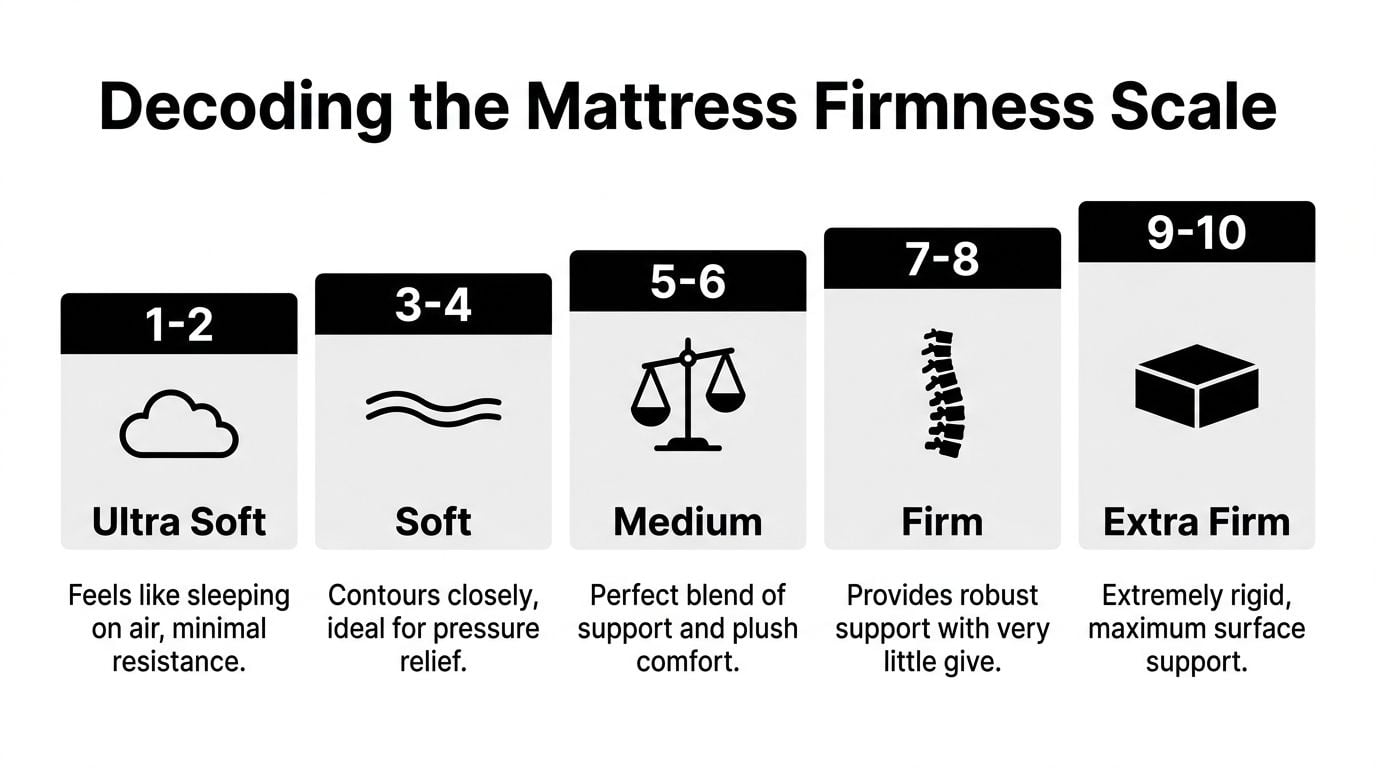
What each range usually feels like
1 to 2 ultra soft
These are plush. You sink in quickly and feel very little surface resistance.
They can feel cozy at first, but they’re usually too specialized for most shoppers.
3 to 4 soft
Soft mattresses contour closely and cushion sharp pressure points well. Sleepers who want a pronounced cradle often start here.
This range can work for lighter sleepers and some side sleepers who need more pressure relief.
5 to 6 medium
This is the middle ground. You get contouring, but not the swallowed-up feeling many people dislike.
According to NapLab, medium-firm mattresses rated 6 out of 10 are the most popular, and 80% of sleepers prefer the 5 to 7 range (NapLab mattress firmness scale).
7 to 8 firm
Firm mattresses have less surface give. They feel flatter, steadier, and more lifted.
That can be a very good thing for sleepers who need stronger support through the midsection.
9 to 10 extra firm
This is a narrow category. These mattresses feel rigid and offer very little contour.
It's generally unnecessary to begin a mattress search with these options.
Why labels still confuse people
One brand’s “medium” may not feel like another brand’s “medium.” That’s why showroom testing matters more than the tag.
A better way to think about firmness is this:
- Soft means more contour and more sink.
- Medium means balanced cushioning and support.
- Firm means less sink and a more lifted feel.
Helpful rule: Don’t shop by adjective alone. Shop by how your spine, shoulders, and hips feel after you’ve been on the bed long enough to settle in.
If you want a broader overview of mattress construction, materials, and comfort categories before visiting a store, this guide is useful: https://www.gorinsfurniture.com/the-ultimate-guide-for-choosing-a-mattress/
Matching Firmness to Your Primary Sleep Position
Sleep position gives you one of the clearest starting points for how to pick mattress firmness. Your body presses into the mattress differently depending on whether you sleep on your side, back, or stomach.
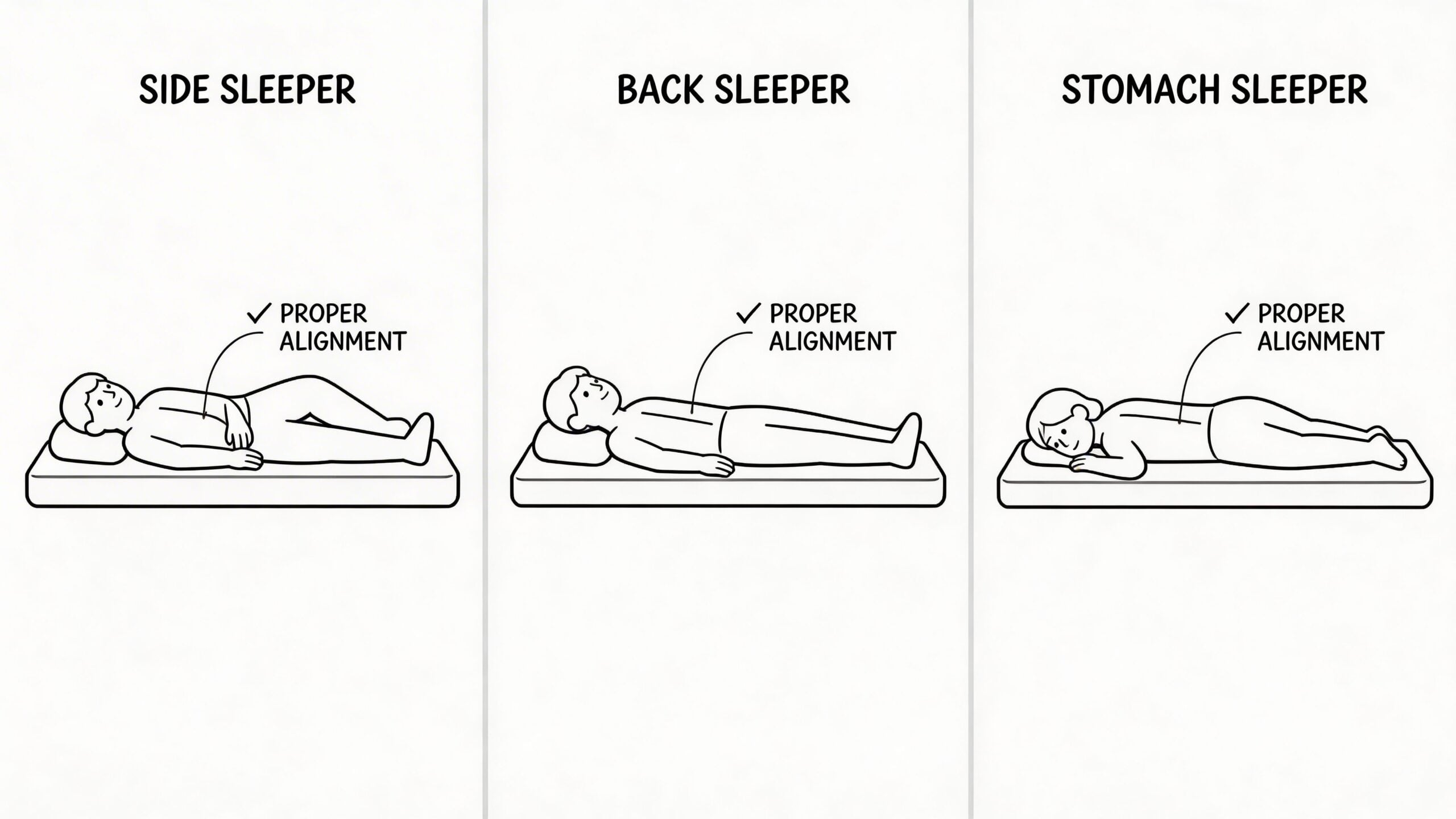
Side sleepers
Side sleeping puts more direct pressure on the shoulders and hips. If the mattress is too firm, those areas don’t sink in enough. That can twist the spine and create numbness, soreness, or frequent repositioning.
A softer surface usually works better here, especially in the comfort layers.
Start around 5 to 6 if you’re a side sleeper. Sleep Doctor notes that side sleepers who choose a mattress in the 5 to 6 firmness range report 35% less pressure on their hips and shoulders than those on firmer options (Sleep Doctor mattress firmness).
Side sleepers usually need enough give for the shoulder and hip to settle without the waist collapsing.
If side sleeping is your main position, this resource goes deeper into body shape, shoulder pressure, and mattress feel: https://www.gorinsfurniture.com/mattress-for-side-sleepers/
Back sleepers
Back sleepers need a balance. The mattress should let the hips settle slightly, but not so much that the lower back loses support.
Too soft, and the pelvis drifts downward. Too firm, and the lumbar area may feel unsupported because the mattress isn’t contouring enough.
Back sleepers often do well in the 5 to 7 range. The exact feel depends on body weight and whether you prefer a more cushioned or more lifted surface.
Stomach sleepers
Stomach sleeping usually calls for a firmer feel. The biggest issue is the midsection sinking lower than the chest and legs, which can increase strain through the lower back.
A firmer mattress helps keep the torso more level.
Start at 7 or higher if you sleep on your stomach most of the night.
Combination sleepers
Some people rotate through all three positions. In that case, don’t chase perfection for each one. Look for the position you spend the most time in, then choose a mattress that still makes movement easy.
Combination sleepers often prefer a feel that’s responsive rather than overly enveloping. A middle-range firmness is often the easiest place to start, then adjust from there based on where pressure or sagging shows up during testing.
How Your Body Weight Influences Firmness Needs
The same mattress does not feel the same to every body.
A sleeper with a lighter frame won’t compress the materials as much. A heavier sleeper will press farther into the comfort layers and interact more directly with the support core. That’s why “firmness” is partly about the bed and partly about who’s on it.
General weight guidelines
Van Vreede lays out a clear starting point: sleepers under 140 lbs often do well on 3 to 5, sleepers from 140 to 220 lbs usually fit 5 to 7, and sleepers over 220 lbs often need 7 to 10 (Van Vreede mattress firmness guide).
That doesn’t replace personal testing, but it keeps you from starting in the wrong aisle.
What this means in real life
Lighter sleepers under 140 lbs
If you’re lighter, many mattresses will feel firmer to you than they do to the average shopper. A bed with very little give may feel hard instead of supportive.
That’s why plush to medium tends to work better. You need enough contour to let your curves settle in.
Average weight sleepers from 140 to 220 lbs
This group usually experiences mattresses closer to the way they’re labeled. Medium to medium-firm is often the sweet spot because it balances comfort and support without going to an extreme.
Heavier sleepers over 220 lbs
Heavier sleepers often need a firmer build to keep the body from sinking too far into the mattress. That doesn’t mean sleeping on something harsh. It means choosing a surface and support system that hold alignment more consistently.
A firmer feel can also help the mattress stay comfortable over time.
Weight changes feel. Don’t assume your friend’s perfect mattress will feel the same to you.
Recommended mattress firmness by weight and sleep position
| Sleeper Weight | Side Sleeper | Back Sleeper | Stomach Sleeper |
|---|---|---|---|
| Under 140 lbs | 3-5 | 3-5 | 5-6 |
| 140-220 lbs | 5-6 | 5-7 | 7-10 |
| Over 220 lbs | 5-7 | 7-10 | 7-10 |
Use the table as a starting map, not a verdict. A lighter side sleeper who loves a buoyant feel may still prefer something closer to medium. A heavier side sleeper may need a firmer support core with enough cushioning on top to avoid shoulder pressure.
If you want help narrowing this down by body type before you try beds in person, this guide is a good companion: https://www.gorinsfurniture.com/which-mattress-is-right-for-your-body-type/
Addressing Health Concerns and Partner Preferences
People rarely shop for a mattress in a vacuum. They come in with a reason.
Sometimes it’s back pain. Sometimes it’s hip discomfort. Sometimes one partner sleeps well and the other wakes up every time someone rolls over.
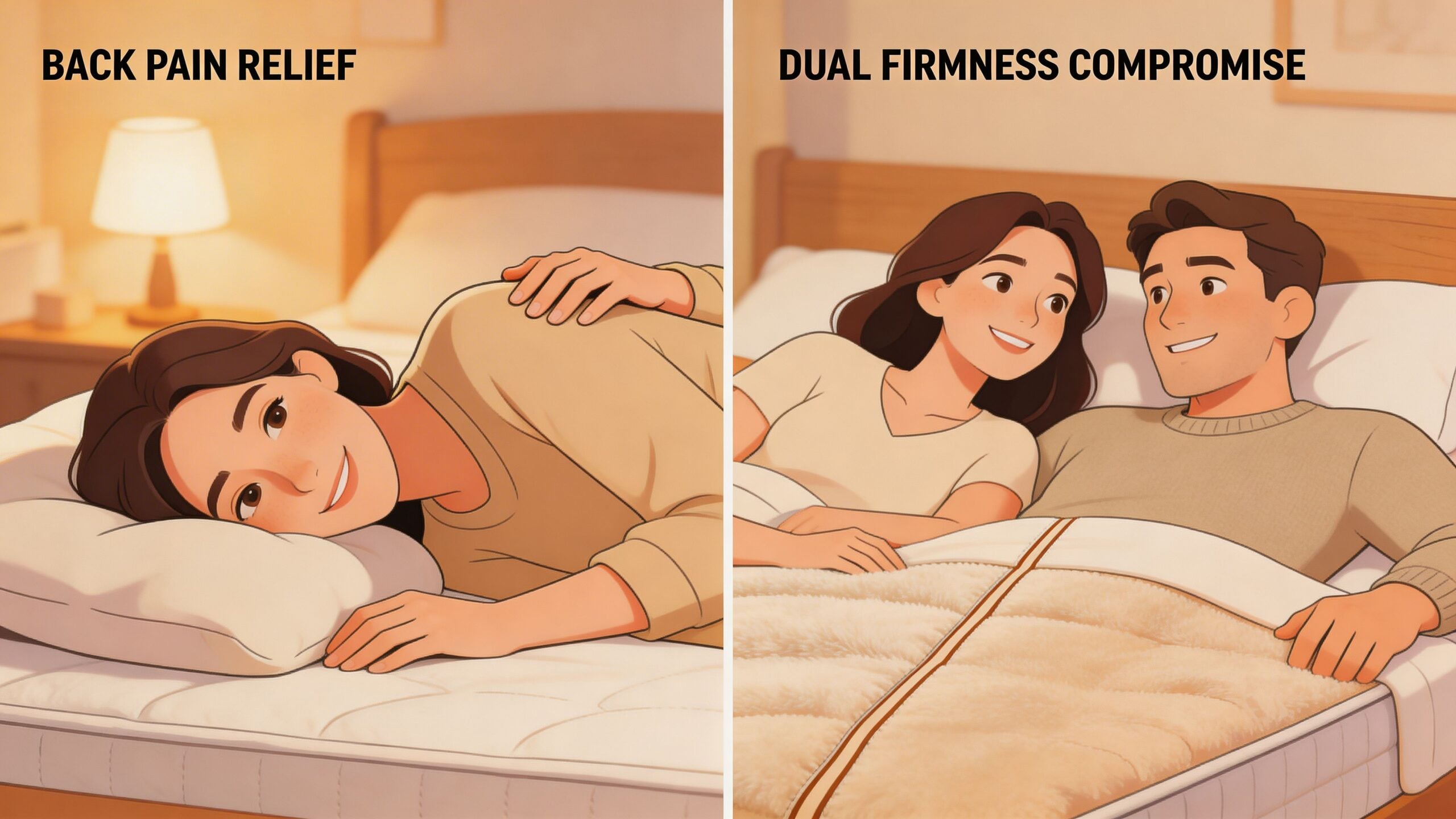
When pain is part of the problem
If your back hurts, don’t assume “firmer is automatically better.” Some backs need more support. Others need more pressure relief and contouring.
A sleeper with tender shoulders, hip pain, or arthritis often needs a mattress that cushions sensitive areas without letting the whole body sag. That’s where material matters as much as firmness. Tempur-Pedic models are known for close pressure relief. Stearns & Foster often appeal to shoppers who want a more substantial, supportive feel with refined cushioning.
If discomfort shows up in unusual ways, such as aching or pains in leg when lying down, it’s smart to consider both mattress fit and medical causes. A mattress can contribute to strain, but it isn’t the only possibility.
When two sleepers need different things
Couples often walk in with opposite preferences.
One likes a plush, body-hugging feel. The other wants to stay lifted and supported. The answer isn’t always “split the difference and hope.” Sometimes a medium-firm model works. Sometimes the right comfort layers solve the issue. Sometimes motion isolation matters more than the firmness number itself.
Look for these shared-bed priorities:
- Motion control so one person’s movement doesn’t keep the other awake
- Edge support if both of you use the full width of the mattress
- Pressure relief for the more sensitive sleeper
- Enough support for the sleeper who hates sinking in
For couples sorting through those tradeoffs, this article is helpful: https://www.gorinsfurniture.com/couples-conundrum-finding-the-mattress-that-works-for-two-sleepers/
Testing Mattresses in the Gorins Sleep Gallery
Online research is useful. It helps you narrow the field.
But firmness becomes real only when your body is on the mattress long enough to settle. That’s where in-person testing matters most.

What to do in the showroom
Casper advises shoppers to lie in their primary sleep position for 10 to 15 minutes on each mattress so they can assess neutral spinal alignment and check for pressure points at the shoulders and hips (Casper mattress firmness scale).
That’s longer than many people expect, but it’s necessary. Your first impression can be misleading.
Try this checklist:
- Wear comfortable clothes so you can move naturally and notice pressure without distraction.
- Lie down in your real position. If you’re a side sleeper at home, don’t test mostly on your back.
- Stay there long enough for your muscles to stop bracing.
- Notice your pressure points. Are your shoulders relaxed or pushed upward? Do your hips feel cushioned?
- Check your lower back. Does it feel supported or strained?
- Roll and reposition if you change positions at night. Movement should feel manageable, not like climbing out of a hole.
What to compare while you test
The Norwich showroom makes this easier because you can compare different feels close together. Shoppers often move between Serta, Beautyrest, Sealy, Tempur-Pedic, and Stearns & Foster to learn what “soft,” “medium,” and “firm” feel like on different constructions.
One useful approach is to test three beds in a row:
- A softer option than you think you want
- Your expected target
- A firmer option than you think you need
That creates contrast. Suddenly the differences become obvious.
Don’t rush the tryout. A mattress isn’t a countertop sample. You need time on it.
This is also where a store such as Gorins Furniture & Mattress can help in practical ways. You can compare mattress feels in person, ask questions about pressure relief versus support, and look into Promotional Financing with equal monthly payments if you’re budgeting for investment-grade quality.
Your Mattress Firmness Questions Answered
How long does a new mattress take to break in
New mattresses often feel a bit firmer at first. Materials settle with use, so give your body some adjustment time before deciding the feel is completely wrong.
Can a topper fix the wrong firmness
Sometimes, but not always. A topper can soften a mattress that feels slightly too firm. It usually can’t fix a mattress that’s unsupportive or sagging.
What if my partner and I need different firmness levels
Start by identifying where your needs overlap. Shared comfort often comes from balancing pressure relief, support, and motion control rather than chasing one exact number.
Is medium-firm always the safest choice
It’s a common starting point, not a universal answer. Your sleep position, body weight, and sensitivity at the shoulders, hips, and lower back matter more than the label.
Since 1936, Gorins Furniture & Mattress has helped Norwich and Eastern CT families create homes they love. From custom-designed Canadel dining sets with thousands of combinations to the latest in Tempur-Pedic sleep technology, they combine a massive selection with the personalized care only a local, family-owned business can provide. If you’re ready to compare mattress firmness in person, visit the Norwich showroom, take the online Style Quiz, or browse the Clearance section for value-driven savings and 5-Star Delivery service.