Guest Bed Ideas: A Norwich Expert’s Guide to Comfort


The text comes in fast. Your sister wants to bring the kids for a weekend. Old friends from out of town are finally making the trip to Norwich. Your in-laws are staying over after a holiday dinner. Then the practical question lands. Where is everyone going to sleep?
That moment is why guest bed ideas matter so much. Most homes are not built around a dedicated spare suite anymore. Rooms do double duty. A home office becomes a weekend bedroom. A den needs to stay useful during the day. A playroom has to convert without turning into chaos.
That shift is not just local. A majority of the world’s population now lives in cities, and compressed living space has increased demand for versatile furniture. In the U.S., many households hosted overnight guests last year, and sofa beds hold a 25% market share in multifunctional furniture as homeowners look for practical ways to make room when space is tight (guest bed ideas for welcoming homes).
In homes across Eastern Connecticut, the challenge usually is not whether people want to host. It is how to host well without sacrificing the way the room works the other fifty weeks of the year.
Since 1936, local families have been solving that exact problem one thoughtful furniture choice at a time. The right guest setup does not need to feel temporary or improvised. It can look finished, feel comfortable, and fit the way you live. If you need inspiration for the room as a whole, this guide on transforming your spare bedroom into a welcoming retreat is a helpful place to start.
Creating a Welcome Space for Friends and Family
A welcoming guest space starts with one simple idea. Do not shop for a bed first. Shop for the way the room needs to behave.
That sounds small, but it changes almost every decision that follows. A guest room that only hosts twice a year can handle a different solution than a home office that needs to become a bedroom every other weekend. A basement bonus room has different needs than a second-floor den. A space used by older parents should not be planned the same way as one used by teenagers during sleepovers.
Start with the room’s daily job
Before you think about frame styles, fabrics, or mattress types, answer these questions:
- Primary use: Is this room mainly an office, sitting room, child’s room, or flexible overflow space?
- Guest frequency: Do visitors stay often, or is this a once-in-a-while arrangement?
- Typical sleeper: Are you planning for one adult, a couple, children, or someone with mobility concerns?
- Storage pressure: Do extra linens, pillows, or suitcases need to live in the same room?
These answers narrow the field fast.
A sofa bed makes sense when seating matters every day. A trundle works when you need sleeping space for children or multiple guests. A Murphy bed suits rooms that need open floor area most of the time. A standard bed can still be the right answer when the room has enough space and comfort is the top priority.
The rooms that work best for guests are the ones that still work for the homeowner after the guests leave.
Measure for movement, not just furniture

Many people measure wall length and stop there. That is how rooms end up looking good on paper but feeling cramped in real life.
Focus on the path people need to move through the room. You want clearance for walking, opening closet doors, pulling out drawers, and setting down a suitcase without stepping sideways around furniture. If the bed folds, slides, or lifts, measure the open position too.
A few practical habits help:
- Mark the footprint on the floor with painter’s tape.
- Test the opening motion of any sleeper, trundle, or wall bed before you buy.
- Account for side tables and lamps, not just the bed itself.
- Check the rug situation if anything rolls or slides.
If your room is tight, this article on stylish solutions for small bedrooms can help you think through layout before you commit.
Think about comfort in real-world terms
A guest bed should suit the person sleeping in it, not just the square footage.
If you host grandparents, seat height and ease of getting in and out matter. If you host couples, mattress width and edge support matter. If you host children, flexibility and durability matter more than a formal look. If you host for holidays, quick setup matters because no one wants a thirty-minute furniture puzzle at the end of a long day.
This planning step saves money and frustration. It also makes shopping simpler, because you are no longer reacting to what looks attractive in a showroom. You are choosing a solution that fits your room, your guests, and your routine.
First Assess Your Space and Needs
Some guest bed ideas look smart in a catalog and become frustrating at home. Others sound simple and end up being exactly right. The difference usually comes down to how the bed will be used, stored, and slept on.
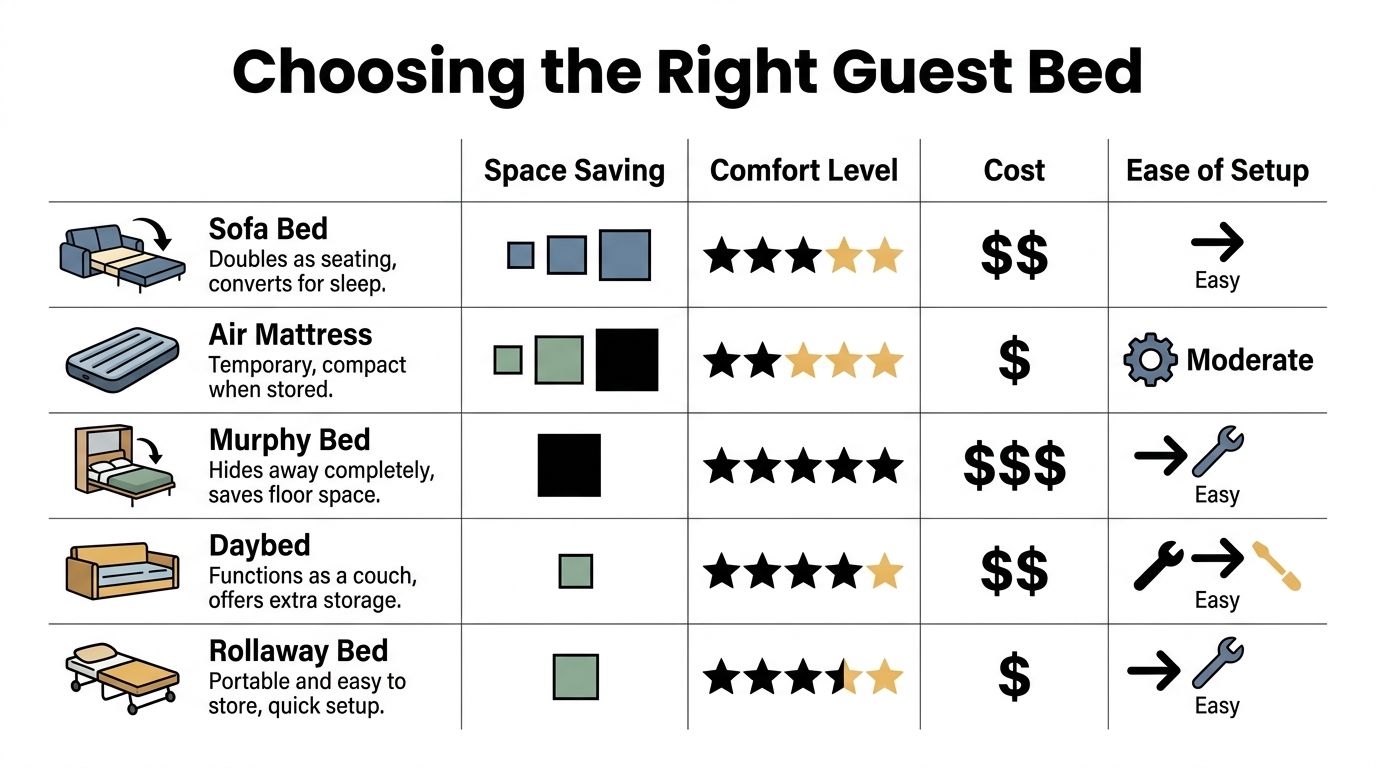
Guest Bed Solutions at a Glance
| Bed Type | Best For | Space Impact | Gorins' Take |
|---|---|---|---|
| Sofa bed | Offices, dens, living spaces | Low during the day, moderate at night | Strong choice when seating matters as much as sleeping |
| Daybed | Flex rooms, reading rooms, teen spaces | Moderate | Good-looking and easy to style, but best for shorter stays |
| Murphy bed | True multi-use rooms | Very low during the day | Excellent when open floor space matters most |
| Trundle bed | Kids, cousins, sleepovers, two singles | Moderate when closed, larger when open | Practical and efficient if floor clearance is available |
| Platform bed | Dedicated guest rooms | Highest permanent footprint | Usually the most straightforward comfort option |
| Lift chair or recliner | Guests with mobility concerns | Low to moderate | A useful specialty option when low beds are difficult |
For a broader look at room-specific options, guest room furniture can help you match the bed type to the rest of the space.
Sofa beds for rooms that need to earn their keep
A sofa bed is often the cleanest answer when one room has to serve two jobs well.
It gives you real seating during the day and sleeping space at night. That is why this category remains so relevant in apartments, dens, finished basements, and office-guest room combinations. It can also look far more refined than people expect, especially when you pay attention to cushion construction, mattress feel, and fabric durability.
What works:
- Daily functionality: You keep a proper sitting room.
- Cleaner visual footprint: The room does not look like a bedroom all week.
- Style flexibility: Upholstery, arm shape, back style, and scale all change the final effect.
What does not work as well:
- Heavy mechanisms: Some models are harder to open than they should be.
- Thin mattresses: Lower-quality sleepers often disappoint with thin mattresses.
- Poor scale choices: An oversized sleeper can crowd a room quickly.
When shoppers ask for a sofa bed that does not feel like a compromise, details become important. A well-built Flexsteel sleeper or an F9 Custom Sofa configuration can make more sense than a generic pull-out because you can tailor the look and comfort level to the room instead of forcing the room to adapt to the furniture.
Daybeds for soft-use guest rooms
Daybeds sit in a useful middle ground. They read more like furniture than a standard bed and less like a mechanism than a sleeper sofa.
That makes them especially appealing in home offices, sunrooms, craft spaces, and upstairs landings where you want the room to feel casual and finished. They are also easy to style with pillows and layered bedding, which helps the room feel intentional rather than improvised.
Their limits are also clear. For taller adults or couples, a daybed can feel restrictive. For frequent overnight use, many homeowners eventually decide they want a more bed-like sleep surface.
Murphy beds for serious space recovery
Murphy beds solve a different problem. They are not about occasional flexibility. They are about reclaiming the room when the bed is not in use.
The practical side matters here. Installation is not casual. The system needs proper wall assessment, the right hardware, and a mattress profile that fits the mechanism. The source material on wall beds notes a step-by-step process that starts with wall measurement and structural review, then moves into hardware selection, installation, and bedding fit. It also reports 95% user satisfaction in space recovery and says these systems can free 40 to 50 square feet of daytime floor space (luxury guest bedroom ideas with Murphy bed planning).
That sounds appealing because it is. But the trade-off is commitment. A Murphy bed is not the easiest route. It is the most architectural route.
Murphy beds work best when you want the room back every day, not just when you need to tuck a bed out of sight once in a while.
A few realities to keep in mind:
- Installation matters: Poor mounting creates long-term headaches.
- Mattress thickness matters: Too thick and the mechanism may not close cleanly.
- Cabinet depth matters: The wall unit needs to suit the room, not dominate it.
Trundles for children, cousins, and flexible sleeping
Trundles remain one of the most underrated guest bed ideas, especially for family homes.
They are useful because they hide sleeping capacity under a main bed. That makes them ideal in children’s rooms, small guest rooms, and homes where visiting grandchildren or siblings often sleep in the same space. According to the methodology cited in the trundle source, users reported 92% comfort equivalence to standalone twins and an 80% space utilization gain versus two separate beds (creative and practical guest bed solutions for small spaces).
That said, not every trundle is equal.
What tends to work:
- Smooth casters
- Proper mattress height
- Enough clearance to pull the lower bed out cleanly
Common issues:
- Rugs catching wheels
- Sheets that do not fit neatly
- Trying to use a mattress that is too thick for the lower frame
If the room will host children often, this can be one of the smartest, least disruptive choices.
Platform beds for uncomplicated comfort
Sometimes the strongest answer is the most straightforward one.
If you have a dedicated guest room and enough floor space, a platform bed or standard bed frame is still hard to beat. It gives guests a familiar sleep experience. It avoids mechanisms. It simplifies bedding. It makes mattress selection easier.
The downside is obvious: the bed permanently claims the room.
For homes with a true spare bedroom, that is often fine. For flex rooms, it may feel like wasted space the rest of the year.
Do not ignore accessibility
Most articles about guest bed ideas stop at compactness. They rarely address the guest who struggles to lower into a low mattress, needs help standing, or sleeps more comfortably with the upper body elevated.
That gap is bigger than many homeowners realize. Many U.S. homeowners over 50 host elderly guests annually, and lift-chair-style guest solutions are seeing 25% year-over-year sales growth according to the mobility-focused source material (angled bed decorating ideas and accessibility gap).
If a guest needs support getting in and out of bed, a stylish low-profile bed is not a success. Safe access matters more than visual trend.
A high-quality lift chair or recliner from brands such as BarcaLounger or UltraComfort can be a practical option for shorter overnight stays, especially in family rooms or dens. It will not replace a proper bed for every guest. It can, however, be the safest and most comfortable choice for the right person.
That is a real trade-off worth naming. Not every guest bed solution should be judged by square footage alone.
Choosing the Right Type of Guest Bed
People forgive a lot in a guest room. They do not expect a private suite. They do expect to sleep well.
That is why the mattress deserves as much attention as the bed itself. A beautifully chosen sleeper, trundle, or platform frame still disappoints if the mattress feels flat, lumpy, too firm, too soft, or impossible to regulate through the night.
Why the mattress matters more in guest rooms
A guest usually arrives tired. They may have driven for hours, come in late, or be sleeping in an unfamiliar home with different light, noise, and temperature. The mattress has one job: remove friction from that experience.
This is also where many homeowners cut corners. They treat the guest mattress like storage. It becomes the old mattress from the primary bedroom, the thin foldable option that was “good enough,” or the sleeper insert that came with the frame, even though no one liked it.
That approach makes the room feel secondhand.
The broader market points in the opposite direction. The U.S. mattress market is substantial, and with a minority of homes having a dedicated guest room, convertible beds have become more important. The same source notes that brands carried by Gorins offer custom firmness levels that rival premium mattresses, which matters in a country where 70% of Americans hosted guests last year (guest sleeping solutions and mattress trends).
A simple way to choose by mattress type
Different guest beds call for different mattress constructions. The goal is not to chase a trend. It is to match support, thickness, and ease of use to the furniture.
Foam
Foam works well in many guest applications because it can feel pressure-relieving and quieter than a spring build. It also often suits sofa beds, trundles, and Murphy beds where profile matters.
Use foam when:
- You need a lower-profile mattress
- You want less motion transfer
- You are outfitting a bed with a mechanism
Be careful if your guest sleeps hot or strongly prefers a traditional spring feel.
Innerspring
Innerspring mattresses feel familiar to many people. They often have a bit more bounce and a more classic bed feel, which some guests immediately like.
Use innerspring when:
- You are furnishing a platform or standard guest bed
- Your visitors prefer a more traditional sleep surface
- You want easier edge definition when sitting down
Their limitation is flexibility. They are not always ideal for every folding frame.
Hybrid
Hybrid mattresses often land in the middle. They combine support and cushioning in a way that works for a wide range of sleepers.
Use a hybrid when:
- The room hosts different kinds of guests
- You want one mattress to satisfy a wide range of people
- You are willing to invest a little more for versatility
For many guest rooms, a medium-firm hybrid is the safest all-around direction.
If you want one mattress feel that offends the fewest people, medium-firm is usually the right place to start.
Special considerations for sofa beds and trundles
Non-standard guest beds require more discipline.
A sleeper sofa mattress has to fold, store, and still provide support. A trundle mattress has to clear the lower frame and roll smoothly. A Murphy bed mattress has to fit the cabinet depth and mechanism. In each case, the wrong thickness causes more trouble than many shoppers expect.
If you are comparing materials and profiles for a sleeper, this guide to choosing a mattress for a sofa bed is a useful outside reference because it explains what matters when a mattress has to bend and store properly.
For in-person testing, this practical guide on how to choose mattress helps narrow comfort preferences before you commit.
Comfort by feel beats guessing
Brand matters, but fit matters more.
In a proper sleep gallery, you can compare Tempur-Pedic, Serta, and Beautyrest side by side and feel the difference between response, contouring, support, and edge stability. That is especially useful for guest rooms because you are usually trying to find the broadest comfort range, not a highly specific feel meant for one sleeper every night.
A few practical rules help:
- Choose medium-firm when in doubt.
- Avoid ultra-plush unless you know your guests prefer it.
- Do not assume the old mattress in the attic is “still fine.”
- Buy for the bed frame’s requirements first, then refine comfort.
The best guest mattress does not announce itself. Your guest should wake up, stretch, and move on with the day without mentioning back pain, numb shoulders, or a rough night.
That is the benchmark.
Selecting the Perfect Mattress for Guests
A guest bed feels finished when the bedding says, “We planned for you.”
That does not mean piling on decorative pieces no one can use. It means building the bed in layers that give guests options and make the room feel calm, clean, and easy to settle into.
Build the bed from the bottom up

Start with the layer people never see. A mattress protector matters because guest beds often sit unused between visits, and you want the sleep surface to stay fresh and protected.
Then add the bedding that guests interact with directly:
- Sheets: Choose breathable, easy-care sheets that do not fight the mattress size.
- Blanket or coverlet: Give guests a lighter layer they can use without wrestling with a full duvet.
- Duvet or comforter: Keep warmth available, but not so heavy that hot sleepers feel trapped.
- Pillows: Offer at least two feel options if possible.
The common mistake is overstyling. Too many throw pillows, fussy layers, or hard-to-find extra blankets make a room feel staged instead of comfortable.
Match bedding scale to the bed
This matters more than homeowners think.
A trundle, sleeper, and daybed all need more careful sizing than a standard queen bed. Oversized blankets drag, bunch, and make setup harder. Undersized ones leave the bed looking skimpy and unfinished.
If you are trying to sort through dimensions before buying layers, this ultimate blanket size guide is a handy reference for matching blanket scale to the mattress you own.
Add the pieces that make overnight stays easier
Guests notice small support items almost immediately. A bedside surface, soft lighting, and a place to set personal items can make a simple room feel much more considered.
Try this checklist:
- Nightstand or bedside table: A phone, glasses, or water bottle needs a landing spot.
- Lamp with easy reach: Guests should not have to cross a dark room to switch off overhead lighting.
- Water and a spare charger: Useful and always appreciated.
- Extra blanket within reach: Better than forcing someone to search closets at midnight.
- A small chest or drawer space: Even one drawer helps longer-stay guests feel less temporary.
Bedroom pieces from lines such as Vaughan-Bassett often work well here because they add function without making the room feel overloaded.
The guest rooms people remember are rarely the most decorated. They are the ones where everything they needed was easy to find.
Keep the room intentional, not crowded
The finishing layer is restraint.
A guest room should not become the place where every leftover chair, lamp, and storage bin ends up. If the room feels crowded, sleep quality drops because movement gets awkward and the bed starts to feel squeezed into the space.
Choose a few useful comforts and stop there. A clean lamp, a good mattress protector, breathable sheets, a supportive pillow mix, and one warm extra layer do more for hospitality than a dozen decorative extras.
For a deeper look at practical layers and bedding basics, complete guide bedding mattress protectors comforters is a strong next step.
Layering Bedding and Adding Thoughtful Comforts
Good guest rooms are rarely built in one purchase. They come together when you decide where to invest, where to simplify, and which pieces need to last.
That is especially true in homes around Norwich, New London, Plainfield, Waterford, and nearby Rhode Island communities, where many rooms need flexibility more than formality: one homeowner may need a custom sleeper for a den. Another may need a compact setup for grandkids. Someone else may be furnishing for older parents and wants easier access, better support, and less day-to-day hassle.
Set your priorities before you set your budget
A smarter budget starts with ranking what matters most: for some households, the biggest investment should go into the mattress because comfort is the make-or-break issue. For others, the right mechanism matters more because the room must change functions quickly. In some homes, upholstery customization matters because the guest bed will sit in the main living space and needs to look right every day.
A useful order is:
- Sleep quality
- Room function
- Ease of operation
- Style and finish details
- Supporting pieces like lighting and storage
That order keeps the budget tied to real use instead of impulse decisions.
Where value shows up over time
Value in a guest room is not just a lower ticket; it is fewer regrets.
Investment-grade quality shows up when a sleeper opens smoothly after repeated use, when the mattress still feels supportive after years of occasional hosting, and when the fabric still looks good in a room you see every day. It also shows up when a custom choice solves a layout problem that off-the-floor furniture could not.
If you are furnishing a room that needs daily seating and occasional sleep, customization can be worth it. The same is true if you are trying to match an existing style in an office, den, or finished basement.
Use financing as a planning tool, not a pressure point
A guest room often includes several purchases at once. Bed, mattress, bedding, and a nightstand can add up quickly when you choose quality pieces.
Promotional financing with equal monthly payment options can make that easier to plan around because it lets you buy the right setup instead of piecing together stopgap solutions that need replacement later. Used carefully, financing is not about overbuying. It is about building a room once, with fewer compromises.
The same goes for clearance shopping. Clearance can be a smart path when the construction is right and the size fits your room. The key is to stay disciplined. A bargain that does not fit the space or the way you host is not value.
Customization is useful when the room has to do more than one thing
A lot of guest bed ideas fail because they only solve one problem.
A room might need seating, hidden sleep space, durable upholstery, a specific scale, and a fabric that works with children or pets. That is where custom programs become practical rather than decorative. The F9 Custom Sofa line is a good example of this approach because you can adjust details like silhouette and feel to better fit the room instead of settling for a one-shape-fits-all sleeper.
The same thinking applies across the home. If you are already reworking adjacent spaces, custom choices in dining or living areas can help the guest room feel connected rather than pieced together from leftovers. Programs like Canadel Custom Dining offer thousands of combinations, which is useful when your home needs continuity from room to room.
The easiest way to overspend on a guest room is to buy twice: first the temporary fix, then the piece you needed.
Make the process local and low-stress
Buying a guest bed is easier when you can sit on it, open it, lie down, and judge the scale in person. Online pictures hide the details that matter most, especially with sleeper mechanisms, mattress feel, and upholstery texture.
That is where local service matters. Delivery, setup, and post-purchase help become part of the value, especially for heavier pieces and specialty items. For households in Eastern Connecticut, that removes a lot of the guesswork.
Since 1936, Gorins Furniture & Mattress has helped Norwich and Eastern CT families create homes they love. From custom-designed Canadel dining sets to the latest in Tempur-Pedic sleep technology, we combine a massive selection with the personalized care only a local, family-owned business can provide. Visit us today to experience quality, value, and our 5-Star Delivery service.
If you are weighing guest bed ideas for your own home, visit Gorins Furniture & Mattress to explore options in person, take the online Style Quiz to narrow your look, or browse the Clearance section for value-driven finds that fit your space and your hosting style.