How Do Lift Chairs Work: Mechanisms & Benefits

A lot of people start asking how do lift chairs work at the same moment. A favorite recliner is no longer easy to get out of.
Maybe it is your dad pushing hard on the armrests and rocking forward twice before he can stand. Maybe it is your spouse recovering from surgery and trying not to put too much strain on sore hips or knees. Maybe it is you, noticing that a simple sit-to-stand movement takes more planning than it used to.
A lift chair solves a very practical problem. It looks and feels like a comfortable recliner, but inside it has a powered mechanism that helps raise the seat and tilt it forward so the user can stand with less effort. In a home, that can mean less strain, more confidence, and fewer awkward moments asking for help.
Regaining Independence One Seat at a Time
Mrs. D. from the Norwich area is the kind of person many of us know. She wanted to stay in her own home, keep her usual routine, and enjoy her evening TV in the same corner of the living room she had used for years. The trouble was not sitting down. It was getting back up.
That is where lift chairs make such a difference. They are not medical-looking contraptions parked in the middle of the room. They are upholstered chairs built for daily use, with a hidden lifting system that gives a steady assist when standing becomes difficult.
For families thinking about long-term comfort at home, a lift chair often fits into a larger plan. If you are looking at entryways, bathroom safety, lighting, and layout changes too, this guide to aging in place home modifications is a useful companion resource.
Why the chair matters emotionally
People often focus on the mechanics first. Fair enough. However, the primary value is dignity.
A chair that helps you stand can mean:
- More privacy: You may not need someone hovering nearby every time you want to get up.
- Less hesitation: Many people stop moving around the house as much when standing feels risky.
- A more normal room: The chair still looks like furniture, not a piece of equipment.
A lift chair works best when it feels like part of your home and part of your routine, not a disruption to either one.
Since 1936, Gorins has served Norwich and Eastern CT as a family-owned business, and that local perspective matters here. When neighbors ask about lift chairs, they are rarely asking for a gadget. They are asking for a way to keep living comfortably at home, designed to fit their lifestyle.
The Mechanics Behind the Gentle Lift
The easiest way to understand a lift chair is to think of three parts working together. A low-voltage DC electric motor, a steel frame, and a lifting mechanism.
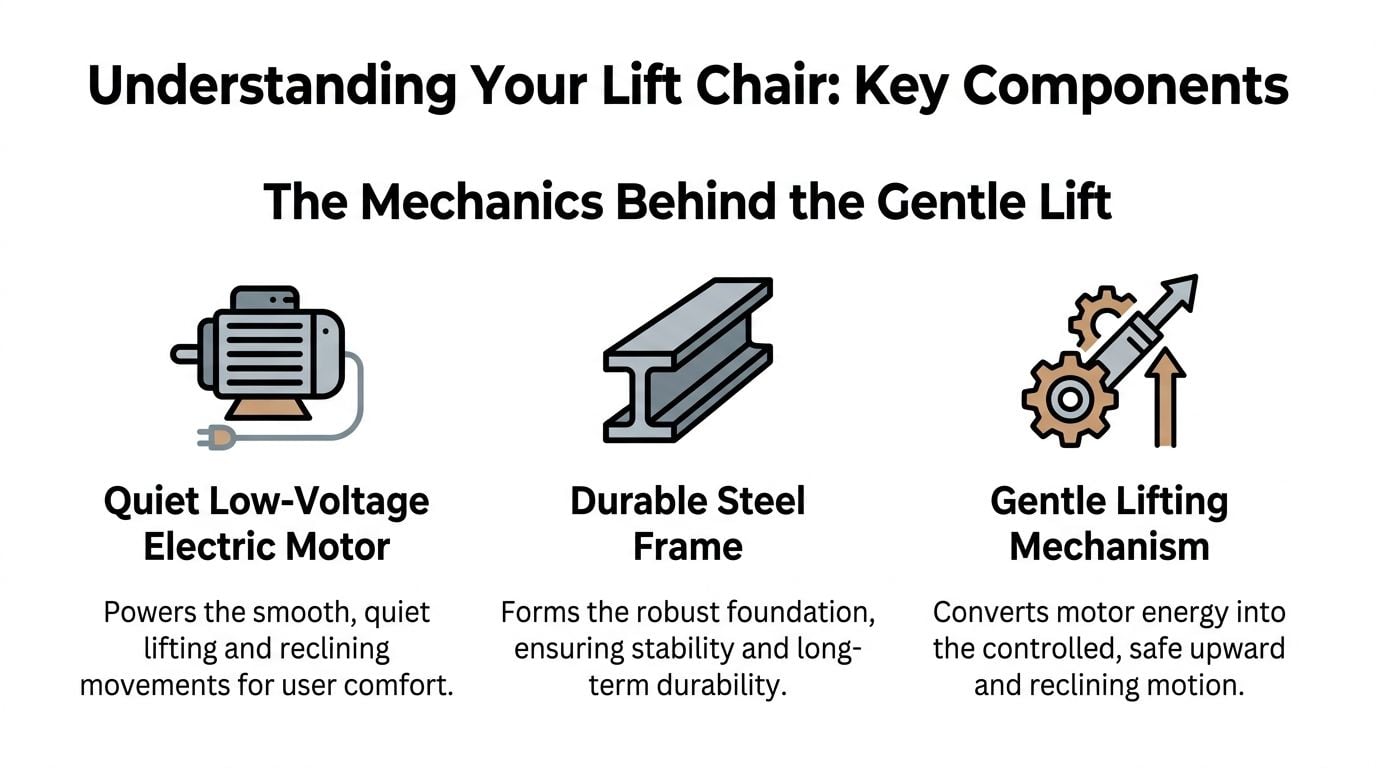
When you press the handheld remote, the motor powers the mechanism under the seat. The frame keeps everything stable. The mechanism then raises and tilts the chair in a controlled motion. According to this explanation of lift chair construction and function, lift chairs use a low-voltage DC electric motor and a durable steel frame, with most models relying on a scissor-lift mechanism while higher-end models use a linear actuator. That same source notes that top models can reach lift heights of up to 29.5 inches.
The scissor-lift design
A scissor-lift mechanism is the most common setup. It uses interlocking steel beams that open and close in a crisscross pattern.
If you have ever seen a car jack expand upward, you already have the right mental picture. As the mechanism opens, it raises the whole seat base and tips it forward. That forward tilt is what helps bring the user into a more natural standing position.
This design is common because it is straightforward and dependable for everyday assistance.
The linear actuator design
A linear actuator works differently. Instead of relying on that crisscrossing lift pattern, it uses a rod-like component that extends and retracts in a smoother, more direct line.
Premium chairs often use this setup because the movement feels more fluid. For someone with arthritis, tenderness after surgery, or a strong dislike of jerky motion, that smoother travel can matter a lot in daily use.
What happens when you press the remote
The process is simpler than commonly expected:
- You press a button on the remote.
- The motor engages and sends power to the chair’s movement system.
- The mechanism rises under the seat.
- The chair tilts forward as it lifts.
- Your hips move higher than your knees, which makes standing easier.
That is the whole idea. The chair is not pulling you up by the arms or forcing you forward. It is changing your body angle so standing requires less effort.
For readers comparing recliner technologies more broadly, Gorins also has a helpful guide on types of power reclining seating.
The safest lift chairs do not move fast. They move predictably.
Where people get confused
One common misunderstanding is thinking the chair only lifts the footrest or only tilts the back. That is not the main standing assist. The key action happens under the seat base.
Another point of confusion is whether all chairs feel the same. They do not. The internal mechanism, the height of the lift, the seat dimensions, and the way the motion starts all affect how secure the chair feels.
Finding Your Perfect Position for Comfort and Health
The lift is only part of the story. The recline options matter just as much, especially if the chair will be used for hours each day.
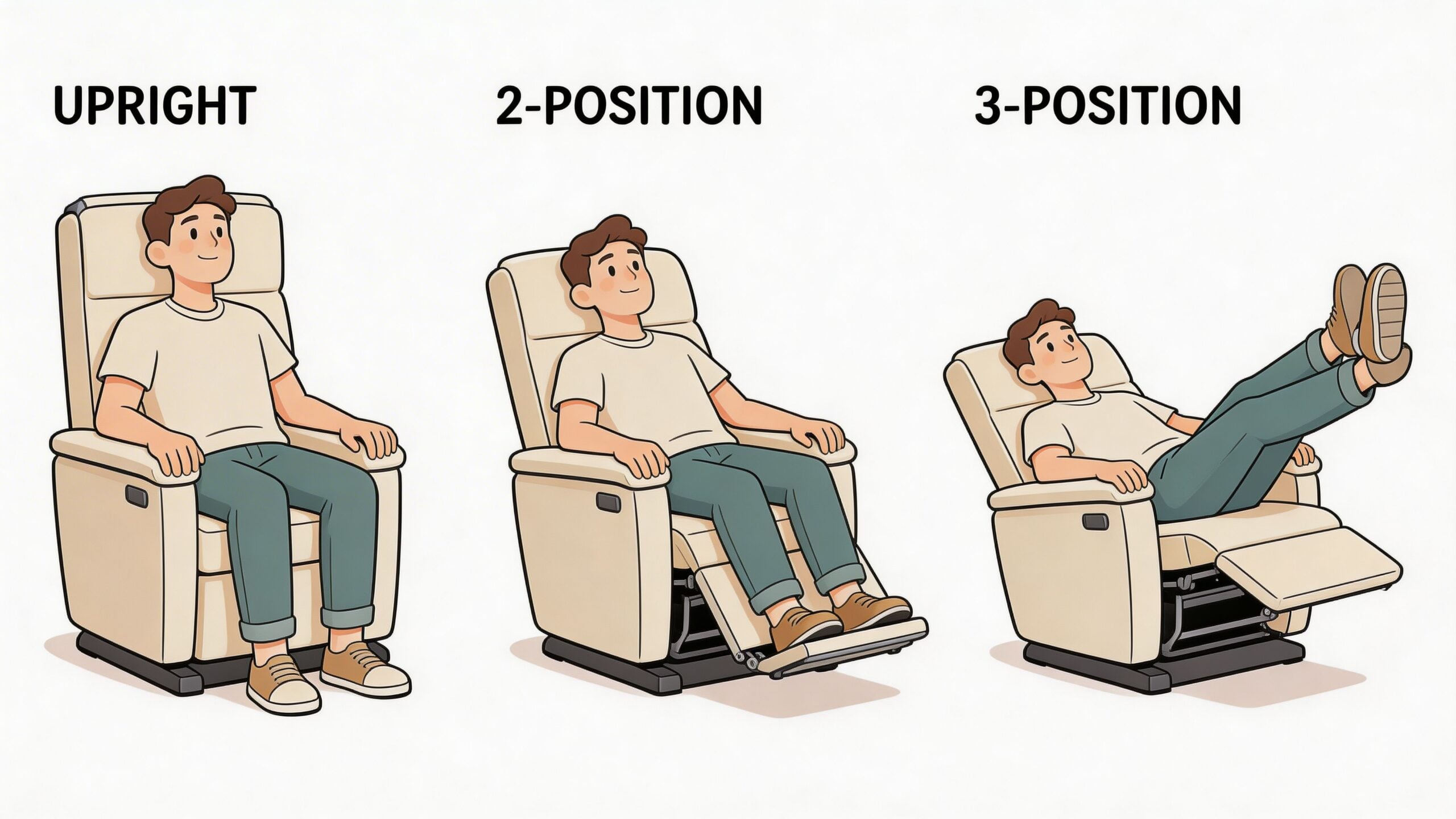
Lift chairs are usually grouped by how many positions they offer. The names can sound technical, but the essential question is simple. How much control do you want over sitting, resting, and elevating your legs?
Two-position chairs
A 2-position chair is the simplest option. It helps the user stand and also reclines back a bit for reading, conversation, or television.
This style fits people who mainly need help getting up and down, not a wide range of lounging positions.
Three-position chairs
A 3-position chair reclines farther. That makes it a better fit for someone who likes to rest in the chair for longer stretches or wants a more nap-friendly angle.
It still works in a fairly straightforward pattern, but it gives more flexibility than a basic model.
Infinite-position chairs
An infinite-position chair offers the most adjustability. These models often use dual-motor systems, which means the backrest and the footrest can move independently rather than together.
That allows you to fine-tune support for your back and legs. It also opens the door to specialized comfort positions, including zero-gravity.
According to this overview of power lift recliner operation, advanced dual-motor systems in infinite-position chairs can achieve a zero-gravity position that may reduce spinal disc pressure by up to 70%. The same source notes that these systems can also provide Trendelenburg-like positioning to help with edema.
If you want a deeper look at that posture and why so many shoppers ask for it by name, Gorins has a guide to unlock zero-gravity.
Lift chair positions at a glance
| Position Type | Recline Capability | Best For |
|---|---|---|
| 2-position | Slight recline | Reading, TV, basic standing assistance |
| 3-position | Deeper recline | Relaxing, longer sitting sessions, napping |
| Infinite-position | Independent adjustment of back and footrest | Personalized comfort, leg elevation, wellness-focused use |
How to choose by lifestyle
The right position type depends less on marketing language and more on daily habits.
- If the chair is mainly a standing aid: A 2-position chair may be enough.
- If the chair doubles as a daytime resting spot: A 3-position model usually makes more sense.
- If comfort is part of a broader wellness plan: An infinite-position chair offers the most control.
Brands such as Best Home Furnishings and Flexsteel often enter the conversation here, because shoppers looking for investment-grade quality usually want refined motion and more personalized positioning.
If a user spends long stretches in the chair, independent adjustment is often worth trying in person before deciding.
Simple Controls and Essential Safety Features
Many expect the chair mechanism to be complicated. The good ones are not.
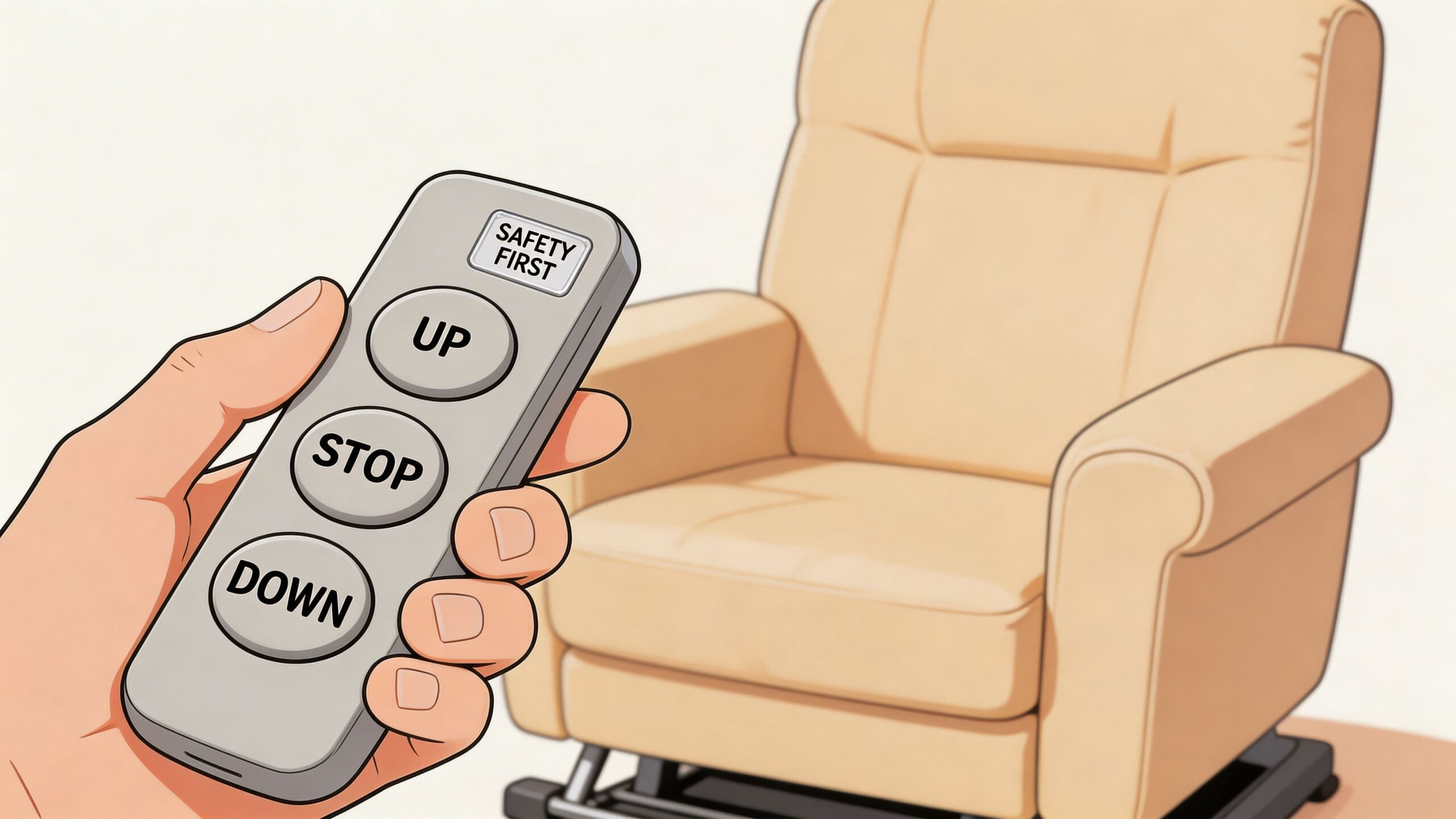
The everyday control is usually a handheld remote with large, easy-to-understand buttons. On a basic model, one button raises the chair and another reclines it. On more advanced chairs, the remote may allow separate control of the back and footrest. Some remotes also include memory settings so a favorite position is easy to return to.
What the user does
In daily use, the process is simple:
- To stand: Press and hold the lift button until the chair rises and tilts forward enough to make standing comfortable.
- To sit back down: Lower into the seat, then use the remote to return the chair to a standard seated position.
- To recline: Hold the recline control until you reach the angle that feels right.
That simplicity matters for users with limited hand strength, stiffness, or fatigue.
Safety features worth asking about
A lift chair should do more than move. It should provide peace of mind.
Look for these practical features:
- Battery backup: During a power outage, this helps the chair return to a usable position so the person is not stranded.
- Smooth stop-and-start motion: A chair should not jolt at the beginning or end of travel.
- Anti-entrapment design: Good chairs are engineered to reduce the chance of trapping objects during movement.
- Stable base construction: The frame should feel solid while lifting, lowering, and reclining.
For more guidance on what older adults often need from this category, Gorins has a useful article on the best recliner for seniors.
A simple showroom test
When you try a chair, do not just sit in it for ten seconds.
Ask yourself:
- Can I reach and understand the remote easily?
- Does the lift feel smooth from the very first inch of movement?
- Do I feel secure when the seat starts to tilt?
- Can I stop at a comfortable point, or does it feel too abrupt?
Those questions tell you more than color swatches ever will.
More Than a Chair The Benefits for Daily Life
The mechanics matter. The daily effect matters more.
A lift chair can reduce the effort of one of the most repeated movements in the house. Sitting down. Standing up. Doing it again at lunch. Again after a nap. Again before bed.

Less strain on sore joints
That benefit is not just a matter of comfort. It shows up biomechanically.
A 2021 study found that assistive lifting seats decreased knee joint moments by up to 11% and hip joint moments by 9-11% during sit-to-stand movement, easing strain for users with conditions such as arthritis, according to the Journal of Healthcare Engineering study on assistive lifting seats.
For someone with stiff knees or painful hips, that can make the difference between moving independently and waiting for help.
More confidence for the user
People often change their behavior when they feel unsteady. They may stay seated longer than they want to. They may avoid getting up for a glass of water. They may hesitate before answering the door.
A lift chair can support a more active day because standing feels less intimidating.
A lighter load for caregivers
Families feel the benefit too. Repeatedly helping someone out of a chair can be tiring and awkward for both people.
A chair that assists with the hardest part of the motion can reduce those physical handoffs. It can also work well alongside broader recovery planning, especially when a person is already using physiotherapy and rehabilitation support after surgery, illness, or a mobility setback.
The goal is not to replace movement. It is to make safe movement more realistic.
Comfort supports routine
There is also a quieter benefit. When a chair feels supportive, people tend to use their living space more normally.
They read. Watch a ballgame. Talk with family. Rest without worrying about the trip back to standing. That return to routine is often what families notice first.
How to Choose the Right Lift Chair in Our Norwich Showroom
Buying the right lift chair is less about picking a category and more about matching the chair to the person. A good fit should support the user’s height, weight, leg position, and daily habits.
A chair can have the right mechanism and still feel wrong if the seat is too deep, the arms are too high, or the lift angle does not match the user’s body.
Start with fit, not fabric
Most shoppers look at color first. The better starting point is posture.
When seated, the user should be able to rest comfortably with proper support through the legs and back. The chair should also bring them forward in a way that feels natural when the lift begins.
Think through these questions:
- How much assistance is needed: Is the goal occasional help, or several lifts each day?
- How long will the chair be used at a time: Short sitting periods and all-day sitting are different needs.
- What type of motion feels comfortable: Some users prefer a simple tilt-forward lift, while others respond better to smoother premium motion.
For more specific buying considerations, Gorins Furniture & Mattress has a page on the best lift chair for elderly.
Try the chair like you would use it at home
In a showroom, people sometimes sit down once, press a button, and decide too quickly. A better test is to use the chair the way life uses it.
Sit fully back. Rest your feet. Recline. Return upright. Lift halfway. Lift farther. Then repeat.
That process helps reveal whether a model from UltraComfort or BarcaLounger feels supportive for your body, not just attractive on the floor.
The local advantage
Our neighbors in Norwich, New London, Plainfield, Waterford, and nearby Eastern CT communities usually learn the most by trying several chairs side by side. That is where local, patient guidance matters.
A family-owned showroom can help you compare fit, motion style, and upholstery without rushing the decision. If customization matters elsewhere in the home, that same approach carries through Gorins’ broader offerings, from Canadel Custom Dining with thousands of combinations to the F9 Custom Sofa series.
Budget matters too
Lift chairs are an investment purchase for many households. That is why Promotional Financing with equal monthly payments can be helpful when a family wants to solve a mobility problem now rather than delay it.
The right chair should feel safe in motion, comfortable at rest, and realistic for your budget.
Your Partner in Comfort and Independence Since 1936
Once you understand how do lift chairs work, the category becomes much less intimidating. A lift chair is a thoughtfully engineered recliner that uses a motor, a sturdy frame, and a lifting system to help someone sit and stand more comfortably.
That simple function can support independence, reduce strain during one of the hardest daily movements, and make a living room feel usable again.
Choosing well still matters. The right mechanism, the right recline range, the right remote, and the right fit all affect how helpful the chair will be in real life. That is one reason many shoppers prefer to compare them in person instead of guessing from a product photo.
If you want to learn more about the people behind the showroom, you can read about this family-owned furniture store.
Since 1936, Gorins Furniture & Mattress has helped Norwich and Eastern CT families create homes they love. From custom-designed Canadel dining sets to the latest in Tempur-Pedic sleep technology, we combine a massive selection with the personalized care only a local, family-owned business can provide. Visit us today to experience quality, value, and our 5-Star Delivery service.
Visit Gorins Furniture & Mattress to try lift chairs in person at the Norwich showroom, take the online Style Quiz for personalized inspiration, or browse the Clearance section if you are looking for value-driven savings on investment-grade comfort for your home.