10 Inch Queen Memory Foam Mattress: A Buyer’s Guide


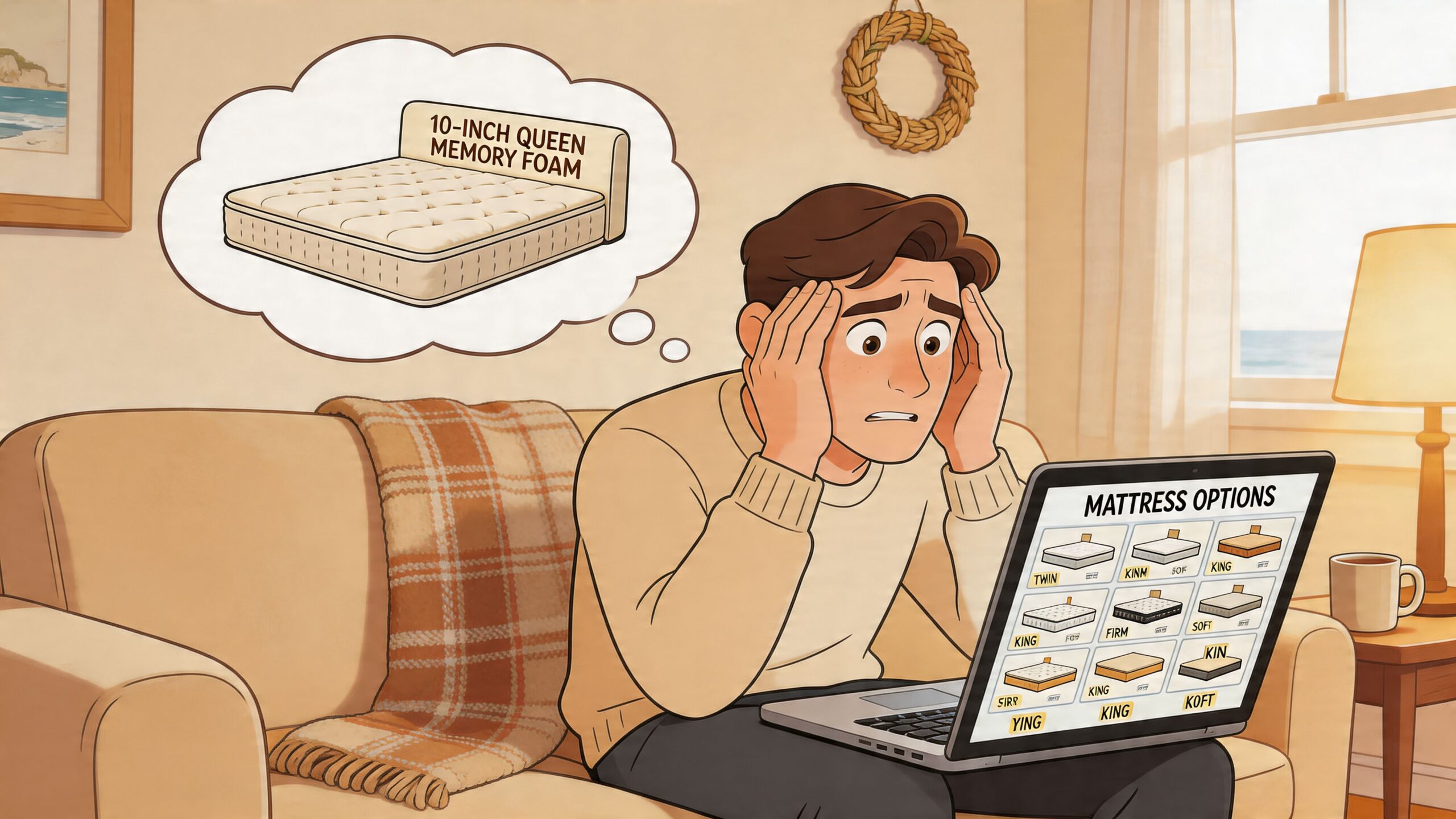
Shopping for a mattress can feel oddly exhausting. You start with one simple goal, sleep better, and within minutes you're staring at pages of foam types, firmness labels, cooling claims, and mattress heights that all sound important but don't always mean much in real life.
That confusion is common for homeowners and renters across Eastern Connecticut. A 10 inch queen memory foam mattress often ends up at the center of the search because it sits in a practical middle ground. It isn't the thinnest option, and it isn't the tallest, plushest profile either. For many people, that's exactly why it makes sense.
If you're trying to decide whether this mattress style fits your room, your body, and your budget, the key is to break the name into three simple parts. 10 inch tells you about thickness and support depth. Queen tells you about size and shared space. Memory foam tells you about the feel, contouring, and motion control. Once those pieces are clear, the whole category gets much easier to shop.
Your Guide to Today's Most Popular Mattress Choice
A lot of shoppers begin with the same question. Why does the 10 inch queen memory foam mattress show up everywhere?
The short answer is balance. According to Sleep Foundation's guide to mattress thickness, the standard thickness of 10 to 12 inches is adequate for most average-sized adults, and 10-inch models fall at the lower end of that optimal range. That helps explain why this profile has become such a common starting point for adult mattress shopping.
What the name actually tells you
A mattress description can sound technical, but this one is straightforward once you unpack it.
- 10 inch means thickness: This affects how much room the mattress has for comfort layers and support foam.
- Queen means size: A queen mattress gives two adults a practical amount of sleeping space without taking over the whole bedroom.
- Memory foam means feel: This material is known for contouring around the body and reducing motion transfer.
For many homes, that combination lands in a comfortable middle lane. It usually fits standard bedrooms well, works for solo sleepers or couples, and gives enough foam depth to feel supportive without becoming overly bulky.
Why 10 inches became the standard
Mattress construction has to do two jobs at once. The upper layers need to cushion pressure points, and the deeper layers need to hold the spine in a healthy position.
Sleep Foundation notes that most comfort layers measure 1 to 4 inches and that the support core should ideally make up at least 50% of total mattress thickness in a typical design, which is part of why this mattress buying guide often helps shoppers understand why 10 inches became such a practical standard. In plain language, a 10-inch mattress gives manufacturers enough room to build a mattress that feels comfortable without sacrificing the base support most adults need.
A good mattress description should answer one basic question. What will this feel like at 10 p.m. and again at 6 a.m. after a full night of sleep?
That is why this category has staying power. It isn't exciting because it's trendy. It's popular because for a large number of households, it covers the basics very well.
How Mattress Thickness Affects Your Sleep Quality
Thickness changes more than appearance. It affects how a mattress handles pressure, movement, edge stability, and long-term wear.
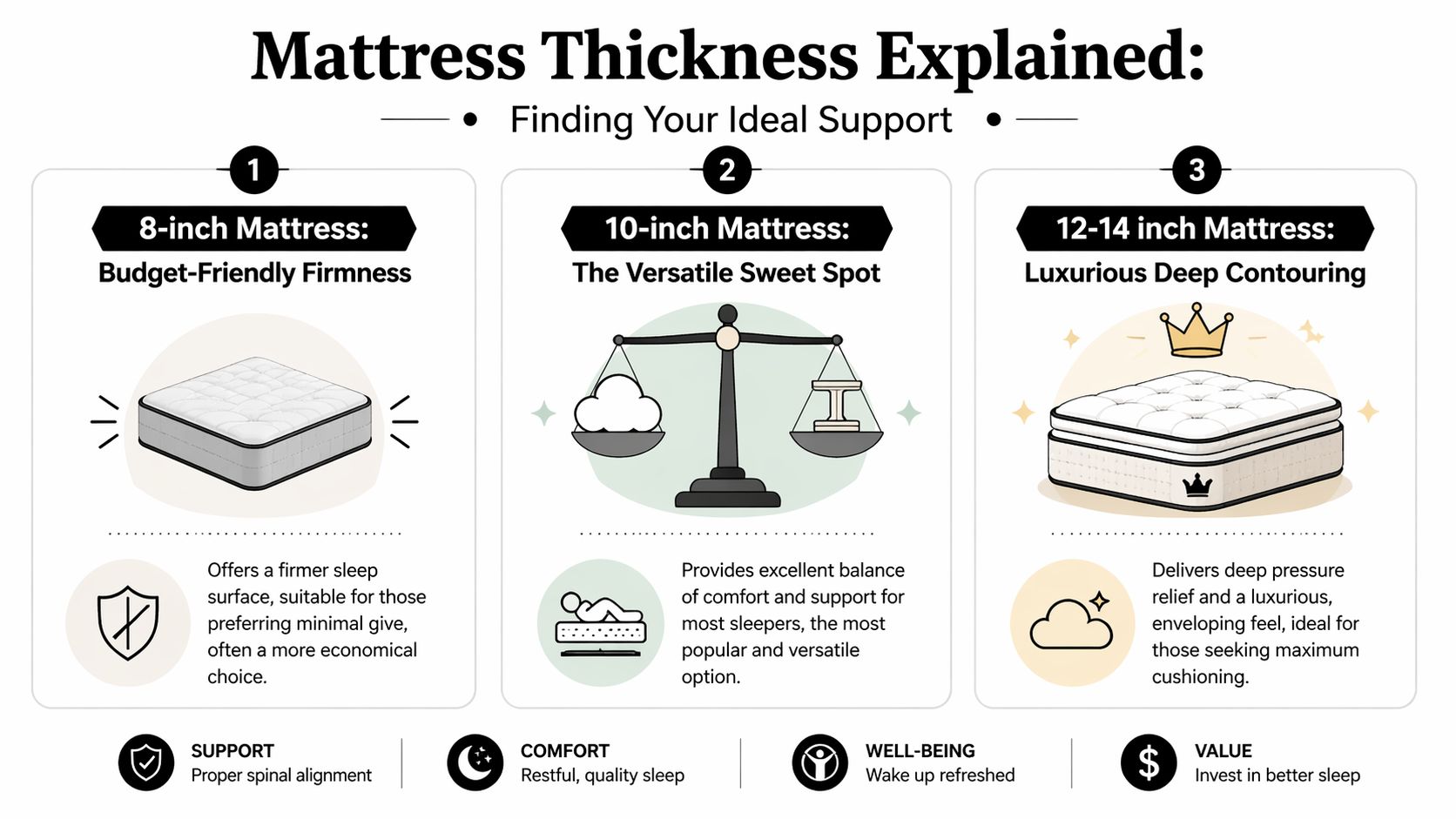
An 8-inch mattress can work in some settings, especially when someone wants a simpler, firmer feel or is furnishing a guest room. A 12-inch or taller mattress may feel fuller and more cushioned, which some shoppers love. But the 10 inch queen memory foam mattress often lands in the sweet spot because it balances support depth with a manageable profile.
What changes when you add thickness
According to this comparison of 8-inch and 10-inch mattresses, a 10-inch mattress provides superior edge support and motion isolation compared to thinner alternatives and is significantly less likely to sag at the edges over time than an 8-inch model. That matters in everyday life.
If you share a queen bed, motion isolation helps when one partner rolls over, gets up early, or comes to bed later. Better edge support matters when you sit on the side to put on socks, read before bed, or want to use more of the surface without feeling like you're drifting off the perimeter.
Mattress Thickness Comparison 8 inch vs 10 inch vs 12 inch plus
| Feature | 8-Inch Mattress (Slim Profile) | 10-Inch Mattress (Standard Profile) | 12-Inch+ Mattress (Plush Profile) |
|---|---|---|---|
| Overall feel | Firmer, simpler | Balanced comfort and support | Deeper cushioning and contouring |
| Best fit | Guest rooms, lighter use, shoppers who like less sink | Primary bedrooms, many average-sized adults, many couples | Shoppers wanting a taller, plusher feel |
| Edge support | More limited | Better edge stability than thinner options | Often more substantial feel, depending on design |
| Motion isolation | More basic | Better movement absorption than 8-inch options | Can feel highly cushioned, depending on layers |
| Bedroom profile | Lower height | Standard look that fits many rooms well | Taller look that may change bed height noticeably |
| Who may want more support | Heavier sleepers may outgrow it quickly | Works well for many, but not every body type | Often worth considering for shoppers needing deeper support cores |
Real-world trade-offs
The main point isn't that thicker is always better. It isn't. The right thickness depends on how the mattress feels under your body.
A 10-inch profile often works well because it gives enough depth for comfort foam on top and a solid support section underneath. That can help couples, restless sleepers, and anyone trying to improve sleep quality by reducing avoidable disruptions at night.
If your current mattress feels fine in the middle but weak at the sides, you're not imagining it. Edge performance changes how much of the bed you actually use.
For many bedrooms, the 10-inch profile is the most practical compromise. It usually feels more complete than a slim mattress without forcing you into the extra height and feel of a plush, thicker build.
Matching Your Mattress to Your Sleep Position and Body Type
The phrase "good for all sleeping positions" sounds reassuring, but it can also be misleading. A mattress doesn't feel the same to every person.
Sleeping position matters. Body type matters too. A 10 inch queen memory foam mattress may feel supportive and balanced for one sleeper, but too shallow or too firm for another.
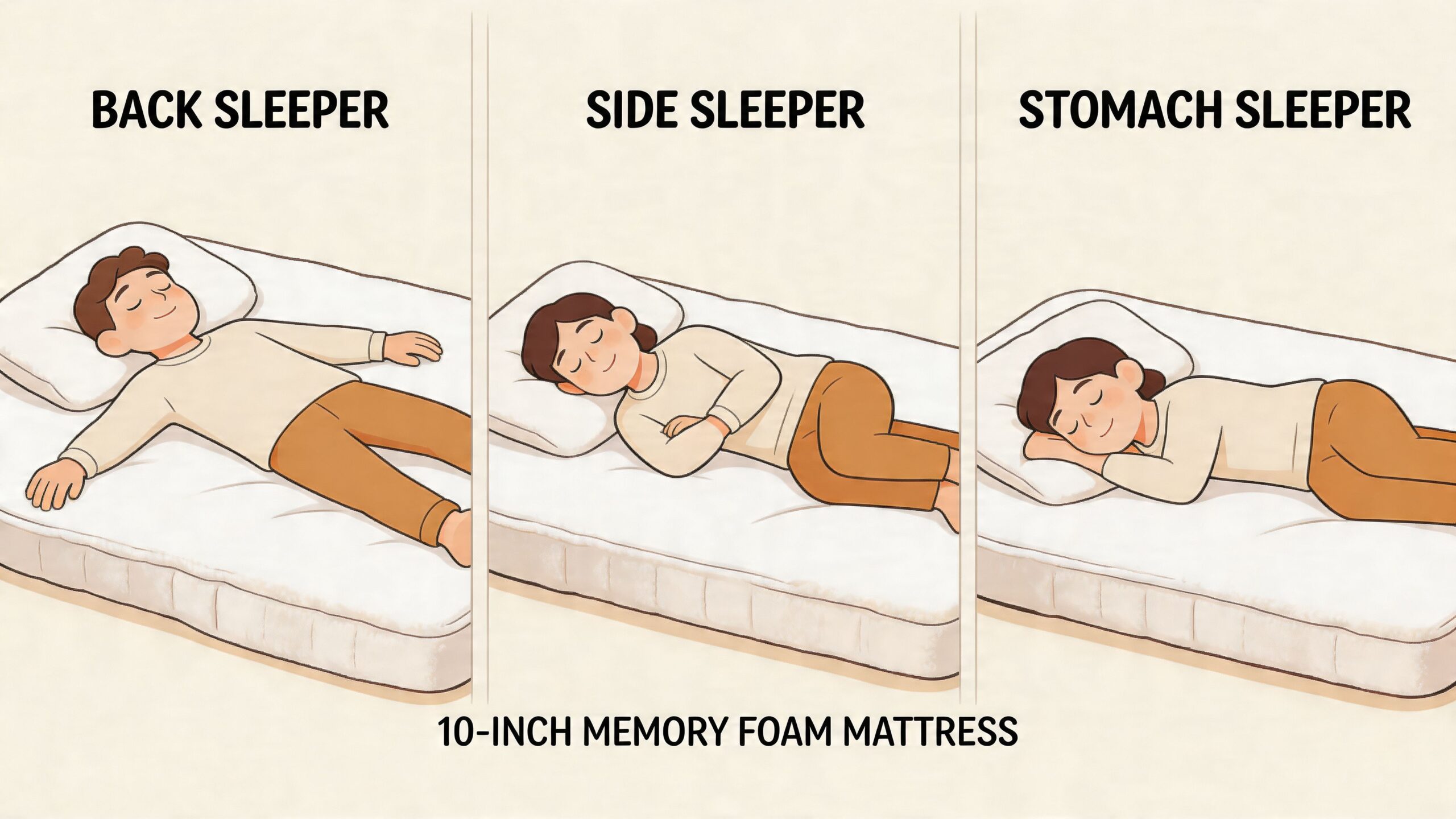
How different sleep positions interact with memory foam
Memory foam responds by contouring around pressure points. That can be helpful, but the amount of contouring you need depends on how you sleep.
Side sleepers usually notice pressure first at the shoulder and hip. If the top layer has enough give, a 10-inch foam mattress can feel relieving and stable.
Back sleepers often do well when the mattress supports the lower back without letting the hips sink too far. Many medium-firm to firm 10-inch foam designs feel comfortable here because the body stays more level.
Stomach sleepers usually need a flatter, steadier surface. Too much softness under the midsection can make alignment feel off. In this position, firmness matters even more than thickness alone.
Why body weight changes the feel
Many mattress guides stop too early. A mattress that feels medium-firm to one person can feel softer to someone heavier and firmer to someone lighter.
According to this guidance on choosing a mattress for your sleeping style, many retailers overstate universality. More specific guidance matters because, as noted in this discussion of mattress support for different body types, a 10-inch mattress with standard foam depth may not provide adequate spinal alignment for individuals over 230 to 250 pounds, and those sleepers often benefit from the thicker support cores found in 12-inch or 14-inch models.
That doesn't mean a 10-inch mattress is wrong. It means fit depends on who is using it.
A simple way to think about fit
- Lighter sleepers: You may experience a 10-inch memory foam mattress as firmer because you don't sink as much into the comfort layers.
- Average-sized sleepers: This is often where the 10-inch profile performs most predictably and comfortably.
- Heavier sleepers: You may compress the upper layers more fully, which can change alignment and increase wear over time.
A mattress should keep your body supported in your favorite sleep position, not just feel comfortable for the first two minutes in a showroom.
What couples should watch for
Two people can love the same mattress for different reasons. One might love the contouring. The other might care more about reduced motion. The challenge comes when body types differ a lot.
In that situation, look closely at these questions:
- Does the lighter sleeper feel enough cushioning?
- Does the heavier sleeper feel enough support through the hips and torso?
- Do both sleepers feel stable near the edge?
If the answer is no for either person, the issue may not be memory foam itself. It may mean that the 10-inch profile isn't deep enough for that pairing. That is a helpful thing to learn before you buy, not after.
Decoding Mattress Layers Firmness and Cooling Technology
Many shoppers hear terms like "support core," "firmness," or "gel memory foam" and feel like they need a translator. You don't. These features are easier to understand when you connect them to what your body feels on the bed.
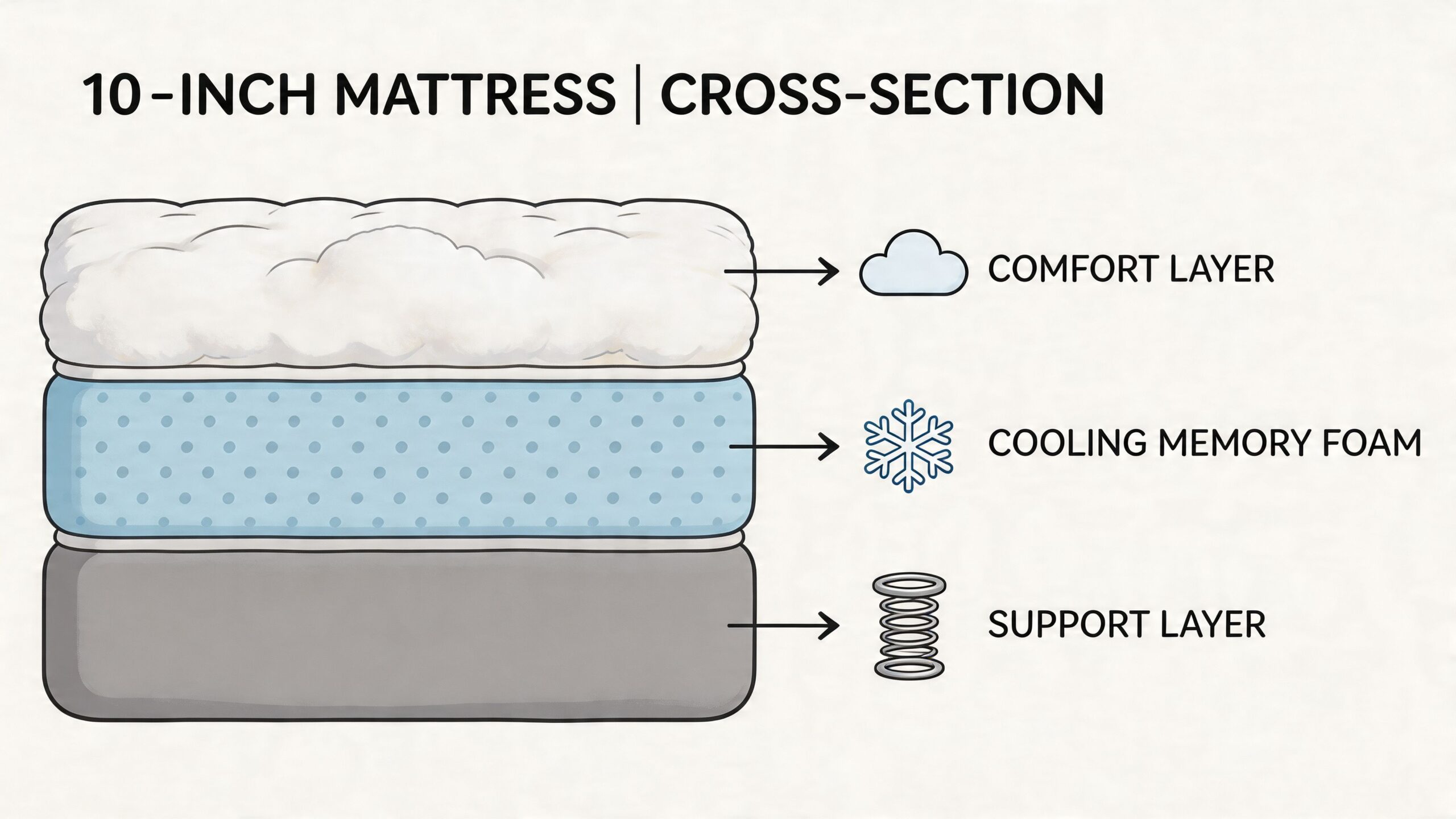
At its simplest, a memory foam mattress is a stack of layers with different jobs. The upper section shapes to your body. The lower section keeps you from sinking too far.
A common 10-inch construction
A practical example helps here. According to this explanation of a standard 10-inch memory foam build, a typical model such as the Ashley Furniture Chime uses a 1.5-inch top layer of memory foam over an 8.5-inch base of high-density firm support foam.
That arrangement tells you a lot about how the mattress is meant to feel.
- The top 1.5 inches create the first impression, providing contouring and pressure relief.
- The 8.5-inch base does the heavy lifting. It keeps the body supported and helps prevent that bottomed-out feeling.
If you've ever laid on a mattress that felt nice for a minute but unsupportive after a while, the support layer was probably the issue.
What firmness really means
Firmness labels can confuse people because they aren't perfectly standardized across brands. One company's medium-firm may feel firmer or softer than another's.
Still, the general idea is useful. A firmer 10-inch memory foam mattress often feels more level and supportive, especially for back or stomach sleepers. A softer one may feel more pressure-relieving at the shoulder and hip, which some side sleepers prefer.
The key is to stop thinking about firmness as a score and start thinking about body response.
Ask yourself:
- Do my hips sink more than my shoulders?
- Do I feel pressure building under one area?
- Can I change positions easily, or do I feel stuck?
Those answers matter more than a label on a tag.
Practical rule: The comfort layer should welcome your body. The support core should stop the sink before alignment disappears.
What density and support are doing behind the scenes
Foam density sounds technical, but the concept is simple. Denser foams generally feel more substantial and often hold up better over time. Support foam acts like the foundation under a house. You don't admire it much, but if it's weak, everything above it suffers.
That is why a 10-inch mattress can feel completely different from another 10-inch mattress. Two mattresses may share the same height, but if one uses stronger support foam and a better top layer, the experience can be much more stable and comfortable.
If you want a deeper explanation of the material itself, this overview of memory foam mattresses helps break down the feel and function without the industry jargon.
Cooling technology in plain language
Traditional memory foam can hold warmth. Many modern designs try to manage that with gel-infused memory foam.
According to Slumberland's description of 10-inch gel memory foam models, gel-infused foam is built to reduce the heat retention associated with traditional foam, and some examples use a 2.5-inch gel layer over support foams. In practice, that usually means a mattress that still contours but doesn't feel as warm as older all-foam designs.
Cooling features matter most for shoppers who already know they sleep warm. They may matter less if your room stays cool, you use breathable bedding, or you don't typically notice heat buildup at night.
A few terms worth remembering
- Memory foam: The contouring material near the top.
- Support foam: The denser base that keeps your spine in a better position.
- Gel infusion: A cooling-oriented feature used in some foam models.
- Firmness: Your overall feel of the mattress, not just one layer.
Once you understand those basics, mattress specs stop feeling mysterious. They become clues about comfort, support, and how the bed is likely to behave in your home.
Choosing the Right Foundation for Your New Mattress
A good mattress can underperform on the wrong base. This catches people off guard because the mattress gets most of the attention, but the foundation affects support, airflow, and long-term wear.
Memory foam needs an even, stable surface. If the base sags, flexes too much, or leaves unsupported gaps, the mattress can feel softer than intended and wear unevenly.
Foundation options that usually make sense
A platform bed is often a simple fit for a 10-inch foam mattress because it provides a broad, supportive surface. A solid foundation can also work well if it is designed for foam mattresses.
A slatted base may be suitable too, as long as the slats are supportive and not spaced too far apart. The main goal is consistent support across the mattress, especially through the center third where body weight tends to concentrate most.
Adjustable bases and everyday comfort
Many shoppers are surprised to learn that foam mattresses often pair well with adjustable bases. Because foam bends more easily than traditional innerspring builds, it can adapt well when the head or foot section lifts.
If you like to read in bed, raise your legs, or desire a sleep posture that better suits your needs, an adjustable bed base guide can help you understand what to look for before you buy.
The right base doesn't just hold the mattress up. It helps the mattress perform the way it was designed to perform.
A quick checklist before setup
- Check the support surface: Make sure the mattress will sit on a flat, stable base.
- Review the manufacturer's guidance: Warranty language often depends on proper support.
- Think about final bed height: A 10-inch mattress on a tall frame will feel very different getting in and out of bed than the same mattress on a low platform.
- Match the base to your habits: If you watch TV, read, or need easier entry and exit, the right base can improve daily comfort.
This part of mattress shopping isn't glamorous, but it matters. A well-chosen foundation protects the mattress and helps you feel the comfort you paid for.
Maximizing Your Mattress Lifespan and Investment
A mattress isn't just another household purchase. It affects how you sleep, how you feel in the morning, and how often you'll need to replace it. That is why durability deserves more attention than it usually gets.
A lot of mattress marketing focuses on first impressions. Plush top. Cooling feel. Convenient delivery. Those things matter, but long-term value matters too.
How long should a 10-inch memory foam mattress last
According to this discussion of mattress lifespan and value, a quality 10-inch memory foam mattress can last between 6 and 10 years, depending on foam density, sleeper weight, and proper maintenance.
That range is useful because it reflects real life. Mattress lifespan isn't just about brand reputation. It's also shaped by who sleeps on the mattress, whether the base provides even support, and how well the mattress is cared for over time.
Small habits that help a lot
You don't need a complicated maintenance routine. A few steady habits go a long way.
- Use a protector: Spills, sweat, and everyday moisture can wear on materials over time.
- Rotate when appropriate: Even wear helps the surface age more evenly.
- Keep the base supportive: A weak foundation can shorten the useful life of the mattress.
- Pay attention early: If a mattress starts feeling different in one area, don't ignore it.
If you want a practical care routine, these mattress maintenance and cleaning tips are a good place to start.
Think in terms of value, not just price
A mattress that supports you well and holds up over time is usually the better investment than one that only feels good on day one. This matters even more if the mattress is for your primary bedroom and gets nightly use.
For some households, stepping up to a better-built mattress can feel financially difficult in the moment. That is where Promotional Financing with equal monthly payments can make a healthier sleep setup more manageable, especially when you're comparing investment-grade options from brands such as Tempur-Pedic or Stearns & Foster.
A mattress becomes expensive when you replace it too soon, not only when you buy it.
When to rethink your choice
If your body type needs more support depth, or if you already know you put heavier wear on a mattress, it may be smarter to choose more support up front rather than hope a lighter build will hold up the same way. That isn't overspending. It's matching the product to the job.
A durable mattress should support both your sleep and your budget over time. That's the standard worth using.
Experience the Difference at the Gorins Sleep Gallery
Online mattress shopping can be useful for research, but it still has one major limitation. You can't feel a mattress through a screen.
That matters because memory foam is highly personal. One person calls it supportive. Another says it feels too firm. A third says it feels just right after five minutes but too warm after twenty. Those are not contradictions. They are reminders that comfort is physical, not theoretical.
Why in-person testing changes the decision
In a showroom, you can learn more in a short visit than you often can from hours of scrolling. You can compare a 10 inch queen memory foam mattress against other profiles, test whether the edge feels secure, and notice whether you enjoy the contouring feel or prefer something more buoyant.
At the Sleep Gallery, that experience centers on comfort by feel. You can lie down on trusted brands such as Tempur-Pedic, Serta, and Beautyrest and see how different constructions respond to your body instead of relying on generic online labels.
What to test when you're on the bed
A lot of shoppers lie down for ten seconds and sit right back up. That usually isn't enough.
Try this instead:
- Stay in your normal sleep position for a few minutes: Side, back, or stomach.
- Roll toward the edge: Notice whether you still feel supported.
- Change positions slowly: Memory foam should contour, but you shouldn't feel trapped.
- Pay attention to your lower back and shoulders: Those areas often tell the truth first.
If you're shopping as a couple, both people should test the mattress together when possible. A queen mattress has shared space, shared movement, and shared trade-offs.
The local advantage matters
A pressure-free showroom experience is especially helpful when the choice isn't obvious. Some people walk in convinced they want all-foam and discover they prefer a hybrid or innerspring. Others assume they need a very thick mattress and realize a 10-inch profile feels better balanced for their body.
That kind of discovery is easier with knowledgeable guidance and side-by-side testing. It is also easier when you're dealing with a local team that serves Norwich, New London, Plainfield, Waterford, and surrounding Eastern CT and Rhode Island communities, rather than a distant chat box.
More than a mattress department
For many households, sleep shopping overlaps with bedroom planning. Bed height, frame style, and room scale all matter. The same trip may spark ideas for the rest of the home too, from custom dining through Canadel to customized seating in the F9 Custom Sofa series, where thousands of combinations make it easier to shape a room around real life instead of settling for one-size-fits-all furniture.
And when it is time for delivery, 5-Star Delivery service adds peace of mind. A mattress is easier to enjoy when the process around it feels organized and respectful.
The best mattress test is simple. Lie down long enough to notice what your body stops worrying about.
That is what in-person shopping does well. It turns mattress specs into lived experience.
Common Questions and Your Next Step to Better Sleep
For many shoppers, the 10 inch queen memory foam mattress is a smart place to begin because it blends a standard adult thickness with a practical queen size and the pressure-relieving feel of memory foam. It isn't perfect for every sleeper, but it often fits a wide range of bedrooms, budgets, and comfort preferences.
The most confident mattress decisions usually come from matching the feel to the person. If the mattress supports your body well, fits your room, and aligns with how you sleep, you're on the right track.
Common questions shoppers ask
Do I need a box spring with a memory foam mattress
Usually, what you need is proper support, not necessarily a traditional box spring. Many memory foam mattresses work best on a platform, solid foundation, supportive slat system, or adjustable base approved for foam use.
How long does a new mattress take to feel normal
Expect a little adjustment time. Your body is adapting to a new sleep surface, and the mattress materials are also settling into regular use. If the comfort feels close but not perfect on night one, that doesn't always mean it is the wrong mattress.
What is the new mattress smell
New foam mattresses can have a temporary odor after unpacking, especially if they arrived compressed in a box. This usually fades with ventilation and time. Opening windows and letting the room air out can help.
Is a 10-inch mattress thick enough for every adult
No. It works well for many average-sized adults, but not all. Some heavier sleepers may do better with thicker support cores, especially if long-term alignment and durability are top concerns.
A simple final checklist
Before you choose, ask yourself these questions:
- Does the mattress support my main sleep position well?
- If I share the bed, does it control motion enough for both of us?
- Does the edge feel usable, not flimsy?
- Will the foundation underneath support it properly?
- Am I buying for short-term convenience or long-term sleep quality?
If you can answer those clearly, mattress shopping gets much less intimidating.
Since 1936, Gorins Furniture & Mattress has helped Norwich and Eastern CT families create homes they love. From custom-designed Canadel dining sets to the latest in Tempur-Pedic sleep technology, they combine a massive selection with the personalized care only a local, family-owned business can provide. Visit the Norwich showroom to test mattresses in person, take the online Style Quiz for personalized guidance, or browse the Clearance section for value-driven savings backed by helpful service and 5-Star Delivery.