Signs You Need a New Mattress: A Local CT Guide

Some mornings tell the truth faster than any mattress label ever will. You get out of bed, stretch, and your back argues with you before your feet hit the floor. You slept for plenty of hours, but you still feel worn down.
A lot of people assume that’s just age, stress, or “sleeping funny.” Sometimes it is. But sometimes your bed is the problem.
A mattress isn’t just another piece of bedroom furniture. It’s the surface holding your spine, shoulders, hips, and joints in one position for hours at a time. When that surface starts failing, your body usually notices before your eyes do.
For families around Norwich and across Eastern CT, that question comes up all the time. Is it me, or is it my mattress? The good news is that there are clear signs you need a new mattress, and most of them are easy to check at home.
Is Your Bed Betraying Your Sleep
One of the most common stories goes like this. You wake up tired, your neck feels tight, your lower back complains, and by midmorning you feel a little better. Then the same thing happens again the next day.
That pattern matters.
If you’ve noticed you’re regularly waking up stiff, it’s worth looking at your sleep surface before blaming your body alone. A mattress that no longer supports you evenly can put your spine in an awkward position for hours at a time, and the result often shows up first thing in the morning.
Many sleepers also notice a mental side to poor rest. You feel more irritable, less focused, and harder to recharge. If that sounds familiar, this look at how your mattress affects your mood and mental health is a useful next read.
A mattress problem often hides in plain sight
People get used to gradual decline. That’s what makes old mattresses tricky. If your bed got uncomfortable overnight, you’d replace it right away. But when support fades bit by bit, many people adapt to the problem and stop questioning it.
A few everyday examples should sound familiar:
- You sleep better in a hotel or guest room. Your body relaxes on a different surface.
- You start the day sore, then loosen up later. That points to overnight positioning.
- You keep adjusting your pillow. Sometimes the pillow isn’t the issue. The mattress underneath it is changing your alignment.
Your body can adapt to a bad mattress for a while. It usually can’t thrive on one.
That’s why the smartest approach is simple. Check what you can see, notice what your body is telling you, and compare both against the age of the mattress. When those three things line up, the answer gets much clearer.
The Visible Clues Your Mattress Is Worn Out
Your mattress leaves evidence. You just need a simple way to read it.

Use the string test for sagging
Take a piece of string, yarn, or a straight cord and pull it tightly across the mattress from one side to the other. Lay it across the area where you sleep most often. Then use a ruler or tape measure to check the gap between the string and the mattress surface.
This gives you a clearer picture than just eyeballing a dip.
A slight body impression can happen with normal use, especially in softer comfort layers. The concern starts when the dip is deep enough to affect support and posture. Industry standards define structural mattress failure at 4-6 inches of sinkage, and a simple fist-in-the-dip check can help confirm when support foam has collapsed, according to Tyner Furniture’s explanation of mattress sinkage standards and the fist test.
Try the fist test in problem areas
If you already know where the sag is, stand beside the bed and press your fist into the dip.
Use this as a practical guide:
- If your fist meets resistance quickly, the comfort layer may be soft but not fully broken down.
- If your fist fits easily into the depression, the core support is likely failing.
- If one side feels very different from the other, uneven wear has set in.
This is especially useful for couples, since one side often breaks down faster than the other.
Practical rule: If the mattress feels less flat than it looks, trust what you feel. Internal breakdown often shows up in support before the cover makes it obvious.
Look for lumps, ridges, and edge collapse
Sagging gets the most attention, but it isn’t the only warning sign. Run your hand across the mattress with the sheets off. Feel for raised spots, bunched material, or ridges that weren’t there when the bed was newer.
Those changes usually mean the inner layers have shifted or compressed unevenly. Common clues include:
- Lumps near the center or shoulders that create pressure points
- A raised ridge between sleepers that pushes each person outward
- Edges that cave in when you sit down, making the mattress harder to enter or exit
If you can feel springs, hard spots, or empty areas beneath the top fabric, the inside materials aren’t doing their job anymore.
Don’t ignore sounds and movement
Noise matters too. A mattress or foundation that squeaks, creaks, or groans every time you roll over is telling you something. While the sound can come from the frame, it can also signal worn coils or internal shifting.
Here’s a quick at-home visual check:
| What you notice | What it often means |
|---|---|
| Dip where you sleep most | Support layers have compressed |
| Lumps or uneven texture | Fill or foam has shifted |
| Edges collapse when seated | Perimeter support is weakening |
| Springs felt through top | Comfort layers are worn out |
| Persistent squeaking | Coils, support core, or frame may be failing |
Visible wear doesn’t always appear all at once. But when the surface looks uneven and the bed feels uneven, those are strong signs you need a new mattress.
How Your Body Signals Its Time for a Change
Sometimes the mattress looks acceptable, but your body has already filed the complaint.
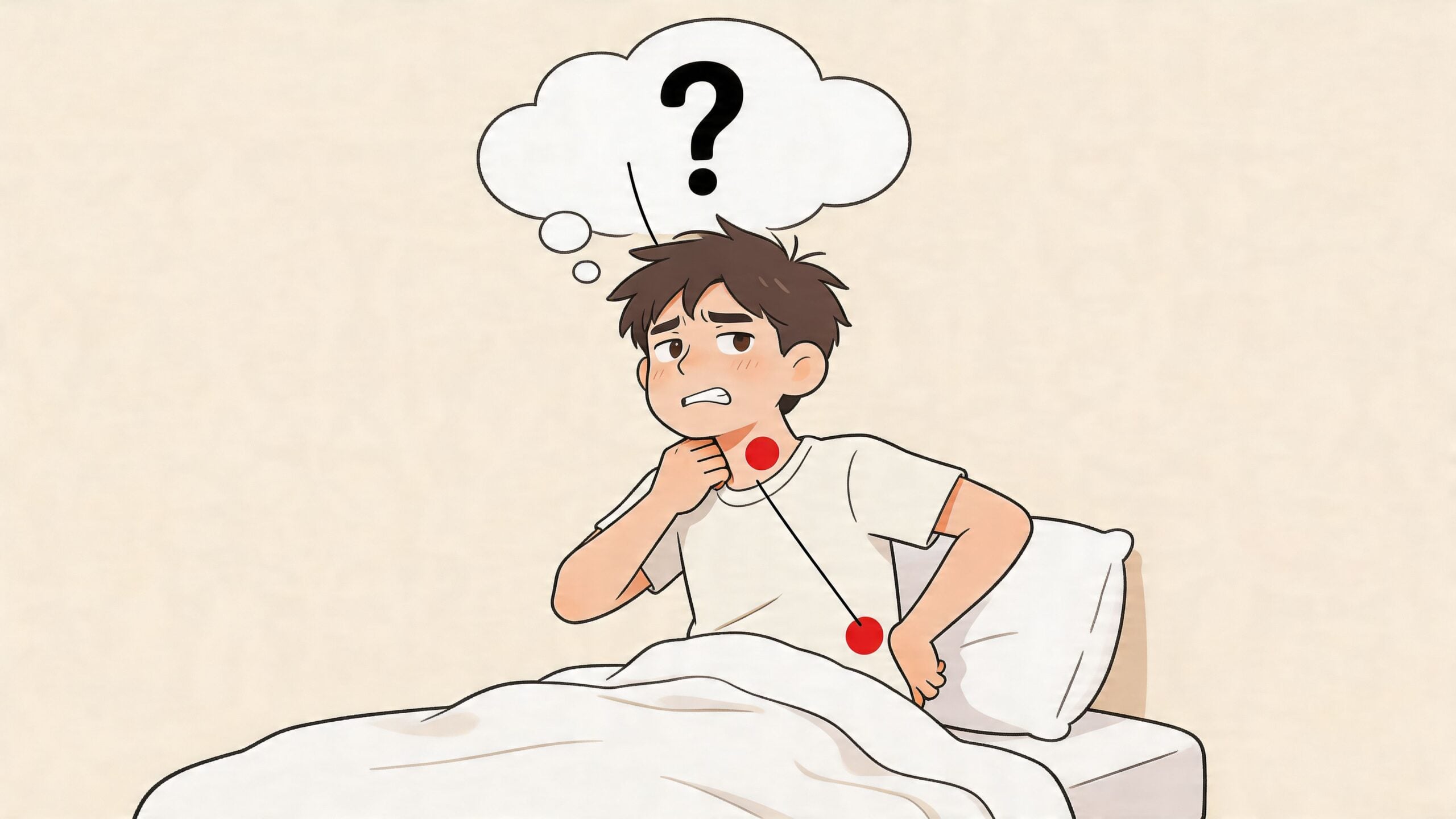
Morning pain is one of the biggest clues
If you wake up with new aches, stiffness, or soreness, especially in your back, neck, shoulders, or hips, pay attention. WebMD identifies this as a primary sign of a failing mattress, noting that older beds stop supporting the spine’s natural curve. The same source also notes that tossing and turning can increase by 25-50% on unsupportive surfaces in its guide to signs it’s time to replace your mattress.
That matters because tossing and turning usually isn’t random. Your body is trying to escape pressure.
A few examples:
- Side sleepers often feel shoulder and hip soreness first.
- Back sleepers may notice tightness in the lower back.
- Stomach sleepers can wake up with a strained neck or pinched feeling through the midsection.
If the discomfort fades once you get moving, that can be another clue that your sleep position, not just daytime activity, is part of the problem.
Poor sleep quality isn’t always about stress
A worn mattress can make sleep lighter and more fragmented. You may not fully wake up, but you shift more, adjust your position more often, and spend less time settled.
That’s one reason people say things like “I slept all night, but I don’t feel restored.” Support layers that have softened too much can no longer hold the heavier parts of the body in line with the lighter ones. That leaves muscles working overnight when they should be recovering.
If pain is part of your sleep story, this guide on helping back pain with the right mattress can help you think through what support feels like.
If you dread the first few steps out of bed but feel better as the day goes on, your mattress deserves a close look.
Allergies and partner disturbance can point to mattress age
Not every sign is pain. Sometimes the complaint is a stuffy nose, more sneezing, or respiratory irritation at night. Older mattresses can collect dust, skin cells, and other irritants over time, so some people notice worsening dust allergies even if they haven’t changed anything else in the room.
Couples often notice another issue first. One person turns, gets up, or shifts, and the other wakes too. That usually means the materials that once absorbed movement have weakened.
Watch for this combination of body-based signs:
- You wake sore in the same places repeatedly
- You sleep hot or restless for no clear reason
- Your partner’s movement wakes you more often
- Your nose or throat feels worse overnight than during the day
When your body keeps sending the same signals, it’s usually worth listening.
Understanding the Official Lifespan of a Mattress
A mattress can look decent and still be past its healthy working life. That’s why age matters so much.
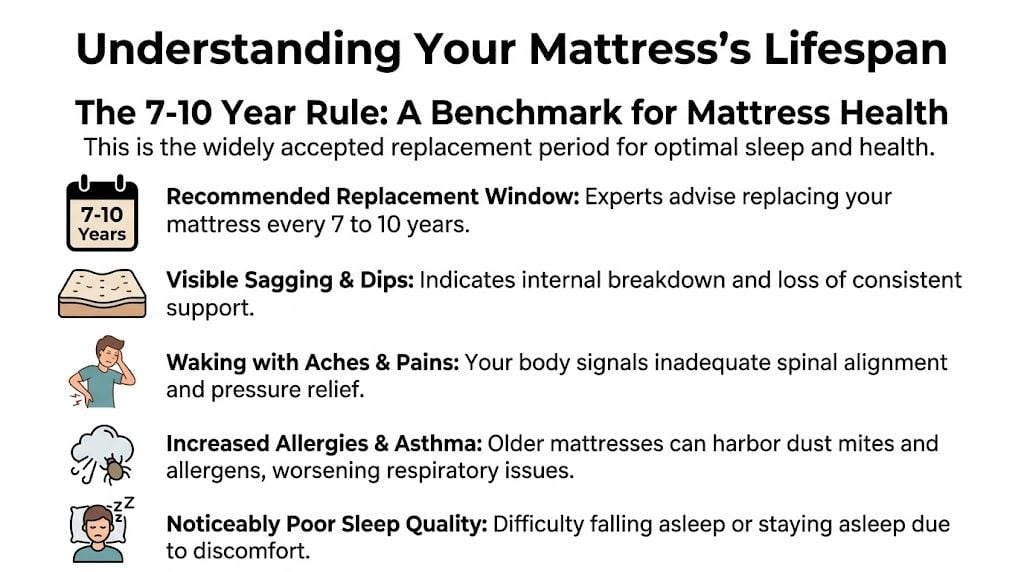
The 7 to 10 year rule is the benchmark
Most mattresses have a finite lifespan of 7-10 years, and that replacement window is widely endorsed because foam, coils, and padding naturally break down over time. A National Sleep Foundation survey referenced by Naturepedic found that 75% of people keep mattresses over 9 years, which correlates with a 20-30% increase in reported chronic back pain, as summarized in this article on when to replace a mattress.
That doesn’t mean every mattress fails on the same birthday. It means that once you’re in that age range, the burden of proof changes. Instead of asking, “Why replace it?” the better question is, “Is it still supporting me the way it should?”
For a fuller look at materials and durability, this article on how long a mattress should last is helpful.
Why age matters even without obvious damage
This is the part many people find confusing. They expect a mattress to fail dramatically. Springs poking out. A giant crater in the center. A visible tear.
That can happen, but most wear is quieter. Foam loses resilience. Coils stop pushing back evenly. Quilted tops flatten. The bed can still look tidy while providing much less support than it once did.
A simple checklist helps:
- Check the law tag or manufacturing tag if you can’t remember when you bought it.
- Think about life changes like a move, a new partner, or a different sleeping style.
- Notice whether the mattress feels older than it looks. That’s common.
An old mattress doesn’t need to look ruined to stop being healthy.
A practical way to use the age rule
Use age as a filter, not the only test.
If your mattress is under the benchmark and still feels supportive, you may just need maintenance or a comfort adjustment. If it’s within or beyond 7-10 years and you’re seeing body symptoms or visible wear, the answer gets much simpler.
That’s what makes the lifespan rule useful. It keeps people from normalizing a bed that has slowly stopped doing its job.
Can You Save Your Mattress with a Topper or Rotation
Many shoppers hesitate, which is reasonable. A topper costs less than a mattress. Rotating feels smart. Cleaning helps. Sometimes those steps buy you time.
But they don’t all solve the same problem.
A topper can soften the surface, not rebuild support
If your mattress feels a bit firm or the quilting has flattened, a topper can improve comfort. It adds cushioning between your body and the sleep surface.
What it can’t do is rebuild a broken support core.
If the mattress has a dip, a hammock effect, or collapsing edges, the topper usually follows that shape. You may feel a little plusher for a few weeks, but your spine is still resting on a compromised foundation.
A simple comparison helps:
| Fix | What it can help with | What it can’t fix |
|---|---|---|
| Mattress topper | Surface comfort, minor firmness issues | Deep sagging, support failure |
| Rotation | More even wear over time | Existing structural breakdown |
| Cleaning | Odors, surface hygiene, maintenance | Pain caused by poor support |
Rotation helps early, not late
Rotation is one of the better maintenance habits, especially if you tend to sleep in the same spot every night. Turning the mattress head-to-foot can spread wear more evenly.
That said, rotation works best before the mattress starts failing. Once a deep body impression forms, rotating it just moves the problem.
Many modern mattresses also aren’t designed to be flipped, which confuses a lot of people. A number of current models from brands such as Serta and Beautyrest have layered constructions with a dedicated top and bottom. Rotation may still be appropriate, but flipping often isn’t.
If you want to stretch the life of a mattress that’s still in decent shape, these mattress maintenance and cleaning tips to extend its lifespan are a good place to start.
Cleaning matters, but it won’t fix a tired bed
A clean mattress usually feels fresher and more comfortable. Vacuuming, airing it out, and spot-treating stains can all help. If you want a practical refresher, this guide on how to clean a mattress like a pro covers the basics well.
Use this rule of thumb:
- Keep it if the mattress is fairly young, still level, and the issue is mostly comfort or cleanliness.
- Replace it if support is failing, pain is recurring, or the bed has reached the age range discussed earlier.
A topper is a comfort tool. It isn’t a structural repair.
That distinction saves people a lot of frustration.
Your Guide to Finding a Healthier Sleep Solution in Norwich
Once you’ve confirmed the signs you need a new mattress, the next step is testing what feels better for your body. That part matters more than commonly realized.

Start with your sleep pattern, not the brand name
Brand matters, but your body matters more. Before you test anything, think about three things:
Your main sleep position
Side sleepers usually need enough pressure relief at the shoulders and hips. Back sleepers often need balanced lumbar support. Stomach sleepers usually do better with a surface that keeps the midsection from sinking too far.Your biggest complaint
Is it heat? Partner movement? Shoulder pressure? Lower back strain? A mattress should solve a real problem, not just feel nice for thirty seconds.Your comfort preference
Some people like the slow, contouring feel of Tempur-Pedic. Others prefer a more buoyant hybrid or innerspring feel from lines like Beautyrest or Serta.
If you want a practical framework before visiting a showroom, this guide on how to choose a mattress can help you narrow the field.
Test a mattress the right way
A quick sit on the edge doesn’t tell you much. Lie down in your normal sleep position and stay there for a few minutes. If you share a bed, test movement together.
Look for these responses from your body:
- Your shoulders should relax, not feel jammed upward.
- Your hips shouldn’t sink too far below the rest of your body.
- Your lower back should feel supported, not pushed up or left hanging.
- You shouldn’t feel compelled to keep adjusting every few seconds.
This is especially important because older beds often create sleep problems through material breakdown. Over time, foams can restrict airflow by up to 60%, raising surface temperature, while old innersprings can increase motion transfer by 30%, disrupting sleep, especially for couples, according to Harding’s Furniture’s overview of how aging mattresses affect sleep quality.
Focus on fit, support, and long-term value
Good mattress shopping is less about chasing trends and more about matching construction to your real life.
Here’s a grounded way to compare options:
- If you sleep hot, ask about breathable materials and cooling covers.
- If you share the bed, test motion isolation carefully.
- If pain is the issue, pay attention to alignment first and plushness second.
- If you want investment-grade quality, look at how the mattress supports the body over time, not just how soft it feels at first touch.
A quality replacement should make bedtime feel easier, not more complicated. The best choice usually feels stable, comfortable, and unsurprising. Your body settles instead of negotiating.
For many local shoppers, that’s why an in-person test matters. You can compare feel side by side, ask questions in plain language, and make a decision based on what your body responds to.
Invest in Rest and Reclaim Your Day
A failing mattress usually doesn’t announce itself with one dramatic moment. It shows up through patterns. Morning soreness. Uneven support. Poor sleep quality. A bed that looked fine a few years ago but doesn’t feel right anymore.
That’s why the smartest approach is simple and practical. Check the surface. Notice your body. Confirm the age. Those three steps catch most mattress problems before you spend another season sleeping on something that’s working against you.
For homeowners and renters across Norwich, Plainfield, New London, Waterford, and nearby Rhode Island communities, better sleep often starts with one honest question. Does your mattress still support the life you’re living now?
If the answer is no, replacing it isn’t a luxury. It’s a health decision. A good mattress supports your back, improves comfort, reduces nightly disruption, and helps you wake up more like yourself.
Since 1936, local families have looked for quality, value, and helpful guidance when making important home decisions. The same mindset applies here. Choose a mattress the way you’d choose any investment-grade part of your home. Carefully, practically, and with your daily well-being in mind.
Since 1936, Gorins Furniture & Mattress has helped Norwich and Eastern CT families create homes they love. If you’re noticing signs you need a new mattress, visit the Norwich showroom to try top sleep brands by feel and get low-pressure guidance suited to your lifestyle. You can also take the online Style Quiz for personalized ideas or browse the Clearance section for value-driven savings.