What Is a Power Recliner? A Norwich Expert’s Guide


You get home, kick off your shoes, and look for that one seat that tells your whole body the day is over. Maybe you want to read, maybe you want to watch a game, maybe your back just wants a break. That’s usually the moment people start asking what is a power recliner, and whether it’s really different from the recliners they grew up with.
For many of our neighbors in Norwich and across Eastern CT, the question isn’t just about comfort. It’s about ease. It’s about whether a chair can support tired legs, help you settle in without wrestling a footrest, and still look right in the room you’ve worked hard to furnish well.
The Modern Evolution of Home Comfort
Since 1936, Gorins has helped local families furnish homes in a way that feels personal, practical, and built to last. That long view matters with reclining furniture, because this category has changed a lot. What used to feel bulky or overly mechanical now fits much more naturally into everyday living rooms, family rooms, and reading corners.

A power recliner is part of that shift. Instead of using body weight or a side lever to move the chair, you press a button and let the chair do the work. That sounds simple, but in real life it changes the whole experience. Someone with sore knees doesn’t have to push hard to close the footrest. Someone settling in for a movie doesn’t have to choose between fully upright and fully back. The chair adjusts more gradually and more precisely.
That helps explain why power recliners have become such a large part of the category. Power recliners accounted for over 60% of the global market share as of 2020, and the overall recliners market was valued at about USD 4.2 billion in 2024, with a projection of USD 6.4 billion by 2033 according to Data Horizzon Research on the recliners market.
Why this matters in real homes
A lot of furniture trends come and go because they photograph well. Power recliners have grown because they solve ordinary problems.
- Less effort: You don’t have to brace, pull, or kick to find a comfortable position.
- More useful comfort: Small adjustments matter when you’re reading, napping, or watching TV.
- Wider appeal: They’re not just for one age group or one decorating style anymore.
A good power recliner doesn’t just lean back. It helps the room work better for the way you actually live in it.
The comfort upgrade people feel right away
It's similar to moving from a manual car window to a power window. Both technically do the same job. One just does it with less strain and much more control.
That’s why people often start by asking about a chair, then end up talking about daily routines. Where will it go? Who will use it most? Does that person read with glasses on, nap in the afternoon, or need their legs raised after a long day? A power recliner sits right at that intersection of furniture, comfort, and long-term use.
How a Power Recliner Actually Works
A power recliner is a chair with an electric motor that moves the reclining parts for you. Instead of relying on a lever and your body weight, the chair uses a powered system of gears and linkages to change positions in a smooth, controlled way.
The easiest analogy is one commonly understood. A manual recliner is like a manual window crank. A power recliner is like a power window. You still control it, but the mechanism handles the heavy lifting.
The basic parts inside the chair
Here’s the simple version of what’s happening when you press the button:
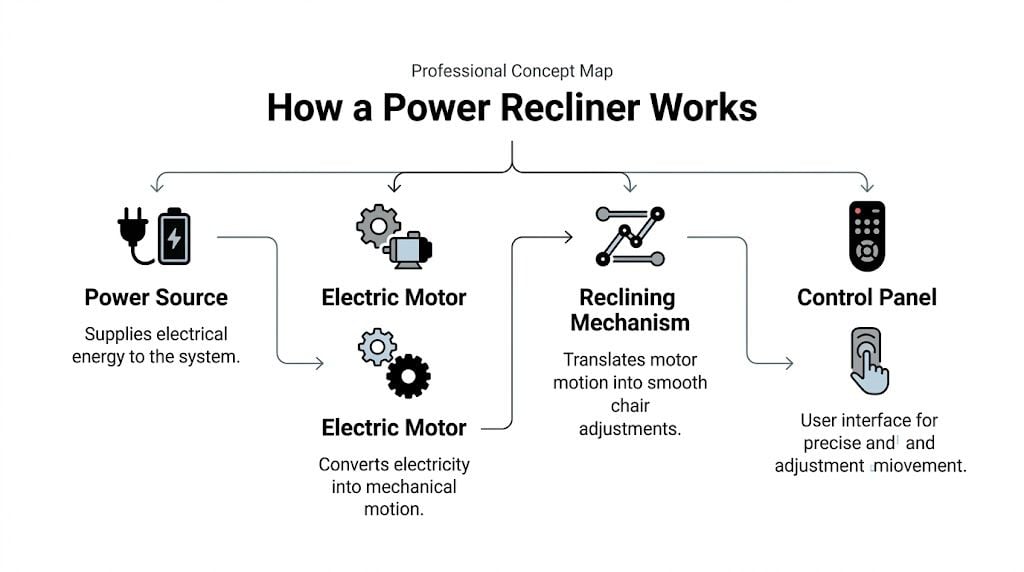
- Power source: The chair plugs into household electricity.
- Motor: The motor turns electrical energy into movement.
- Gears and levers: These guide the chair through its reclining motion.
- Controls: Usually buttons on the arm, though some models may use a remote.
When people hear “motorized chair,” they sometimes imagine something complicated or fragile. In practice, the concept is pretty straightforward. You press a button, the motor engages, and the chair moves in a controlled sequence.
What the motion feels like
Most power recliners don’t drop backward suddenly. They move in a gradual, measured way. That’s one reason many people find them easier to use than a traditional recliner. You can stop when the angle feels right instead of settling for the nearest preset position.
According to this breakdown of how electric recliner chairs work, a power recliner uses an electric motor to drive gears and levers for precise adjustment. That same source explains the difference between single-motor and dual-motor systems, which is where many shoppers get confused.
Practical rule: If you want simple one-touch comfort, a single-motor chair may be enough. If you want to fine-tune your posture, dual-motor control is usually worth a closer look.
Single motor and dual motor
A single-motor recliner moves the backrest and footrest together. Press the control, and both sections work as one coordinated motion. For many people, that’s perfectly comfortable and easy to use.
A dual-motor recliner separates those movements. You can raise your feet without reclining as far back, or lean back more without changing your leg position in the same way. That kind of independent adjustment can matter a lot for someone who wants a specific seated posture.
Here’s a plain-language explanation:
- Single motor: One switch controls one main reclining pattern.
- Dual motor: You get more room to customize your sitting position.
People who are also researching mobility seating often find it helpful to compare this mechanism with lift technology. This guide on how lift chairs work can help clarify where the overlap ends and where the functions are different.
Why the mechanics matter to comfort
The technology only matters if it improves everyday use. In a good power recliner, the mechanism should feel smooth, quiet, and predictable. You shouldn’t feel like you’re fighting the chair. You should feel like the chair is responding to you.
That’s the answer to what is a power recliner. It’s not just a recliner with a plug. It’s a seating system designed to give you more control over how you rest.
Key Features That Define Modern Comfort
Once you understand the motor, the next question is usually what else comes with it. Modern power recliners often include features that sound technical on paper but make very practical differences once you sit down.
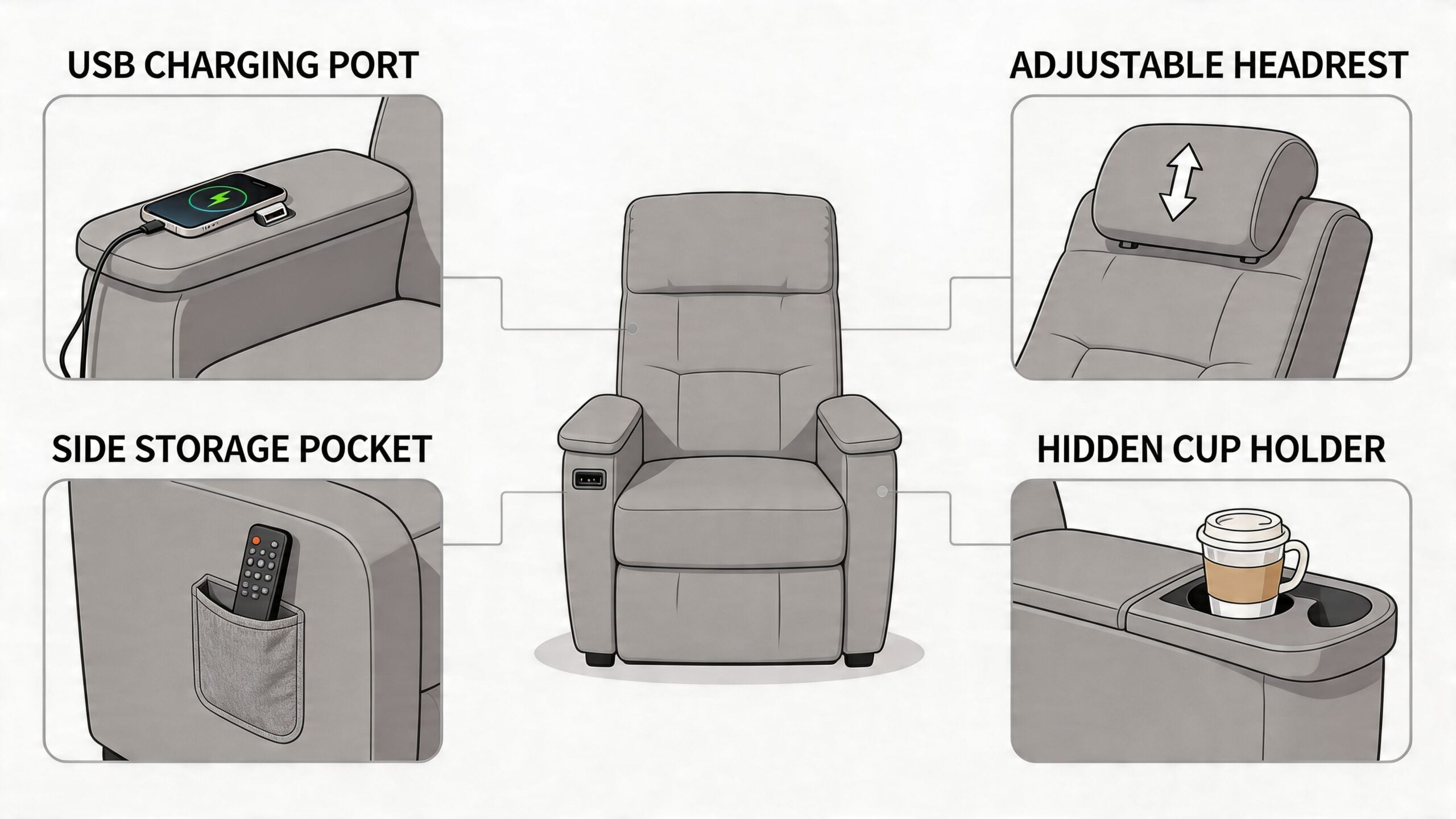
Features that change daily use
Power headrests: These let you adjust the top portion of the chair so your head and neck feel supported while you read or watch TV. Instead of stuffing a pillow behind your shoulders, you can bring the support to you.
Power lumbar support: This feature helps fine-tune lower back comfort. For someone who spends a lot of time seated, that extra adjustment can make a chair feel more customized instead of merely soft.
USB charging ports: It sounds small until you use it. If your chair becomes your regular evening seat, having a place to charge a phone or tablet keeps cords from stretching across the room.
Heat and massage functions: Some people love these. Others skip them. The important part is knowing they’re comfort extras, not the main reason to choose a chair. If you enjoy gentle warmth or a soothing seated experience, they can be a nice addition.
Zero-gravity positioning: This term can sound more dramatic than it needs to. In plain language, it refers to a posture that raises the legs and redistributes pressure in a way many people find very relaxing. If you want a clearer explanation, this article on unlocking zero gravity gives a useful overview.
Features that affect how the chair fits your room
Not every feature is about your body. Some are about how the chair behaves in the space.
- Wall-saver designs: Helpful when the chair needs to live in a tighter room.
- Swivel or gliding bases: Good for people who want a chair that feels more active and conversational.
- Hidden controls: Useful when you want the chair to blend in visually rather than announce itself as motion furniture.
If a feature doesn’t improve the way you sit, reach, read, recharge, or relax, it’s probably not a must-have for your home.
What shoppers often get wrong
Many people focus only on the recline button and miss the support features. That’s like shopping for a mattress based only on how soft it feels for the first minute. The better question is how the chair supports you after an hour.
A power headrest matters if you watch television with progressive lenses. Lumbar support matters if your lower back gets tired. A USB port matters if this chair is replacing your old “favorite spot” in the house. The right feature set depends less on trend and more on your routine.
That’s also why in-person testing matters so much with lines like Flexsteel and BarcaLounger. Two chairs can look similar online and feel completely different once you adjust the headrest, settle into the seat, and hold a position for more than a few seconds.
Power Recliners vs Manual Recliners and Lift Chairs
Not every reclining chair solves the same problem. Some shoppers want simple comfort. Others want easier movement in and out of the seat. That’s why it helps to separate three categories: power recliners, manual recliners, and lift chairs.
The move toward electric recliners started in the mid-1900s, bringing push-button comfort into more homes. That shift made adjustable seating easier to use, and these chairs are also associated with benefits like reduced back pain and improved circulation. The same source notes that North America, especially the USA, leads the world in recliner sales in this history of electric recliners in American homes.
Power recliner and manual recliner compared
| Feature | Power Recliner | Manual Recliner |
|---|---|---|
| Ease of use | Adjusts by button | Adjusts by lever or body pressure |
| Position control | More precise, easier to stop where you like | More limited feel |
| Outlet needed | Yes | No |
| Best fit for | People who want convenience and fine adjustment | People who prefer mechanical simplicity |
A manual recliner still has a place. It can be a good fit for someone who wants straightforward operation and doesn’t mind using a little physical effort. A power recliner fits better when ease, smoother motion, and more exact positioning matter.
Where lift chairs are different
A lift chair is not just another power recliner. It’s designed to help the user rise to a standing position more safely and with less strain. That function makes it a more specialized seating option, often chosen for mobility needs rather than comfort alone.
If you’re comparing these categories for an older family member, this guide to the best lift chair for elderly users can help you sort out when standing assistance should be part of the decision.
A simple self-check
You’re probably looking at the right category if this sounds familiar:
- Choose manual if you want basic reclining and minimal electrical dependency.
- Choose power if you want smoother adjustment and easier everyday comfort.
- Choose a lift chair if the user needs help getting up safely from seated position.
That distinction saves people from buying a chair that’s comfortable but not suited to the person who’ll use it most.
Benefits and Potential Drawbacks to Consider
A power recliner can be a smart comfort upgrade, but it’s still worth looking at the whole picture. Honest furniture advice should include what works well and what asks a little more from your budget, your room, and your maintenance expectations.
Why people love them
The biggest benefit is control. You’re not locked into one reclining motion or one stopping point. You can make small changes until the chair feels right for reading, resting, or watching television.
They’re also easier on the body. If someone has stiffness, limited strength, or just doesn’t enjoy the push-and-pull of a manual mechanism, the powered movement removes that friction from the routine.
Other benefits often include:
- More personalized comfort: Small position changes can make a big difference over a long sitting session.
- Better usability across ages: The chair is easier to operate for many adults, not just seniors.
- A more refined seating experience: The motion tends to feel smoother and more controlled.
What deserves a second thought
Power recliners do have more components than manual chairs. More moving parts can mean more things to service over time. That’s not a reason to avoid them, but it is a reason to buy thoughtfully.
According to this overview of power recliner reliability and ownership concerns, a Consumer Reports survey found that 28% of power recliner owners experienced motor issues within 3 years. That stat doesn’t mean every chair will have trouble. It does mean service support should be part of the buying decision, not an afterthought.
Buy the chair for comfort, but buy the dealer for support.
The practical tradeoff
Here’s the tradeoff in plain terms. A power recliner gives you more convenience and more customization. In exchange, you accept electrical dependence and the possibility of mechanical service down the road.
That’s especially relevant for shoppers comparing different comfort needs. If the chair is for an older adult or someone with ongoing mobility concerns, this article on the best recliner for seniors can help narrow the field by use case, not just by appearance.
For many households, the primary deciding factor isn’t whether a power recliner could ever need repair. It’s whether you’ll have a clear path to help if it does. That’s where local service matters more than glossy product photos.
Your Guide to Buying the Perfect Power Recliner at Gorins
Buying a power recliner goes more smoothly when you treat it like a fit decision, not just a style decision. The right chair has to work with your room, your body, and your habits.
Start with the room
Measure the space where the recliner will sit. Then think beyond the footprint. Ask how the chair will open, whether it will sit near a wall, and where the power source is.
A power recliner also uses electricity over time. Living Spaces’ explanation of power recliners notes that energy use can be 100 to 350W, adding about $15 to $45 to an annual energy bill. That doesn’t make it expensive to run in every home, but it does make energy efficiency part of the long-term value conversation.
Sit in it like you mean it
A fast sit-down in a showroom rarely tells you enough. Spend a few minutes in the chair. Recline. Return upright. Adjust the headrest if the model has one. Notice whether your feet feel supported and whether your head lands in a natural reading or TV position.
A few things to pay attention to:
- Seat depth: If your knees hit awkwardly or your feet don’t land comfortably, keep looking.
- Control placement: The buttons should feel easy to find without hunting for them.
- Motion quality: You want smooth movement, not jerky starts or noisy operation.
- Support after a few minutes: Initial softness isn’t the same as lasting comfort.
Match the chair to the person, not the trend
A power recliner for a tall movie watcher may be very different from one for a petite reader or a person recovering from surgery. Some shoppers also need seating that works alongside broader home health planning. If mobility support is part of the bigger picture, it can help to explore various medical equipment options so the chair fits into a wider plan for comfort and safety at home.
Ask about construction and customization
Showroom shopping offers a real advantage. You can compare seat feel, arm height, upholstery texture, and motion style side by side. You can also ask better questions. Is the chair available in a performance fabric? Does it come with power headrest or lumbar? Is there a silhouette that feels cleaner for a more design-forward room?
For shoppers who want a room to feel coordinated rather than pieced together, custom programs matter too. The same household that’s selecting a recliner may also be planning a sofa through the F9 Custom Sofa program or a dining update with Canadel, which offers thousands of combinations. That broader design flexibility helps a comfort chair feel intentional in the room.
If you want a fuller shopping framework before visiting, this ultimate recliner buying guide is a useful planning tool.
The right recliner should feel easy to use on day one and sensible to own years later.
Think in terms of investment-grade value
A lower price on paper doesn’t always equal better value if the fit is off, the controls feel awkward, or the support isn’t there when you need service. That’s why many shoppers look at Best Home Furnishings, Flexsteel, BarcaLounger, or UltraComfort in person before deciding.
Promotional Financing with equal monthly payments can also make a larger purchase feel more manageable, especially when the chair is part of a broader living room update. The same goes for delivery and setup. With powered furniture, careful placement matters.
Investing in Your Daily Comfort and Well-Being
A power recliner is really about reducing friction in daily life. You press a button, your body settles where it needs to be, and the chair adapts with you instead of asking you to work around it. That’s why understanding what is a power recliner matters before you buy. Once you know how the mechanism works, which features affect real comfort, and where service fits into long-term ownership, the choice gets much clearer.
For anyone thinking beyond recliners alone, it can also be helpful to read about understanding the enduring benefits of 8-way hand-tied furniture. It’s a good reminder that comfort furniture isn’t just about features. Construction still matters.
Since 1936, Norwich-area families have counted on a local, family-operated approach that values quality, helpful service, and furniture suited to your lifestyle. That same mindset applies whether you’re choosing a single recliner, building out a living room, or testing mattresses by feel in the Sleep Gallery with brands like Tempur-Pedic, Serta, and Beautyrest for healthier sleep.
Visit Gorins Furniture & Mattress to try power recliners in person at the Norwich showroom, take the online Style Quiz for guidance suited to your taste, or browse the Clearance section if you’re looking for value-driven savings on investment-grade comfort.