Best Serta Mattress for Stomach Sleepers: Firmness Guide


You wake on your stomach at 5 a.m., face turned to one side, one arm under the pillow, and there's a dull ache across the lower back that wasn't there when you went to bed. The mattress felt fine in the showroom. Two years later there's a shallow trench where your hips rest, and the middle of your body has been sinking into it every night since.
Stomach sleeping puts the heaviest part of the body into the softest part of the mattress. The torso sinks, the pelvis drops, and the lumbar curve deepens into a position the lower back muscles then hold for hours. No mattress can stop the neck from turning, because you have to breathe. What a mattress can do is keep the hips level with the chest, and that's a support problem before it's ever a comfort problem.
Serta answers it with several different constructions, which is both the difficulty and the opportunity. There isn't one best Serta mattress for stomach sleepers. There's a firmness band and a build type that fit your weight, plus a shortlist of models worth testing against both.
Serta Models Worth Shortlisting for Stomach Sleepers
Stomach sleepers need resistance under the midsection more than they need deep cushioning. A surface that gives way lets the abdomen and hips sink, which increases lumbar extension and pulls the spine out of alignment. That single rule removes most plush and pillow-top builds from consideration before anyone lies down.
The six models below are the ones worth putting on a floor-test list. They run from firm down to medium-plush, and each solves the support problem a different way.
Serta models for stomach sleepers at a glance
| Model | Firmness | Key construction | Best fit |
|---|---|---|---|
| Serta Classic Firm | Firm | 13-inch profile, 800-density coil support, three lower-back and hip zones | Stomach sleepers who want firm push-back |
| Serta Perfect Sleeper Enhanced Firm | Firm | 825-coil Custom Support, gel-foam lumbar band, extra-deep foam rail | Heavier stomach sleepers who need lumbar reinforcement |
| Serta Perfect Sleeper Sleep Excellence | Not published by Serta, confirm on the floor model | 825-coil Custom Support | Stomach sleepers who want coil-based support |
| Serta Arctic Premier Firm Foam | 7/10 | Firm foam core | Stomach sleepers above about 130 pounds |
| Serta Perfect Sleeper Innerspring | Medium-plush | Innerspring with strong edge support | Lighter stomach sleepers whose hips stay level |
| Serta iComfort | Not published by Serta, judge by zone feel | Five-zone support design | Stomach and back sleepers who want zoned support |
The firm end of the shortlist
Serta Classic Firm is the most direct answer in the line, with a 13-inch profile, an 800-density coil support system and three support zones aimed at the lower back and hips. Serta's own product page for that model tells stomach sleepers to avoid anything softer than medium, which makes this the anchor of the group. Its limit is transparency: the published coil count and zone layout are construction data, not standardized laboratory firmness or spinal-alignment measurements, so the floor model decides what the page can't.
Serta Perfect Sleeper Enhanced Firm takes the same 825-coil Custom Support system and adds a gel-foam lumbar band plus an extra-deep foam rail. That reinforcement suits heavier stomach sleepers who need extra resistance where the lower back meets the surface. The trade-off is the rail itself, which can feel unforgiving under a lighter frame.
Serta Perfect Sleeper Sleep Excellence carries the 825-coil Custom Support system without the added lumbar band, so it delivers coil-based push-back in a simpler build. Serta doesn't publish a firmness rating for it, which means the feel has to be judged in person rather than ordered on specification alone.
The weight-dependent picks
Serta Arctic Premier Firm Foam is the one model that independent testing found resisted sinkage beneath the abdomen well enough for most stomach sleepers. Sleep Foundation's in-house evaluation rated it 7/10 for firmness and judged it supportive for stomach sleepers above 130 pounds, while noting it may feel too hard for lighter users (Sleep Foundation's Serta Arctic review). The limit runs in the other direction: the same firmness that holds a heavier sleeper level can leave a lighter one feeling like they're lying on a board.
Serta Perfect Sleeper Innerspring was found in separate laboratory testing to limit hip sinkage well enough to support lighter stomach sleepers, with very strong edge performance as a bonus. The medium-plush build was judged insufficient for average-weight and heavier stomach sleepers, who sink through the comfort layers instead of being held by them.
Serta iComfort uses a five-zone support design that firms up around naturally curved areas such as the lower back and upper thigh while cushioning the shoulders, hips and lower legs. That targeted approach is useful for a sleeper who starts on the stomach and rolls to the side. What it doesn't publish is a firmness number, so zoning has to be judged by feel.
A shortlist, not a verdict. Every model here still has to pass a prone test on the floor, because the same mattress can feel supportive at 125 pounds and soft at 200.
The weight benchmark that emerges is simple. Lighter stomach sleepers can often tolerate a supportive medium or medium-firm model provided the pelvis stays level, while anyone above roughly 130 pounds should favor a firm surface with real lumbar or zoned support. Edge support matters too, since a stomach sleeper sits up and rolls over more than the position suggests.
None of this shortlist replaces a test. Buyers still weighing brands can read this Serta and Beautyrest comparison to see how the constructions diverge before narrowing to one model.
Matching Firmness to Your Body Weight
A medium-firm surface is the most defensible starting point for most stomach sleepers, and Serta's firm models suit the position as well. A 2021 systematic review examined 39 qualifying studies published through 2019 and concluded that medium-firm mattresses were associated with improved comfort, sleep quality and spinal alignment (systematic review of mattress firmness research). The same review reported that benefits increased progressively during the first 1 to 4 weeks after adopting a new mattress, and that improvements showed up across different ages, heights, weights and body-mass-index categories.
That evidence covers mattresses broadly rather than Serta products specifically. It tells a shopper which models to compare, not which one to buy.
Firmness target by body weight and sleep pattern
| Body weight or pattern | Recommended firmness | Support priority | Fit check |
|---|---|---|---|
| Under about 130 pounds | Medium or medium-firm | Hip and pelvis support | Hips stay level with the shoulders |
| About 130 pounds and above | Firm or extra-firm | Lumbar and zoned support | Hips do not sink below the rib line |
| Combination sleepers | Medium-firm with targeted cushioning | Shoulder pressure relief | Comfortable in stomach, side and back positions |
| Couples with different positions | Two firmness levels compared on the same day | Each sleeper's dominant position | Both partners pass the prone check on the shared surface |
Under about 130 pounds, a medium or medium-firm surface is usually enough, provided the pelvis stays level and the hip bones don't press through. At about 130 pounds and above, firm or extra-firm with lumbar or zoned support is the safer bet, because a lighter build lets the midsection travel. Combination sleepers need medium-firm with some targeted cushioning, since the shoulder takes over once the body rolls.
Couples are the hard case. One firmness rarely serves two different positions, so each partner tests separately and the couple picks the surface that fails neither sleeper in their dominant position.
Whatever the band, the check is identical: lying prone, the hips should not drop noticeably below the rib line.
A useful starting point for the shopping trip is to look at how a showroom organizes its floor, because Gorins Furniture & Mattress shelves mattresses by comfort level, Plush, Ultra-Plush, Medium, Firm and Extra Firm, which lets a shopper walk the whole range in order rather than guessing at labels. That guide to picking mattress firmness walks through the same scale.
The decision takes three steps. Pick a firmness level from the table, choose two Serta models at that level, then test both on the same day while the comparison is fresh.
How Serta Construction Changes Stomach Support
Two mattresses can both carry a firm label and still feel completely different under a stomach sleeper's hips. The label describes the surface; the construction describes what happens after the first inch of compression. Serta spans all three build families, and the company's own timeline explains how it got there: it dates to 1931 with the Perfect Sleeper, added a continuous-coil innerspring design in the 1980s and introduced the iComfort gel memory foam system in 2011.
That history is the reason a stomach sleeper should compare construction and firmness together instead of choosing by brand name, as the diagram below shows.
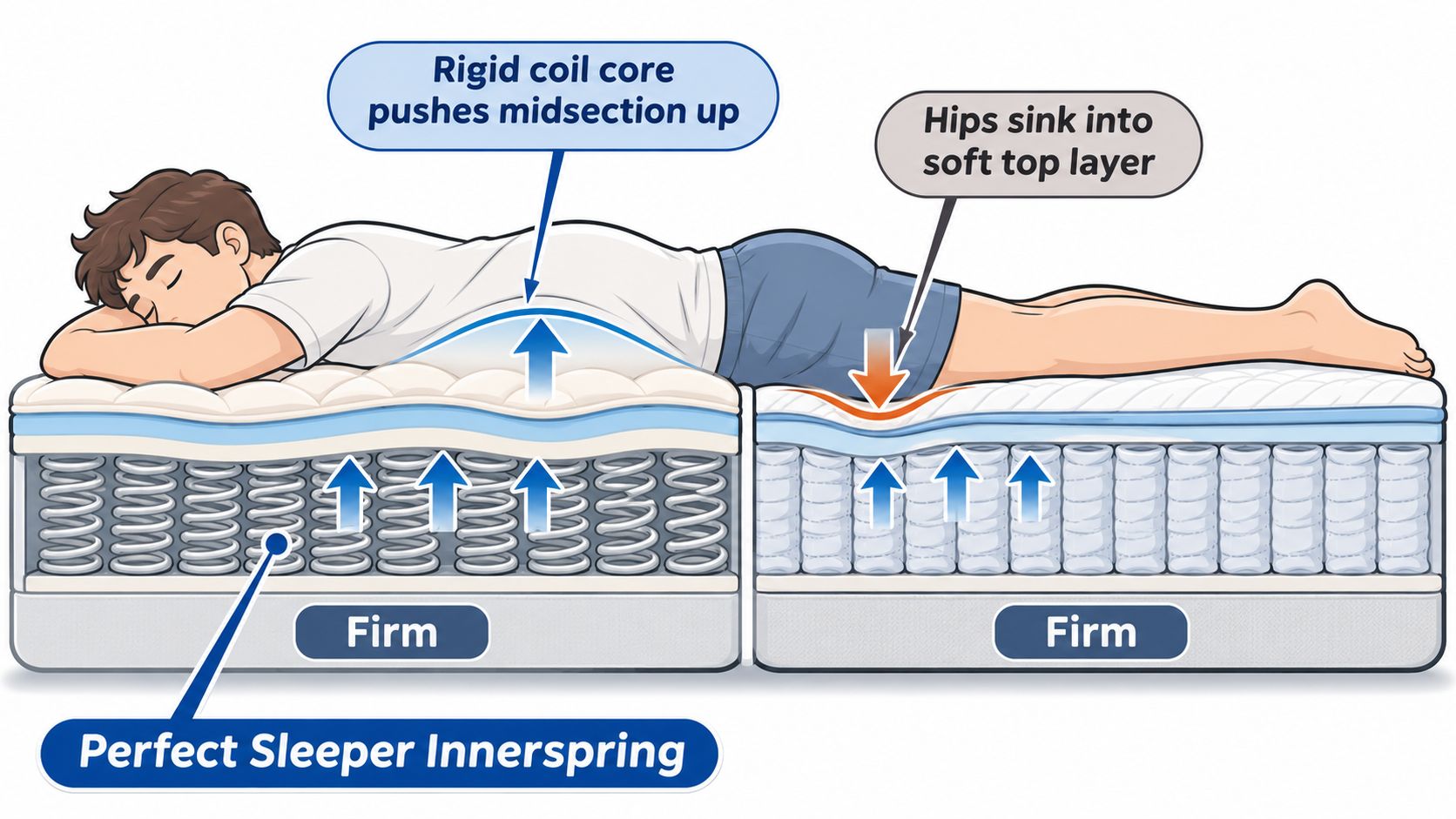
Innerspring and coil builds, such as the Perfect Sleeper Innerspring and the 825-coil Custom Support models, give buoyant push-back and resist hip sinkage through the coil layer itself. A strong edge helps in daily use, because the sleeper sits up and rolls over on the same surface.
Foam and hybrid builds
Foam builds, such as the Arctic Premier Firm Foam, feel more contoured. The foam has to be firm enough to stop the abdomen from dipping, or the contouring becomes sinkage.
Hybrid builds pair a coil core with foam comfort layers, so the top feels softer at contact while the coils still carry the load. That combination changes what happens under the hips compared with a tight-top innerspring, and it is why a stomach sleeper choosing a hybrid should lean firm rather than plush. The floor selection at most retailers includes memory foam, hybrid and innerspring models plus adjustable bases, and a base changes the hip angle enough to be worth testing with the mattress.
The hips decide more than the label. A firm mattress with a weak core sags, and a well-built core under a modest cushioning layer holds the pelvis exactly where it belongs.
Zoning is the other variable. Three zones on the Classic Firm and five on the iComfort both target the lower back, while the iComfort also cushions the shoulders and hips. A tight top with minimal cushioning above the core keeps the sleeper closer to that support, which matters more here than in any other position. This guide to sleep posture and spinal alignment covers how each posture loads the spine and explains why the middle of the body does most of the deciding.
When comparing builds on a floor, judge the surface under the hips first, the lumbar zone second and the edge last. That order reflects what keeps a stomach sleeper level, and this breakdown of hybrid mattresses for stomach sleepers applies the same sequence to coil-and-foam designs.
Serta Picks for Combination Sleepers and Budgets
Most guides assume a stomach sleeper stays on the stomach all night. Plenty start face down and roll to the side or back within an hour, and a single-position recommendation can leave them on an unnecessarily hard mattress with shoulder pain by morning. Serta classifies several models as suitable for both stomach and back sleepers, and its Perfect Sleeper range spans firm, extra-firm, medium pillow-top and plush options (Serta Perfect Sleeper Standard Firm). The useful conclusion for a restless sleeper is a medium-firm or firm model with targeted cushioning rather than the hardest bed on the floor.
The test is a three-position comparison: stomach, then side, then back, checking hip sinkage against shoulder pressure each time. Whichever position feels worst tells you more than the one that feels best, because that's the position that gets slept in second.
Couples hit the same wall from a different angle. One partner's firm stomach surface is the other's shoulder problem, so each sleeper tests independently and the pair chooses the model that fails neither of them in their main position.
Buy the support core, not the top padding. The layers that keep the hips level are the ones that decide whether the mattress is still working in year four.
On budget, the shortlist splits by construction rather than by marketing tier. Name-brand mattresses are sold at budget-friendly, premium and ultra-premium price levels, and the difference between adjoining tiers is usually the coil system and the number of comfort layers, not the warranty. Ask for a written quote on each finalist, because the Mattress Recommendations page lists mattresses with 'Call for Price' rather than a set price, so the showroom quote is the only real number.
Higher-weight stomach sleepers should ask specifically about reinforced coils, taller constructions, and strong edge support, all of which cut the risk of premature sagging where the hips concentrate load. Serta's product pages flag zoned support across collections but don't explain how those zones behave when a sleeper changes position at 3 a.m. That question is best put to a person standing next to the bed. For sleepers still deciding how much of the night they spend on their side, this guide to the best mattress for combination sleepers is the right starting point.
The rule that ties it together has three parts: choose the firmness for the position you spend the most time in, make sure shoulders and hips are both cushioned, and put the money into the support layers that keep the hips level.
Testing Serta Models in the Showroom
A fair test is mostly about setup. Bring the weight and the sleep positions that matter, wear normal clothes rather than a coat, and compare two or three finalists on the same day so the memory of one doesn't fade before the next. Lie on each for the same length of time.
Test back to back rather than in sequence across a week. A firm surface can feel almost rigid straight after ten minutes on a plush one, and that contrast is misleading in both directions. Gorins Furniture & Mattress encourages customers to try different mattress comfort levels in person and compare mattresses side by side, which is exactly the arrangement that produces a reliable answer.
In-store trial checklist for stomach sleepers
| Test | What to check | Pass sign |
|---|---|---|
| Stomach position, 10 minutes | Hip and abdomen height | Hips stay near the rib line with no noticeable dip |
| Side position | Shoulder pressure against hip support | Shoulder and hip both cushioned without strain |
| Back position | Lower back gap | Lower back supported without an arch |
| Edge test | Sitting on the edge | Edge holds without rolling off |
| Two-model compare | Same weight, same time per model | Clear preference for one model |
Then verify what you're feeling. Ask an associate to walk through the construction on the spec sheet, coil count, zone layout and foam layers, and check each figure against the published specification. If the floor model has been broken in by months of customers, ask how old it is, since a settled display and a new-in-box mattress don't feel identical in week one.
The checklist gives signs rather than measured numbers, because stomach-sleeper support is a feel test. Nothing on that sheet substitutes for the judgment your own hips make after ten minutes face down.
The single rule that decides the choice: note which model passes every test and which fails even one position. The failing position is the one that will keep you awake at 3 a.m., no matter how good the other two felt.
Trial, Returns and Financing Before You Commit
A new mattress needs time before it can be judged. Serta notes that a new mattress can take up to 45 days to settle in, and describes its firm models as providing a stable, lifted feel with minimal sink rather than feeling rock-hard (Serta firm mattress collection). The same guidance notes that firm models are popular with stomach and back sleepers, while medium-firm adds cushioning and contouring without giving up support.
Judge the mattress after the settling period, not on day one. A short daily note of hip or lower-back discomfort is enough to separate a body adjusting to a firmer surface from a surface that is wrong.
Write it down before you sign. The comfort-exchange window, the warranty terms and the return policy are three separate documents, and the sales conversation isn't one of them.
The policy checks are quick but easy to skip:
- Comfort-exchange window: confirm how many days it covers and whether the mattress must be in original condition.
- Warranty terms: check what counts as a defect, since body impressions and sagging thresholds are defined differently across models.
- Return policy in writing: get it before purchase, not after the first bad night.
- Foundation requirement: most warranties require a compatible base, so confirm what the mattress must sit on.
Financing comes next. Gorins Furniture & Mattress offers promotional financing with equal monthly payments, which lowers the barrier to a big-ticket purchase without changing the mattress you chose. Approval is subject to credit, and the showroom can confirm which programs apply to a specific model. If the monthly number is the deciding factor, this explanation of whether to finance a mattress covers the trade-offs.
Sleep specialists on the floor match a mattress to comfort preference, sleep position, support needs and budget, so the final conversation is worth having with someone who can read the spec sheet.
Before signing, confirm four things: the trial window, the exchange terms, the warranty and the monthly payment.
Confirm Your Serta Pick at the Norwich Showroom
The whole process compresses into four steps. Work through them in order and the decision stops being a guess.
- Shortlist two or three models from the first table, favoring firm builds unless body weight points toward medium or medium-firm.
- Pick the firmness level from the weight table, using the prone check as the deciding test rather than the label.
- Test the finalists on the same day with the checklist, in stomach, side and back positions.
- Confirm the terms on trial, exchange, warranty and monthly payment before anything is signed.
The online Style Quiz narrows the shortlist before the visit, since recommendations are built from quiz answers and the expertise of trained sleep specialists. Shoppers working to a tighter number should check the Clearance section, where value-driven options sit alongside the regular floor, and current store offers include savings of up to 15% off.
Gorins Furniture & Mattress has been family-owned and locally operated since 1936, serving Norwich, New London, Plainfield, Waterford and the surrounding Eastern Connecticut and Rhode Island communities.
Visit the Norwich showroom to lie on your finalists in all three positions. Take the online Style Quiz to narrow the shortlist before you arrive. Browse the Clearance section for value-driven savings on a supportive build.
Since 1936, Gorins Furniture & Mattress has helped Norwich and Eastern CT families create homes they love. From custom-designed Canadel dining sets to the latest in Tempur-Pedic sleep technology, we combine a massive selection with the personalized care only a local, family-owned business can provide. Visit us today to experience quality, value, and our 5-Star Delivery service.
The Sleep Gallery at Gorins Furniture & Mattress stocks Serta alongside Tempur-Pedic, Beautyrest and Stearns & Foster, so the firm and medium-firm builds on this shortlist can be compared side by side in a single visit instead of ordered sight unseen. Sleep specialists there match a mattress to sleep position, support needs and budget, and the showroom sits a short drive from Norwich, New London, Plainfield and Waterford. Stop by Gorins Furniture & Mattress to lie on the finalists and settle the question in person.