Best Upholstered Dining Chairs: How to Choose Well in 2026


Watch a family sit down to dinner and the whole buying decision plays out in about ten seconds. Four people, four chairs, and everyone reaches for the same one. The other three get pushed in and forgotten until a guest arrives.
That pattern says more about upholstered dining chairs than any product photo. The chair that gets picked every night has a seat that supports the thigh, a back someone can lean into without sliding forward, and a fabric that still looks decent after a year of spaghetti night. The one nobody picks usually has a seat that's too deep, a cushion that's gone flat, or an arm that won't clear the table apron.
This guide works the way the question gets answered on a showroom floor. Fit first, build second, fabric third, style last, because style is the only part that doesn't change how the chair performs. What follows gives you the measurements to take, the fabric rating to ask for by name, and the disclosure questions most buying guides skip entirely, including what's in that stain treatment.
Top Upholstered Dining Chair Picks by Household Need
Buy for the dinner that happens four nights a week, not the one you host twice a year. Weeknight chairs take kids, pets, and a bag slung over the back. A holiday table pulls every chair out and needs the room to look finished. The weeknight chair is the one that still looks decent in year five.
Gorins Furniture & Mattress has been furnishing that kind of house since 1936, from a family-owned and operated showroom in Norwich that serves New London, Plainfield, and the surrounding Connecticut and Rhode Island communities.
| Household need | Look for | Why it works | Watch for |
|---|---|---|---|
| Busy family with kids and pets | Performance fabric with a heavy-residential abrasion rating and a cleanable or removable cover | Holds up to spills and daily sliding | Loose weaves that pill and snag |
| Formal dining room used on weekends | Tufted or channel-back chair on a hardwood frame | Polished look that holds its shape | Deep tufting that traps dust |
| Small dining room | Armless or low-back chair with a slim profile | Slides under the table and looks lighter in the room | Less back support during long meals |
| Mixed-height household | Moderately deep, supportive seat with a rounded front edge | Comfortable for shorter and taller users | Overstuffed cushions that compress over time |
| Matched set built to order | Canadel Custom Dining fabric, finish and size choices | Thousands of combinations to match your room | Made-to-order timing, so confirm lead times at the showroom |
Three checks decide the row. The seat has to fit the people who sit there. The chair has to slide under that table. The fabric has to be rated for how many meals that seat sees in a week. Miss one and the chair ends up against the wall.
Kids and pets move the priority to the cover. A thicker pad does less for longevity than a removable, cleanable cover and a tight weave. The kid-friendly and pet-friendly furniture guide walks through which constructions survive real households.
Pick the row before you fall for a photo. A busy table needs that heavy-residential abrasion rating. A weekend dining room can take tufting or a channel back on hardwood if you will live with the dust deep tufts collect. A small room wants an armless or low-back chair that tucks away, even though long meals get less support. Mixed heights do better on a moderately deep seat with a rounded front edge than on an overstuffed cushion that packs down. A matched set built to order is Canadel Custom Dining: fabric, finish, and size in thousands of combinations. Confirm the lead time at the showroom before you order.
Frame, Fill and the Safety Label to Check First
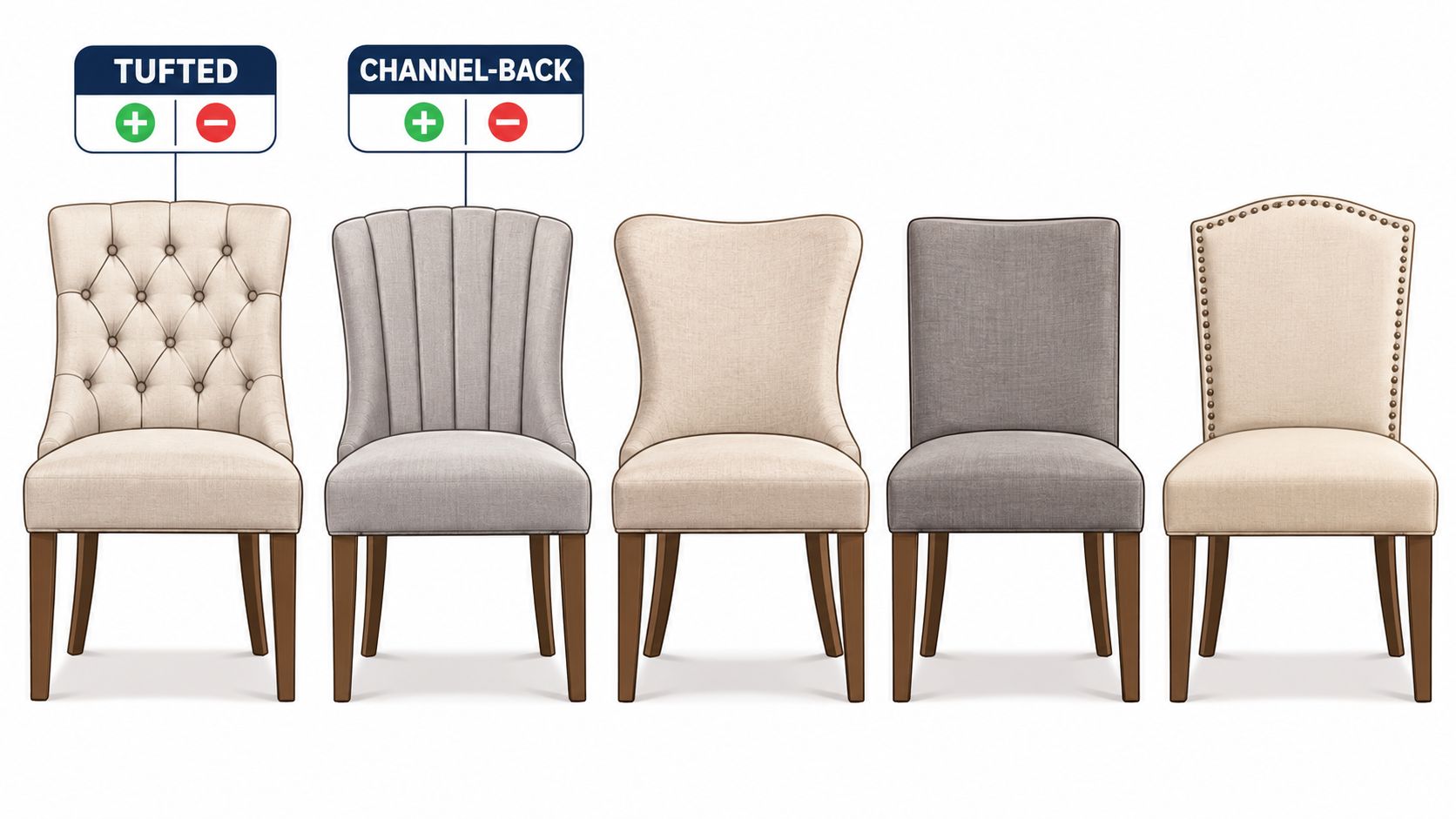
Five back styles can look equally good in a photo. What separates them is invisible until you rock the chair.
Test the frame in thirty seconds
Put both hands on the top of the back and rock the chair side to side, then front to back, with some force. Then lift one corner an inch and set it down. A frame worth buying stays quiet. Creaks and clicks mean joints are moving, and moving joints are how a chair starts to wobble two years in.
Ask what the frame is made of. Kiln-dried hardwood or engineered hardwood with doweled joints, glue, and corner blocks at the seat rails will outlast particleboard or stapled assemblies every time. Staples pull. Corner blocks spread the load across the rail instead of concentrating it at one fastener.
Ask for foam density as a number
Seat fill is where cheap chairs hide. A high-resilience foam with a stated density resists flattening under daily use. Soft, low-density foam feels wonderful in week one and packs down within a season or two, leaving a dip where each person sits. Ask for the density figure and whether the seat core is wrapped in batting. Batting adds surface softness without changing how the foam underneath behaves, so it should not be sold as a durability upgrade.
Find the compliance label
Upholstered dining chairs with an upholstered seat, back, or arm and intended for indoor use fall under a federal flammability requirement. Dining and kitchen chairs count when their seats and backs are continuously upholstered. The mandatory standard is codified in 16 C.F.R. Part 1640, took effect on June 25, 2021, incorporates California Technical Bulletin 117-2013, and calls for a permanent compliance label on products manufactured, imported, or reupholstered on or after that date, with labeling enforcement starting June 25, 2022.
That bulletin evaluates four components separately: cover fabric, resilient filling, barrier material, and decking. A chair can pass through a barrier that fully surrounds the filling, or through cover fabric and filling that both pass. Ask which path this chair used. Then ask what sits inside the seat: the foam density, whether a barrier wraps the fill, and whether any flame-retardant treatment is in the foam or the cover. A label that only says the chair complies, with no answers on those points, is not enough for a chair that sees dinner every night. No label on newer stock means no documentation. Ask for it, and treat silence as a reason to keep looking.
Showroom checklist: frame material and joinery, foam density figure, seat and back upholstery coverage, the permanent compliance label, barrier or fabric-and-fill compliance path, any flame-retardant treatment in the foam or cover, and the warranty terms in writing.
Pros and Cons of Each Upholstered Dining Chair Style
Style comes last because it can't fix a bad frame. It does decide how the chair lives with crumbs, how it tucks under the table, and how much support it gives during a long meal.
Tufted
- Formal weight that suits a room with a chandelier and a rug
- Texture without pattern, so the chair reads rich in a solid color
- Holds its shape because the buttoning pulls the cover tight
- Buttons collect crumbs in every dimple
- Hard to wipe down in a straight pass
- Repairs show, since a re-covered panel rarely matches the rest
Channel-back
- Clean vertical lines that suit modern and traditional rooms
- Firm back support from the padded channels
- Quick to vacuum compared with tufting
- Seams take the wear first where people lean back on elbows
- Less give against the spine than a loose back cushion
- Spills follow the seam line and need blotting fast
Slipcovered or removable-cover
- Washable covers that handle a spill without a service call
- A look you can update without replacing the chair
- Forgiving of wear, since covers take the abrasion
- Fit loosens with laundering and re-fitting
- Careful laundering required to keep size and color
- Skirts and ties need retucking after guests
Wingback or chairs with arms
- Supportive for lingering after the plates are cleared
- Cozy proportions for a corner or the head of the table
- Defines the end of a table visually
- Arms block the tuck under a deep apron
- Adds bulk in a tight room
- Arm faces wear first where hands rest
Armless or low-back upholstered chairs
- Slides fully under the table
- Visually light in an small room
- Easy to move for cleaning
- Less support over a long meal
- No armrest to push up from
- Can look skimpy against a heavy table
The Norwich showroom carries lines from Flexsteel and Craftmaster, and each brand offers a different spread of these styles, so ask which shapes each one builds before committing to a silhouette. For a wider read on how a chair style sits against the rest of the room, the guide to dining room styles for every home is worth a look before the visit.
Style sets the look. Construction and fabric set the lifespan, and one of those two you can verify with a label.
Fabric Durability and Stain Resistance Explained
A chair at a family table needs fabric that can handle repeated use and the occasional spill. Check abrasion and stain resistance separately. A listing that calls fabric “performance” without giving its rub-test result, cleaning code, or treatment details leaves key buying questions unanswered.
The two abrasion tests aren't interchangeable
ASTM D4157 Wyzenbeek testing rubs fabric back and forth in the warp and filling directions. Martindale testing uses a circular rubbing motion under a defined load. Results are reported in double rubs or cycles, and the methods do not convert directly. A 40,000 Martindale result and a 30,000 Wyzenbeek result are not equivalent claims.
| Use case | Wyzenbeek (double rubs) | Martindale (cycles) |
|---|---|---|
| General indoor upholstery | 15,000 | Same-method comparison only |
| Medium-duty residential | 20,000–30,000 | 15,000–30,000 |
| Heavy-duty or high-traffic dining | 30,000 | 40,000 |
| Conservative target for daily family meals | 30,000–40,000 | 30,000–50,000-plus |
The Association for Contract Textiles sets a benchmark of 15,000 double rubs for some general indoor upholstery and 30,000 double rubs for high-traffic dining-area use. Practical upholstery guidance places heavy-duty fabric at approximately 30,000 Wyzenbeek double rubs or 40,000 Martindale cycles. For daily meals, children, pets, and guests, it recommends 30,000–40,000 Wyzenbeek or 30,000–50,000-plus Martindale, as explained in this dining chair upholstery breakdown. For a busy family table, choose near the top of those ranges.
What the rub count doesn't tell you
Abrasion results measure wear from rubbing. They don't tell you about stain resistance, seam strength, colorfastness, or how to clean the fabric. Ask about each separately, and check the cleaning code before using any cleaner.
- W means water-based cleaners are safe.
- S means use solvent-based cleaner only. Water can leave a ring.
- WS accepts either.
- X means vacuum only. Don't use liquid cleaner.
Get the code in writing and test any cleaning product on a hidden seam first. A protective finish is a separate choice from the fabric's abrasion rating. You can compare stain protection options before deciding whether a mill-applied finish or an aftermarket treatment suits your household.
Ask what's in the finish
Stain treatments can involve chemicals, so ask what the finish contains and whether the manufacturer provides PFAS-free documentation. Minnesota's PFAS product prohibitions took effect on January 1, 2025, and cover textile furnishings. For a dining chair, request the fiber content, treatment details, and any available documentation before choosing.
Solution-dyed polyester and olefin have pigment inside the fiber, while an aftermarket treatment is applied afterward. Ask the retailer to identify which one the chair uses and what care it requires. The upholstery fabric library can help you compare fabric options against the demands of your household.
Sizing, Seat Height and Table Clearance
A chair can look right and still leave the shortest regular diner dangling or the tallest one pressed against the table apron. Start with the fit at your actual table: the seat should sit about 10 to 12 inches (25 to 30 cm) below the finished tabletop. Typical dining tables at 28 to 30 inches pair with seats around 17 to 19 inches, according to this dining chair height guide. Check the table and chair together before deciding.
Upholstered seats compress under a person's weight, lowering the sitting height below the unloaded specification. Measure the loaded seat height, then check the apron depth. A deep apron can restrict thigh room even when the table and chair measurements appear compatible.
| Measurement | Typical target | How to check |
|---|---|---|
| Table height | 28–30 in | Measure from floor to the finished tabletop |
| Seat-to-tabletop difference | 10–12 in (25–30 cm) | Subtract seat height from table height |
| Seat height after sitting | 17–19 in typical | Remeasure with a user seated, not only unloaded |
| Seat height against user | 88%–95% of popliteal height | Measure floor to underside of the knee in shoes |
| Seat width | 20–22 in clothed | Measure across the seat at its widest point |
| Seat depth | 15–17 in benchmark | Test against the shortest regular user |
| Knee clearance | 1–2 in (2.5–5 cm) | Sit fully back and check the gap at the knee crease |
These targets draw on the dining chair height guide, one ergonomics summary, and the Canadian Centre for Occupational Health and Safety. Treat them as starting points, then confirm the chair suits the people and table in your home.
Fit the shortest regular user, not the average
Measure the shortest person who sits at the table regularly, wearing their usual shoes, from the floor to the underside of the knee. This is popliteal height. The ergonomics summary puts a workable seat height at roughly 88%–95% of that measurement and gives a typical clothed seat width of about 20–22 inches. A seat that is too wide can make shorter sitters slide; one that is too narrow puts pressure on the hips.
Seat depth deserves the same practical check. Use 15–17 inches as a benchmark, then have the shortest regular user sit fully back. The gap between the seat edge and knee crease should be 1–2 inches (2.5–5 cm), as described by the Canadian Centre for Occupational Health and Safety. An edge pressing into the crease can restrict circulation and encourage forward perching.
A chair that cannot slide beneath the apron pushes the sitter forward. Check the tuck before choosing the cushion.
Arms and apron clearance determine whether the chair fits the table at all. Slide it into place with someone seated. If the arms strike the apron or the seat cannot move fully under the table, the diner may lean forward, putting strain on the back and thighs. For counter and bar setups, use this guide to dining table heights to check the appropriate height relationship.
How to Care for Upholstered Dining Chairs
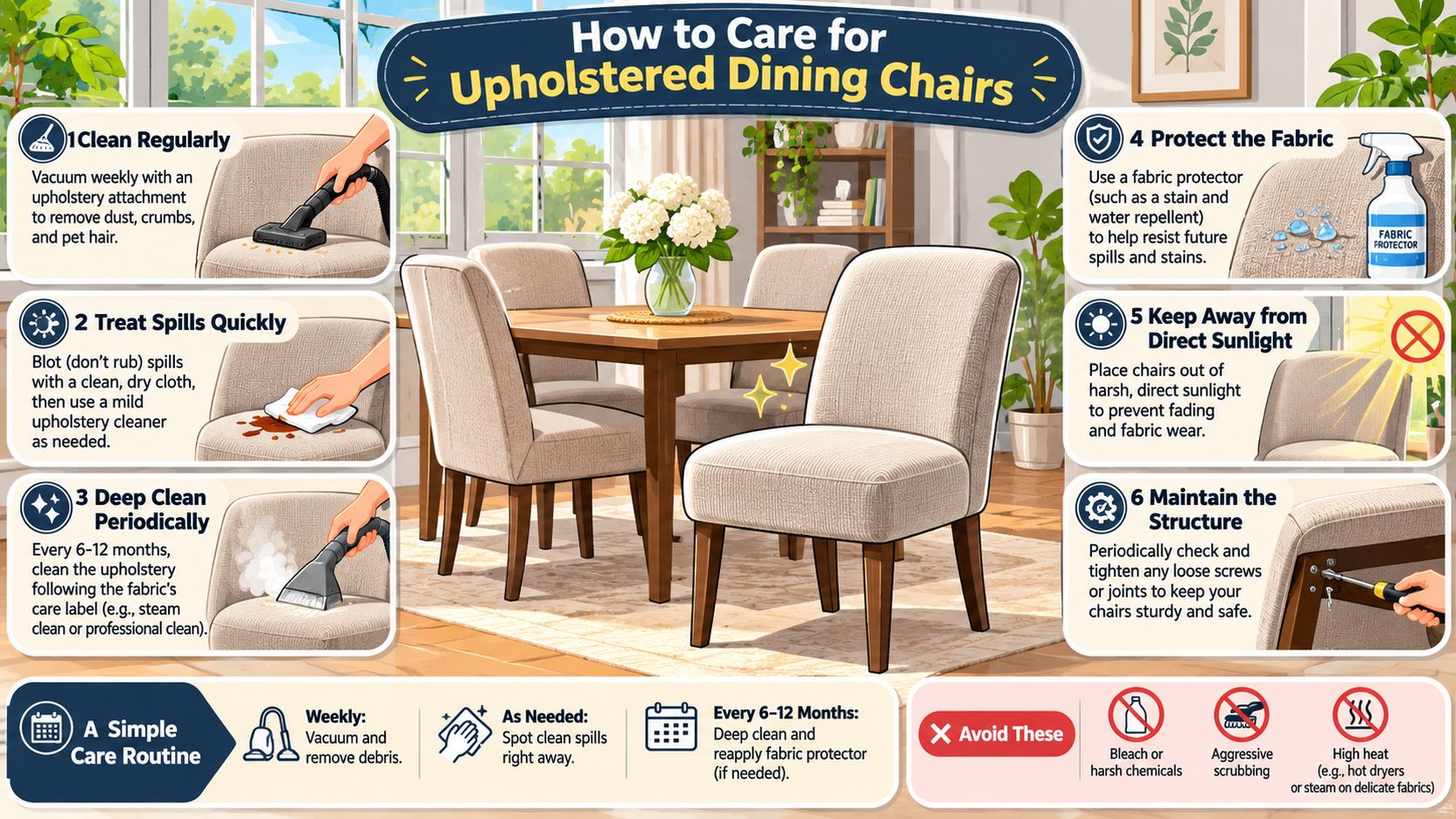
Care is what protects the money already spent. A chair with a good frame and a rated fabric will outlast a badly kept one by years, and most of the work takes minutes a week.
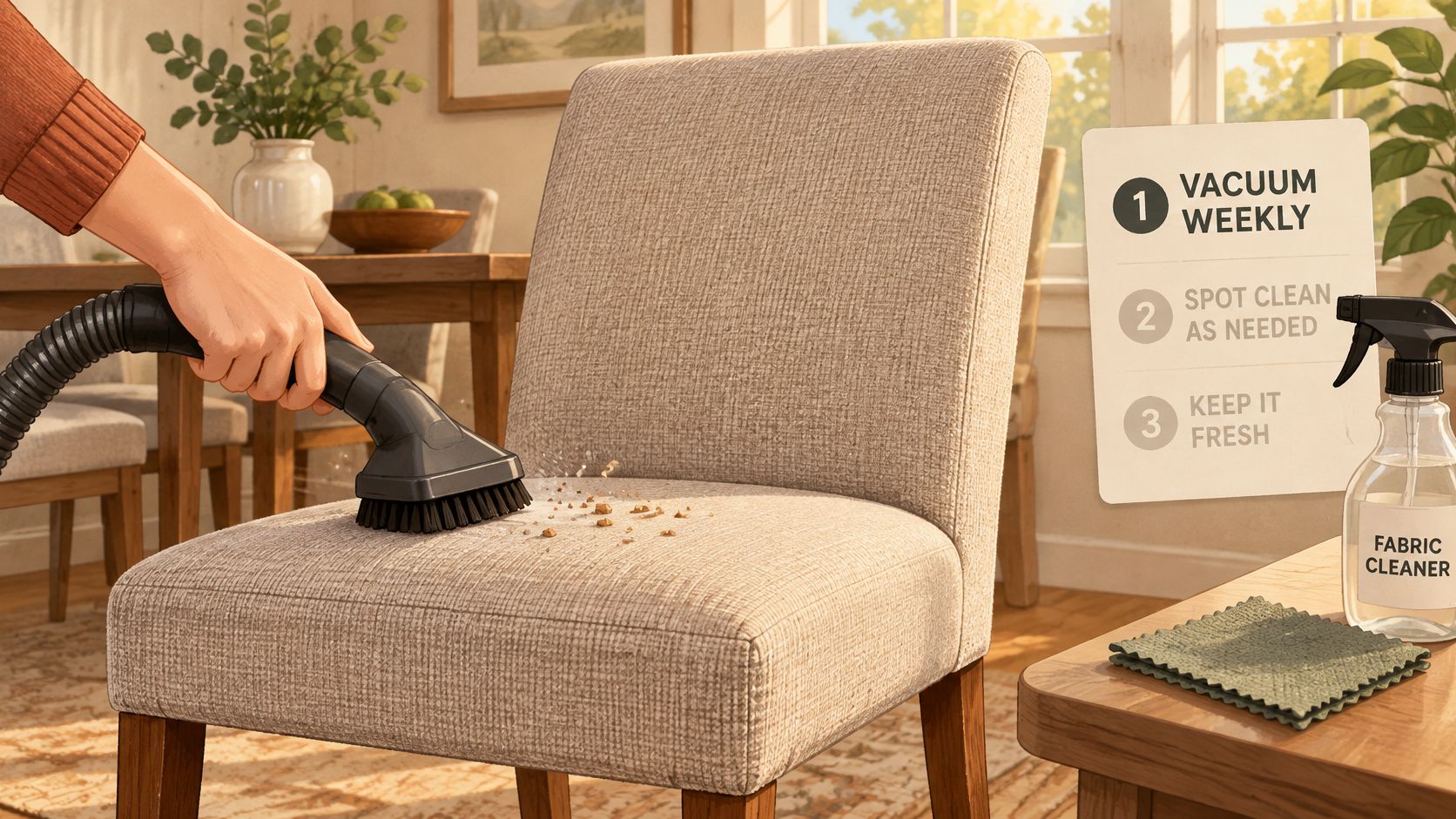
- Vacuum weekly with an upholstery brush. Grit works into the weave and abrades fibers with every sit, so removing it slows the wear the rub count promised.
- Check the cleaning code before any product. The tag decides whether water or solvent is safe, and the wrong one can set a stain or leave a ring.
- Blot spills within minutes using a clean white cloth. Press, don't rub, because rubbing pushes the stain deeper into the fill.
- Test every cleaner on a hidden seam and let it dry fully. Some products change a fabric's appearance only after they cure.
- Rotate loose seat cushions where the fill allows. One spot shouldn't carry every meal and every guest.
- Keep chairs out of direct sun and away from heaters. Sun fades covers and heat dries foam, which is what turns a firm seat soft.
- Tighten screws and check joints every few months. Loose joints are where creaks start, and creaks are cheaper to fix early.
- Fit felt pads and lift rather than drag. Dragging stresses both the floor and the leg joints.
Post-purchase questions about cleaning products, a stubborn stain, or a joint that's started to move can go to the store's service department in Norwich rather than a call center.
Price Ranges, Value and Financing Options
Price per chair tells you almost nothing on its own. What separates the tiers is the frame under the fabric, the density of the foam, and the abrasion rating of the cover, so compare those three across any two chairs before comparing the numbers.
- Entry level, in stock. Standard frames and standard fabrics. Compare the joinery and ask for foam density, because this is the tier where both get trimmed first.
- Mid range. A performance fabric with a documented rating, a hardwood frame, and a foam core with a stated density. This is usually the sweet spot for a daily-use family table.
- Premium, made to order. Custom fabric, finish, and size, including the Canadel Custom Dining program, where you're specifying the chair rather than choosing from a floor.
Many listings show Call for Price rather than a figure, so a spec sheet beats an online number every time. The Norwich team can confirm current ranges, and there are two savings routes worth knowing before you go. The store runs savings of up to 15% off, and if you find a lower price for the same product at a local competitor, they'll match it on the spot.
Read the financing terms before you sign
Promotional Financing on equal monthly payments has a simple structure. The required monthly payment equals the promotional purchase amount divided by the number of promotional months, and paying each one on time clears the balance by the end of the term with no interest on that purchase, per the financing terms. Financing is subject to credit approval.
Deferred interest is a different animal. The Consumer Financial Protection Bureau explains that if the entire promotional balance isn't paid by the deadline, interest accrued from the purchase date can be added to what's left. A missed month can cost more than the discount saved. The no-interest furniture financing overview sets out how the plans are structured.
At the counter, ask four things: the repayment period, the required monthly payment, the exact deadline, and whether it's true zero interest or deferred interest.
Choose Your Chairs at the Norwich Showroom
A chair can look right and still crowd the table or press behind the knees. At the Norwich showroom, judge each option by how it fits your table and household, then check whether its fabric suits daily use.
Canadel Custom Dining offers thousands of combinations of sizes, shapes, finishes, and fabrics, so you can configure a dining set around your room. Gorins also guides customers through customizing chairs, tables, and other furniture. Many dining collections offer choices in fabric, finish, color, and configuration, while special orders can include custom upholstery, Amish-crafted furniture, and special finishes.
Make the visit useful with these five checks:
- Bring two measurements. Note the table's finished height and the shortest regular user's knee height.
- Bring your abrasion target. Ask for fabrics that meet the rating you chose for your household, and check the cleaning code for each.
- Sit fully back. Check the space behind the knee, then slide the chair under the table while seated.
- Ask about construction and labeling. Request details on foam density, frame material and joinery, and the permanent compliance label. Ask what chemical disclosures are available.
- Ask about customization. Confirm upholstery and finish options, along with the lead time for made-to-order pieces.
Choose your next step based on what you need. Visit the Norwich showroom to sit in the chairs and check them at a table. Take the online Style Quiz first if you want help narrowing your design direction, or arrange a design consultation to discuss fabrics, finishes, and room layout.
Gorins Furniture & Mattress has served Norwich and Eastern Connecticut since 1936. Its dining options include tables, chairs, benches, buffets, hutches, and dining storage solutions. For a visit, bring your measurements and fabric rating, then compare how each chair supports you and fits beneath your table. Start planning at Gorins Furniture & Mattress, or take the Style Quiz before you go.