Sleeper Sectional Sofa with Chaise: Buyer’s Guide 2026


A Norwich renter has a familiar puzzle: a hypothetical 12-by-14-foot living room needs to seat the family, provide somewhere to stretch out, and accommodate an overnight guest. A sleeper sectional sofa with chaise could handle all of that, but only if the open bed leaves a usable route through the room. The upholstery is the easy decision. The harder decisions involve the chaise corner, the sleeper mechanism, and the space guests need after everyone else goes to bed.
What a Sleeper Sectional With Chaise Does for Your Room
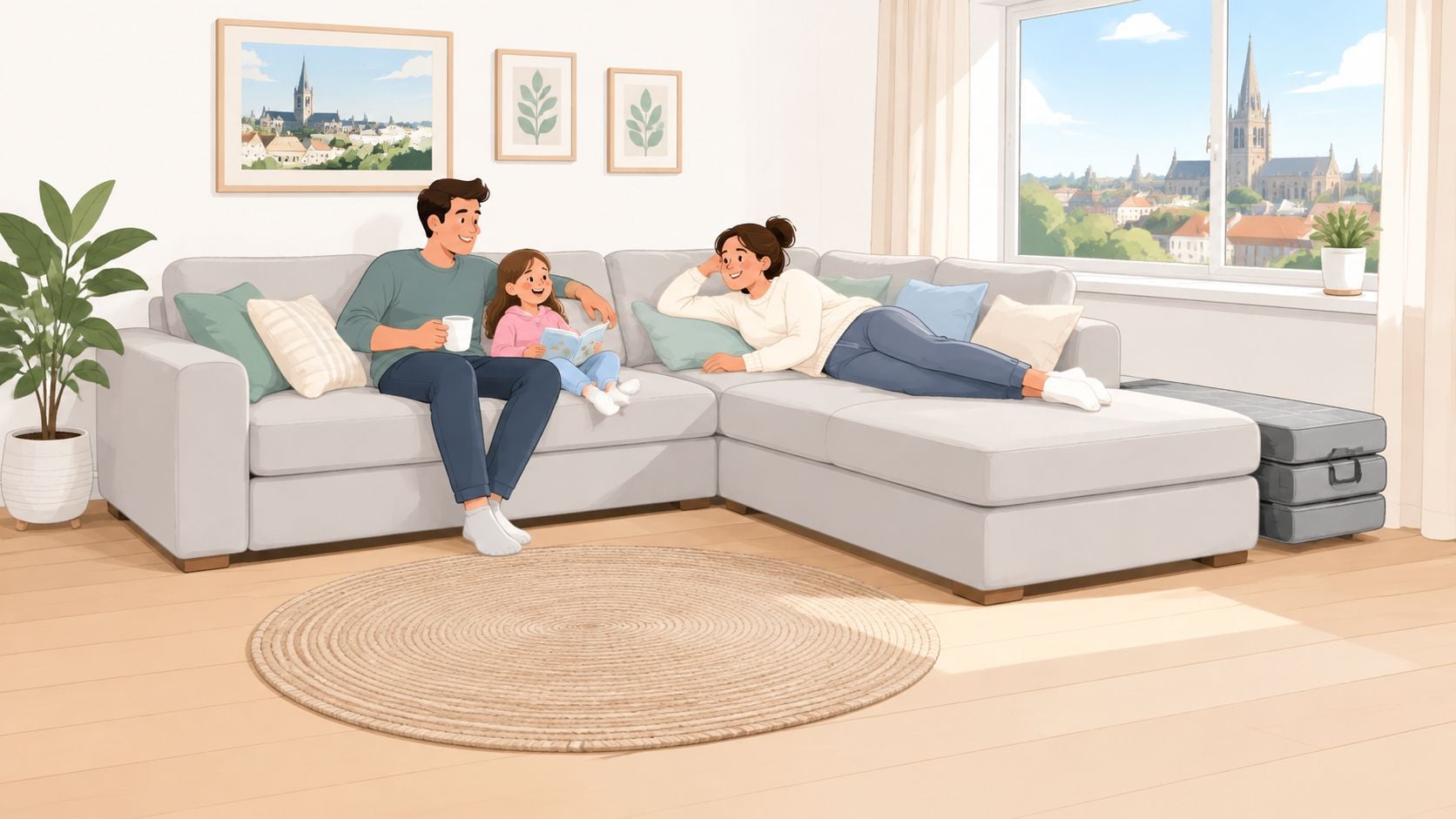
A sleeper sectional combines everyday seating, an extended lounging zone, and a concealed bed. It's the furniture equivalent of a Swiss Army knife: several tools sharing one handle. That arrangement can eliminate a separate lounge chair and guest bed, although it doesn't eliminate the floor space needed when the bed opens.
For the Norwich renter, the chaise might face the television during the day while the sleeper accommodates visiting family at night. The catch is the coffee table, lamp, and route to the bathroom. Those still need somewhere to go when the living room becomes a bedroom.
Why the Combined Footprint Matters
The space pressure is real: the U.S. Census Bureau reported a median unit size of 1,800 square feet for single-family detached and mobile homes, compared with 1,300 square feet for renter-occupied units. Multifunctional furniture can make smaller rooms more useful, provided conversion doesn't require dismantling the entire seating area.
The idea itself isn't new: U.S. patent records document convertible bed furniture patented in 1916, placing the underlying concept more than a century before today's sectional styling.
- Everyday value: The seating arrangement should suit normal evenings, not just occasional visitors.
- Overnight practicality: Guests need a usable sleep surface and access around the projecting chaise.
- Household fit: Conversion should be manageable for whoever will actually operate the mechanism.
Founded in 1936 by Samuel and Martha Gorin, Gorins Furniture & Mattress's family history describes a locally owned, family-operated business serving Norwich neighbors across three generations. The buying decision remains straightforward: whether this combined footprint suits the room and the household's daily routine.
Measure the Closed and Open Footprint Before You Shop
A chaise can fit neatly beside a wall and still obstruct the room once the bed opens. Measure the sectional in both positions, then check the space between the bed, chaise, and the route people need to use. The floor plan has to work as one system.
Typical reference footprints for a sleeper sectional with chaise
| Measurement | Typical reference value | What it tells buyers |
|---|---|---|
| Closed sectional footprint | About 100 in wide × 67 in deep × 39 in high | The everyday floor space the sofa occupies |
| Chaise length | 63 in, with a longer option of 73 in described in the Woman's Day review | The length of the lounge zone and how far it projects into the room |
| Longer chaise option | 73 in | Extra lounging length can reduce the passage around the open bed |
| Queen-labeled sleeper surface | About 60 in wide × 72–74 in long | Queen width does not guarantee standard queen length |
| Standard queen mattress | 60 × 80 in | A full-length comparison for available sleeping space |
| Preliminary walkway allowance around the opened bed | About 30 in (76 cm) | A starting point for checking passage past the bed and chaise, not an accessibility standard |
Treat these as reference dimensions, not specifications for every sectional. Mattress length is different from the full distance between the sofa's back and the deployed bed's foot. The frame, back, and opening mechanism also take up floor space. Before comparing models, check open and closed sofa bed dimensions alongside the listed mattress size.
A longer chaise gives more room to stretch out, but its outer corner may pinch the route around the open bed. The trade-off is sharper when the chaise sits beside the only usable passage. Check the complete layout before choosing the longer option.
Mark the Entire System on the Floor
Use painter's tape, a tape measure, and a simple sketch. Gorins' room-measuring guide can help organize the room measurements. Mark the sofa, chaise, deployed bed, and walking route together.
- Record the closed envelope. Measure overall width, depth, and height, including the chaise, arms, and cushions. A frame-only measurement can understate the space the sofa occupies.
- Mark the chaise projection. Measure from the wall behind the sofa to the chaise's far edge. Tape this corner clearly, since it can narrow the route once the bed is open.
- Add the deployed mechanism. Get the full distance from the wall to the bed's foot, and note mattress thickness. Thickness affects folding clearance, but it is not another horizontal floor measurement.
- Outline a walking route. Mark the preliminary allowance in the table, then walk through it. Carrying bedding or using a mobility aid may require more room.
- Check fixed obstacles. Mark door swings, outlets, vents, baseboard heaters, and furniture that will stay in place.
- Reverse the layout. Tape both chaise orientations using the actual module drawings. Confirm the configuration before treating either floor plan as final.
Practical rule: If the open bed blocks a necessary route, adjust the layout before choosing fabric or adding another feature.
Make the Queen Label the Final Check
A queen label describes width, not necessarily a standard queen's full length. A sleep surface around 60 in wide × 72–74 in long is shorter than a 60 × 80 in standard queen. Taller guests may have less legroom, while nearby arms or the chaise can limit how sleepers position themselves.
Check the mattress dimensions and the open arrangement together. The bed should fit without requiring guests to sleep diagonally, climb over each other, or squeeze past the chaise. A closed sofa that fits against the wall is only half the measurement.
Test Seat Comfort and Chaise Depth in Daily Use
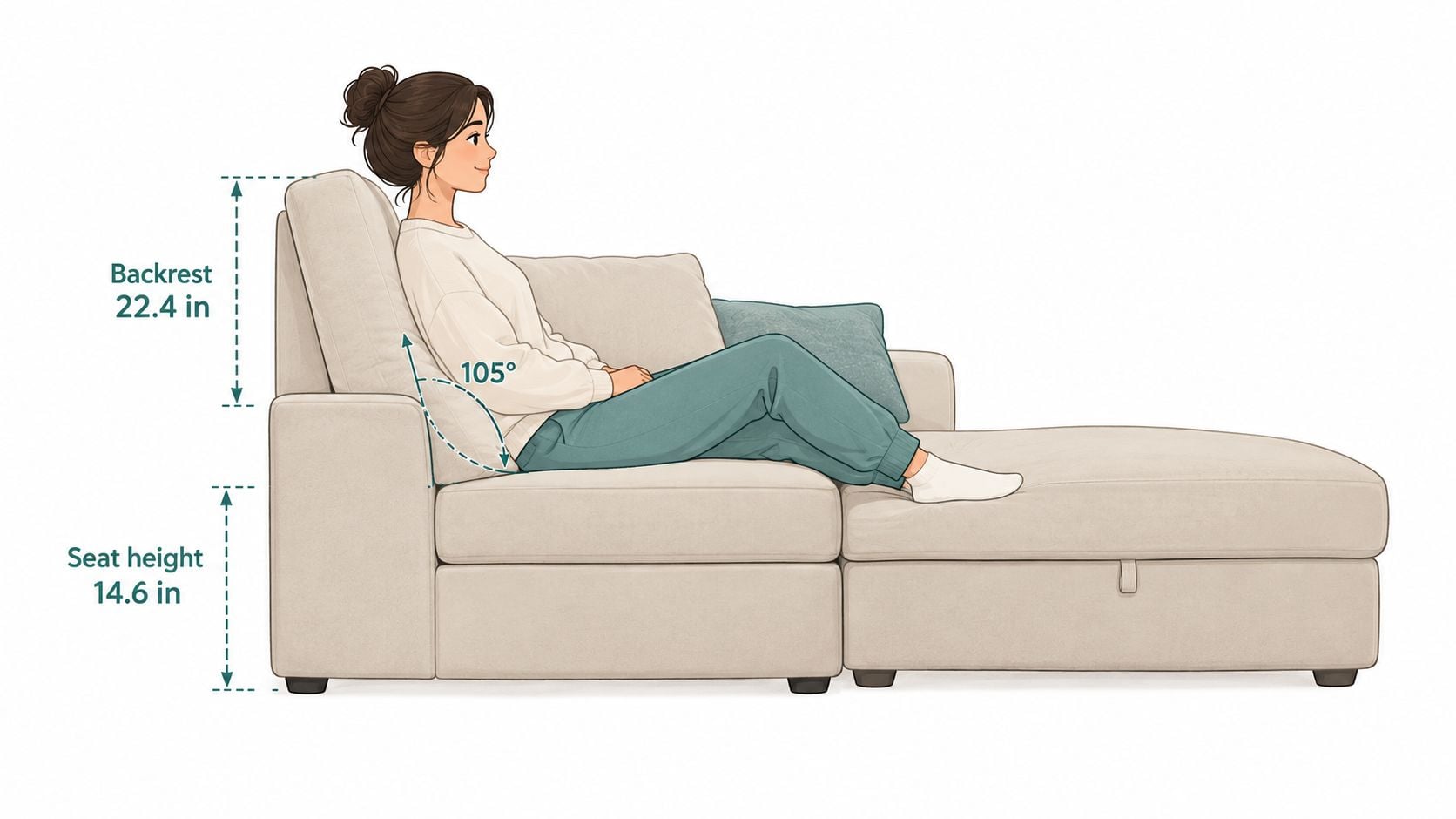
An anthropometric sofa study recommended approximately 37 cm (14.6 in) seat height, 57 cm (22.4 in) backrest height, and 62 cm (24.4 in) seat width per user, with a 105-degree seat-to-back angle and a 5-degree seat-surface slope. These are technical starting points, not universal shopping specifications. Body proportions and cushion compression change how the same sofa supports different people.
A dining chair favors upright activity. A recliner favors prolonged relaxation. A sectional with chaise attempts both, so its upright seats and lounging section need separate tests.
Measure Comfort Under Load
An unloaded cushion can look supportive while sinking enough to change the sitting position. Compressed seat depth is the useful measurement: the distance available when someone is seated normally and the back cushion has settled.
For upright sitting, the occupant should reach the back cushion without sliding the pelvis forward. On the chaise, the cushion should support the thighs without forcing the lower back away from the backrest. A longer cushion isn't automatically more comfortable if the person ends up slouching to reach support.
Asymmetric reclining also concentrates force where the sofa seat meets the chaise. Poor support at that transition can contribute to cushion sag or looseness at the frame connection. Inspect the junction while someone changes position, not only while the furniture is empty.
A pull-out mechanism beneath the main seats can restrict usable depth and change the cushion feel. The sofa seats may therefore feel different from the chaise even when their upholstery matches.
Use a Showroom Test That Resembles Home
The useful test involves ordinary movement rather than a quick sit on the front edge.
- Sit upright first: Remain seated long enough for the cushion to settle. Check foot support, pressure behind the knees, and whether the backrest can be reached comfortably.
- Recline naturally: Stretch out on the chaise, then change position. Check the seat-to-chaise transition for a hard edge or a noticeable drop.
- Operate the sleeper: The intended user should open and close it, checking for awkward reaches and interference with cushions.
- Watch the structure: Look for frame flex, rocking feet, shifting connectors, and uneven floor contact.
A comfortable chaise doesn't compensate for an uncomfortable main seat. Most households will use both zones differently.
Investment-grade quality means more than a substantial-looking frame. Support, replaceable components, clear care instructions, and a mechanism that operates smoothly all deserve attention before decorative details.
Choosing a Sleeper Mattress That Fits the Frame
Sleeper mattress types compared
| Mattress type | Typical thickness | Feel and support | Best for | Watch for |
|---|---|---|---|---|
| Innerspring | 4–6 in as a shopping reference; frame approval governs | Firm, bouncy surface | Guests and value-conscious buyers | Less pressure relief for side sleepers |
| Memory foam | 4–6 in as a shopping reference; frame approval governs | Contouring, slower response | Side sleepers wanting pressure relief | Heat retention and a deeper sink |
| Hybrid, coils with foam layers | 5–7 in as a shopping reference; frame approval governs | Balanced support with airflow | Couples and mixed sleep styles | Thickness may exceed mechanism clearance |
| Latex | 4–6 in as a shopping reference; frame approval governs | Responsive, often cooler-feeling than memory foam | Sleepers wanting a springy feel; verify natural-material content | Higher weight and price |
| Mattress with added topper | Adds 2–3 in as a shopping reference; removal may be necessary | Softer, more cushioned | Adjusting comfort after purchase | Confirm clearance and the manufacturer's rules first |
The Sleep Gallery approach is comfort by feel, with healthier sleep as the aim rather than a promise attached to a particular material. Norwich shoppers can compare Tempur-Pedic, Serta, Beautyrest, Stearns & Foster, Sealy, and King Koil to understand their preferred support and pressure relief. Those bedroom-mattress brands don't establish which replacement mattress fits a sectional.
Sleeper mattresses are usually thinner than bedroom mattresses because they must fold or stow inside a furniture frame. Their performance depends on the support deck as well as the comfort layers. A plush surface over an uneven deck won't solve a structural dip.
Respect the Folding Clearance
A thicker mattress may reduce pressure from the support beneath it, but the mechanism still needs room to fold. Excess thickness can prevent closure, strain hinges, or leave the furniture partly open. Added bedding can also catch moving parts.
Request the maximum approved mattress and bedding thickness in writing. Ask whether the limit includes a protector, fitted sheet, or topper, and whether bedding must be removed before closing. A topper that needs separate storage should be included in the household's storage plan.
Gorins' Ashley Furniture sleeper sofa guide offers another starting point for reviewing sleeper options. The exact frame specification should control the final mattress choice, not a generic thickness category.
Separate Mattress Safety From Sofa Safety
The Consumer Product Safety Commission's guidance says a detachable sofa-bed mattress is likely covered by 16 C.F.R. Parts 1632 and 1633, while the remaining upholstered sofa is generally covered by Part 1640 and the applicable upholstered-furniture smolder-resistance methods. Buyers should ask which requirements apply to the actual product rather than assuming a sofa label covers every component.
Useful questions include:
- Detachable construction: Can the mattress be removed independently of the mechanism?
- Documentation: Which compliance documents and product labels apply to that mattress?
- Replacement compatibility: Which replacement mattresses preserve the intended configuration?
- Added bedding: Does the manufacturer approve the proposed protector or topper?
Compare the Complete Sleeping Surface
A practical showroom trial is about ten minutes in the person's normal sleeping position. That's a testing routine, not a guarantee of overnight comfort. Side sleepers should check shoulder and hip pressure; back sleepers should notice whether the pelvis sinks below the surrounding surface.
Check seams and transitions with body weight on the bed. Couples should test together when possible because combined loading can expose a dip that an unloaded mattress hides.
For payment planning, Gorins' financing information identifies the Nest Credit Card, issued by Comenity Capital Bank, and partnerships with TD Bank, including promotional equal-monthly-payment programs and “No Interest if Paid in Full” offers, subject to credit qualification. The approved mattress and mechanism should be priced together before selecting a payment arrangement.
Configuration and Customization Choices That Change Daily Use
The chaise, sleeper mechanism, and walkways need to work as one arrangement. A F9 Custom Sofa series configuration can include choices such as arm style, back type, welt treatment, and cushion firmness. Confirm that the sleeper mechanism is available with the exact frame and layout you want. Custom upholstery does not mean every mechanism fits every module.
Configuration choices and what each one changes
| Choice | Options | What it changes |
|---|---|---|
| Chaise side | Left-facing or right-facing | Traffic flow and where the bed opens |
| Sleeper location | Sofa section or chaise section, where offered | Usable seat depth and the shape of the opened bed |
| Arm style | Track, rolled, or flat arms | Ease of sitting down and standing up, and visual weight |
| Back type | Fixed or loose back cushions | Lounging angle and access for cleaning |
| Cushion firmness | Soft, medium, or firm | Initial comfort, settling, and ease of rising |
| Welt and fabric | Welt detail and fabric grade | Appearance, wear, and cleaning over time |
Set the Chaise Side Before the Decorative Details
Set the chaise orientation against the room's actual routes. A chaise beside a window may keep the path from the entry clear, while the opposite side may leave guests more room to reach the opened bed. The right choice depends on how people will move through the room when the sectional is in use.
Facing terms can be unclear. Ask for a top-down plan that marks the doorway, television, chaise, and bed footprint. This makes the orientation easier to confirm than a verbal description, and it helps reveal whether the open bed blocks a walkway.
Sleeper placement affects both lounging and sleeping space. A mechanism in the sofa section can leave the chaise free for lounging, but may limit the depth of the main seats. A system that uses the chaise can create a different bed shape and may rely on adjoining cushions. Check the open configuration alongside the chaise, rather than treating the mattress dimensions as the whole footprint.
Specify Support and Maintenance
Arm shape affects how much room the sectional occupies and how easy it is to use. A broad rolled arm takes space without adding seating width. A stable, reachable arm may help someone sit down or stand up, depending on the person and the frame.
Softer cushions feel inviting at first but can allow more sinking. Firmer cushions reduce that movement, though firmness alone does not establish durability. Ask about cushion construction, replacement availability, and whether loose cushions can be rotated. These details matter when you are balancing plush lounging against easier movement.
For upholstery, request the cleaning code and view a fabric sample in home lighting. Match performance claims to the household's needs, such as spills, pet hair, or frequent use. Fabric, cushion, and arm choices should support daily routines without compromising the bed layout.
Made-to-order choices also apply to Canadel furniture customization, which describes combinations of sizes, shapes, finishes, and fabrics. Coordinating materials across adjacent rooms can create a connected look without requiring a matching furniture suite.
Use the custom sectional with chaise guide to narrow the layout choices. Bring a floor plan to the Norwich showroom and ask for sketches of both chaise orientations, showing the bed when open. That makes it easier to judge the full footprint and the remaining walking space before settling on upholstery details.
Pros, Cons and Who a Sleeper Sectional Suits Best
When the bed is open, the chaise and the remaining walkways become part of the same layout. A sleeper sectional can suit a room that needs flexible seating, but a “queen” label alone does not tell you whether the bed will fit beside the chaise or leave a usable route through the room. Check the open arrangement as well as the closed one.
Weigh the Everyday Benefits Against the Work
Advantages
- Room definition: The sectional can mark out a seating area beside dining or circulation space.
- Dedicated lounging: The chaise gives one person room to stretch out without shifting an ottoman.
- Flexible footprint: One fixed arrangement can work well when the household prefers not to rearrange separate seating pieces.
Drawbacks
- Moving weight: Sleeper hardware makes components harder to reposition, which matters if the layout changes often.
- Conversion effort: Opening, making, and closing the bed adds a recurring task for the household.
- Mattress limitations: Foldable bedding feels different from a dedicated bedroom bed.
- Difficult transfers: Deep, yielding seats can make standing harder, especially when the arms are difficult to reach.
A paper on age-friendly furniture identifies seat height and cushion firmness as relevant to posture transitions. It reports that 76% of adults aged 60 and older considered armrests helpful when sitting down and standing up. For households with mobility concerns, check how the intended user rises from the seat and operates the bed, rather than judging comfort by the cushion alone.
Test Accessibility With the Actual User
- Supportive seat: The occupant should be able to rise without repeated rocking or assistance.
- Stable arms: Check that a hand can reach a secure surface for support.
- Manageable height: Feet should rest steadily, while the seat remains practical to leave.
- Low-force conversion: The user should operate the mechanism without heavy lifting or an unstable stance.
- Usable circulation: Check passage with the walker or assistance arrangement the household regularly uses.
Renters and small-home owners may find the format useful when it replaces furniture they would otherwise need. It is a weaker fit for households that rarely host, need to move furniture frequently, or cannot spare the floor area when the bed opens. Compare the room's needs with Gorins' sofa-versus-sectional comparison.
For a shopping shortlist, ask about Flexsteel, Best Home Furnishings, Craftmaster, Ashley Furniture, Aspen Home, and Vaughan-Bassett. These brands cover different furniture categories, so confirm which current lines offer a sleeper with chaise rather than assuming every brand has one.
Confirm Fit, Delivery and Payment Before You Order
Before ordering, get written specifications for the open-bed length and width, maximum approved bedding thickness, and applicable sleeper-mattress compliance documentation. The configuration sheet should also list the chaise orientation, fabric, cushion selection, and included mattress. Check that the open bed and chaise leave usable walking space together, rather than judging each footprint on its own.
Check the Route and the Service
- Measure the delivery path. Check door openings, hallways, stair turns, elevator interiors, railings, and tight corners.
- Confirm component handling. Ask whether modules separate, backs come off, or pieces can safely tilt through restricted openings.
- Define delivery service. Ask what 5-Star Delivery includes, such as room placement, assembly, a sleeper demonstration, and packaging removal.
Gorins' local-service information describes service in Norwich, New London, Plainfield, Waterford, and surrounding Eastern Connecticut and Rhode Island communities, including delivery and post-purchase support. Confirm how to reach the service department and which warranty issues require manufacturer authorization.
Compare the Complete Order Price
Compare the base configuration with the fully specified order. List chaise upgrades, fabric grade, mattress selection, and mechanism changes separately so you can weigh each against its value.
Review the furniture payment guide and check the payoff deadline for any deferred-interest offer. Interest may apply if the promotional balance is not paid in full by that deadline.
A showroom visit can help resolve details a configuration sheet cannot, but compare the written specifications before deciding. At the Norwich showroom, you can operate the sleeper and discuss upholstery and delivery requirements.
About Gorins
Gorins Furniture & Mattress is a family-owned furniture and mattress retailer serving Norwich and nearby communities. Its offerings include Canadel custom dining, Tempur-Pedic mattresses, and delivery service.
A sleeper sectional should work for ordinary evenings as well as overnight guests. Bring a floor plan to Gorins Furniture & Mattress, compare chaise layouts, test the sleeping surface, and discuss custom upholstery and delivery requirements in the Norwich showroom.