Sofa vs Sectional: A Norwich Buyer’s Practical Guide


A Norwich homeowner stands in an empty living room with a tape measure in one hand and a floor plan in the other. The question sounds simple, sofa vs sectional, but the right answer depends on what happens in that room every day. Evening television, children dropping school bags, a dog claiming the warmest cushion, guests arriving through the front hall, and someone needing a clear route to the kitchen all matter more than a showroom photograph.
A sofa keeps a room flexible and visually open. A sectional can deliver a more generous lounging zone and make better use of a corner. The strongest decision comes from matching the furniture to the room's traffic, the household's habits, and the total investment, not choosing the larger piece.
The Living Room Decision Norwich Shoppers Face
The Norwich homeowner measuring an empty room usually starts with the longest wall. That's sensible, but it's only the first question. The more important question is whether the room supports a linear seating arrangement or needs furniture that gathers people together around a corner.
A couple who streams television most evenings may prefer a sofa with deeper cushions, a chaise, or an accent chair. They might not need the largest possible seat count, but they will notice seat depth, cushion support, and whether both people can stretch out without fighting for the comfortable position. A household with children, pets, and regular family visits may get more practical value from an L-shaped sectional because it creates one defined zone for sitting, lounging, and conversation.
The room's obstacles matter
Doors, windows, radiators, fireplaces, outlets, and routes to adjoining rooms determine what fits. A sectional can look perfect against a wall on paper and still block the path from the hallway or make a window difficult to open. A sofa usually leaves more placement choices, especially when paired with chairs that can move as the room evolves.
Before visiting a showroom, the household should mark these features on a floor plan:
- Entry points: Record every door swing and the route people use most often.
- Fixed features: Mark windows, radiators, fireplaces, outlets, and built-in shelving.
- Entertainment position: Note the intended television location and the preferred viewing direction.
- Delivery route: Measure narrow turns, stairs, hallways, and the entry door, not just the final room.
Practical rule: The best piece is the one that supports a normal weekday evening, not merely the one that fills the room most impressively.
Budget deserves the same practical treatment. A sofa may carry a lower starting price, while a sectional can require more fabric, more modules, and more complicated delivery. Yet the gap can change after upgraded upholstery, cushion construction, chaise pieces, storage, power motion, and other selected features enter the order. Buyers should compare the complete configuration and its delivery cost before deciding which format represents better value.
For Norwich, New London, Plainfield, Waterford, and nearby Eastern Connecticut and Rhode Island households, the decision is therefore less about fashion than fit. A sofa suits a room that needs freedom. A sectional suits a room that benefits from a permanent gathering place.
Sofa and Sectional at a Glance
A sofa is a freestanding, usually linear seat with a back and arms. It works as a single anchor, a divider in an open plan, or one part of a broader arrangement with chairs and tables.
A sectional links several seating modules into a continuous arrangement, commonly an L-shape or U-shape. Some designs use a chaise instead of a second arm, while modular programs allow individual pieces to be rearranged or selected for a particular wall and doorway.
The labels help shoppers begin, but they don't determine comfort. Seat depth, cushion density, frame support, arm height, and the dimensions of the people using the furniture matter more than whether a product is called a sofa or sectional.
| Factor | Sofa | Sectional |
|---|---|---|
| Footprint | Linear and easier to place along one wall | Larger, often using a corner or two connected walls |
| Seating arrangement | Separate positions with a clear outline | Continuous seating with corner or chaise lounging |
| Flexibility | Easier to float, center, move, or pair with chairs | More committed to one orientation unless modular |
| Room character | Lighter, more open, and often more formal | Defined, relaxed, and gathered around one zone |
| Best everyday use | Conversation, flexible layouts, and smaller rooms | Television, stretching out, family lounging, and frequent hosting |
| Main risk | May leave a broad room feeling under-furnished | May restrict circulation or dominate a narrow room |
On a comparable wall length, a sectional can provide more usable seating because it reduces the number of arms and makes use of corner space. A sofa can still become the stronger choice when the household values rearrangement, wants two chairs facing the main seat, or expects the room to change over time.
Style is more than the outline
Arm profile changes how substantial the piece appears. Narrow arms can preserve sitting room within a fixed width, while broad arms create a more traditional, enveloping look. Raised legs can make a sofa feel lighter, whereas a low base makes either format appear more grounded.
Orientation also deserves attention. A left-arm-facing chaise and a right-arm-facing chaise aren't interchangeable once the room is arranged. Buyers comparing exact models should check the configuration drawing, overall depth, seat depth, and delivery dimensions rather than relying on a product category alone.
For a practical overview of the choices involved, Norwich shoppers can review sectional configuration guidance. The useful question isn't whether a sectional is better. It's whether the selected arrangement gives the household the seats and comfort it needs without sacrificing the room's circulation.
Room Size and Layout That Actually Decide It
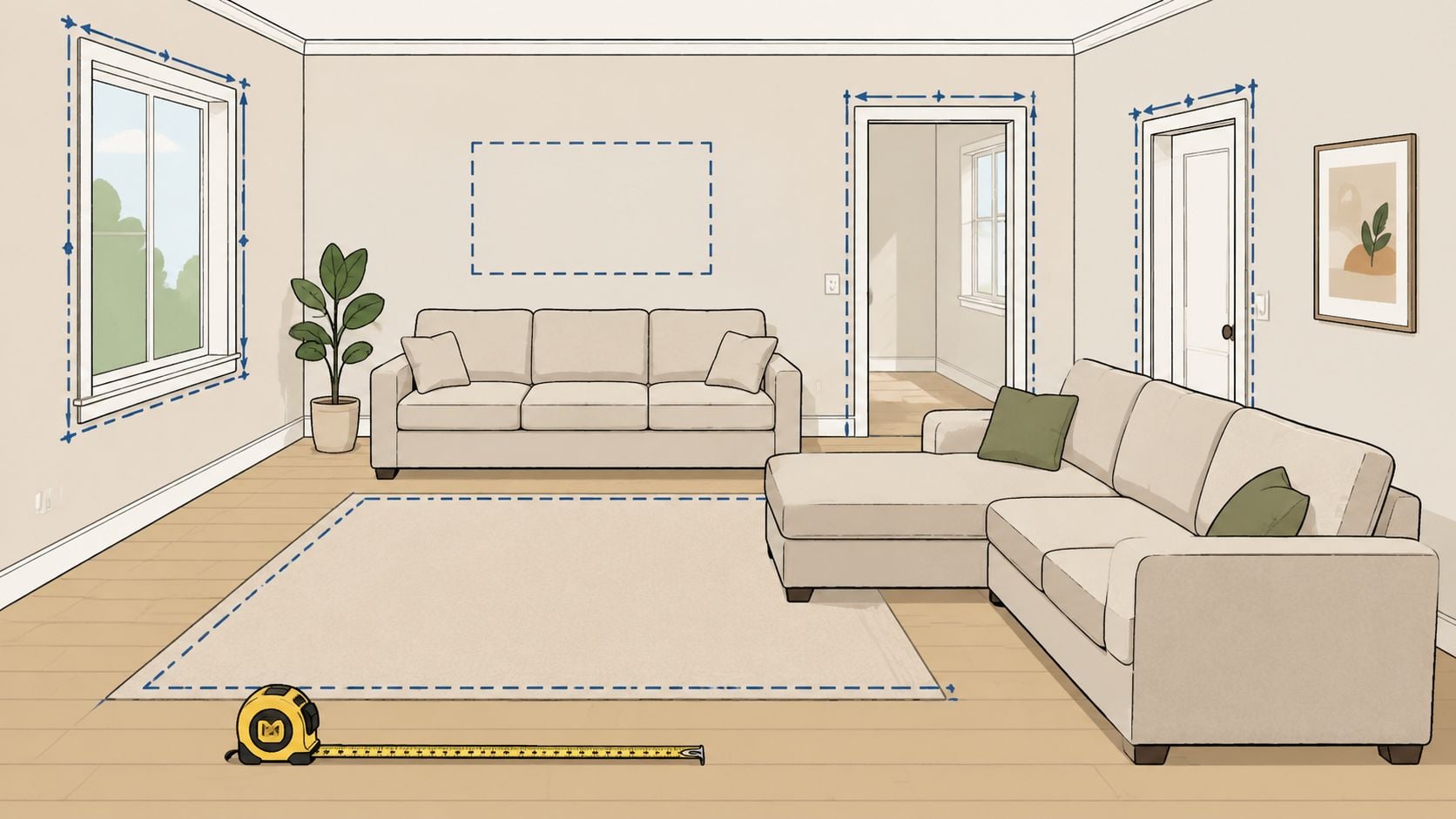
Room size decides the category only after the usable space has been measured. Total square footage can mislead because doors, radiators, windows, and walkways consume the footprint. A sofa that fits a wall may still project too far into the room, while a sectional that uses a corner may create a better seating zone but block a fireplace or the route into an adjoining space.
Seat-depth geometry is especially important. Sofas commonly measure about 21 to 24 inches deep, while sectionals often use similar per-seat depth ranges and gain lounging capacity through connected modules and corners, as outlined in this seat-depth buying guide. Broader ergonomic guidance describes compact, upright seating in the range of about 38 to 43 centimetres, or 15 to 17 inches, while deeper lounge seating supports a more relaxed posture. The exact measurement on a product specification sheet matters more than the furniture label.
Protect the traffic lanes
Main walkways should preserve about 36 inches of clearance, and seating should generally sit 18 to 24 inches from a coffee table, according to sectional sizing guidance. Those are working targets, not permission to squeeze a large piece into a difficult room. A busy passage to a kitchen or front door needs enough room for people to pass without turning sideways.
A compact Norwich living room may suit a standard sofa, an apartment-sized sectional, or a reversible two-piece configuration. A longer room may benefit from a sectional that converts an unused corner into a chaise and establishes a natural television or conversation area. In an open-plan home, floating an L-shape can separate living and dining spaces without a wall, but it can also make delivery and later rearrangement harder.
Households comparing smaller alternatives can also choose a small sofa when preserving a clear lane matters more than maximizing continuous seating. The right test is physical, not theoretical.
Tape the footprint before ordering
Use painter's tape to mark the full width and depth of the proposed sofa or sectional. Then place temporary chair shapes around it and stand in the doorway, near the television, and in the adjoining room. This reveals blocked views and awkward paths before a deposit is placed.
Seat-per-foot efficiency matters too. A larger configuration doesn't automatically deliver better performance if half the room becomes unusable. A sofa can win in a narrow room because it leaves the circulation open, while a sectional can win in a generous room because it turns otherwise wasted corner space into a comfortable seat.
For a Norwich living room layout example, the living room sectional layout guide offers a useful planning reference. The deciding measurement is the usable footprint after traffic, not the room's headline dimensions.
Which Wins in Real Households
A sofa wins when flexibility is part of the brief. It suits a formal sitting room, a smaller Norwich apartment, a long narrow room, or a household that likes to rearrange furniture when the television, rug, or accent chairs change. A freestanding sofa can float as a divider, sit against a wall, or move to another room without forcing the rest of the layout to follow.
A sectional wins when the room already has a clear purpose. Family television rooms, open-plan spaces, regular game nights, and homes that host larger gatherings benefit from one connected seating zone. People can sit together without creating a patchwork of separate pieces, and a chaise or corner can support the daily lounging that a straight sofa may not provide.
| Household Profile | Better Fit | Why |
|---|---|---|
| Couple with occasional visitors | Sofa with chairs or chaise | Offers comfortable daily seating and future flexibility |
| Family television room | Sectional | Keeps several people facing the screen while allowing relaxed posture |
| Small apartment or narrow room | Sofa | Protects walkways and leaves room for movable chairs |
| Frequent family hosting | Properly sized sectional | Creates more continuous seating in one defined zone |
| Formal living room | Sofa with complementary chairs | Supports conversation and a lighter, more balanced appearance |
| Open-plan living and dining area | Sectional, if circulation allows | Defines the living area without adding a partition |
The quiet advantages of a sofa
A sofa-plus-two-chairs arrangement often delivers more adaptable comfort for a couple than a small sectional. The chairs can face the sofa for conversation, turn toward a window, or move aside when guests arrive. That arrangement also spreads visual weight through the room rather than creating one large block.
The drawback is cost and coordination. Reaching the same practical seating capacity may require additional pieces, and separate upholstery can create a less unified appearance. A broad room may also look unfinished if the sofa is left to carry the entire layout.
The quiet risks of a sectional
Sectionals can box in narrow rooms, interrupt traffic past a corner, and commit the household to one orientation for years. A U-shaped design needs generous clearance on every side, while a chaise can make one end difficult to use for side tables or walk-through access.
The recommendation is straightforward. Choose the sofa when the room must remain adaptable. Choose the sectional when the household already knows that daily life revolves around one generous gathering zone. Children, pets, and regular sleepover guests usually push the decision toward a properly measured sectional, while frequent moves or redecorating push it toward a sofa.
Custom Programs That Make the Choice Easier
The most useful shift in the sofa vs sectional decision is to stop treating the two formats as rigid boxes. A custom sofa can be fitted to a room, and a modular sectional can be assembled around the room's actual dimensions. The format still matters, but configuration often matters more.
Start with the seating shell
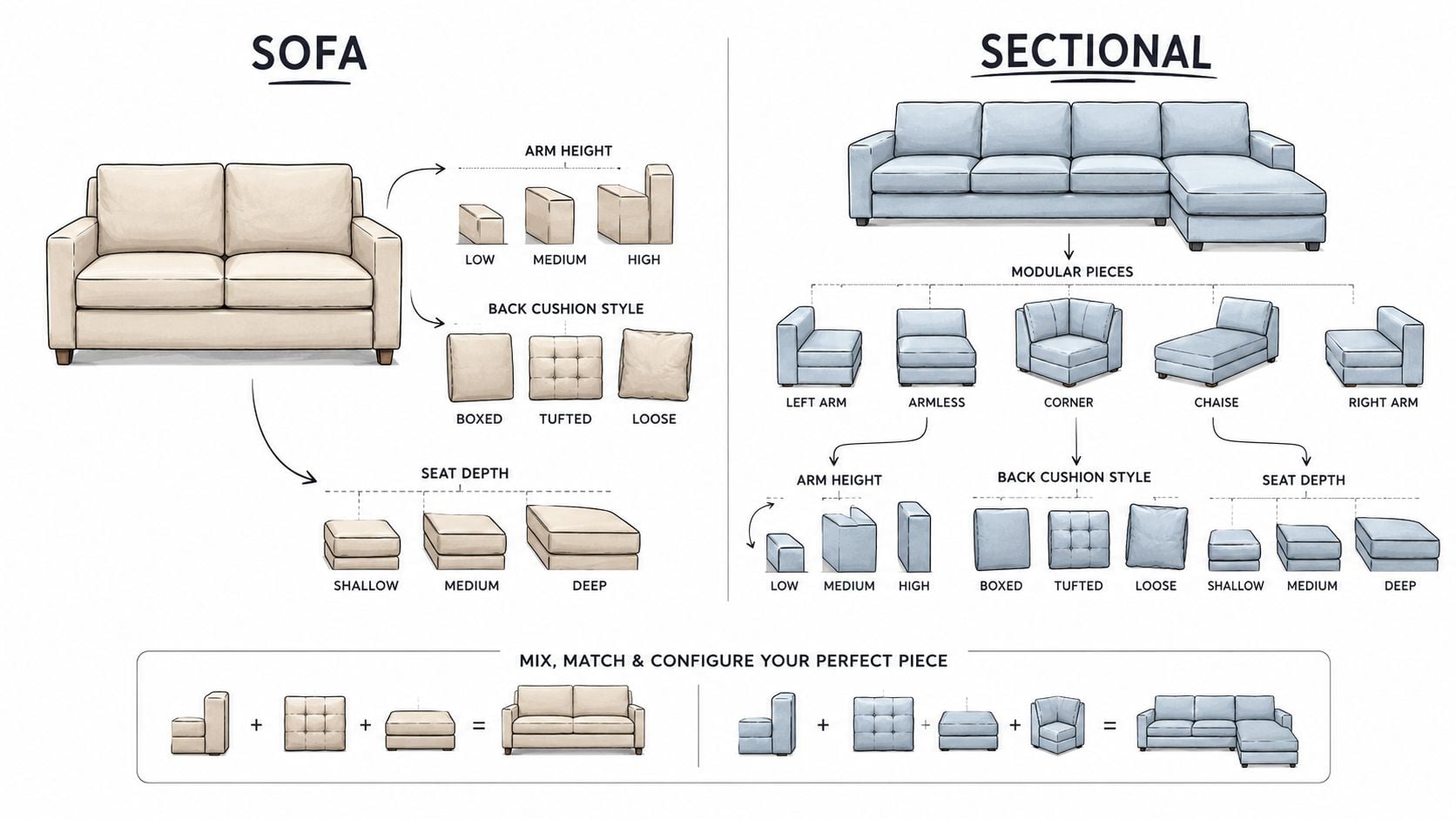
A custom sofa program can allow the buyer to select details such as:
- Arm height and shape: Lower or narrower arms can make a piece feel less imposing and preserve usable seat width.
- Back cushion style: A structured back offers a tidier appearance, while a softer option supports a more relaxed feel.
- Seat depth: The depth should suit the household's preferred posture, from upright reading to full-body lounging.
- Leg finish and upholstery: These details change the visual weight and help the piece coordinate with existing flooring, tables, and textiles.
That approach makes a smaller-footprint sofa feel deliberate rather than compromised. A household doesn't need a sectional because it wants deeper seating or a particular fabric.
Build the sectional from the room outward
Modular sectionals commonly use left-arm, armless, corner, and right-arm pieces. That lets a Norwich household build an L-shape, U-shape, chaise-end arrangement, or another configuration while checking wall length and doorway clearance at each stage.
The F9 Custom Sofa series is relevant here because its made-to-order approach can support both sofa and sectional decisions. Gorins also offers the Canadel Custom Dining partnership, where thousands of combinations are possible, demonstrating the same broader principle: furniture can be specified around a home rather than selected only from a fixed display.
Custom upholstery also brings practical choices. Performance weaves can suit households with pets, while leather and upgraded fabric tiers change the tactile experience and the overall investment. Cushion fill affects the way a seat feels on the first day and after regular use, so buyers should test samples and sit on comparable constructions.
The custom sofa design program gives shoppers a starting point for this process. Custom orders typically add lead time, but they also let the buyer settle the selected configuration and price at the time of order. In the showroom, a furniture advisor can sketch alternatives, test orientation, and turn the question from “Which shape looks right?” into “Which arrangement works in this room?”
Gorins Furniture & Mattress, founded in 1936 and locally owned and family-operated, is one Norwich option for working through those configuration decisions. Its staff can discuss living room pieces alongside the wider Living Room Furniture Eastern CT needs of households in Norwich and surrounding communities.
Budget, Fabric Upgrades, and Financing the Right Way
The cost decision needs a full worksheet, not a glance at the ticket. Consumer data shows a wide spread among sectional buyers. Half of actual sectional buyers spent $1,000 to $2,999, while 15% spent $5,000 to $10,000 or more, and 51% of shoppers considering a sectional expected to remain in the $1,000 to $2,999 range, according to this sectional buying survey. Those figures show why a buyer should establish a complete budget before choosing the largest configuration.
| Format | Typical Norwich Price Band | Common Upgrade Cost Drivers |
|---|---|---|
| Stock sofa | Entry to mid-range investment | Fabric grade, cushion fill, leg finish, delivery |
| Custom sofa | Mid to higher investment | Made-to-order upholstery, depth, arms, back style, leather |
| Stock sectional | Mid to higher investment | Chaise, corner construction, performance fabric, delivery access |
| Custom sectional | Higher investment | Additional modules, fabric yardage, leather grade, motion, storage, delivery complexity |
The table uses qualitative bands because the final figure depends on the selected frame, upholstery, dimensions, and services. A multi-piece sectional can cost more because it includes more structure and material, while a custom sofa may add cost through upholstery and cushion construction.
Add every cost before comparing
worksheet should include:
- Furniture configuration: Count every sofa, chaise, corner, armless, or console module.
- Material selection: Compare standard fabric, performance fabric, and leather on the complete order.
- Comfort construction: Ask how cushion fill and support affect the feel and maintenance.
- Delivery requirements: Include access concerns for stairs, narrow turns, and multi-piece handling.
- Taxes and services: Use the final delivered total rather than the displayed starting price.
Households researching textile care can review these interior fabric performance tips, then ask the showroom for fabric-specific cleaning and durability information. The upholstery materials guide can also help buyers distinguish appearance from everyday practicality.
Financing must be read, not assumed
Promotional Financing with equal monthly payments can lower the barrier to a larger purchase, but the term and conditions matter. Furniture offers may use 24, 36, or 60 equal monthly payments, with the payment calculated from the financed balance and promotional term, and some offers may require a down payment, as explained in the equal-payment financing information.
A financing disclosure for home furnishings states that promotional plans require credit approval and may charge interest if the balance isn't paid in full by the end of the promotional period, as described in this furniture financing disclosure. The buyer should compare the financed balance, payment schedule, due dates, and full repayment requirement before signing.
Custom modular furniture may also be offered through APR-based payment examples ranging from 0.00% to 35.99% APR, depending on creditworthiness and term length, according to this modular sectional payment information. The responsible choice is the configuration whose total cost and monthly obligation remain comfortable throughout the entire promotional window.
Your Norwich Buyer Checklist and Next Steps
The purchase should begin at home, not in the showroom. A short measuring exercise prevents the most expensive type of mistake, ordering a piece that fits the room but can't reach it.
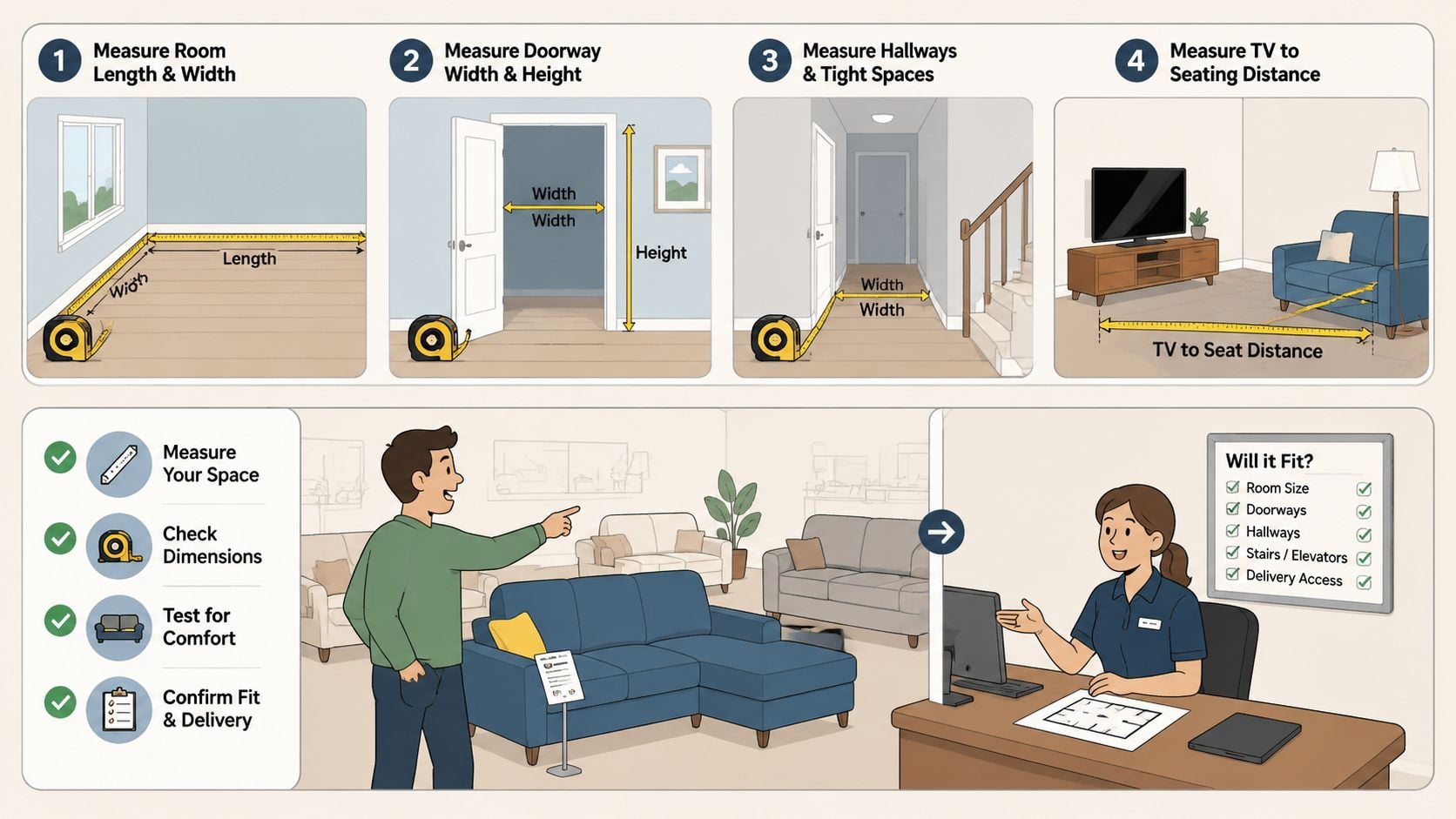
Before the visit
- Measure the room: Record each usable wall, then note windows, radiators, fireplaces, and door swings.
- Measure the route: Check the entry door, hallway, stair turns, and any narrow approach to the living room.
- Mark the television: Establish the intended screen wall and the seating direction.
- Tape the footprint: Mark the proposed width and depth on the floor, then walk around it during a normal evening.
- Photograph the room: Include adjoining spaces so the furniture advisor can see the whole circulation pattern.
At the Norwich showroom
A useful appointment should test the furniture rather than rely on a quick visual impression. The household can work through the online Style Quiz, sit in three depth options, compare upright and lounge positions, and check whether the arm height works beside existing tables.
The advisor should also ask about:
- Cushion fill: Confirm the support and maintenance expectations.
- Fabric durability: Request performance information for children, pets, and frequent use.
- Configuration: Review the exact left-facing or right-facing orientation.
- Finish details: Confirm leg finish, welt details, fabric, and leather selections.
- Delivery access: Match the order to the measured Norwich address and route.
Gorins' The Sleep Gallery is a separate consideration when the same household is furnishing bedrooms. It carries brands including Tempur-Pedic, Serta, and Beautyrest, with an emphasis on comfort by feel and healthier sleep. Premium mattress brands can have separate financing terms, and one retailer's offer specifically names Tempur-Pedic, Stearns & Foster, and Beautyrest Black for a 72-month interest-free plan with equal monthly payments, subject to its stated terms, as shown in this premium mattress financing offer.
For furniture financing details, Norwich shoppers can review no-interest furniture financing and ask the sales team to outline payment scenarios through available in-house options. The order form should include the configuration drawing, cushion fill, leg finish, upholstery selection, delivery access notes, and the final total.
Since 1936, Gorins Furniture & Mattress has helped Norwich and Eastern CT families create homes they love. From custom-designed Canadel dining sets to the latest in Tempur-Pedic sleep technology, the locally owned, family-operated business combines a broad selection with personalized care and 5-Star Delivery service.
Gorins Furniture & Mattress offers custom sofas, modular sectionals, upholstery guidance, and Promotional Financing with equal monthly payments for qualifying purchases. Norwich neighbors can visit Gorins Furniture & Mattress to test sofa and sectional depths, take the online Style Quiz, or browse the Clearance section for value-driven savings before choosing the configuration that fits both the room and the budget.