Perfect Living Room Furniture Arrangement With Fireplace

You're standing in your living room, looking at the fireplace, the sofa, the TV, and that one walkway everyone cuts through, and nothing feels settled. The room might have good bones, but the furniture arrangement doesn't quite support how your household lives. One person wants a cozy fire-viewing setup, someone else wants a clear TV angle, and everyone needs to move through the room without weaving around corners.
That's where a smart living room furniture arrangement with fireplace starts to matter. In homes across Norwich, New London, Plainfield, Waterford, and the surrounding Eastern CT communities, the fireplace still acts like the room's visual anchor. The trick isn't forcing a magazine-perfect layout. It's building one that respects the fireplace, supports conversation, and still works on a Tuesday night when the family is spread across the room.
Since 1936, local families have leaned on practical furniture advice because most real rooms aren't blank boxes. They have corner hearths, tight walls, windows in inconvenient spots, and furniture that almost fits. The good news is that workable layouts follow a few reliable principles.
How I Plan a Living Room Furniture Arrangement With Fireplace
When a customer brings room photos into our Norwich showroom, the first thing I do isn't talk about sofas. It's talk about tape measures. A fireplace layout fails at the numbers long before it fails on style, so the plan always starts the same way. If you are learning how to measure room for furniture, or how to measure a room for furniture that includes a hearth, these living room layout measurements form the baseline for every decision that follows.
- Measure the room shell. Record length and width in at least two spots per wall. Older homes are rarely square. Also record ceiling height if you're considering tall pieces or an above-mantel TV.
- Measure the fireplace itself. Get the hearth width, how far the hearth projects into the room, and the mantel depth. Those two projections eat floor space that flat-wall rooms don't lose.
- Map the fixed features. Doors and their swing arcs, window positions and sill heights, vents, radiators, and any openings to other rooms.
- Trace the traffic lines. Note the path people already walk, usually kitchen-bound, before you decide where anything goes.
- Sketch it to scale. Even a rough 1-square = 1-foot drawing on graph paper catches problems a mental picture won't.
- Log furniture dimensions against the sketch. Sofa depth, chair width, coffee-table footprint, written next to the room numbers, not remembered.
A quick example: a 14-by-15-foot room with a centered hearth projecting 20 inches effectively gives you a usable depth of about 160 inches (13 feet 4 inches) from the hearth face to the opposite wall. Subtract a 36-inch walkway along one side and a 38-inch-deep sofa placed against the far wall, and you are left with roughly 86 inches of open floor between the sofa front and the walkway edge. That remaining span must also hold your coffee table and knee space, which shows why fireplace furniture clearance measurements often rule out oversized sectionals before you ever set foot in a store.
The Foundation Assess Your Space and Fireplace
A good fireplace layout starts on paper, not with furniture scraping across the floor. The measurement workflow above covers the general room; this section focuses on what the fireplace itself demands.
In Eastern CT homes, I see the same pattern again and again. The room looks straightforward until you account for the hearth depth, the window that limits chair placement, and the walkway everyone uses to get to the kitchen or hall. Families often try two or three arrangements before realizing the room was giving them the answer all along.
Record the hearth width and how far the hearth and mantel project into the room, then subtract those projections from your usable floor area before you shop. Measuring furniture placement is really a clearance exercise, not just a check of whether a sofa fits the wall. Accessibility standards offer a useful benchmark here: an accessible route generally needs at least 36 inches of continuous clear width (1991 ADA design standards). Even if no one in your home uses a wheelchair, that 36-inch minimum is a sensible target for main walkways — 24 inches is our studio's working squeeze-through tolerance for secondary paths, and less than that gets old fast.
If you need accurate dimensions before buying or rearranging, Gorins has a practical guide on how to measure furniture for your space.
Practical rule: The sofa usually has the fewest workable positions. Place that first, then fit the rest of the room around it.
Identify the room's pressure points
Every living room has one or two constraints that drive the whole plan. In many Norwich, New London, and Plainfield area homes, it's a narrow pass-through lane, an off-center firebox, or a mantel wall that looks generous until you try to place full-size seating nearby.
Odd-shaped rooms deserve their own attention. When furnishing an awkward footprint, identifying the pressure points first and then picking furniture that fits them is a strategy we share with showroom visitors, and via Pinnacle Property Media you will find a useful walkthrough that mirrors that same approach.
At this stage, centered and corner fireplaces begin to create different layout problems. A centered fireplace often supports symmetry. A corner fireplace changes the angle of the room and uses wall space you may have counted on for a media cabinet, a longer sofa, or a pair of matching chairs.
Another common mistake is pushing every seat against the walls. That usually leaves the middle of the room empty, weakens the fireplace as a focal point, and makes conversation feel scattered. Pulling seating in a little often improves comfort and traffic flow at the same time.
Decide how the room needs to work
Before choosing a layout, get clear on the room's job. A family room that handles movie nights, holiday guests, and everyday lounging needs a different plan than a quieter sitting room.
Ask:
- Will the room be used more for conversation or TV?
- Does the fireplace need to share attention with a screen?
- Do people cross through this space to reach another room?
- Will you need flexible seating for guests, kids, or both?
These answers shape the furniture choices too. In our showroom, this is often the point where custom options make more sense than trying to force standard sizes into an awkward room. A slightly shorter sofa, a tighter chair profile, or an upholstered ottoman instead of a bulky coffee table can solve a layout problem without giving up comfort. Fabric matters just as much. Busy households usually need materials that wear well and still feel warm and inviting. If you are comparing premium fabrics and custom upholstery, focus on cleanability, texture, and how the material looks in firelight, not just the swatch under store lighting.
Gorins has been helping local families make those calls since 1936. The value is not just in buying furniture. It's in getting pieces sized, upholstered, and arranged for the way your home works.
Classic Layouts for Centered Fireplaces
A centered fireplace does a lot of the hard work for you. In many Eastern CT homes, especially colonials and capes around Norwich, the room already wants a balanced layout. The goal is to use that structure without making the space feel stiff or old-fashioned.
The strongest layouts keep the seating group tied to the hearth, then adjust for how your family lives. Some households want a room that handles conversation first. Others need space for reading, casual TV, or kids spreading out on the rug. The layout has to serve those habits, not just look right in a photo.
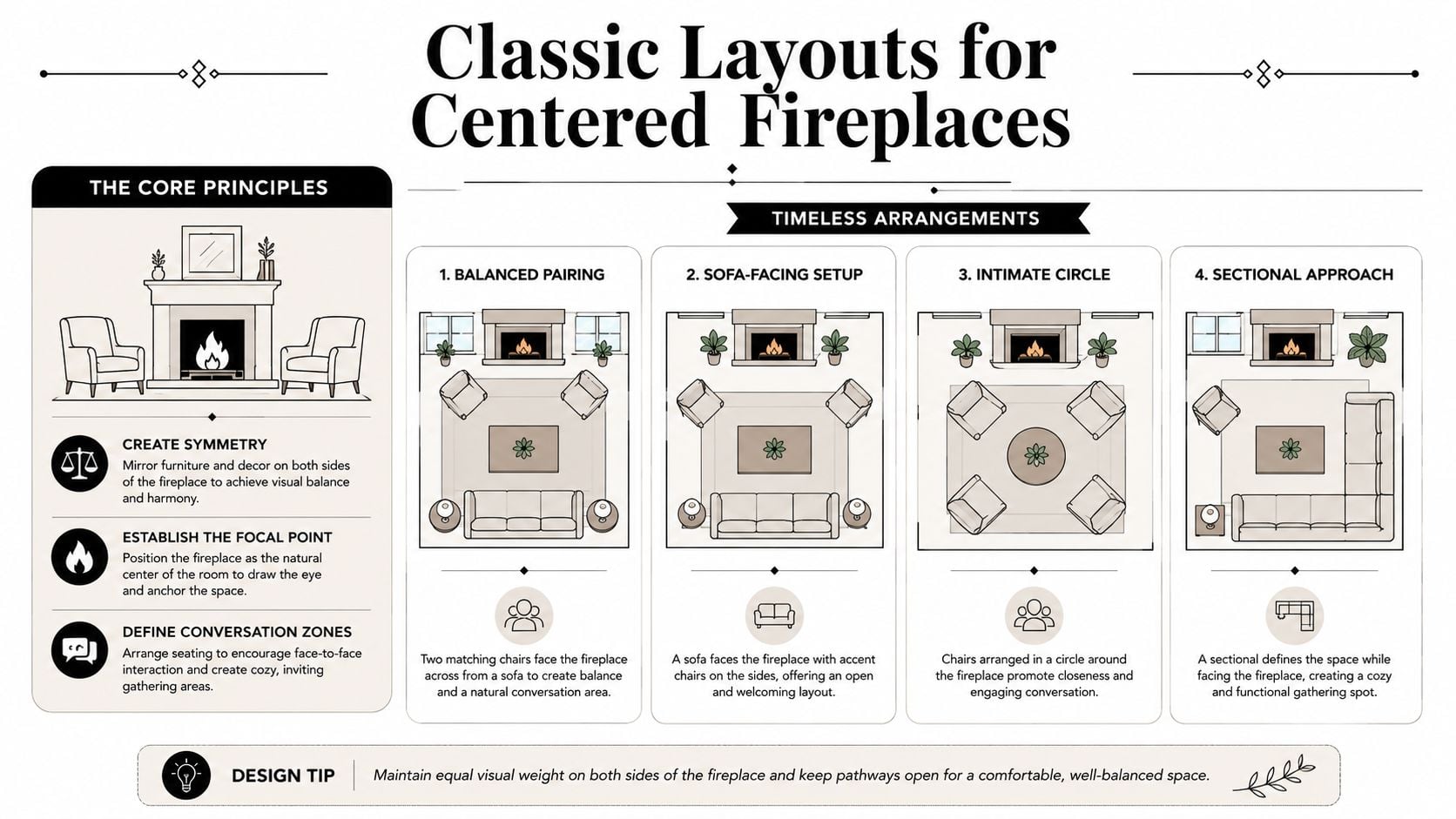
The sofa and two chairs arrangement
This is the centered-fireplace layout I recommend most often. A sofa faces the fireplace, and two chairs sit across from it or angle inward toward the coffee table.
It works because it gives you balance without forcing perfect symmetry. People can talk easily, the fireplace stays in view, and the chairs are easy to move a few inches when guests come over. In smaller living rooms, I usually steer people toward chairs with narrower arms and open legs. That keeps the room lighter and protects the walking paths.
A few choices improve this layout right away:
- Angle the chairs slightly inward so the grouping feels welcoming instead of rigid
- Use one properly sized rug to hold the full seating area together
- Add only the tables you need so the room stays open and easy to move through
The face to face sofa layout
Two sofas facing each other make sense in a wider room or in a home where people gather often. This plan creates a strong conversation zone, and it suits a centered fireplace because the architecture already supports a formal kind of balance.
I've used this layout in plenty of older Norwich homes where the fireplace wall, windows, and room proportions all line up cleanly. When the room has the width for it, two sofas can feel calm and generous. When the room is too tight, the same layout feels crowded fast. That is the trade-off.
Watch the clearance around the coffee table and the path behind each sofa. If those spaces start shrinking, the room usually needs a smaller sofa, a narrower table, or a different plan altogether. That is often where custom sizing helps. At Gorins, a slightly shorter sofa or a shallower profile can save a layout that would fail with standard showroom dimensions.
For homeowners who want a less expected setup, Gorins also shares uncommon furniture arrangements that work wonders without giving up comfort or function.
The sectional that defines the zone
A sectional works well when the living room opens to a dining space, kitchen, or hallway and you need the furniture to shape the room. Instead of pushing everything to the walls, the sectional marks out the seating area and keeps the fireplace connected to the rest of the space.
This layout asks for restraint. A sectional that is too deep or too long can dominate the fireplace wall and make the mantel look undersized. A sectional with the right proportions does the opposite. It anchors the room and still leaves space for lamps, side tables, and clean circulation. That is why many families here do better with a customized sectional than an oversized one bought off the floor.
A well-scaled Flexsteel sectional is often a good fit for this approach. One side can face the fireplace directly, while the return gives extra seating for conversation or TV viewing without splitting the room in two.
| Layout | Works well for | Watch out for |
|---|---|---|
| Sofa plus two chairs | Mixed-use family rooms | Too many small pieces can clutter the seating area |
| Two sofas | Conversation-focused rooms and wider floor plans | Needs enough width around the coffee table and walkways |
| Sectional | Open layouts and larger households | Can overpower a modest fireplace wall if the scale is off |
The best centered-fireplace rooms feel settled, comfortable, and easy to use. That usually comes from getting the proportions right, choosing furniture that fits the architecture, and making smart adjustments instead of forcing a stock layout into a real Eastern CT home.
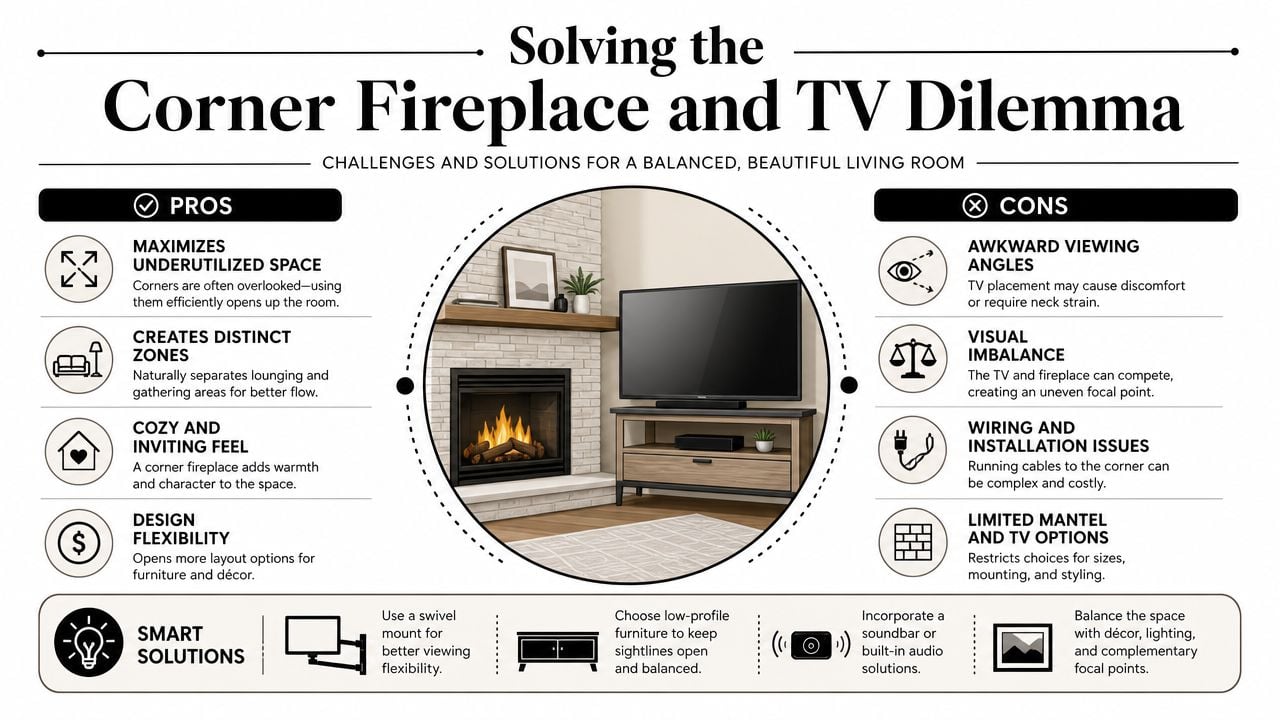
Solving the Corner Fireplace and TV Dilemma
Corner fireplaces test every instinct people have about furniture placement. The angle changes the room. One wall disappears as a clear option, the fireplace no longer sits in the middle, and then the TV enters the argument.
This is why corner rooms need a decision process, not a decorating formula. The harder question isn't how to make the fireplace the focal point. It's how to balance fireplace sightlines, TV viewing, and circulation so the room doesn't feel awkward, as discussed in this corner fireplace and TV layout article. That same guidance also points out that swivel chairs can help people pivot between the fireplace and the television.
TV above the fireplace or beside it
Both solutions can work. Neither is universally right.
If you mount the TV above the mantel, you free up another wall for seating. That can be useful in a compact room where every full wall matters. The downside is that the fireplace and TV become one tall visual stack, which some rooms handle better than others.
Putting the TV on the adjacent flat wall often creates a more natural furniture arrangement. The sofa can face that wall, and the fireplace still stays in the room's visual field. In many open-plan homes, that's the cleaner answer because it gives each feature its own role.
The diagonal and floating approach
A corner fireplace room rarely improves when everything gets pushed back to the edges. Floating the furniture inward often solves more than people expect.
Try these strategies:
- Turn the main sofa toward the room's strongest flat wall if that wall also supports the TV
- Use an L-shape with a sofa and one chair or loveseat so the fireplace still feels acknowledged, according to this corner fireplace layout discussion
- Angle a chair rather than the whole room when you need flexibility without visual chaos
- Choose a round coffee table when a sharp-cornered table would tighten the pathway
Sometimes the room wants a diagonal reading, not a square one. That doesn't mean placing every piece on an angle. It means respecting the way the fireplace shifts the room's center of gravity.
Flexible seating wins in awkward rooms
Compact recliners and swivel chairs are particularly well-suited for these situations. A swivel chair near a corner fireplace can face the fire during conversation, then turn toward the TV later without forcing the whole layout to do double duty. In practical terms, that's often better than trying to make one fixed sofa line solve every problem.
I also like this approach for households that use the room differently throughout the day. Morning coffee, family TV time, guests on weekends, quiet reading in the evening. One rigid arrangement doesn't always serve all of that.
If you're trying to reconcile both media viewing and comfort, this guide on sofa and television placement gives a useful planning lens.
A corner fireplace room works best when the furniture supports movement first, then view lines, then perfect symmetry.
That order matters more than people think.
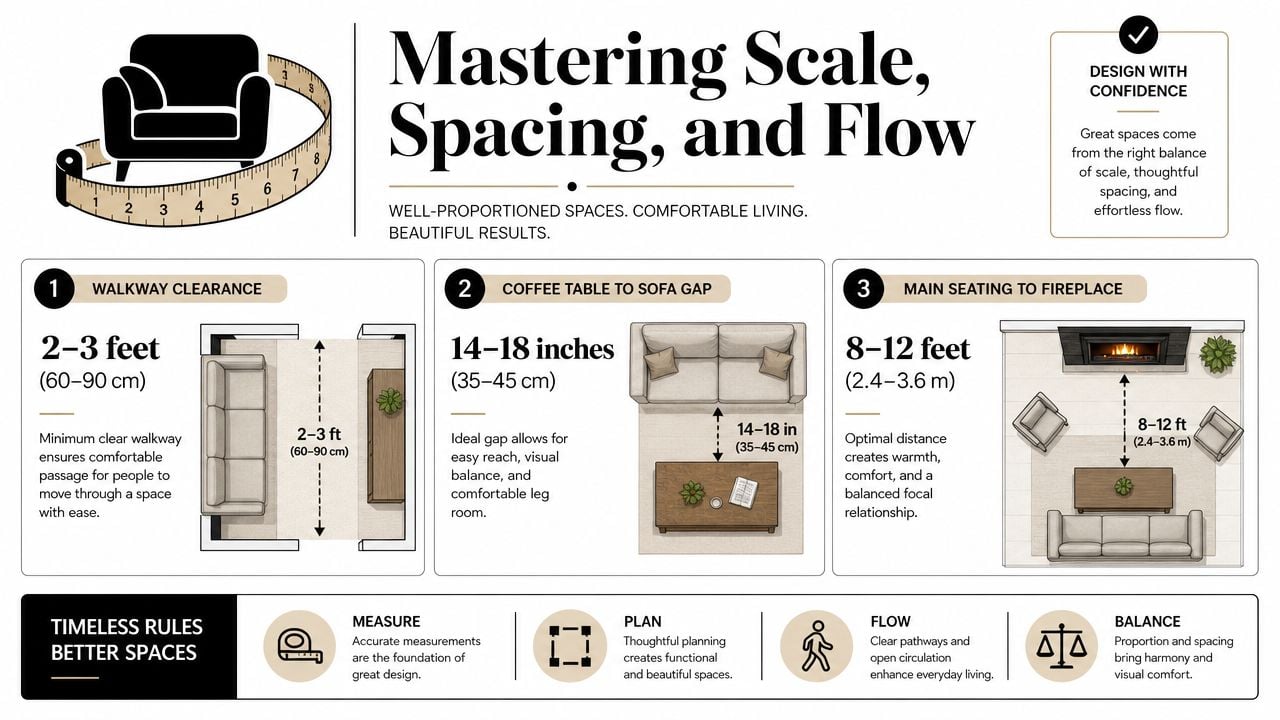
Mastering Scale Spacing and Flow
Some rooms feel crowded with very little furniture. Others feel welcoming even with a full seating group. The difference is usually scale and spacing — and around a fireplace, spacing is a safety question as much as a comfort one.
The numbers that matter most in a hearth room:
- 14–18 inches between the sofa or chairs and the coffee table — close enough to set a mug down, far enough to pull knees in
- 30–36 inches for primary walkways; 24 inches is our studio's minimum tolerable guideline on a secondary path
- At least 36 inches of clear width along any main circulation route, matching the accessibility benchmark noted above
- Turning space matters if the room serves older family members: U.S. Access Board guidance notes that passing a narrow obstruction requires additional clearance, such as a 48-inch minimum width at the turn with 42 inches approaching it, or a turning space of at least 60 inches in diameter (U.S. Access Board accessible-routes guidance)
Decorative spacing and heat clearance are two different checks. Aesthetic distances like the ones above govern comfort, but a working fireplace also imposes its own clearances on anything flammable. The National Fire Protection Association advises maintaining specified clearances between heating appliances and combustible materials, so always follow the manufacturer's guidance for your specific firebox and keep seating, throws, and curtains back from an active hearth (NFPA home heating safety guidelines). When in doubt, keep seating farther from the hearth than the design plan requires.
Measure before you buy — a quick fit checklist:
- Compare sofa depth against hearth projection: the walkway between them should stay at least 30 inches.
- Check that the coffee table leaves 14–18 inches of knee room from every seat.
- Confirm no chair blocks a fire-viewing angle from the main sofa or sits in a traffic lane.
- Note mantel overhang depth before placing a media piece or floor lamp beneath it.
- Consider visual weight: a low-profile arm or open-leg base keeps the hearth sightline clear, and a rug sized to the seating group anchors the arrangement without crowding the mantel wall.
This is one place where made-to-order furniture changes the outcome. In many Eastern CT homes, the issue isn't style. It's fit. A sofa that's just a bit too long can force the whole arrangement out of balance, especially around a fireplace where sightlines matter. The F9 Custom Sofa series is useful in those situations because it gives you thousands of combinations across size and style details. That lets the furniture fit the room instead of making the room submit to standard dimensions. A shorter sofa, a different arm profile, or a cleaner back can be the difference between a walkway that works and one that always feels pinched.
For homeowners sorting through proportions before they buy, Gorins has a practical guide to choosing furniture for your home's layout.
Scale also affects mood. If you want the room to feel warmer once the layout is settled, it helps to discover cozy home styling tips that layer in softness without adding clutter.
Designer's check: If people have to turn sideways, step around corners, or squeeze between a chair and table, the room is asking for less furniture or better-scaled pieces.
A strong layout feels calm because nothing is competing harder than it should.
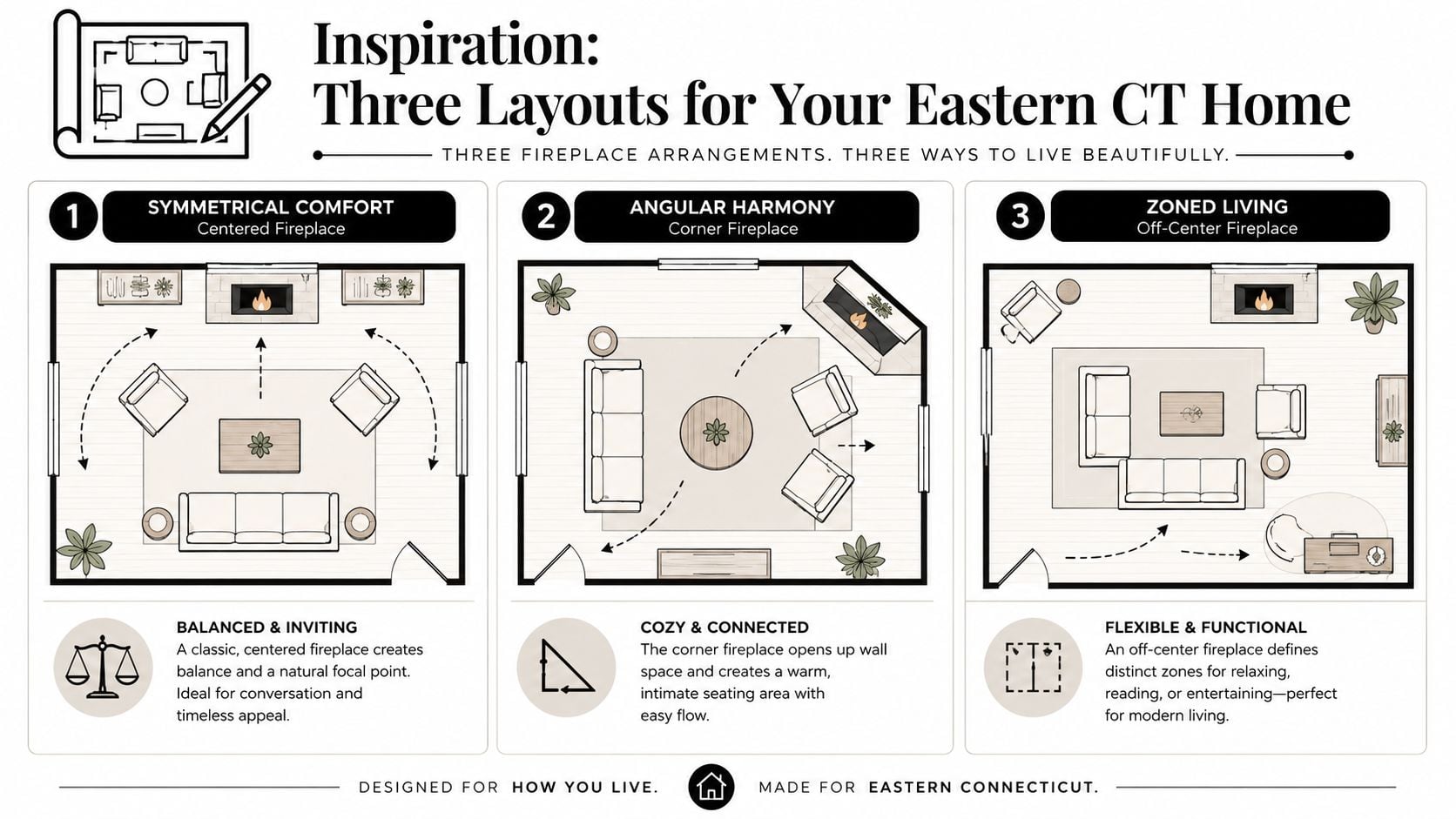
Inspiration Three Layouts for Your Eastern CT Home
These are the three room shapes we see most often around here, usually as phone photos with measurements scribbled on the back of an envelope. For each one, the deciding numbers come first — the layout follows from them. The thresholds below reflect our studio's working rules of thumb rather than universal standards.
The centered-fireplace colonial
Constraint: symmetry you don't want to break. Key measurements: hearth width and projection, plus the width left between hearth and front window.
As a working guideline, if you have 8 feet or more between the hearth edge and the window wall, a sofa facing the fireplace with two angled accent chairs opposite works, and the room still reads balanced. If that gap shrinks below about 7 feet, swap the two chairs for one chair and an ottoman — the seating still frames the hearth, but the walkway survives. A rectangular rug and a clean-lined coffee table finish it without crowding the middle.
The corner-fireplace bungalow
Constraint: one flat wall gone, TV still needs a home. Key measurements: the length of each adjacent wall, the diagonal distance from the corner to the room's center, and the depth of any furniture planned near the fireplace.
In our experience, when the adjacent walls run 10 feet or more, a loveseat facing the longer wall with a swivel chair floating near the fireplace gives you both a TV angle and a fire view. Below roughly 9 feet per wall, drop to a loveseat-plus-armless-chair combination or the seating will strangle the walkway. The swivel chair earns its spot here — it's the cheapest way to serve two focal points in one tight corner.
The open-plan Waterford great room
Constraint: no architecture defines the living zone. Key measurements: the depth you can afford for a boundary piece without blocking the kitchen path, and the distance from fireplace wall to the dining area.
As a studio benchmark, if you have 12 feet or more of clear depth, a sectional works with one side facing the fireplace and the return marking the living-zone edge. With 10 feet or less, the sectional's depth plus a walkway exceeds the space — a sofa facing the hearth with a console table behind it makes the boundary instead. Here's the trade-off at a glance:
| Home style | Main challenge | Smart layout move |
|---|---|---|
| Colonial | Keeping symmetry from feeling stiff | Soften with angled chairs |
| Open plan | Defining the living zone | Use sectional shape as boundary |
| Bungalow | Saving circulation around corners | Choose fewer, more flexible pieces |
Some of the best fireplace rooms aren't the biggest ones. They're the ones where every piece knows its job.
If you want more visual examples before you start moving furniture, these living room layout ideas are a useful next step.
Frequently Asked Questions
What is the 2/3 rule for furniture?
It's a proportion guideline we use as a starting point: a rug should run at least two-thirds the length of the sofa it anchors, and major furniture groupings should occupy about two-thirds of the wall they sit against. In a fireplace room, that means the seating group should roughly fill two-thirds of the hearth wall's width — wide enough to balance the fireplace, narrow enough to leave breathing room on both sides.
What is the 4 inch rule for furniture?
Our studio's version of this commonly cited guideline says keep the gap between a sofa's back and the wall to about 4 inches or less. Anything wider collects dropped remotes and dust and makes the sofa look pushed out of the arrangement. Around a fireplace wall, that same rule applies to the mantel side — a sofa hovering inches off the hearth wall reads as a layout that never quite committed.
What size couch should I get for a 12×12 room?
A 12-by-12 room has 144 square feet, which in our planning experience supports a standard sofa up to about 84 inches long — a full-size or apartment sofa, not an oversized one. Keep the sofa depth to roughly 36–38 inches, pair it with one chair or a loveseat rather than a full chair set, and use a coffee table no larger than about 40 inches wide so the 14–18-inch knee space survives. Skip deep sectionals here; most will eat the walkway.
How much clearance should furniture keep from a fireplace?
Comfort spacing of 14–18 inches between seating and the coffee table, and 30+ inches of walkway, governs the room plan — but an active fireplace adds its own heat clearance that varies by firebox type, fuel, and manufacturer. Check the manufacturer's clearance guidance for your unit and authoritative sources such as the NFPA, and keep anything flammable, including upholstery and throws, well back from an operating hearth.
Can furniture face both the TV and the fireplace?
Yes, and it's one of the most common requests we help with. Swivel chairs are the easiest answer: they pivot between the hearth and the screen without moving. Otherwise, angle the primary sofa slightly off-axis to the fireplace and let a chair or loveseat cover the TV wall, or mount the TV above the mantel if viewing heights work for your household. One fixed sofa line rarely serves both focal points well.
Your Perfect Living Room Awaits at Gorins
A fireplace gives a living room identity, but the furniture arrangement determines whether that identity feels welcoming or awkward. The right plan respects the hearth, supports how people move through the room, and matches the way the household spends time there.
That's where local guidance matters. Homes in Norwich and across Eastern CT aren't all built from the same template, so a successful layout usually comes down to careful measuring, realistic furniture choices, and a willingness to solve the room you have instead of chasing a generic showroom picture. Since 1936, families here have counted on that kind of practical help from a local, family-operated business grounded in quality, value, and helpful service.
Customization is often the difference-maker. With thousands of combinations available through programs like Canadel Custom Dining and the F9 Custom Sofa series, it's possible to tailor size, shape, and finish to the room instead of settling for close enough. Promotional Financing with equal monthly payments also helps many households make thoughtful, long-term furniture decisions without rushing.
If you want to learn more about the local story behind that approach, visit the family-owned furniture store page.
Ready to move from guessing to a room that works?
- Visit the Norwich showroom to sit, compare, and see how different scales and layouts feel in person.
- Take the online Style Quiz if you want help narrowing down the look that fits your home and lifestyle.
- Browse the Clearance section for value-driven finds that still support a polished, long-lasting room design.
If you're ready to create a living room that feels right around your fireplace, Gorins Furniture & Mattress is a practical place to start. Since 1936, they've helped Norwich and Eastern CT families furnish their homes with personalized guidance, custom options, and a low-pressure showroom experience.