Gliders for Nurseries: A Buyer’s Guide for Norwich, CT


The nursery usually starts with the fun choices. Paint, crib, a lamp, maybe a soft rug. Then you get to the chair, and suddenly the decision feels more serious. That seat may become the place where you feed at 2 a.m., settle a fussy baby before dawn, and take a breath when the day feels longer than expected.
That's why gliders for nurseries deserve more thought than they often get. A good one supports your back, keeps motion smooth and quiet, and still feels worth owning long after the baby stage has passed. A poor one can squeak, sit awkwardly, and turn a daily routine into a strain.
For families around Norwich and Eastern CT, I always suggest looking at a nursery glider as part comfort piece, part long-term home investment. Trends come and go. A well-built chair that fits your body and your room keeps earning its place.
Creating a Haven for You and Your Baby
A nursery glider isn't just another item on a checklist. It's often the one seat in the house that gets used with the most purpose. You'll use it when your shoulders are tired, when the room is dark, and when comfort matters more than style language on a product tag.
That helps explain why demand keeps growing. The global nursery glider and recliner sector is projected to grow at a 4.4% CAGR from 2026 to 2033, tied to stronger focus on infant sleep environments and multifunctional furniture, according to this nursery glider and recliner market forecast. Parents aren't treating these chairs like extras. They're treating them like working pieces of furniture.

Start with the moments that happen in the chair
Before you compare fabrics or bases, think about the tasks the chair has to handle well.
- Feeding support: You need arm placement that doesn't force your shoulders upward.
- Soothing rhythm: Motion should feel steady, not jerky or noisy.
- Getting up safely: The seat can't be so deep or soft that it traps you when you're holding a sleeping baby.
- Daily living: A side table, dim light, and washable textiles matter almost as much as the chair itself.
A nursery works best when the chair supports the routine, not when it simply matches the crib.
There's also the visual side of the room. If you're still pulling the nursery together, this Nifty Posters kids art guide is a useful reference for choosing wall art that feels gentle and age-appropriate without making the room look overly themed.
What new parents often misunderstand
Many people shop for the chair last and choose with their eyes first. That's backwards. The best gliders for nurseries usually win on comfort, scale, and durability before they win on trend appeal.
A simple test helps. Sit down, settle your shoulders, place your arms as if you're holding a baby, and stay there for a few minutes. If your lower back already feels unsupported in the showroom, it won't improve during a late-night feeding.
Choosing Your Comfort Motion Gliders Rockers and Recliners
The terms get mixed together all the time. Glider. Rocker. Recliner. Some chairs combine features, but the base motion still matters because it changes how the chair feels every day.
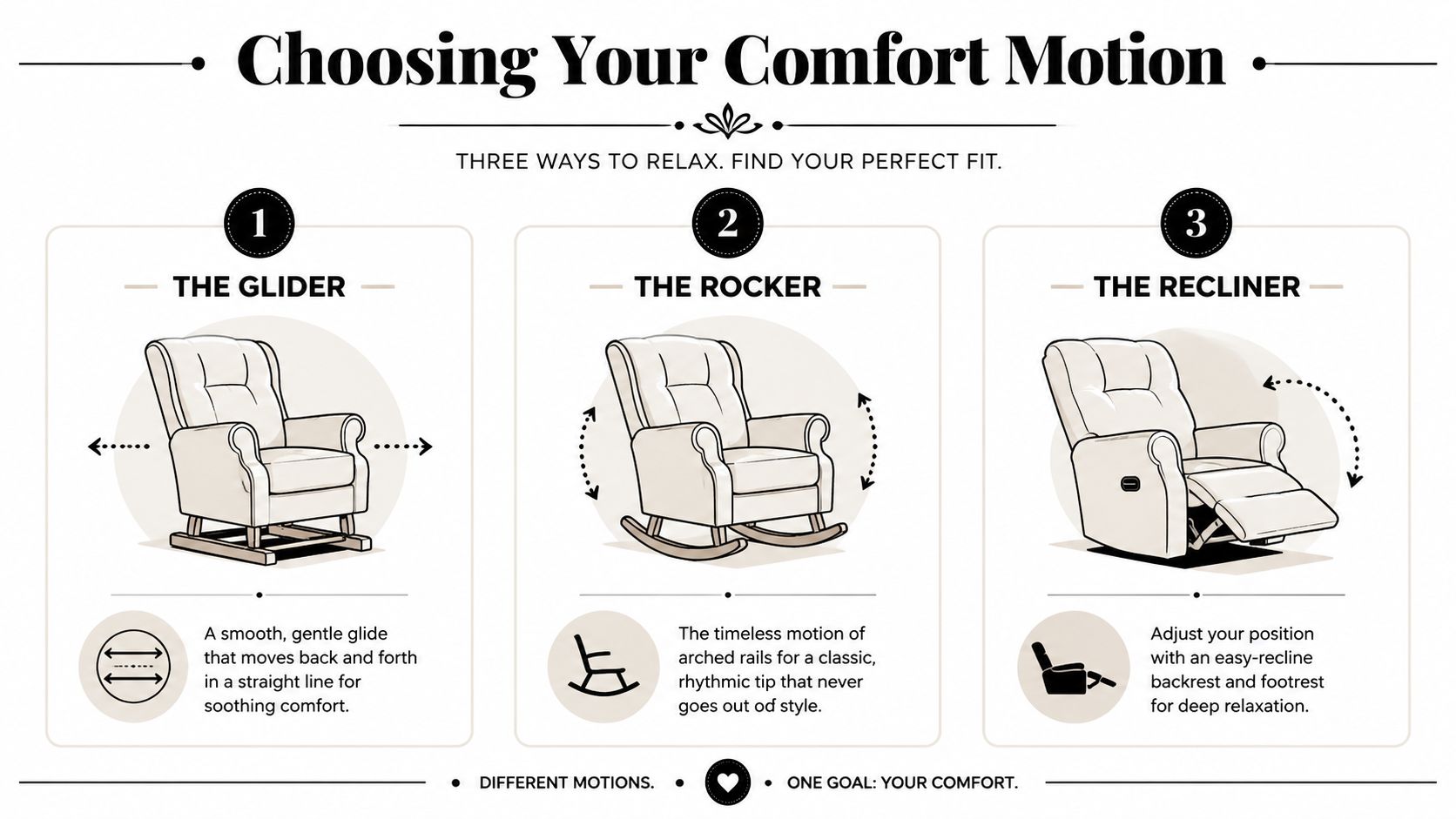
A glider moves on a fixed track in a smooth horizontal path. A rocker tips in an arc on curved runners. A recliner changes body position by leaning back and often raising a footrest, but it may or may not glide.
According to this glider versus rocker comparison, gliders reduce bumpiness by up to 50% compared to rockers, and 85% of parents in Consumer Reports survey findings rated gliders higher for daily use. That lines up with what many parents notice right away in person. The motion feels steadier and easier to control.
Glider vs Rocker vs Recliner at a glance
| Feature | Glider | Rocker | Recliner |
|---|---|---|---|
| Motion style | Smooth horizontal glide on a fixed track | Arc-based rocking on curved legs | Back reclines, footrest may rise |
| Best for | Feeding, soothing, steady daily use | Traditional feel and simple motion | Resting, leg support, longer sitting sessions |
| Feel in motion | More controlled | More rhythmic and old-fashioned | Usually more stationary unless combined with glide |
| Noise potential | Often quieter | Can feel more audible over time | Depends on mechanism |
| Nursery fit | Strong all-around choice | Works if you like classic styling | Best when comfort and recline matter most |
Which one suits real life best
If your main job for the chair is feeding and soothing, a glider usually gives you the easiest motion to live with. It doesn't ask your body to keep adjusting with each arc the way a rocker can.
If you love the classic look of a rocker, that's fine. Just make sure you like the actual movement, not only the appearance. A chair can be beautiful and still feel wrong after twenty minutes.
If deep lounging matters most, a recliner earns its place. Some new parents also look at textured upholstery and high-quality finishes for rooms that need to feel polished, not overly baby-focused. This example of luxury boucle furniture for new parents shows how some nursery seating now crosses over into more design-led spaces.
A practical showroom test
Bring your attention to three things when you sit down:
- Your elbows: They should rest naturally, not hover.
- Your feet: You should feel grounded when upright.
- The motion: Start and stop the chair several times. Smooth matters more than dramatic.
If you want a plain-language breakdown of how the mechanism differs from a traditional rocking chair, this guide explaining what a glider chair is is a helpful primer.
And if you're shopping brands such as Best Home Furnishings, test them slowly. A quick sit tells you very little. Two or three minutes reveals much more.
What Makes an Investment-Grade Glider
A nursery chair can look substantial and still be built lightly inside. What matters most is hidden under the seat and inside the frame. That's where quality separates itself from a chair that only feels good on day one.
According to this engineering-focused nursery glider explainer, nursery gliders use high-tensile steel bearings and dual-rail tracks for smooth motion, and that construction can reduce noise by up to 70% compared to traditional rockers. The same source notes that locking mechanisms on premium models help secure the chair to prevent accidents.
The parts worth checking
When I assess a glider as a furniture designer, I look at the working pieces first.
- Track system: A dual-rail setup tends to feel more planted and controlled.
- Bearings: Better bearings usually mean less friction and less chatter over time.
- Locking feature: Useful if you want the chair to stay put while getting in and out.
- Enclosed mechanism: This helps protect the moving parts and makes the base feel cleaner and safer around little hands.
Practical rule: If the motion starts with a jerk, the chair is telling you something about its build quality.
Why the frame and upholstery still matter
The mechanism gets the spotlight, but the frame carries the long-term load. A good glider needs a solid structure and upholstery that can take repeated use without looking tired in a hurry.
That's also where material knowledge matters. Tight weaves, resilient cushions, and durable upholstery all affect how the chair ages in your home. If you're sorting through fabric choices, this upholstery materials guide helps explain how different coverings behave in real family use.
Well-made models from names like Flexsteel often stand out because they feel composed under weight. They don't wobble, they don't sound loose, and the seat doesn't collapse beneath you. That's what investment-grade quality feels like in plain terms.
Essential Features for Comfort and Convenience
Construction tells you whether the chair is built well. Features tell you whether it fits your daily life. Some are nice extras. A few make a real difference when you're spending long stretches in the seat.
The strongest examples are the ones that reduce physical strain without making the chair fussy to use. According to this nursery glider buying guide, premium gliders with adjustable lumbar support can reduce lower back strain by up to 40% during prolonged breastfeeding sessions, and quiet brushless motors operating below 30 dB help keep recline movement from disturbing the baby.
Features that earn their keep
Not every add-on deserves your attention. These usually do:
- Power recline: Helpful when you want to change position without shifting a sleeping baby.
- Adjustable lumbar: Valuable if your lower back tires easily.
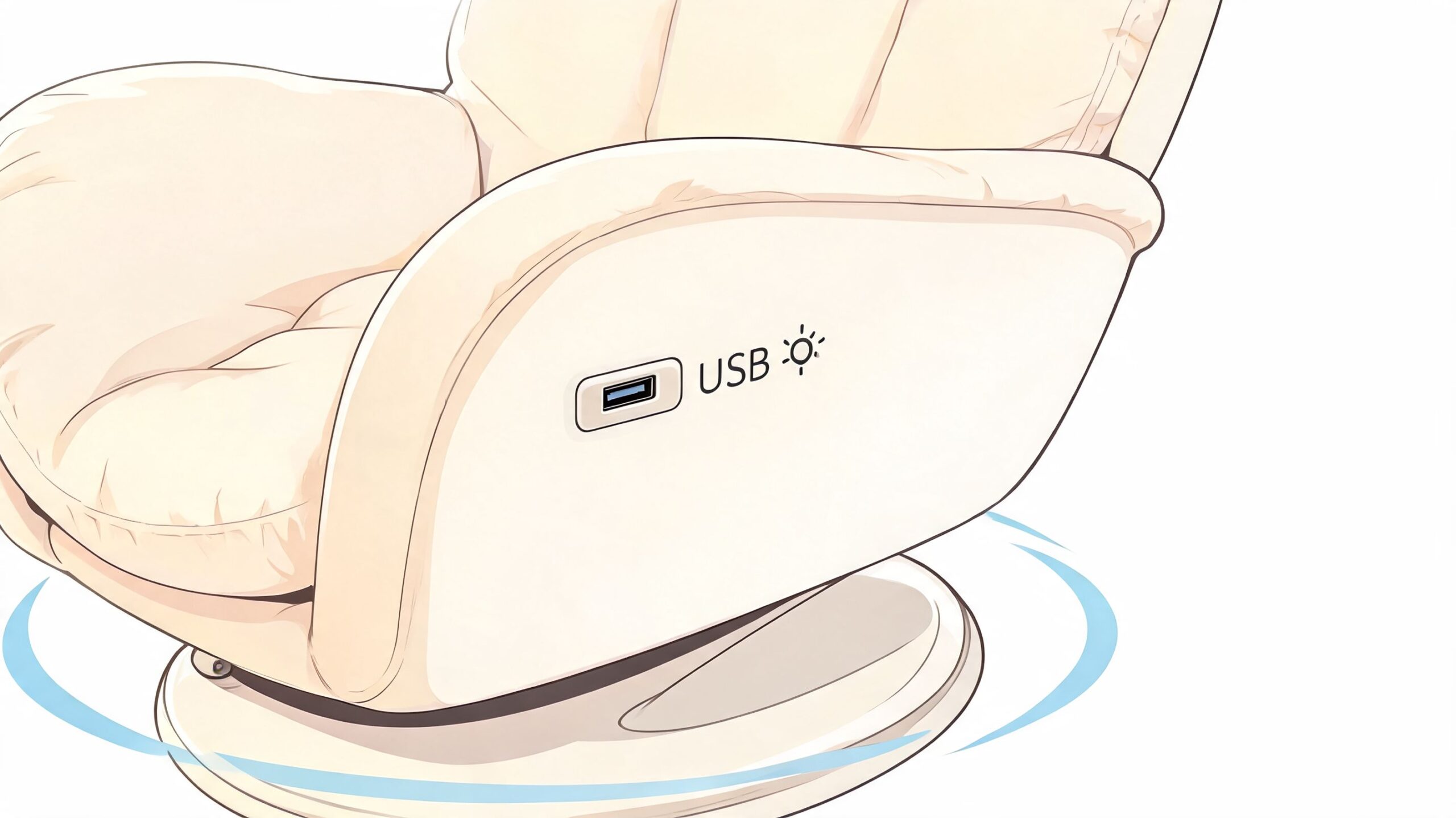
- Swivel base: Makes it easier to turn toward a side table or crib.
- USB charging port: Convenient if your phone doubles as your clock, monitor, or white noise control.
A good power recliner should move smoothly and predictably. The best ones don't call attention to themselves. They let you settle in, adjust, and stay comfortable.
Match features to your routine
Some parents want a simple manual glider and a small side table. Others know they'll benefit from power support and easier position changes. Neither approach is wrong.
The key is to avoid paying for features you won't use. If you tend to read, feed, and sit upright, prioritize lumbar and arm support. If you know you'll spend long contact-nap stretches in the chair, recline and head support become more important.
For a broader look at how reclining features affect daily comfort, this recliner buying guide gives useful context. It's especially relevant if you're considering nursery seating that may later move into another room.
Brands known for comfort-focused seating, including UltraComfort, have helped push these ergonomic features into mainstream family furniture. That's a good change. The chair should adapt to the person using it, not the other way around.
Sizing and Styling Your Nursery Glider
A glider can feel perfect in a showroom and awkward in a nursery if the scale is wrong. Many smart buyers get tripped up by this common oversight. They measure wall length but forget about clearance, walking space, and where the side table will live.
A longer view helps here too. As noted in this article on nursery glider longevity, a durable, well-made glider that moves from the nursery to a playroom or guest room can amortize its value over 5 to 10 years, rather than only the first 18 months. That's one reason I encourage families to choose a chair that looks at home beyond the nursery.

Measure the room the right way
Don't stop at width and depth on the spec tag. Think about how the chair behaves.
- Check rear clearance: Gliding and reclining models need breathing room.
- Map the approach path: You should be able to walk to the crib without squeezing past the chair.
- Add the side table: The table isn't optional in practice, even if it's small.
- Test doorway access: A chair that fits the room still has to get into the room.
If you need help with room planning and access, this furniture measuring guide covers the basics clearly.
Style for now and later
Smart design choices pay off in these moments. A nursery glider doesn't need to look baby-specific to work beautifully in a nursery. In fact, the most versatile choices usually don't.
Consider these combinations:
- Soft gray or cream performance fabric: Easy to carry into a bedroom or guest room later.
- Warm wood or muted metal accents: Works with both nursery furniture and more grown-up spaces.
- Clean silhouette: Less likely to feel dated once the crib is gone.
Choose the chair for the life of your home, not only for the season of the nursery.
Customization matters here. If you already appreciate made-to-order living room furniture, the same mindset works for nursery seating. Fabric texture, cushion feel, and finish details can make a chair easier to keep and easier to move into another room later. That's the difference between buying a baby item and buying a lasting piece of furniture.
Your Guide to Shopping Local at Gorins
Online research helps, but a nursery glider is still a sit-before-you-buy piece. Motion, seat height, arm placement, and cushion feel are hard to judge from photos alone. For many parents, the final decision gets easier the moment they test a few chairs side by side.
That's one reason local furniture shopping still matters. You can compare gliders for nurseries in real time, feel the fabrics, and notice what your body responds to. A chair that looks ideal on a screen may feel too deep, too firm, or too noisy when you use it.
Why a showroom visit changes the decision
A good showroom lets you answer the questions that matter most:
- Does the glide feel smooth to you?
- Do the arms support feeding posture comfortably?
- Can you stand up easily while holding weight?
- Does the upholstery feel suited to family life?
That local guidance also tends to be calmer and more practical. Instead of sorting through endless reviews, you get help from someone who can point out differences in motion, construction, and fit. If you value the service side of buying close to home, this look at why families choose a family-owned furniture store captures that experience well.
What Eastern CT families should look for
For our neighbors in Norwich, New London, Plainfield, Waterford, and nearby Rhode Island communities, I'd keep the checklist simple.
- Investment-grade quality: Look for a chair you'd still want in another room later.
- Adjusted to your lifestyle: Prioritize the motion and features that match your routine.
- Customization options: Fabric and finish choices matter when the chair needs to blend into your home.
- Financial flexibility: Promotional financing with equal monthly payments can make a better long-term choice easier to bring home.
There's also comfort in working with a business that's been part of the community for generations. Since 1936, family-owned guidance has helped local shoppers make decisions based on value and fit, not pressure.
Since 1936, Gorins Furniture & Mattress has helped Norwich and Eastern CT families create homes they love. If you're shopping for gliders for nurseries, visit the Norwich showroom to compare comfort by feel, explore custom options, and get personalized guidance from a local team. You can also take the online Style Quiz or browse the Clearance section for value-driven savings.