Home Office and Bedroom Ideas for Small Spaces

A lot of bedrooms in Norwich and across Eastern CT are doing double duty now. One side of the room holds the bed, the other holds a laptop, charging cords, paperwork, and the daily pressure of trying to stay focused in a space that was never meant to be an office.
That setup can work, but only if the room stops feeling accidental. Good home office and bedroom ideas aren’t about cramming a desk beside a dresser and hoping for the best. They’re about giving each part of the room a job, choosing furniture that earns its footprint, and protecting your sleep while you work.
The New Normal for Homes in Norwich and Eastern CT
For many households, the bedroom became the backup office first and the permanent office second. A small guest room turned into a work zone. A primary bedroom corner became the only quiet place for calls. A nightstand started sharing space with notebooks and chargers.

That experience is common, not a sign that you planned poorly. The shift was fast. Pre-pandemic, about 20% of U.S. workers operated from home, and that rose to 71% by December 2020. During that change, 28.5% of remote workers set up their office in the master bedroom, according to home office ergonomics data summarized here.
What I see in real homes
In local homes, the same problems show up again and again. The desk is too deep for the wall. The chair works for dinner but not for a workday. The bed becomes overflow storage because there’s nowhere else for files, bags, and tech to land.
The fix usually isn’t bigger square footage. It’s a better plan.
Practical rule: If your bedroom office feels chaotic by midweek, the issue usually isn’t motivation. It’s that the room has no clear boundary between where work starts and where rest begins.
A well-designed hybrid room should do three things:
- Support focus: You need a dependable place to sit, work, and take calls.
- Protect sleep: The room still has to feel calm at night.
- Hide the evidence: Office clutter needs a home when the workday ends.
That’s where a local, design-first approach helps. Since 1936, Gorins has served families in Norwich and nearby communities with practical furnishing guidance rooted in real homes, real budgets, and real space constraints. If you’re starting from scratch, their home design starting point is a useful place to organize your thinking before you buy anything.
Why this room needs more intention than other rooms
A bedroom office has higher stakes than a spare room office. Mistakes follow you all day. The wrong chair bothers your back at noon, and the wrong layout still nags at you when you’re trying to fall asleep.
That’s why the strongest home office and bedroom ideas usually look quieter, not busier. Fewer pieces. Better proportions. Storage that closes. Lighting that changes with the time of day. Materials that feel appropriate for both work and rest.
Assess Your Space and Zone for Success
Before you shop, measure. Not roughly. Precisely.
Most layout problems start when people buy furniture for the idea of the room instead of the room they have. Measure wall lengths, window placement, outlet locations, door swing, and the clearance around the bed. Then watch how you move through the room in the morning and at night. That traffic pattern matters as much as the floor plan.
Start with zones, not furniture
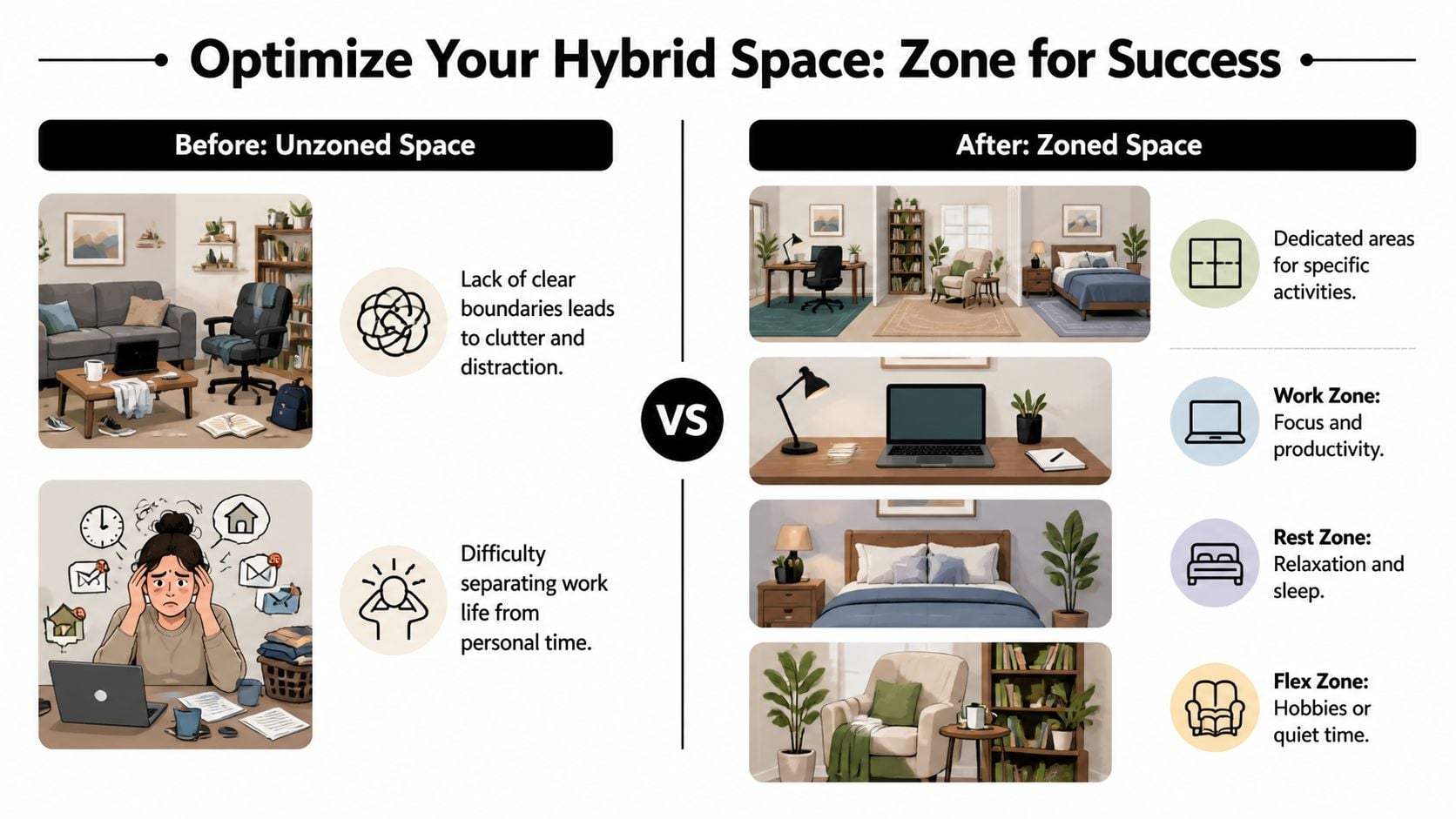
The biggest upgrade in a bedroom office is usually zoning. You’re telling your brain, and your daily habits, that different parts of the room serve different purposes.
A planned layout pays off. A data-driven approach to layout design can deliver 35 to 60% higher space efficiency than intuitive placement, reduce wasted area by up to 40%, and boost self-reported productivity by 25%, based on office layout analysis discussed here.
You don’t need commercial tools to apply that thinking at home. You just need to notice what’s getting in your way.
Try this checklist before moving a single piece:
- Mark your work zone where daylight is useful but glare won’t hit the screen.
- Protect your sleep zone by keeping office equipment from visually spilling onto the bed.
- Assign a flex zone for reading, dressing, or temporary storage.
- Test clearances for drawers, chair movement, and bedside access.
- Watch what collects on the floor or bed. That clutter usually tells you which storage is missing.
Three layouts that usually work
Some room shapes give you only one sensible answer. Most give you a few.
| Layout | Best use | What works well | What to avoid |
|---|---|---|---|
| Corner Command Center | Bedrooms with one open corner | Compact desk, floating shelves, clear view into room | Oversized chair that blocks circulation |
| Linear Wall Office | Long walls with room beside the bed | Shallow desk, low storage, balanced sightline | Tall pieces that make the wall feel heavy |
| Hidden Closet Workstation | Rooms with underused closet space | Door-close storage, visual separation, tidy finish | Forcing deep equipment into a shallow niche |
Put the desk where your body can work. Put storage where your eyes can ignore it after hours.
The Corner Command Center works well when the room has awkward leftover space. The Linear Wall Office suits bedrooms where the bed already anchors one side. The Hidden Closet Workstation is often the cleanest visual solution because the work area can disappear.
If your room feels tight, this guide on how to make a small room feel big is worth reading before you finalize placement. It helps you avoid the common mistake of solving storage by visually overcrowding the room.
What doesn’t work well
A few choices almost always create friction:
- Centering the desk in the room when floor space is limited
- Placing the desk at the foot of the bed if that turns the bed into office backdrop and storage bench
- Using the bed as secondary seating during the workday
- Letting printer paper, chargers, and files stay visible after work hours
The room should feel edited. That’s usually the difference between a bedroom that happens to contain a desk and a hybrid room that is effective.
Choosing Smart Multipurpose Furniture
The right furniture can rescue a small room. The wrong furniture makes it feel permanently compromised.
The need isn’t for more pieces. It’s for fewer pieces that do more. That’s why the strongest home office and bedroom ideas rely on furniture with clean proportions, concealed storage, and enough durability to handle daily use without looking tired in a year.
Start with the desk you actually need
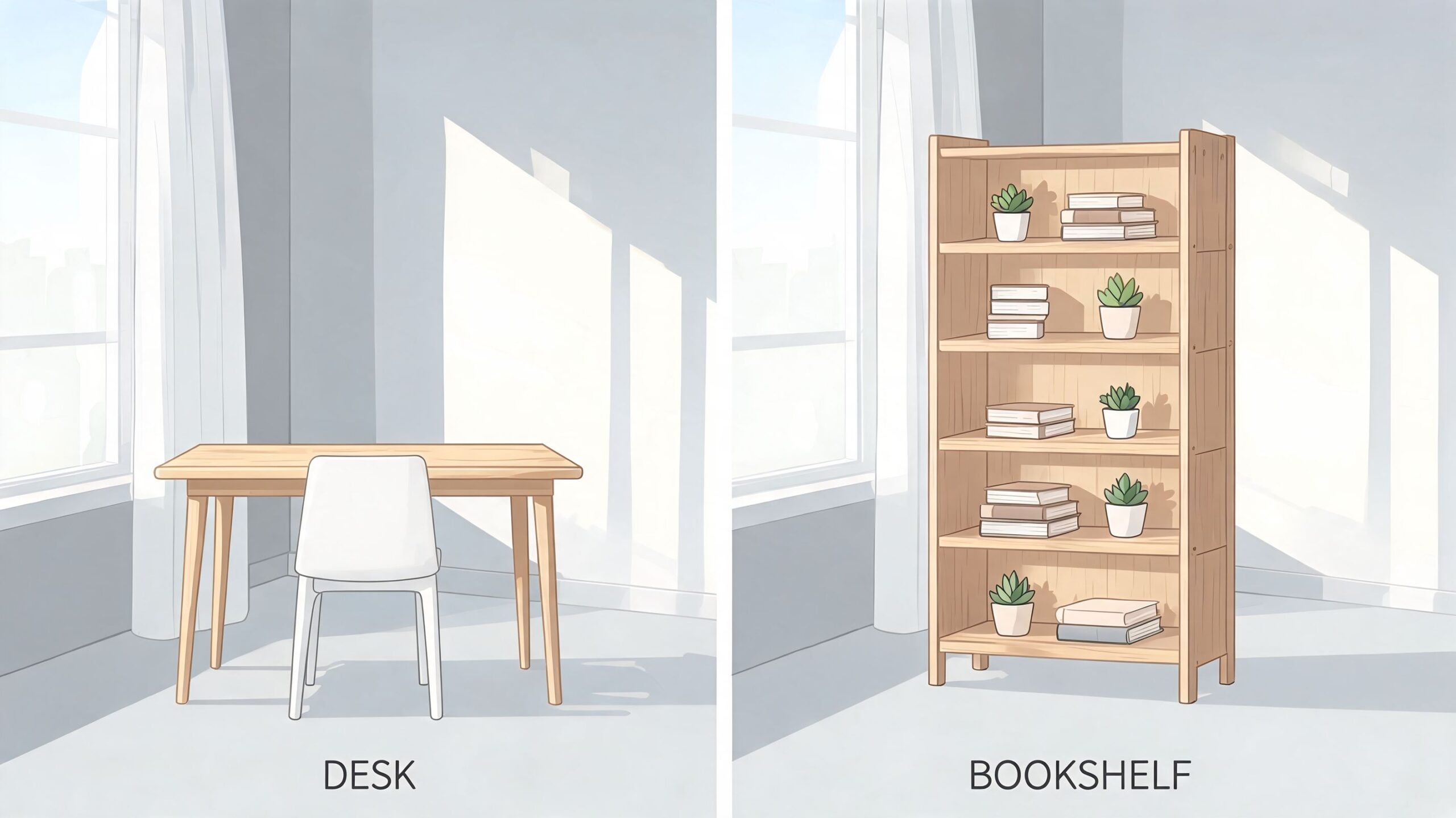
People often overbuy desks. If your job is laptop-based, a compact writing desk with smart storage may serve you better than a large executive desk that overwhelms the room.
Here’s a practical comparison.
| Desk Type | Best For | Footprint | Storage |
|---|---|---|---|
| Writing desk | Light computer work, minimal setup | Small to medium | Limited |
| Secretary desk | Rooms that need visual calm | Small to medium | Hidden interior storage |
| Ladder or wall desk | Narrow rooms and corners | Small | Light shelving |
| Credenza-style desk | Shared storage and dual-purpose use | Medium | Good closed storage |
| Closet-fit workstation | Rooms needing concealment | Small | Depends on built-ins or add-ons |
A secretary desk is one of the most overlooked solutions in a bedroom office. It closes up when you finish work, which matters more in a sleep space than people expect. A credenza-style desk works better if you handle paper, devices, or supplies that need nearby storage. A wall desk can be the right call in a renter-friendly room where every inch counts.
If you want a broader look at optimizing small bedroom space, that resource offers useful examples of how furniture can reduce visual clutter in tight layouts.
Multipurpose pieces worth the floor space
Not every dual-purpose piece is worth buying. Some save space on paper but create daily annoyance. The best ones feel easy to use.
Good candidates include:
- Murphy beds for rooms that function as office first, guest room second
- Sleeper sofas in flex spaces that need occasional sleeping capacity
- Storage beds for linens, files, or off-season items
- Bookcases with cabinet bases to display decor and hide office supplies
- Upholstered benches that work at the bed, under a window, or as soft seating for calls
Where quality matters
Investment-grade construction proves its worth. A cheap desk wobbles. A low-grade sleeper becomes a compromise both sitting and sleeping. Hinges, slides, cushion support, and surface durability matter more in a hybrid room because every piece gets used harder.
Brands like Flexsteel and Aspen Home are good examples of furniture that tends to make sense here because the designs are practical and the build quality is made for real use. Flexsteel works especially well when you need seating or casegoods that won’t feel temporary. Aspen Home often gets the office side right, with designs that feel residential instead of corporate.
For custom seating, the F9 Custom Sofa approach also fits this category well. It allows for thousands of combinations in size, arm style, cushion feel, and fabric, which matters when the sofa has to function as both everyday seating and part of a sleep-ready room.
One practical path is to compare options through a local source that carries desks, storage, seating, and bedroom pieces together. This guide to multifunctional home office furniture is useful for sorting through which pieces deserve the investment and which ones can stay simple.
Buy for the closed-room view. In a bedroom office, furniture has to look right at 10 a.m. and at 10 p.m.
The Support System for Sleep and Work
A hybrid room only succeeds if it supports your body in both modes. That means the mattress and the chair matter more than the decorative extras.
Support for the night shift
If your bedroom now carries work stress, video calls, and screen time, your mattress has to do more heavy lifting. At night, you need the room to shift back into recovery mode, and the bed is the center of that reset.
Trying mattresses in person still matters for these reasons. The differences between Tempur-Pedic, Serta, and Beautyrest aren’t abstract when you lie down on them. One person wants pressure relief and contouring. Another wants a more buoyant surface. Another needs a firmer feel that still cushions shoulders and hips. That’s why “comfort by feel” is still the most useful way to shop.
If you’re narrowing options, this mattress buying guide helps organize the decision around sleep habits, support preferences, and room needs instead of marketing language.
Support for the workday
The chair deserves the same attention. A bedroom office often gets furnished in reverse. People pick the desk first because it’s visible, then settle for a chair that “works for now.” That usually leads to shoulder tension, poor posture, and a room that looks patched together.
Look for:
- Lumbar support that keeps you upright without pushing you too far forward
- Seat depth that lets you sit back comfortably
- Arms that don’t force your shoulders upward
- A profile that fits the room so the chair doesn’t look like it belongs in a cubicle
A quality bedroom office chair should maintain the aesthetic of home furniture. This is why upholstered seating or refined swivel chairs often work better than bulky mesh task chairs in this setting. Best Home Furnishings is one example of a brand whose seating can bridge comfort and a more residential look.
The real trade-off
A mattress should disappear into comfort. A work chair should keep you alert. Those are opposite jobs.
Trying to make one piece do both usually backfires. Working from bed sounds convenient until your posture suffers and the bed starts feeling like an extension of your to-do list. Using a casual accent chair for long work sessions can look pretty, but it rarely holds up through a full week.
The bedroom office works best when sleep furniture supports recovery and work furniture supports posture. Blending the look is smart. Blending the function usually isn’t.
If the room budget is tight, prioritize the pieces your body uses longest. In most homes, that means the mattress first and the chair second.
Mastering Storage Lighting and Style
Once the layout and main furniture are right, the room still needs three finishing systems to work every day. Storage keeps surfaces clear. Lighting helps the room change roles. Style makes the whole space feel intentional instead of improvised.
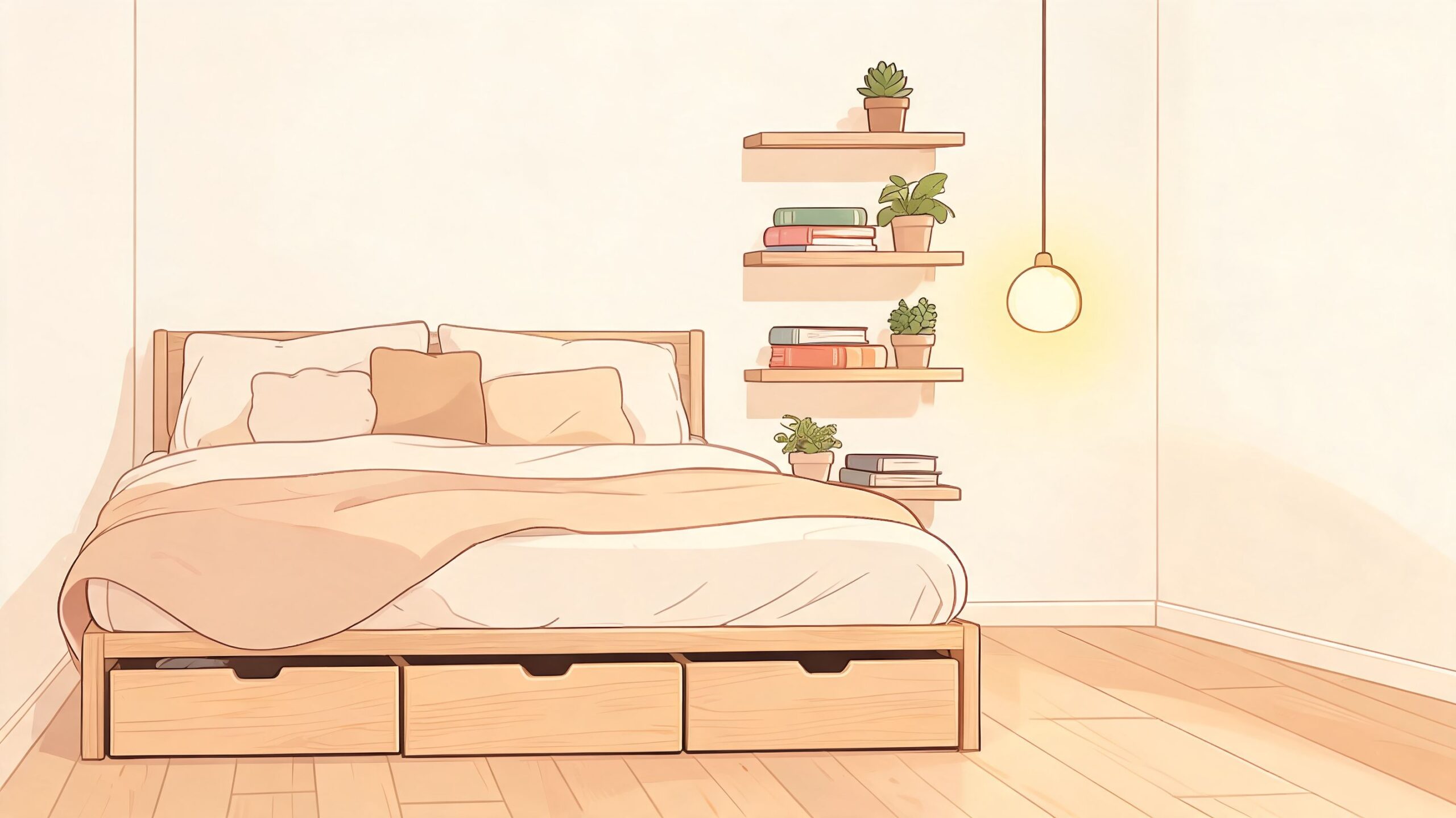
Storage that closes, not just stores
Open shelving has its place, but bedroom offices usually need more concealed storage than people think. If every work tool stays visible, the room never fully becomes a bedroom again.
The strongest storage mix often includes:
- Vertical shelving for books, baskets, and display pieces
- Under-bed drawers for low-visibility storage
- Closed-door cabinets or credenzas for paperwork and devices
- Nightstands with real capacity instead of decorative-only pieces
For custom-minded households, the logic behind Canadel applies here even though many people know the brand from dining. The value is in tailoring dimensions, finish, and function so the piece fits the room rather than forcing the room to adapt. That same custom mindset is useful when you need storage that works around a bed, desk, and tight circulation path.
If you’re evaluating bedroom pieces, these storage-focused bedroom furniture features can help you decide what deserves drawer space and what can stay open.
Lighting that changes with the day
A bedroom office needs layered light. One overhead fixture isn’t enough.
Use three types:
| Lighting layer | Job in the room | Good placement |
|---|---|---|
| Ambient | General room light | Ceiling fixture or flush mount |
| Task | Focused work light | Desk lamp or adjustable wall sconce |
| Accent | Calm, evening mood | Bedside lamp or soft indirect light |
Natural light helps, but it also needs control. Glare on screens is distracting, and too much brightness late in the day can make the room feel unsettled. For practical inspiration, these home office window treatment ideas are useful if you’re trying to balance privacy, filtered daylight, and a cleaner backdrop.
Style that keeps the room calm
Bedroom offices usually look best when the palette stays disciplined. That doesn’t mean bland. It means fewer visual arguments.
A contemporary look often works especially well because the lines are cleaner and the room feels less crowded. Contemporary is the most popular bedroom style at 27.01% of designs, according to this bedroom design analysis. That tracks with what works in smaller hybrid rooms: simpler profiles, less visual bulk, and easier coordination between bed, desk, and storage.
A few styling moves make a big difference:
- Repeat one wood tone across key pieces so the room feels connected
- Use textiles to soften the work zone, like a rug under the desk area or custom-fit curtains
- Limit desktop decor to pieces that can stay neat when the laptop is open
- Separate wall art by zone, keeping more energetic pieces near the desk and calmer pieces near the bed
A bedroom office should feel quieter at night than it does during work hours, even if the furniture stays in place.
Protect Your Rest and Finance Your Vision
The final piece is psychological. A bedroom office doesn’t just need physical organization. It needs a shutdown routine.
That can be simple. Close the laptop. Put papers in a drawer. Turn off the desk lamp. Switch on the bedside light. Even a short reset tells your brain the workday is over.
Small boundaries matter
Physical separation has measurable benefits. Having a dedicated workspace can reduce work-related stress by 28% and improve sleep quality by as much as 22%, according to research summarized here on workspace separation and well-being.
A few habits help protect that benefit:
- Put work away nightly if your desk is visible from the bed
- Keep charging cables controlled so the room doesn’t look active after hours
- Use separate lighting scenes for work time and bedtime
- Avoid using the bed as your daytime office, even on rushed mornings
Make the room possible without forcing the budget
A good hybrid room is an investment in daily function, not a one-weekend impulse buy. Most households are better off buying fewer, stronger pieces and building the room in the right order than filling it quickly with stopgap furniture.
That’s also where financing can make the plan realistic. Promotional Financing with equal monthly payments can make investment-grade choices more manageable for families in Norwich, Plainfield, Waterford, New London, and nearby Rhode Island communities. If the room needs a better mattress, a work chair, and storage, you don’t always have to do it all in one cash purchase.
Since 1936, Gorins Furniture & Mattress has helped Norwich and Eastern CT families create homes they love. From custom-designed Canadel dining sets to the latest in Tempur-Pedic sleep technology, they combine a massive selection with the personalized care only a local, family-owned business can provide. Visit Gorins Furniture & Mattress to visit the Norwich showroom, take the online Style Quiz, or browse the Clearance section for value-driven savings.