Custom Extendable Dining Table: How to Size and Order


A family in Norwich may have a dining table that works beautifully for everyday meals, then find it suddenly too small when holiday guests arrive. The reverse problem is just as common: a table ordered for a large gathering can crowd the room the rest of the year. A custom extendable dining table should solve both problems, but only if its fully extended size, mechanism, seating positions, and clearance work in the actual home.
The useful way to shop is to treat the closed and extended table as two separate room layouts. Measure both, test the mechanism in person, and check who can use it comfortably before deciding by seat count or finish. That's how a flexible table becomes a practical fit for daily life, not just a solution for one dinner.
Extendable Dining Table Sizes by Seat Count
A four-person household may need space for eight at Thanksgiving, so size the table for both its everyday and hosting configurations. A practical everyday benchmark is 120–140 cm (47–55 inches) long, about 80 cm (31.5 inches) wide, and 72–75 cm (28.3–29.5 inches) high, with room for four to six people, according to dining-furniture ergonomic research. Treat this as a starting range, then confirm the chair and base dimensions before ordering.
In our showroom, we plan about 24 inches of table edge per diner at a rectangular table. That puts six diners at roughly 72 inches of seating length; 90 inches gives them more space. Gorins' dining table size guide provides room-by-room examples, but the selected model's measurements should guide your order.
| Seats | Closed length | Extended length | Clearance around table |
|---|---|---|---|
| 4 people | 47–55 in | Depends on the selected leaf and table family | 36 in minimum, 42 in comfortable |
| 6 people | 55–60 in | 72 in | 36–42 in |
| 8 people | 60–72 in | Depends on the selected leaf and table family | 42 in comfortable |
| 10 people | Depends on the selected table family | 120 in | 42 in comfortable |
Seat count alone does not set the extended length. Leaf size and table design determine the final measurement, so check the manufacturer's dimensions rather than ordering from a general chart. For ten people, 120 inches long is a useful planning example. MODERN LYFE's ten-person table guide offers another reference for larger gatherings.
Practical rule: Choose the closed length for your usual seating, then assess the fully extended table as its own setup. Check that diners can reach their seats, chairs can be occupied comfortably, and people can pass through the room. If opening or closing the table takes two people, test the handling before ordering.
The closed table serves daily routines; the fully extended version must work for hosting, with its own access and seating positions. Confirm both configurations against the selected table's exact dimensions before placing an order.
How to Measure Your Room for an Extended Table
The familiar mistake is measuring for the chairs and forgetting the walkway. A table can look right in its closed position yet block a doorway or the route to the kitchen when the leaves are in place. Measure the open layout first, then check whether the compact version works too.
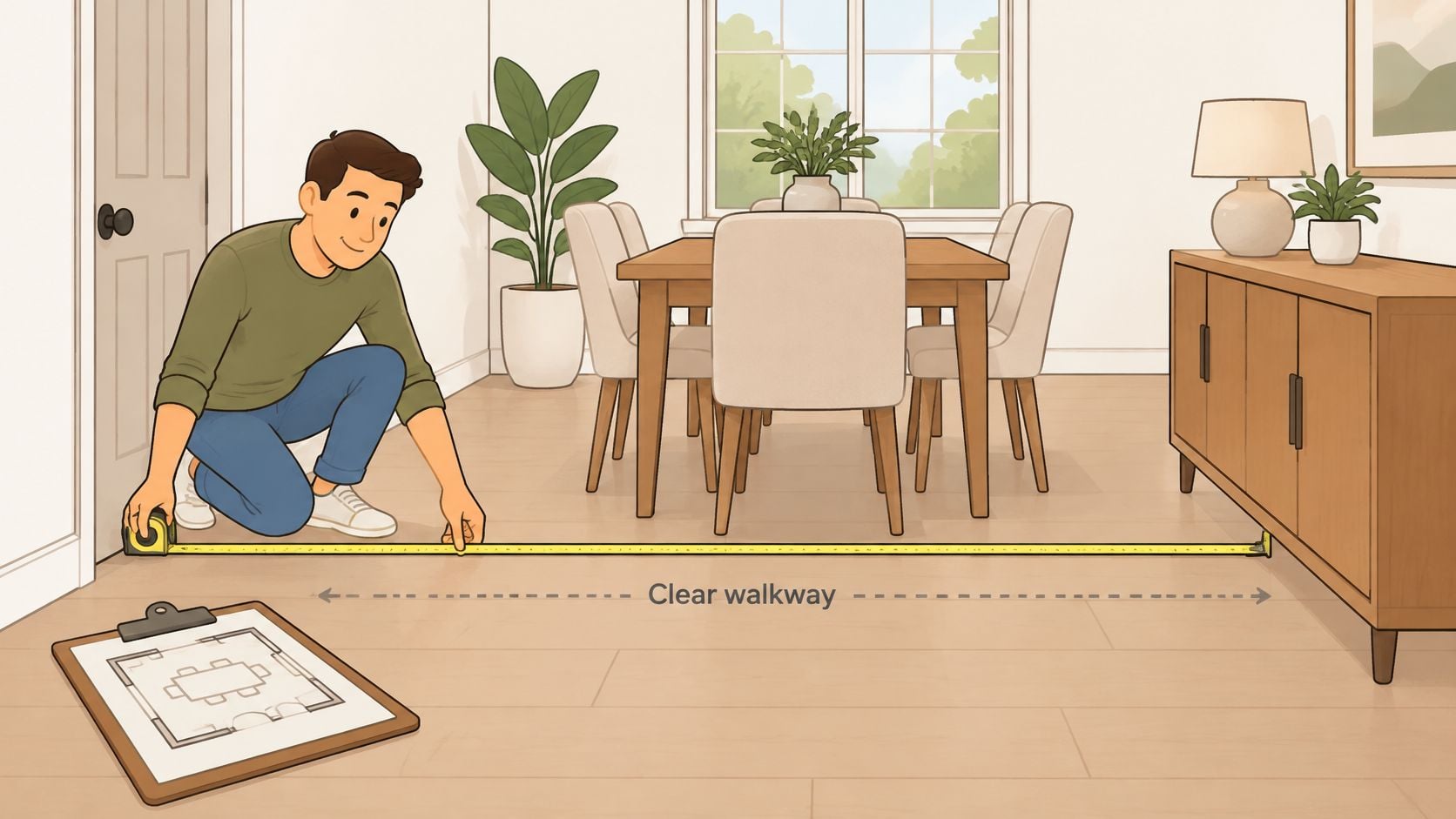
- Measure usable room length and width. Include the space between walls, doors, windows, and built-ins, since those features can limit the footprint even when the floor looks open.
- Start with the fully extended table. The largest configuration is the harder one to accommodate, and it's the one most likely to interfere with movement.
- Reserve 90–100 cm (36–42 inches) around the table. This space lets chairs pull out and gives people a route behind seated diners. The clearance needs to work on each side, not just at the room's widest point.
- Allow about 50–60 cm (20–24 inches) of table edge per diner. Then check the base or legs, because a nominal seat won't work if a support occupies that position.
- Walk the doorway route with the table extended. Check the door swing and the path people use to reach adjoining rooms.
- Record three measurements. Write down the closed footprint, the extended footprint, and clearance when chairs are occupied. Approve the design only when all three fit the room's daily use.
Consider a room that's 10 feet long with a doorway at one end. A 96-inch extension may appear plausible when viewed as a table measurement alone, but end clearance also takes up space. The extended arrangement can therefore interfere with the doorway even if the closed table fits neatly.
For a repeatable room-measuring method, consult Gorins' guide to measuring a room. The test is simple: don't approve a table just because its footprint fits on paper. A table that technically fits can still fail if the occupied chairs or open mechanism block the path to the kitchen.
Extension Mechanisms Compared for Daily Use
A table can feel straightforward when closed and become a different product when extended. Before choosing a mechanism, consider how often you will open it, where its leaves will go, and whether the people in your household can manage them safely. A system suited to occasional holiday hosting may frustrate a household that extends the table every few weeks.
| Mechanism | How it extends | Where leaves live | Best fit |
|---|---|---|---|
| Self-storing butterfly leaf | A hinged leaf opens from inside the tabletop | Inside the table, with no loose parts | Frequent extending in smaller rooms |
| Draw leaf | Leaves slide out from beneath the tabletop | In the base, with no loose parts | Regular extensions for bigger gatherings |
| Drop-in leaf | Loose boards fit into a center opening | Separate pieces that need protected storage | Larger extensions for occasional hosting |
| Expanding round top | Center segments or inserts open the top | Ask whether the inserts stay in a base cabinet or need separate protected storage | Round tables seating four to eight |
Compare the mechanisms against four practical questions:
- How often will the table open? With frequent use, a leaf stored in the table is ready when needed.
- Can the leaves stay inside the table? If they cannot, choose a dry, protected place for loose parts and make sure you can reach it.
- How much added length does the usual gathering need? Choose the extension that fits the usual gathering, and plan for the largest one only if it happens often.
- Who will handle the parts? A loose leaf can be awkward to lift, carry, and align. Check whether one person can manage it or whether two people are needed.
A couple that hosts twice a year may be comfortable keeping a drop-in leaf in a labeled bag in a dry storage area. A family that opens its table every few weeks may prefer a draw leaf that stays with the table, so nobody has to find and carry a separate piece before guests arrive.
Self-storing systems reduce the chance of losing a loose leaf. Drop-in leaves can offer a larger extension, but they take protected storage and safe handling. Judge the options with the table fully extended: check where the pieces are stored, how they are carried, and whether the person setting up can reach and align them. For frequent gatherings, a self-storing or draw-leaf design may be easier to manage. For occasional use, a drop-in leaf can work if its storage is settled in advance. During a showroom demonstration, ask to see how an expanding round top opens and where its inserts are kept.
Stability and Easy-Operation Tests Before You Order
A table that feels solid while closed doesn't prove it will perform well at full length. The extended configuration creates different structural demands, so assess it on its own rather than treating closed-state solidity as a pass.
During a showroom demonstration, ask to operate the table as intended, then check:
- Open and close it through five full cycles. Watch whether the center seam stays flush each time, rather than aligning only on the first opening.
- Inspect support under the added leaf. Ask whether a center leg or beam supports it in the extended position.
- Apply light pressure to the extended section. Listen and feel for wobble, movement, or a joint that creeps open.
- Look at the locks, alignment pins, and track. Those components help the top halves meet and stay in position.
- Ask about adjustment and repair. Get the mechanism warranty terms in writing, including whether service or adjustment is covered.
A useful inspection also considers who will use the table. Maximum seating isn't the same as maximum usability, especially if an expanded layout puts a leg or crossbar where someone needs knee room.
- Approach: Can a wheelchair reach the table without hitting a pedestal or crossbar?
- Knee space: Is there usable clearance in both the compact and expanded positions?
- Operation: Does extending the table require lifting, pulling, or two-person handling?
- Grip and safety: Can someone with limited grip strength operate the mechanism without strain or unsafe hand placement?
A Norwich household with a grandparent who uses a walker can test the table with that walker before choosing a design. The family can see whether the approach remains clear in both configurations, instead of assuming that the listed seat count tells the whole story.
For a broader selection checklist, use Gorins' key steps to choosing a dining table. Bring the chairs that will be used at home, or the relevant mobility device, to the showroom. Testing the actual arrangement reveals problems a product description can't.
Materials, Finishes and Styling That Suit Your Room
A table can feel solid when closed and behave differently once its leaves are in place. Choose wood and finishes with the expanded top in mind, and check how the material around the joint is supported. For guidance on how hardwoods differ in durability and appearance, see Gorins' hardwood selection guide.
| Material | Strengths | Watch for | Best fit |
|---|---|---|---|
| Solid oak | Hard, durable, with strong grain character | Seasonal movement at the extension seam | Busy households and traditional rooms |
| Solid maple | Dense, smooth, with even color | Light tones show stains; wood moves with humidity | Modern rooms and light-toned finishes |
| Hardwood veneer on a stable core | Stable top with less seasonal movement | Veneer can wear through; repairs need care | Tops that need to stay flat across the extension |
| Engineered composite top | Consistent surface and low upkeep | Lower-density cores may move with temperature and wear hardware | Value-focused buyers seeking low maintenance |
Solid wood responds to humidity, which can affect alignment where the leaves meet. A stable core can reduce seasonal movement. With a composite top, ask about the core's density and how the leaf is supported, since temperature-related movement can put wear on the hardware. Find out what adjustments are possible, and inspect the joint with the table fully extended.
Take finish samples home if you can. Compare them against the floors and chairs in daylight, since showroom lighting can change how undertones appear.
- Match undertones: Check the finish against the room's wood tones, rather than judging it by a small swatch alone.
- Plan for daily wear: Medium or darker finishes may disguise marks better in homes with children or pets.
- Keep visual weight in scale: A substantial base can crowd a compact room; a delicate-looking table may seem undersized in a larger one.
- Place the pendant for everyday use: Center it over the closed table length, since the light generally stays in place when the tabletop extends.
Then open the table and view the finish across the full surface. Leaves may show slight differences in grain or color, especially beside a sun-exposed main top. Check that the expanded arrangement still suits the room's lighting and the surrounding furniture. A finish should look at home in both configurations and work with the wear of regular meals.
Canadel Custom Dining Options You Can Specify
A family of six in Norwich wants seating for eight during holiday meals. Start by checking which Canadel table family offers an extended length that fits the room. Canadel Custom Dining works from defined table families, so the first choice is the family. Gorins lists Champlain, Hurteau, Saint-Tropez, Loft, and Westmount among the available options, with dimensions and extensions varying by family (Gorins' custom dining table information).
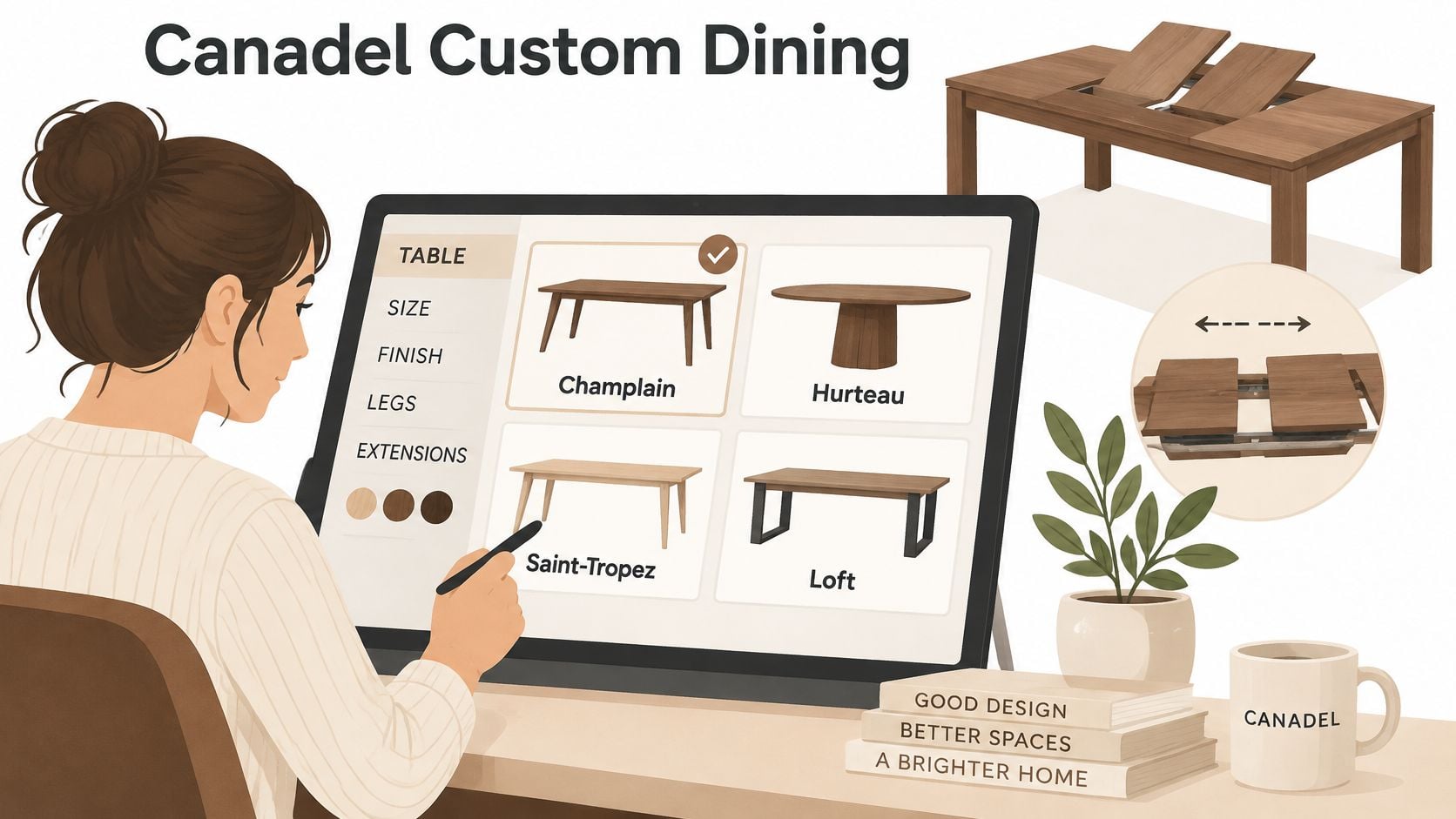
Treat the fully extended table as its own setup. Measure its full length in the room, then check whether diners can reach their seats and move around them comfortably. If the table requires two people to open or position leaves, ask to try that process before ordering. A suitable closed footprint alone does not confirm that the expanded arrangement will work.
Options to coordinate include:
- Size options within the selected family, including an extension that suits the room and intended seating.
- The top profile and base or leg style, which shape the table's appearance and affect where chairs can sit.
- Wood finish, with more than 40 options across the program, as listed in Gorins' overview of Canadel options.
- Chair style and fabric, with over 150 fabric choices across the program, also covered in Gorins' overview of Canadel options.
- Table and chair combinations, selected to suit the room and how the household entertains.
The program offers more than 9 million possible combinations, so confirm that the preferred finish, size, base, and chairs are available together. A showroom consultation can help narrow the choices to options compatible with the selected family and dimensions.
Set the extended length and seating layout first. Then choose the base, finish, and chairs around that arrangement.
- Choose a family by room shape. Compare its available dimensions with the dining area.
- Set the extended length first. Confirm the expanded footprint before choosing finishes.
- Check access around the extended table. Make sure diners can reach seats and move through the room.
- Choose a base that leaves room for chairs. Check leg placement at each intended seating position.
- Confirm every dimension in writing. Specify both closed and extended measurements.
Confirm the Order and Visit the Norwich Showroom
A table that feels solid when closed may behave differently at full extension. At the Norwich showroom, test it open: check that diners can reach their seats, chairs can move without catching, and two people can operate the mechanism comfortably. The expanded table is its own configuration, so assess that layout before placing a custom order.
Gorins Furniture & Mattress traces its origins to 1936, when Samuel and Martha Gorin started the business. Later generations have continued the family-operated company's focus on home furnishings and service (Gorins' company history).
Use the measurements from the earlier room-planning step, then focus the showroom visit on decisions that still need checking:
- Test the selected table family and mechanism. Open and close the table more than once, and note whether the leaves align and the movement suits the people who will use it.
- Check access at full extension. Pull out chairs and walk around the table to see whether the expanded setup leaves practical routes through the room.
- Ask about warranty coverage and adjustments. Find out what support is available if the mechanism needs attention.
- Confirm financing terms and delivery timing. Ask which Promotional Financing terms are currently available, and get the custom-order lead time before committing. The custom-order guide explains the ordering process.
- Plan delivery and placement. Confirm how the table will enter the home and where the delivery team will position it.
Custom orders take longer than in-stock pieces. If the timing does not suit, ask about available clearance dining tables instead of relying on an unlinked section reference.
Visit the Norwich showroom with your measurements and questions about operation or access. The Style Quiz can also help narrow the look and options that fit your home.
Gorins Furniture & Mattress serves Norwich and Eastern CT families with dining furniture, showroom guidance, and delivery planning. For a custom extendable table, bring your measurements to Gorins Furniture & Mattress and test the fully extended setup before choosing.