Custom Wood Dining Room Table: Your Complete Buyer’s Guide


A Norwich homeowner can make every attractive choice and still end up with the wrong dining table. The tabletop may look perfect online, yet fail to clear the doorway, leave too little room for chairs, or develop stress at a joint after a New England heating season. A custom wood dining room table earns its price only when it fits the room, the household, and the home's moisture conditions.
The category itself remains substantial. The global wood dining table market was estimated at USD 4.75 billion in 2024 and is projected to reach USD 10.13 billion by 2035, with a projected 7.13% compound annual growth rate from 2025 to 2035 according to wood dining table market projections. That growth reflects what showroom shoppers already understand: wood offers presence, repairability, and a finish that can become part of a home's history.
Why a Custom Wood Dining Room Table Is Worth Thinking Through
A family in Norwich once found a table that looked ideal on a screen. After delivery, the first problem appeared at the front door. The top scraped the trim, the base made chair placement awkward, and the advertised seating capacity assumed smaller chairs than the family owned. The second problem arrived with seasonal movement, when a stressed joint began to open.
That isn't a failure of custom furniture. It's a warning about buying a stock piece without checking the room and construction. A custom program should produce a documented fit, not merely let a shopper swap one stain for another. Buyers considering a high-value furnishing should understand why the purchase deserves careful planning, as explained in this guide to high-consideration furniture purchases.
Three decisions change performance
Structural size and clearance determine whether people can pull out chairs, walk behind seated guests, and open nearby doors. A table that fits the room's footprint may still fail once chair arms, radiator covers, a hutch, or a rug enter the calculation.
Species and construction method affect how the surface looks, wears, and responds to humidity. A busy household may need a forgiving grain and a durable protective finish, while a formal dining room may justify a more expressive species and refined edge.
Shape and edge profile control movement through the room. Rounded corners help in tight walkways, a pedestal can free chair positions, and a thicker eased edge can make a large top feel substantial without appearing harsh.
Showroom rule: Custom means the table is specified around the room and the people using it. It doesn't mean every available option belongs in the same design.
The Norwich showroom approach associated with Canadel Custom Dining treats the table as a fit-for-space project. The shopper chooses dimensions, shape, finish, chairs, benches, and related details, while the designer checks whether those choices work together. That process matters because a table is both a visual centerpiece and a working piece of architecture. Wood also remains the dominant dining-table material in broad market estimates, with wood representing 52.69% in one 2025 estimate and 39.45% in another according to dining table market material data. The exact estimate varies, but the buying lesson is consistent. Wood remains a serious long-term choice, not a passing decorative preference.
Sizing the Table to Your Room and Family
Sizing comes before stain, species, or chair fabric. A table can be beautiful and still make a dining room feel permanently crowded. Start with the finished table edge, then measure outward to every obstacle that matters.
Allow 36 inches of clearance from the table edge to a wall, buffet, cabinet, or other fixed object on all sides. That space lets most diners pull out a chair and gives someone a reasonable path behind them. Plan about 24 inches per seated person along the table edge, and allow 12 to 14 inches of tabletop depth per place setting so plates, glasses, and serving pieces don't compete for space.
Measure the room in working conditions
Use painter's tape on the floor to mark the proposed tabletop. Then test the details that online listings omit:
- Door swings: Open every nearby door fully, including pantry and closet doors.
- Radiator covers: Measure their actual projection, not just the wall behind them.
- Hutch depth: Include doors and drawers when they're open.
- Chair pull-back: Mark the arc required to move each chair from tucked to occupied.
- Rug allowance: A dining rug should extend 24 inches beyond the table on all sides, giving chair legs room to remain on the rug as guests sit down.
A 72-by-42-inch rectangular table is a useful example for a household that wants six comfortable seats, with leaves extending it to 96 inches for ten. A 54-inch round table can seat six without head positions, which makes conversation feel more equal but gives the room less flexibility for serving furniture.
| Seats | Rectangular (L x W) | Round Diameter | Minimum Room (L x W) | Clearance on All Sides |
|---|---|---|---|---|
| Four | 48 x 36 inches | 42 to 48 inches | Table size plus 72 inches in each direction | 36 inches |
| Six | 72 x 42 inches | 54 inches | Table size plus 72 inches in each direction | 36 inches |
| Eight | 84 to 96 x 42 to 48 inches | 60 to 72 inches | Table size plus 72 inches in each direction | 36 inches |
Choose chairs and benches together
Two armchairs at the heads of a rectangular table create a finished look, but their arms consume clearance and can interfere with the table apron. If every side uses armless chairs, the layout gains flexibility. A bench works best where the wall or room boundary gives it a clear resting position, or where children need easy access. It's a poor choice if the bench must be dragged across a rug every time someone sits down.
For more measurement guidance before a Norwich consultation, use this dining table size guide. The correct custom specification begins with a room that has been measured, including the inconvenient parts.
Choosing Wood Species, Solid Construction, and Joinery
Wood species should follow the household's habits, not a trend board alone. A table used for homework, holiday meals, and daily snacks needs a different surface strategy from a rarely used formal piece. Broadly, custom programs tend to offer four practical wood families.
Rustic hardwoods, including wormy maple and distressed oak, disguise small marks through visible variation. Tight-grain classics, such as maple and birch, create a cleaner appearance and suit households that prefer restrained character. Open-grain woods, including oak and ash, make texture part of the design. Premium species, such as walnut and cherry, bring richer color and can develop a deeper patina over time.
The material decision
Solid wood makes sense for tops and edges that may eventually need refinishing. A solid top still requires movement-aware construction, because wood responds to changing moisture across the grain. Veneer works well for stable decorative surfaces, especially when a design calls for a consistent pattern, but it shouldn't be sold as a substitute for a solid top when future refinishing is a priority.
The joint matters as much as the species. A table may use mortise-and-tenon connections reinforced with corner blocks. A doweled rail system offers a practical middle ground when properly designed. Basic bolt-through construction can work in the right application, but it deserves closer inspection because hardware and rail design determine how the base handles repeated movement and relocation.
| Wood Family | Best For | Grain Style | Durability Notes |
|---|---|---|---|
| Wormy maple and distressed oak | Busy homes that welcome character | Varied, rustic | Visual variation helps conceal everyday wear |
| Maple and birch | Clean, understated interiors | Tighter and more uniform | A good fit for households seeking a calmer surface |
| Oak and ash | Statement tables with visible texture | Open and pronounced | Grain contributes strongly to the finished appearance |
| Walnut and cherry | Long-term investment pieces | Rich, refined character | Color and patina can become more expressive with age |
Shoppers who want a clearer explanation of material choices can review this hardwood guide for longevity and style. The key question at the Norwich showroom is simple: does the chosen wood suit the way the household eats, works, hosts, and cleans?
Tabletop Shapes and Edge Profiles That Fit Real Homes
Shape should solve a traffic problem before it satisfies a style preference. Rectangular and boat-shaped tops suit long rooms with clear sightlines, while round and oval tops help square rooms, alcoves, and households that add chairs unpredictably. A rounded perimeter can also make a narrow passage feel less confrontational than a sharp corner.
A pedestal base usually improves chair-arm placement because guests aren't forced to avoid corner legs. A leg base can provide a lighter visual appearance and strong structural presence, but the leg position must be tested with the chosen chairs. Extension leaves introduce another consideration. The everyday table may feel compact, while the expanded version changes circulation and can require a different chair arrangement.
| Shape | Best Room Type | Seats Flexibility | Notes |
|---|---|---|---|
| Rectangular | Long dining rooms | Strong with leaves | Efficient for defined head and side seating |
| Boat-shaped | Long rooms needing softer corners | Good | Keeps a formal length while easing traffic |
| Round | Square rooms and compact areas | Flexible for conversation | No fixed head positions |
| Oval | Awkward rooms and mixed circulation | Strong | Adds length without sharp corners |
| Pill-shaped | Contemporary rooms with active walkways | Good | Rounded ends help movement around the table |
Edge profiles deserve attention
An eased square keeps the silhouette crisp while softening the touch. A beveled edge adds a visible angle and can make a substantial top appear lighter. A round-over feels comfortable against elbows. A live edge preserves irregular natural contours but demands extra attention in a heated Connecticut home, where seasonal moisture changes can stress exposed irregularities. A reverse-bevel creates a shadow line that makes the top appear thinner.
A floor plan with chair pull-back arcs is more useful than a phone photo alone. Bring both to the designer, along with the rug size and the location of every doorway. Shoppers evaluating small dining spaces can also consult these practical cafe table tips for useful thinking about circulation, spacing, and compact layouts. For shape-specific guidance, this dining table shapes resource gives the conversation a useful starting point.
How the Custom Order Workflow Actually Works
A custom order becomes easier when the buyer arrives prepared. The Norwich showroom consultation should begin with the room, not with a finish chip. Bring measurements, ceiling height, doorway widths, chair references, and the Pinterest images that show the intended mood.
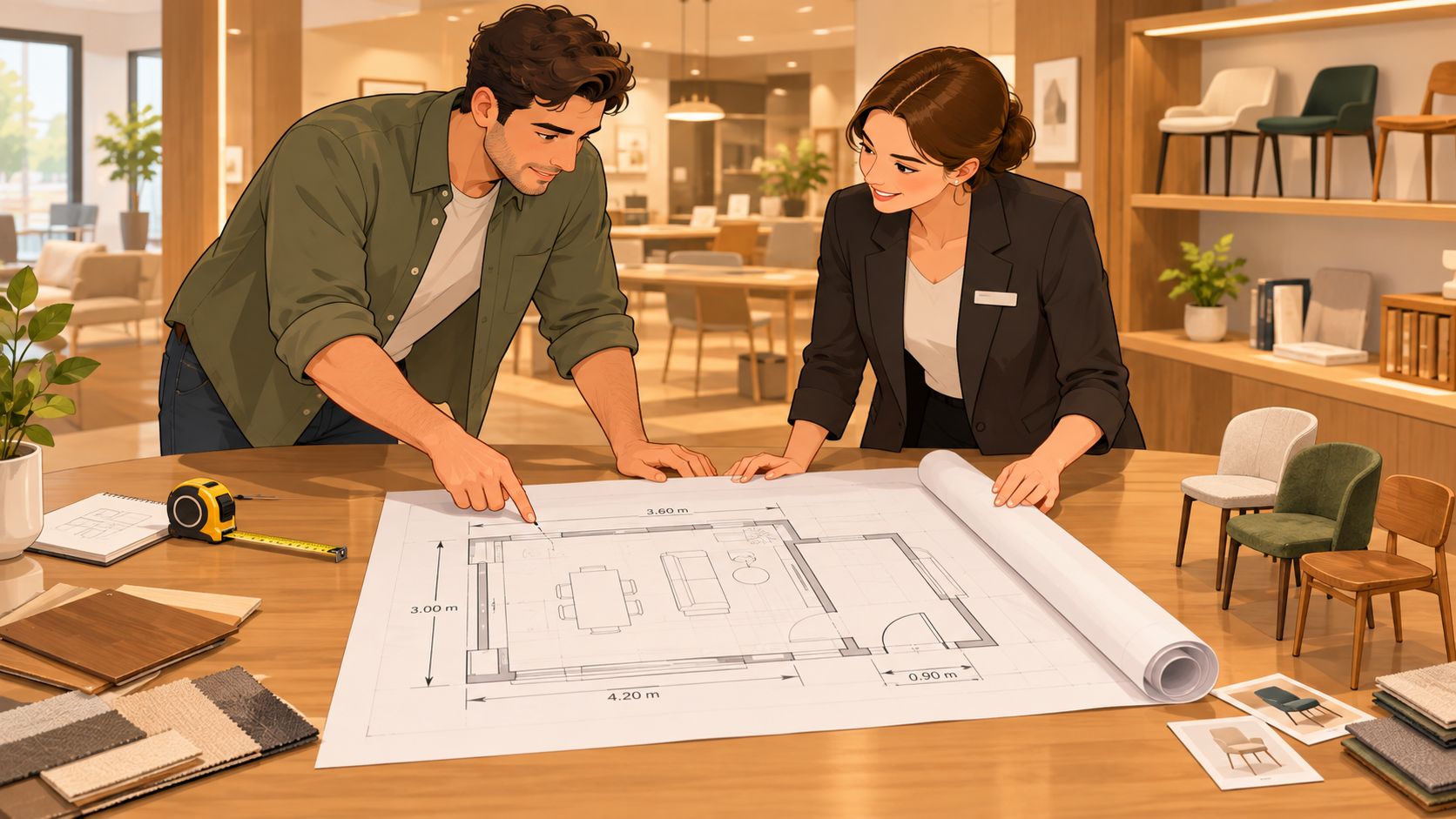
The specification comes before the deposit
The designer records the decisions that define the piece:
- Consultation: The room and lifestyle establish the working dimensions.
- Spec sheet: Species, stain, size, shape, edge, base, and leaf count become a written order.
- Order confirmation: The deposit reserves production capacity and confirms the approved details.
- Production: The maker builds and finishes the piece according to the documented specifications.
- Delivery: The delivery team plans the route, brings the table inside, and completes placement or assembly.
Production often takes six to twelve weeks, depending on capacity and program. A 50% deposit is standard for many made-to-order arrangements because the piece has been allocated to a specific customer and contains selections that may not suit another buyer. Mid-order changes can be limited once materials have been cut, finishing has begun, or production has entered its final stages. The approved spec sheet matters more than a later recollection.
A homeowner pickup truck ramp isn't a sensible plan for a large top. A 96-inch surface needs controlled handling, doorway planning, and protection from damage during installation. The custom order starting guide helps buyers prepare for the consultation, while this custom versus semi-custom cabinet guide offers useful broader context on why early decisions and documented specifications matter in made-to-order work.
Calling ahead saves a second trip. It also gives the showroom time to confirm which samples, program details, and measurement resources will be available.
Finishes, Humidity, and Long-Term Stability
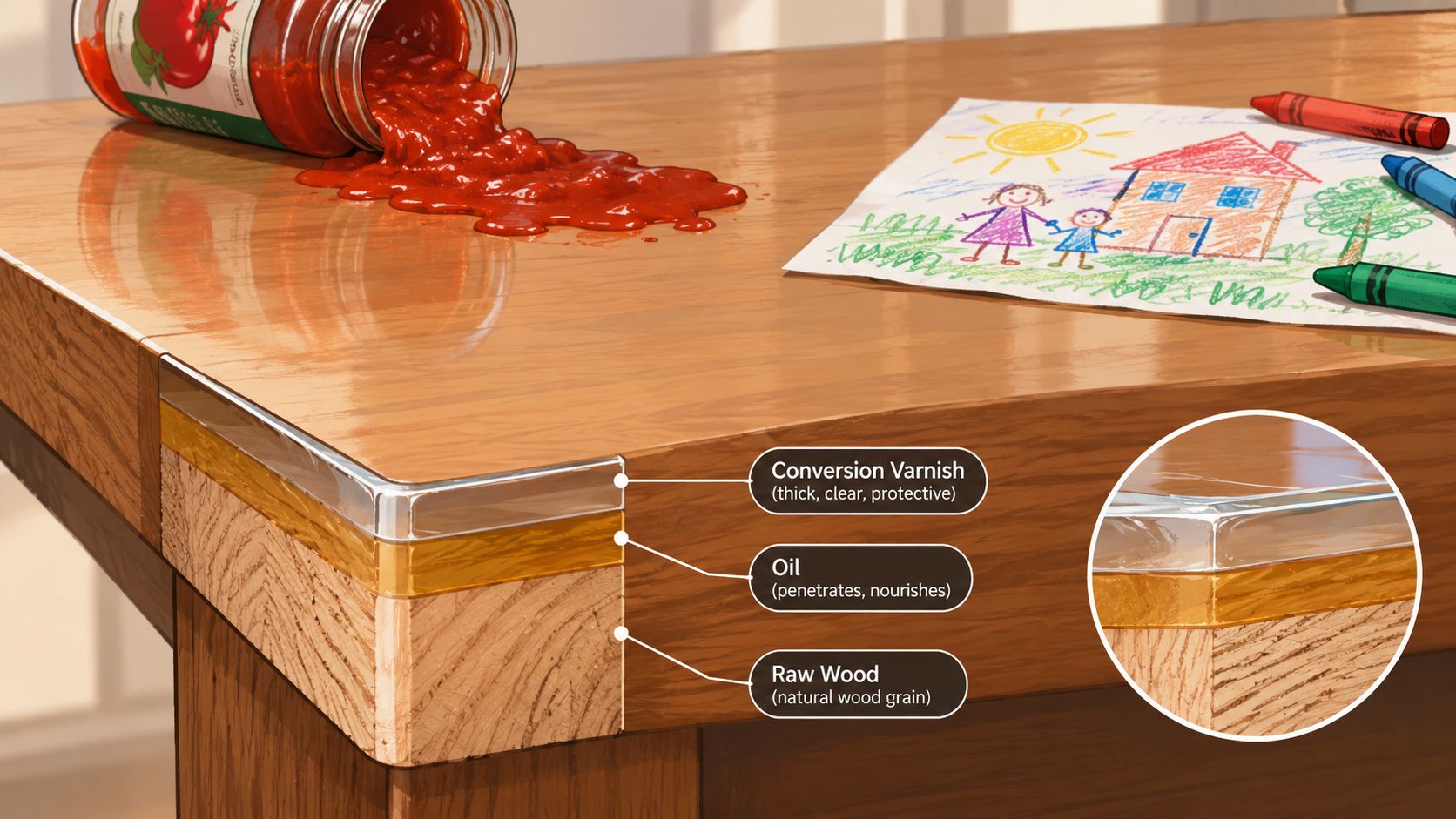
A finish is a protective system, not a decorative afterthought. Conversion varnish generally provides a tougher barrier against spills and routine abuse. Oil emphasizes touch and natural depth but may call for more attentive care. Hardwax oil sits between those priorities, giving a natural feel while adding surface protection that still requires sensible maintenance.
The most important factor is often the room itself. Solid wood expands and contracts mainly across the grain as relative humidity changes, so a wide tabletop needs movement-tolerant attachment hardware. Suitable approaches include figure-8 fasteners, Z-clips, slotted holes, or a center-fixed screw point. Purdue guidance advises a conservative 2% movement allowance, while Canadian woodworking guidance recommends fixing the top at only one reference point so the rest can move freely, as described in this wood movement reference.
Humidity belongs in the purchase conversation
Independent guidance commonly places comfortable indoor relative humidity around 40% to 55%, with some warnings that levels above about 65% increase the risk of swelling, cracks, and joint stress, as discussed in this solid wood dining table climate guide. A humidistat makes that condition visible instead of leaving the table to respond to guesswork.
Practical rule: A solid table shouldn't be tightly trapped between a fixed base and changing indoor air. The top needs room to move.
Interior furniture stock is commonly targeted around 8% moisture content for assembly, while other timber guidance discusses properly jointed and glued boards at 12% to 15% moisture content as stable in service. That difference explains why acclimation matters. Lumber should reach the final interior environment before machining and glue-up, and both faces should receive balanced finishing. Storing a finished table over a damp basement, placing it beside an intense heat source, or allowing one face to absorb moisture can increase cupping and joint stress.
Oak, maple, and birch also accept stain differently. Two-tone tops need matched sealer coats so one area doesn't pull finish unevenly. Daily protection remains straightforward:
- Use coasters and mats: Keep wet glasses, hot dishes, and craft materials from sitting directly on the finish.
- Clean promptly: Use a soft cloth and the care method specified for the finish.
- Avoid harsh products: Abrasive cleaners can dull or damage the protective layer.
- Control the room: Watch humidity through the heating and cooling seasons.
Lead Times, Financing, and Your Next Step
A made-to-order table has three practical clocks. The first is the design clock, when the shop drawing and approval are completed. The second is the production clock, when the table is built and finished. The third is the delivery clock, when the home is ready and the installation route is scheduled.
A realistic planning framework looks like this:
- Shop drawing and approval: Allow 1 to 2 weeks for dimensions, details, and sign-off.
- Production and finishing: Allow 8 to 14 weeks, depending on species and the selected program.
- Delivery and assembly scheduling: Allow 1 to 3 weeks to arrange white-glove placement.
Those windows can shift. Rush service may shorten the queue at an added cost, while made-to-stock pieces can avoid custom production altogether. Clearance-floor tables offer the fastest path, but the buyer generally accepts the existing size, shape, finish, and construction. A clearance piece may still allow chair or accessory coordination, but it won't provide the same full specification control as a new custom order.
Payment deserves the same scrutiny as design
Promotional financing often divides the financed purchase amount by the promotional term to create equal monthly payments. Some plans round payments up, and no-interest treatment typically depends on paying the balance in full by the end of the promotional period, as explained in this promotional financing formula. Qualification can also depend on specific purchase brackets, with examples ranging from $199 to $3,600 across different plans and lenders, according to these furniture financing thresholds.
| Option | Typical Timeline | Best For | Key Consideration |
|---|---|---|---|
| Custom order | Shop approval, production, then delivery scheduling | Buyers who need exact dimensions and finish | Confirm every specification before the order enters production |
| Made-to-stock | Shorter than a custom queue | Buyers who can accept available configurations | Less control over size and finish |
| Clearance floor | Immediate or near-immediate availability | Value-focused buyers with flexible room requirements | Existing specifications usually remain fixed |
| Promotional financing | Follows the selected promotional term | Buyers managing a larger purchase through equal payments | Read the payoff terms and confirm the full balance plan |
The next step is concrete. Bring room dimensions, doorway photos, chair measurements, and the intended rug size to the Norwich showroom. Request a formal quote with itemized specifications, arrange a delivery survey for tight stairs or elevators, and reserve a consultation slot before the next production batch closes. Gorins Furniture & Mattress can also help shoppers coordinate custom dining with broader room plans, while its custom living program includes the F9 Custom Sofa series with thousands of possible combinations. Promotional financing with equal monthly payments can lower the initial barrier for an investment-grade purchase, subject to approval and plan terms.
Since 1936, Gorins Furniture & Mattress has helped Norwich and Eastern CT families create homes they love. For a custom wood dining room table, visit the Norwich showroom with the room measurements and let the design team build a Canadel dining specification around the space, the chairs, and the household's budget.