Dining Table Shapes: Find Your Perfect Fit


A lot of households start the same way. The room is measured, the wall color is chosen, and then the dining table becomes the sticking point. In many Norwich, Waterford, and New London homes, the question isn't just whether a table fits. It's whether the room still works once chairs are out, dinner is served, and everyone is sitting there talking.
That's where dining table shapes matter more than most buying guides admit. A table isn't only a surface. It sets traffic flow, defines how formal a meal feels, and changes whether conversation stays shared or breaks into little side channels. In Eastern CT homes, where dining rooms often have to do double duty for weeknight meals, homework, and holiday hosting, shape has a bigger impact than style alone.
Choosing More Than Just a Table
A table choice usually gets made in a real-life moment. Someone is setting down a weeknight pasta dinner, one person is half out of their chair to grab the Parmesan, another is helping with homework, and everyone is talking across plates, serving bowls, and elbows. That is the moment table shape shows its value, or its flaws.
Seat count matters, but it is only part of the job. The better test is how the table handles ordinary family use, holiday overflow, and the kind of conversation a household naturally has. In our showroom at Gorins, that is often the difference between a table that only fits the room and one that makes the room feel good to live in.
Conversation geometry changes the room
Shape controls what I call conversation geometry. It affects who makes eye contact easily, who becomes the natural host, how serving dishes travel, and whether one meal becomes a single shared conversation or several smaller ones.
A round table keeps everyone on more equal footing. A rectangular table creates clear ends and a stronger sense of order. Square tables can feel intimate in the right room, but they also ask more from the floor plan than many homeowners expect. Those are practical trade-offs, not style opinions.
For readers comparing how round and rectangular layouts affect seating and guest interaction, PlanSeats' event table guide offers a useful outside reference.
Some families want one conversation that includes everybody. Others want structure, serving space, and a clear host position.
Both are valid.
That is why shape should be decided before finish, edge detail, or chair fabric. A beautiful top cannot fix a table that makes daily meals feel cramped or disconnected. If you are still sorting out proportions, our dining table size guide for room planning and seating clearances helps connect shape with real household use.
The table is a working part of the home
In Eastern CT homes, the dining table rarely has just one purpose. It handles breakfast, projects, laptops, birthdays, and the extra chairs pulled in when family comes over from down the road or across the state. A good table shape supports that rhythm without making the room harder to use.
At Gorins, we guide people through three questions first:
- How does the household gather most often? Daily meals for four call for a different shape than frequent holiday hosting.
- What kind of interaction feels natural? Some families like everyone facing into one shared conversation. Others prefer a more traditional setup with clear places and easier serving lines.
- How should the room move around the table? Corners, chair placement, and walking paths all change how comfortable the space feels in practice.
That is also where custom options matter. The right top shape, base style, and size can be configured so the table works with the way your home functions, not just the way it looks in a catalog.
The Numbers That Matter Sizing and Spacing Rules
A dining room usually feels wrong before anyone can explain why. Chairs catch the wall, someone has to scoot sideways to sit down, and conversation breaks because half the table is straining to hear the other end. Good sizing prevents that.
Start with the space around the table
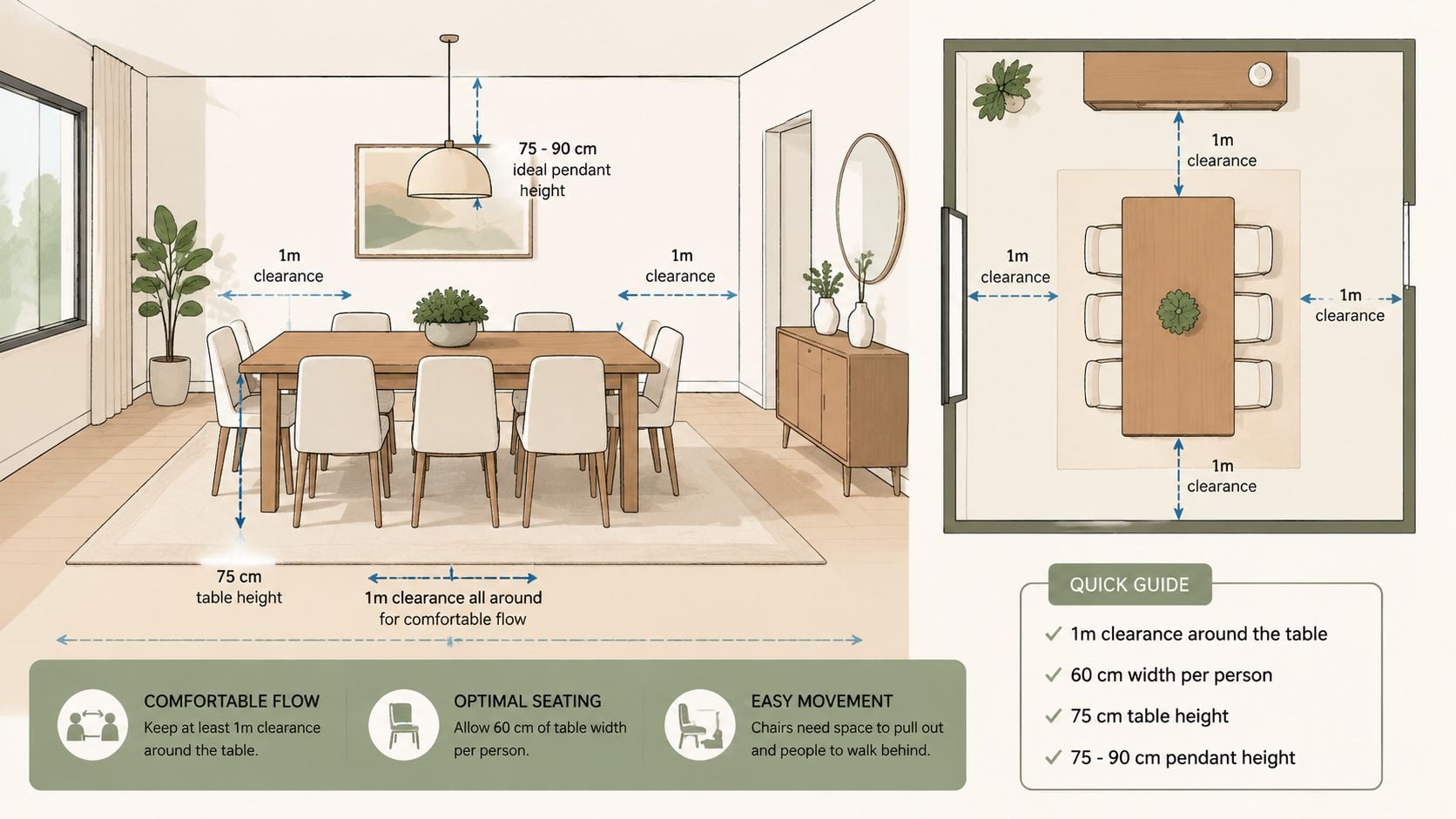
In practice, the room around the table matters more than the tabletop itself. For comfortable everyday use, plan on about 42 to 48 inches between the table edge and the wall, cabinet, or any other obstruction. That gives people enough room to pull a chair out, sit down without twisting, and pass behind someone who is already seated.
I tell clients at Gorins to measure the room as if dinner is already happening, not as if the chairs are neatly tucked in for a photo. That small shift catches mistakes early.
Check three spots first:
- Table edge to wall or casework: This is the clearance that affects daily comfort.
- Chair pull-back zone: Dining chairs need room to move, especially if the seat has arms or a curved back.
- Traffic paths: Doorways, kitchen routes, and openings to the family room often create the main squeeze point.
A room that only works with every chair pushed in will feel cramped every day.
If you want help mapping those clearances to your room, our dining table size guide for room planning and seating clearances walks through the process in more detail.
Give each person enough room to eat and talk comfortably
Seat count on paper is only part of the story. What matters in real life is whether each person has enough width for place settings, elbows, and a relaxed posture.
As a working rule, allow about 24 inches of table edge per person. In many homes, once you go much narrower than that, diners start competing for space. Glasses drift into the next setting, serving dishes crowd the middle, and conversation geometry gets worse because people turn their shoulders instead of sitting naturally toward the group.
Table width matters too. Tops under 36 inches can work in very tight spaces, but they usually ask for a compromise. There is less room for serving pieces, center decor needs to stay modest, and two people facing each other can feel close in a way that is either intimate or inconvenient, depending on the household.
Watch the chair, not just the tabletop
In compact dining areas across Eastern CT, I often see the same problem. The table technically fits, but the chairs make the room awkward.
Chair depth, arm height, and back angle all affect how much usable space you need. A slender side chair behaves very differently from a fully upholstered host chair. Bench seating changes the equation again, especially if one side of the table sits near a wall or window.
That is one reason custom options matter at Gorins. A narrower top, a pedestal base, or a less bulky chair profile can solve a layout problem without making the room feel undersized.
Readers considering bench seating in a tighter layout may also find this guide on Choosing a backed dining bench helpful for weighing comfort, support, and visual weight.
Use numbers to protect the way the room feels
The right measurements do more than keep traffic moving. They shape the way people gather.
A table with enough clearance and personal space supports easy meals, better eye contact, and smoother conversation across the whole group. A table that is too large for the room does the opposite. It creates physical tension, and that tension changes how the room feels socially. That is why sizing should be settled before anyone falls in love with a shape or finish.
The Classic Rectangular Table for Traditional Spaces
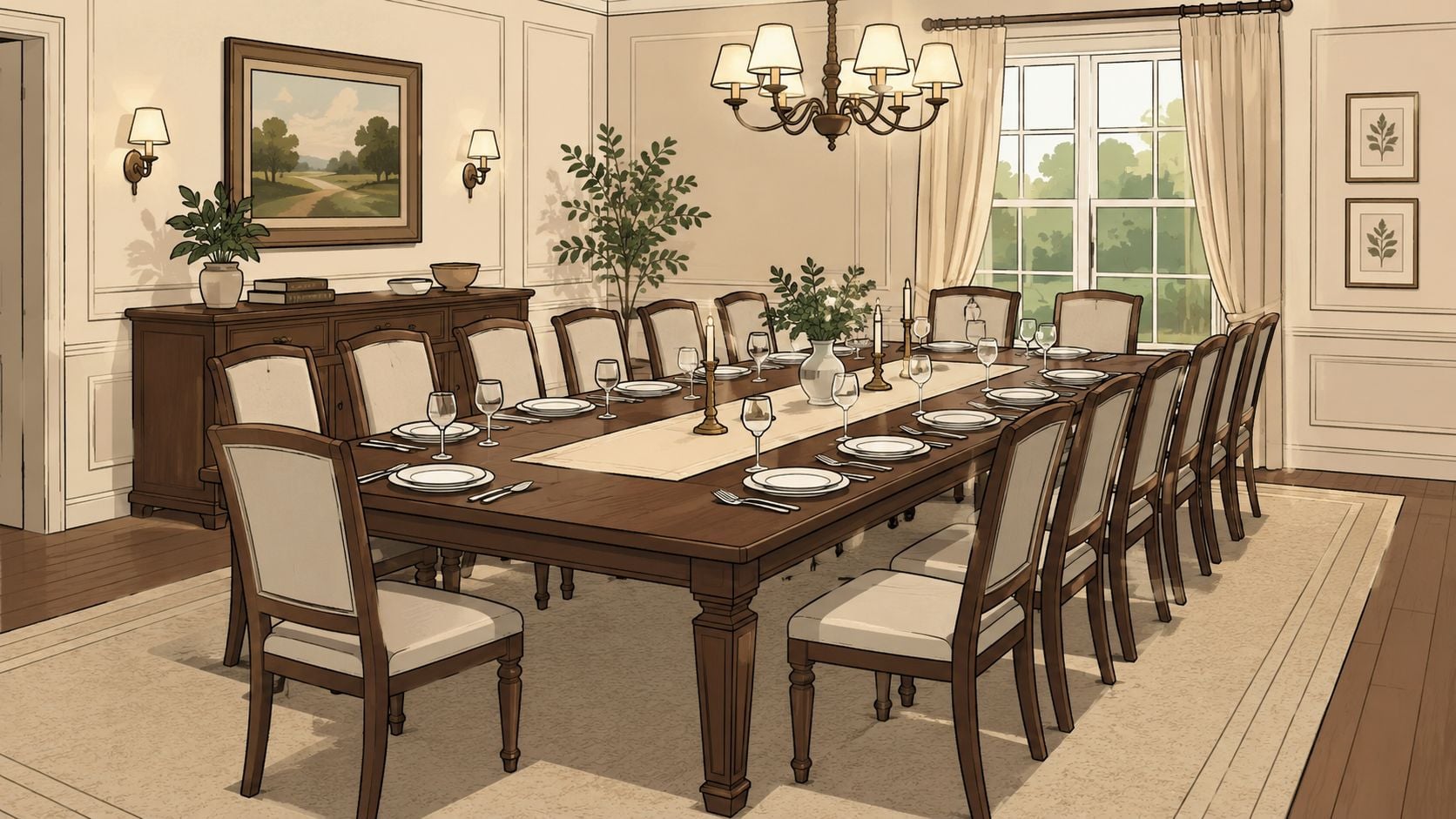
A rectangular table works best when the room itself has direction. In many Eastern CT homes, the dining area is longer than it is wide, with a centered chandelier, a sideboard on one wall, and a natural path in from the kitchen. This shape supports that architecture cleanly and gives the room a settled, traditional feel.
Where rectangular tables shine
Rectangular tables are strong working tables. They give you uninterrupted edge seating, generous space for serving dishes, and a layout that feels organized during holidays, birthdays, and Sunday dinners. If you like the rhythm of place settings lined up, candles down the center, and a host seat at each end, this shape does that naturally.
They also create a specific kind of conversation geometry. People seated across from each other connect easily, while the full table often breaks into smaller conversations as the guest count rises. For many families, that is a benefit. Adults can talk at one end, kids can settle in at the other, and the meal still feels connected.
Design-wise, rectangles are easy to plan around. They align well with rectangular rugs, long buffets, and wall-centered layouts, so the whole room tends to feel orderly without much visual correction.
Where they fall short
The same proportions that make a rectangular table useful can make it feel more formal and less intimate on an ordinary weeknight. If your household uses dinner as the main time to catch up together, a longer top can stretch people farther apart than they expect.
Corners matter too. In tighter rooms, they sharpen every pathway and can make circulation feel pinched, especially in homes with children or busy traffic between the kitchen and the rest of the house.
I also caution clients against assuming a rectangular table always provides the greatest seating capacity comfortably. It often seats the most on paper. In real use, the base style, leg placement, and chair width decide whether those seats feel relaxed or cramped.
Best-fit households and room types
A rectangular dining table is usually the right choice for:
- Traditional dining rooms: Especially rooms with a strong long axis and centered lighting
- Households that host often: The shape handles serving platters, seasonal decor, and formal place settings well
- Families who want structure: End seats and side seating create a clear, familiar arrangement
- Rooms that need visual order: The straight lines pair easily with casegoods and symmetrical layouts
At Gorins, we often help clients fine-tune this shape rather than replace it. A trestle base can free up chair placement. Softer corners can make movement easier. A custom width can keep the table substantial without overpowering the room.
If you are planning for larger family meals, our dining table dimensions for 8 guide is a useful next step.
The Sociable Round and Oval Tables
A family can sit at the same table every night and still have a very different dinner, because of the shape. Round and oval dining tables change conversation geometry. People make eye contact more easily, side conversations break out less often, and the whole group tends to stay part of one shared exchange.

Why curved tables feel more social
Round tables remove the head-of-table hierarchy. That changes the feel of the meal right away. In homes across Eastern CT, I often recommend them for households that treat dinner as real family time, not just a place to eat before everyone heads in a different direction.
Oval tables offer a similar social benefit with a little more reach. They suit rooms that run long, older homes with narrower dining areas, and households that want softer circulation without giving up serving space. The shape still brings people inward, but it fits rooms that cannot comfortably handle a large round top.
Curved edges also help the room work better day to day. Traffic stays smoother because there are no sharp corners jutting into the path between the kitchen, pantry, or hallway. In active homes, that difference shows up fast.
The practical sizing difference
Round and oval tables ask you to balance intimacy against capacity. A round top usually feels best for smaller groups because everyone stays within easy speaking distance. Once the diameter grows too much, the table can start to feel wide rather than welcoming.
Oval tables solve part of that problem. They add length for extra guests while keeping the perimeter softer and easier to move around than a hard-cornered rectangle. For many clients, that makes an oval the better everyday compromise, especially in rooms where clear walkways matter as much as seat count.
Base design matters here, too. A pedestal or trestle base often gives curved tables a real advantage because chairs can slide around more freely without table legs dictating every seat position.
Round versus oval in real homes
Choose the shape based on how the room behaves during an actual meal, not just how it looks empty.
- Round tables: Best for square or nearly square rooms, smaller households, and dinners centered on one shared conversation
- Oval tables: Better for narrower rooms, longer sightlines, and households that need more flexibility without a formal feel
- Curved silhouettes: Easier on circulation in busy spaces, especially where children, serving traffic, or multiple entry points affect the layout
- Pedestal and trestle bases: Usually improve comfort because seat placement stays more flexible
At Gorins, we often help clients fine-tune this choice with custom sizing, base styles, and extension options that fit the way their home runs. For households that want everyday softness with guest-ready flexibility, this oval table with leaves option is a strong place to start.
The Modern Square and Versatile Extension Tables
A square table earns its keep in rooms that need order. In a square dining area, a breakfast nook, or an open kitchen where every inch has to work hard, it can feel calm, centered, and intentional.
A significant advantage is conversation geometry. Everyone sits at a similar distance, so the table supports one shared discussion without a formal head position. That gives square tables some of the social ease of a round top, but with cleaner lines and a more architectural look that suits many newer homes in Eastern CT.
Square tables also handle boundary conditions well. If one side of the dining area lives near cabinetry, a built-in, or a through-path, the shape often reads neater than a rectangle and wastes less visual space. The catch is capacity. Once a square table gets too large, the center starts to feel far away for everyday meals, and the room can begin to feel blocked rather than balanced.
That is why I usually recommend square tables for smaller groups or rooms that are close to square themselves. In the right setting, they feel intimate and composed. In the wrong one, they can feel heavy.
Extension tables solve a different problem. They let the room stay comfortable on an ordinary Tuesday and still handle Thanksgiving, birthdays, or a last-minute invite to the neighbors. For many families, that flexibility matters more than picking a single perfect fixed size.
A few extension styles serve different habits well:
- Self-storing leaves: Best for households that want quick changes without hunting for stored parts
- Add-in leaves: Good when entertaining happens a few times a year and the table stays compact most of the time
- Square-to-rectangle extensions: A smart choice for homes that want close everyday conversation, then more reach and seating for guests
The opened size needs the same scrutiny as the closed size. Tape out both footprints on the floor. Pull chairs back. Walk the route from kitchen to table, and from table to any nearby doorway. That simple test catches problems early, especially in older Connecticut homes where rooms often look generous until the chairs are occupied.
Base design matters here too. A handsome extension mechanism does not help if table legs land right where guests want to sit. We check that detail often at Gorins because a table can look right in the showroom and still frustrate people at home if the support placement steals usable seats.
If you want a practical example, the Lyncott dining extension table shows how an extension piece can keep daily meals comfortable while giving you extra room when the guest list grows. After the table is set, the wall treatment helps finish the room. This guide to Dining room wall art is a helpful reference for balancing the table with what surrounds it.
Styling Your Dining Space Like a Pro
A dining table can be the right shape and still look unfinished if the surrounding choices fight it. Chairs that are too bulky, a rug that's too small, or lighting hung at the wrong scale can make a good table feel awkward. The room needs a supporting cast that matches the shape and purpose of the table.
Match chair scale to table behavior
Chairs should fit the table visually and functionally. A heavy upholstered armchair can anchor the ends of a rectangular table in a formal room, while slimmer side chairs may serve a round or square table better because they keep the perimeter lighter and movement easier.
Useful pairings often look like this:
- Rectangular table plus mixed seating: Works well when the room has a formal tone and a clear head position.
- Round table plus lighter chairs: Keeps the shape airy and easy to move around.
- Oval or extension table plus adaptable chairs: Helps the room flex between daily use and entertaining.
The chair doesn't just need to match the table. It needs to match how often people linger there.
Use lighting to reinforce the shape
Lighting should echo the tabletop, not argue with it. A linear fixture usually suits a rectangular or oval surface. A centered pendant or chandelier often feels better over a round or square top because the geometry aligns naturally.
The fixture also needs visual breathing room. If the table has a strong, heavy base, lighter lighting can balance it. If the table is visually spare, a statement fixture can provide the room with needed presence.
Ground the room with a rug and finishing layers
An area rug can make the dining zone feel intentional, especially in open-concept homes. The rug should support the full use of the chairs, not just the table itself. If chair legs catch the edge every time someone sits down, the room will feel unsettled no matter how pretty it looks.
Three finishing moves make a big difference:
- Wall art with scale: Oversized or grouped pieces can give the dining room more identity. For inspiration on placement and composition, this guide to dining room wall art is worth a look.
- A useful centerpiece: Bowls, low florals, or a tray should leave room for real meals, not block sightlines.
- Textural contrast: Wood, upholstery, metal, glass, and fabric should feel layered rather than matchy.
For readers building out the full room, Gorins' article on dining room accessories that go beyond the table offers practical finishing guidance.
Design Your Perfect Table at Gorins Furniture
The hardest part of shopping for dining tables is that many homes fall between standard options. One table is the right length but the wrong shape. Another has the right silhouette but a finish that doesn't belong with the rest of the room. That's where customization changes the experience from compromise to fit.
Since 1936, Gorins Furniture & Mattress has helped families across Norwich, New London, Plainfield, Waterford, and surrounding Eastern CT and Rhode Island communities furnish homes with a local, neighborly approach. That heritage matters in dining furniture because the right recommendation usually comes from listening first, not pushing a one-size-fits-all answer.
Why custom dining makes sense
Custom dining is often the best path when a household needs a specific shape, a particular scale, or a finish that works with existing wood tones. With Canadel Custom Dining, shoppers can choose from thousands of combinations of shapes, sizes, finishes, bases, and chair styles to build a table designed for the room and the household's habits.
That level of flexibility helps solve common problems:
- Awkward room proportions: A custom size can fit a room that standard dimensions can't serve well.
- Lifestyle mismatch: A family that wants better conversation flow can choose a shape that supports that.
- Design continuity: Finish and chair choices can connect the dining area to the rest of the home.
Local guidance makes selection easier
A strong showroom experience still matters, especially for investment-grade furniture. Seeing wood finishes in person, comparing edge profiles, and testing chair comfort takes much of the guesswork out of a custom order. For many shoppers, that's the difference between hoping a piece works and knowing it does.
Gorins also brings that same design-minded flexibility into other rooms of the home. The F9 Custom Sofa series gives living room shoppers the same customized-to-your-lifestyle approach, and the Sleep Gallery features Tempur-Pedic, Serta, and Beautyrest with a focus on comfort by feel and healthier sleep.
A custom table isn't about adding complexity. It's about removing compromise.
Value, delivery, and next steps
Custom furniture should still feel approachable. Gorins offers Promotional Financing with equal monthly payments, which can make a major dining purchase easier to plan for without reducing the conversation to “cheap.” That's a better fit for households looking for affordable luxury and long-term value.
As a Furniture store Norwich CT shoppers have trusted for generations, Gorins pairs broad selection with personalized help, family-operated service, and a showroom experience built around real homes in Eastern Connecticut. For needs such as Custom Dining Norwich, Living Room Furniture Eastern CT, or Canadel Furniture Connecticut, the advantage is simple. More fit, less compromise, and guidance that stays grounded in how people live.
Since 1936, Gorins Furniture & Mattress has helped Norwich and Eastern CT families create homes they love. From custom-designed Canadel dining sets to the latest in Tempur-Pedic sleep technology, they combine a massive selection with the personalized care only a local, family-owned business can provide. Visit the Norwich showroom, take the online Style Quiz, or browse the Clearance section to find quality, value, and their 5-Star Delivery service.