Recliner High Back


A recliner with a tall back isn't automatically a comfortable recliner. That popular shortcut ignores the measurements that determine whether the chair supports the body or encourages slouching. A backrest can reach the neck and still fail if the seat is too deep, the lumbar curve sits in the wrong place, or the headrest pushes the head forward.
For homeowners in Norwich and throughout Eastern Connecticut, the better approach is simple: treat a recliner high back as a complete seating system. The back height, seat depth, seat height, width, lumbar position, recline motion, and room placement must work together. That's how shoppers find investment-grade comfort instead of buying an impressive-looking chair that becomes uncomfortable after a short sitting session.
Why a Tall Backrest Does Not Guarantee Comfort
A tall backrest provides coverage, not necessarily support. High-back seating has roots in early twentieth-century Adirondack furniture. In 1905, Harry Bunnell received a U.S. patent for a chair based on Thomas Lee's design, featuring a tall back, inclined seat, and broad armrests. The design came from Westport, New York, and favored a wide, solid structure that supported a relaxed posture rather than the upright geometry of a dining chair. A related account describes Lee's original version as using 11 boards, with the back positioned at approximately a 90-degree angle to the sloping seat. The Smithsonian's history of the Adirondack chair shows how raised back support and an inclined seat became lasting priorities in leisure seating.
That history explains why the high-back concept remains appealing, but it doesn't prove that every tall chair fits every body. A chair can cover the shoulders and head while leaving the pelvis unsupported. If the seat is too deep, the user may slide forward to reach the floor, flattening the lower-back curve and creating tension through the shoulders.
Support depends on proportion
Anthropometric chair research connects backrest height with seated height, which combines the trunk, neck, and head dimensions. A general-purpose backrest may be approximately 75% of seated height, while effective lumbar support sits between the second and fifth lumbar vertebrae, according to research on chair sizing and ergonomic dimensions. These measurements matter more than a product label that merely says “high back.”
A supportive recliner should let the user sit fully back while keeping the pelvis stable. The lumbar area should meet the natural inward curve of the lower back, and the headrest should meet the back of the head without forcing the neck forward. The shoulders shouldn't hover in front of the backrest because the cushion is too far behind them.
Practical rule: A high back is useful only when the seat depth, lumbar placement, and head support fit the same body.
Style still matters. A tall silhouette can anchor a living room, especially when the upholstery, arm shape, and scale suit the surrounding furniture. For visual ideas about how high-back seating can fit into a considered room, The Sofa Cover Crafter's high-back sofa advice offers useful design context. Comfort, however, must be tested in the chair rather than judged from its outline.
Norwich shoppers comparing supportive seating can also review reclining sofas with lumbar support when a full sofa configuration makes more sense than a single chair. The same principle applies: the visible height is only one part of the fit.
Measuring Your Body for the Perfect Recliner Fit
The strongest showroom test begins before the shopper sits down. A few simple measurements can eliminate chairs that look suitable but won't support the user properly.
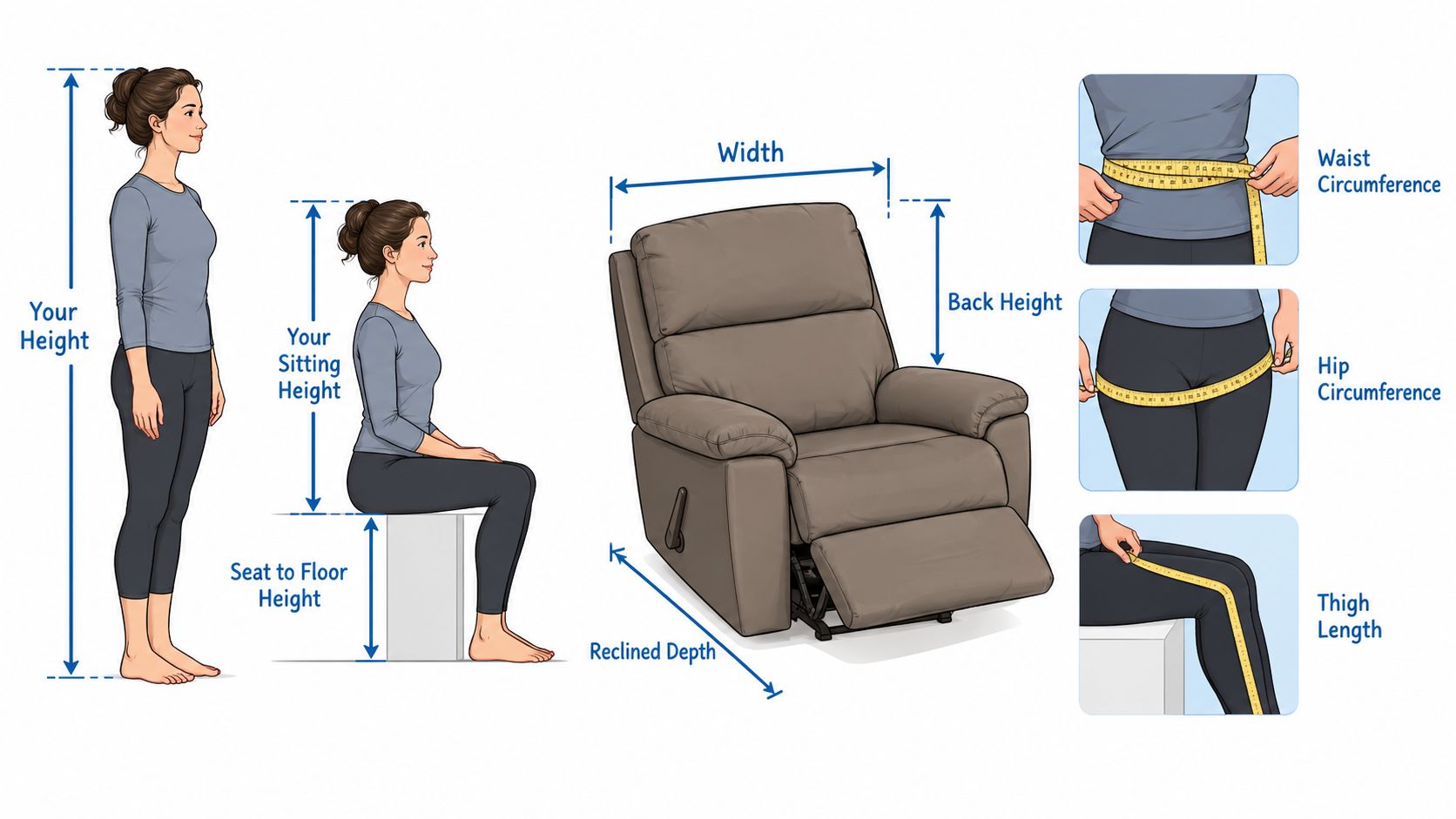
Take the measurements that affect fit
Use a firm chair, keep the feet flat, and ask another person to measure where possible.
Seated height: Measure from the seat surface to the top of the head while sitting naturally. This helps compare the user's body with the chair's back height and headrest position.
Shoulder height: Measure from the seat to the top of the shoulders. The backrest should support the upper back without stopping below the shoulder blades or pushing them forward.
Hip width: Measure across the widest part of the hips while seated. The chair should provide room to sit squarely without forcing the user into a tilted posture.
Thigh length: Measure from the back of the hip to the bend behind the knee. This helps determine whether the seat is too deep, which can leave the feet unsupported or encourage sliding.
Popliteal height: Measure from the floor to the bend behind the knee while seated. This is the key comparison for seat height. A seat that's too high can leave the feet dangling, while a seat that's too low can make standing harder.
Record the measurements before visiting the showroom. Manufacturer specifications for seat depth, seat height, back height, and width are more useful than the phrase “high back” alone. Guidance on how to measure furniture before purchase can also help households account for doorways, halls, and the intended room.
Use a repeatable showroom routine
A sit test should include more than a quick impression. The following checks reveal whether the chair supports the user's actual posture:
Pelvis first: Sit fully back, letting the pelvis contact the cushion. The lower back should meet the lumbar area without a gap or a concentrated lump of pressure.
Knee clearance: The seat edge should finish before the bend behind the knee. Excessive depth can press into the legs or tempt the user to slide forward.
Head position: Recline and return upright. The headrest should support the head without pushing the chin toward the chest or the neck in front of the shoulders.
Foot contact: In the upright position, both feet should rest securely on the floor when the seat height suits the user. A footrest should support the lower legs without forcing the knees into an awkward angle.
Width and arms: The armrests should let the shoulders relax. Narrow seating can compress the hips, while overly broad seating can prevent the arms from receiving useful support.
The best-fitting high-back recliner may not be the tallest chair on the floor. It's the chair that keeps the pelvis stable, the lumbar curve supported, the head aligned, and the feet secure across several positions.
Choosing Between Manual, Power, and Lift Options
Once the dimensions fit, the mechanism determines how the chair behaves throughout the day. A manual recliner can be straightforward and dependable, while a power recliner gives the user more control over movement. A lift chair adds assistance during the transition from sitting to standing, which makes it a different category rather than merely a more advanced recliner.
Manual recliners suit simple routines
A manual model typically uses a lever or body weight to open the footrest and recline the back. It works well for users who have enough leg and arm strength to operate the mechanism without strain and who prefer a chair with fewer powered components.
The tradeoff is control. The user may have fewer independent adjustments, and returning upright can require more effort. A manual mechanism also deserves a careful test because some chairs need a deliberate push through the legs or back to close the footrest.
Power recliners provide controlled adjustment
Power models are useful when the user wants gradual positioning or has difficulty operating a manual lever. A chair with independent back recline, power headrest, lumbar adjustment, or seat-pan movement can help the user find a position that supports reading, conversation, television viewing, or rest.
The important question isn't whether a chair has a motor. It's whether the movements match the user's needs. Independent back recline can adjust the upper body without immediately forcing the legs into a fully extended position. Seat-pan tilt can change the relationship between the pelvis, thighs, and backrest. A wired control should be easy to see and reach, and the cord should be routed safely.
A practical comparison is useful:
| Configuration | Best suited to | Main consideration |
|---|---|---|
| Manual recliner | Users comfortable with a lever or push-back action | Opening and closing may require more physical effort |
| Power recliner | Users who want gradual, independent positioning | The control, cord, and adjustment range need testing |
| Lift chair | Users who need help transitioning to standing | The lifting path and room clearance must suit the user |
For a closer look at the practical differences, power recliners versus manual recliners provides a useful starting point.
Lift chairs address transfers, not just lounging
A lift chair gently tilts the user forward to assist with standing. That movement can support independence for older adults or people with limited mobility, but it shouldn't be treated as a substitute for safe transfer technique or professional medical guidance.
The user should test the full sequence, including sitting down, reclining, returning upright, and standing. Arms should provide balance, but they shouldn't become a walking aid. A stable floor, open path, and suitable chair height matter as much as the motor.
Gorins Furniture & Mattress offers specialty seating that includes high-leg recliners and lift-chair options from established furniture categories, including UltraComfort. The Norwich showroom also carries reclining configurations with features such as power headrests and lumbar support, allowing shoppers to compare appearance, fit, and operation in person.
The Science of Pressure Distribution and Reclining
Soft cushions can feel comfortable at first, but lasting comfort depends on how the chair distributes pressure. Upright sitting tends to concentrate pressure near the ischial tuberosities, commonly called the sit bones. Reclining shifts support toward the thoracic region around the shoulder blades and away from the spine, while broader sacral-pelvic and thoracic contact can spread the load more effectively than lumbar-only support, according to Herman Miller's review of pressure distribution.
That shift explains why a recliner can feel better than a rigid upright chair, but reclining alone doesn't solve every pressure problem. A backrest that reclines without a coordinated seat-pan movement can increase peak pressure in the buttocks and lower back even as pressure decreases in the upper back and thighs.
Seat-pan movement changes the result
The seat pan controls the relationship between the pelvis and the thighs. When the back reclines while the seat remains fixed, the body may slide or rotate against the cushions. Adding seat-pan tilt can redistribute load toward the back and away from the buttocks, helping the chair maintain more stable contact with the user.
A well-designed high-back recliner should therefore be tested in multiple positions:
- Upright: The pelvis should remain back, with the lower back supported and the feet secure.
- Partially reclined: The shoulders should settle into the backrest without the head moving sharply forward.
- Reading position: The user should be able to hold a book or device without rounding the neck and upper back.
- Fully reclined: The legs should feel supported rather than suspended, and the user shouldn't feel pulled downward.
- Returning upright: The chair should bring the user forward in a controlled way without destabilizing the pelvis.
A study involving older adults found that small tilt and recline adjustments significantly reduced sitting-interface pressure, while measurable increases in ischial blood flow occurred primarily at larger combined tilt-and-recline angles, as reported in the same pressure-distribution review. That distinction matters. A chair can feel relaxed without placing the body in the position that best relieves pressure.
Test every position you'll use at home, not only the fully reclined position that feels most luxurious in a showroom.
Users with limited mobility should spend enough time testing transitions and pressure relief. The chair needs to support the body during ordinary sitting, conversation, reading, and standing, not only during a short demonstration.
Customizing Your Upholstery and Financing the Investment
A high-back recliner can either disappear into a room or become a deliberate design element. The difference comes from proportion, upholstery, arm shape, stitching, and the relationship between the chair and the rest of the living room. Investment-grade quality doesn't require a traditional appearance. A refined silhouette, restrained welt, or carefully selected fabric can make supportive seating feel integrated rather than added on.
Build the chair around the room
Custom programs show how physical configuration and style can work together. The F9 custom upholstery program offers four arm styles, panel, sock, track, and crescent. It also provides four back configurations, including semi-attached knife-edge, loose knife-edge, semi-attached boxed, and loose boxed.
Tailoring changes the visual edge treatment. Available choices include:
- Welt or piping for a defined outline.
- French seam with a single needle for a cleaner crafted detail.
- Saddle stitch with a double needle for a more pronounced finish.
The program extends to sofas, sleepers, loveseats, chairs, ottomans, and sectionals. Its construction specifications include a 2.0-density high-resiliency foam core with Dacron wrapping and a 100% Dacron polyester-fiber back cushion in separate compartments, as documented in the F9 custom upholstery specifications. A separate documented F9 configuration uses gently curved crescent arms, a semi-attached boxed back, welted detailing, and three seat cushions, illustrating how several choices combine into one finished look.
The same custom-order mindset applies to the broader home. Gorins supports Canadel Custom Dining, where households can select among sizes, shapes, finishes, and fabrics for a dining setting that suits their lifestyle. For living spaces, shoppers can coordinate a recliner's undertone and texture with sofas, accent chairs, rugs, and case goods rather than treating comfort seating as an isolated purchase.
A guide to upholstery materials and their practical differences helps shoppers consider cleaning needs, hand feel, durability, and visual weight before selecting a covering.
Plan the payment as carefully as the upholstery
Promotional financing can make an investment purchase easier to budget, but the terms need close attention. Gorins advertises No Interest if Paid in Full plans and equal-monthly-payment programs through the Nest Credit Card, issued by Comenity Capital Bank, and through partnerships with TD Bank. Approval is required.
These structures aren't interchangeable. A no-interest-if-paid-in-full promotion generally requires the promotional balance to be paid completely by the stated deadline to avoid deferred-interest terms disclosed in the account agreement. An equal-monthly-payment plan divides the promotional balance into scheduled installments. Shoppers should review the account agreement for the applicable APR, term, minimum purchase requirements, and late-payment conditions before accepting an offer.
That approach keeps financing practical and transparent. The chair should fit the person, the room, and the household budget without turning a comfort purchase into a pressured decision.
Household Safety and Strategic Room Placement
A recliner needs enough space to operate safely. The footrest, backrest, power cord, nearby tables, children, pets, and walking paths all affect how the chair functions after delivery. Families with older adults or users with limited mobility should assess the entire transfer area, not only the chair's stability while someone is seated.
Furniture safety deserves particular attention in multigenerational homes. Furniture Today reported that eight children died after becoming trapped in or under recliners over the past decade, while ASTM International was developing a voluntary recliner safety standard, as described in Furniture Today's recliner safety coverage. Children should never play on, under, or around an open recliner mechanism.
Use a placement checklist
Before delivery, measure the intended location and review the walking route.
Clear the operating zone: Leave enough room for the footrest and backrest to move without striking a wall, table, lamp, or another chair.
Choose an even surface: Uneven flooring can affect stability and may change how the base sits during transfers.
Protect the floor appropriately: A rug pad or suitable floor protection can help prevent movement and surface damage. Households with hardwood can consult Flacks Flooring's hardwood furniture-care guide for practical protection ideas.
Route the power cord safely: Keep cords away from walking paths, pinch points, heat sources, and areas where children or pets can pull them.
Keep children away from moving parts: Establish a clear household rule that the footrest and mechanism aren't play areas.
Avoid using the chair as a walking aid: Users with limited mobility should push from a stable surface or use the transfer method recommended by a caregiver or clinician, rather than pulling hard on the arms or back.
Check surrounding furniture: Don't place the recliner where a user must twist around a table or narrow passage to sit or stand.
Test the transfer: The user should sit down, recline, return upright, and stand while another adult observes the movement during the initial setup.
Australian mandatory toppling-furniture information requirements introduced in 2025 emphasized that older people with reduced strength or mobility may face greater risk because they can rely on furniture for support and suffer severe injury if furniture tips. The broader lesson applies at home: stability must be evaluated during standing and sitting, not only while the chair is occupied.
For a room-specific plan, living room furniture placement guidance can help households protect clear paths while keeping the recliner connected to conversation areas. The best location usually gives the user a direct route to the chair, enough clearance to operate it, and a comfortable relationship with lighting, tables, and other seating.
Since 1936, Gorins Furniture & Mattress has helped Norwich and Eastern CT families create homes they love. From custom-designed Canadel dining sets to the latest in Tempur-Pedic sleep technology, the family-operated business combines a broad selection with personalized local care, including a Sleep Gallery with Tempur-Pedic, Serta, and Beautyrest options for comfort by feel and healthier sleep, plus promotional financing, clearance value, and delivery service.
Visit Gorins Furniture & Mattress in the Norwich showroom to compare high-back recliners, power configurations, lift chairs, and upholstery choices with practical fitting guidance. Shoppers can also take the online Style Quiz or browse the Clearance section for value-driven savings before choosing investment-grade comfort for the home.