Power Recliner vs Manual: Expert Comparison

A lot of shoppers start this search in the same moment. They get home, drop the keys on the counter, and want one chair that feels right at the end of a long day. Not flashy. Not complicated. Just comfortable in a way that fits the room, the routine, and the people using it.
That's why power recliner vs manual isn't just a feature question. It's a daily-life question. In homes around Norwich, New London, Plainfield, and Waterford, the better choice usually comes down to how the chair will be used on an ordinary Tuesday night, who needs the seat to work hardest, and how much flexibility the room allows.
Since 1936, locally owned, family-operated furniture businesses in Eastern Connecticut have helped neighbors sort through these decisions with a practical lens. The same thinking applies here. A recliner should feel like investment-grade quality, not a short-term compromise. It should be suited to your lifestyle, whether that means easier mobility, a quieter nursery corner, or a classic reading chair that can sit anywhere in the room.
Table of Contents
- Choosing Your Perfect Seat for Relaxation
- The Core Difference How They Recline
- A Detailed Comparison for Eastern CT Homes
- Modern Features and Timeless Style
- Which Recliner Truly Fits Your Lifestyle
- Make Your Choice with Confidence at Gorins
- Frequently Asked Questions from Our Neighbors
Choosing Your Perfect Seat for Relaxation
A recliner usually becomes the most claimed seat in the house. One person uses it for evening TV, another for reading, and someone else ends up napping there on weekends. That's why the wrong choice gets noticed quickly.
In many Eastern CT homes, the question starts with comfort but ends with routine. A couple furnishing a den may want a chair that blends into traditional décor and can move if the room gets rearranged. A family setting up a nursery may care more about quiet operation and easy one-handed use. A homeowner planning for long-term comfort may put smooth movement and support at the top of the list.
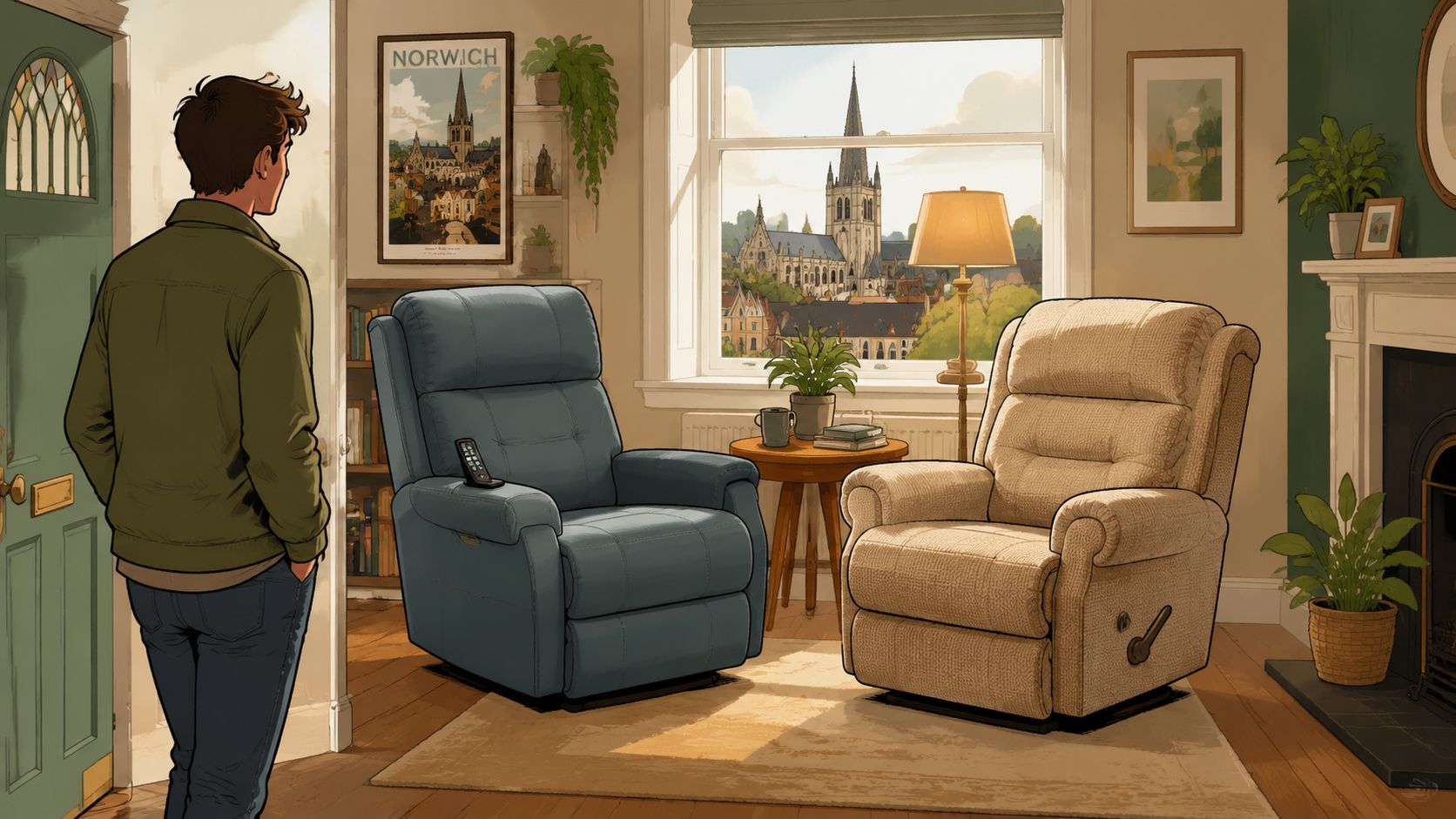
The most useful way to compare power recliner vs manual is to look at the chair as part of the home, not as a standalone gadget. A recliner affects traffic flow, outlet placement, daily comfort, and how easy it is for different family members to use the seat without effort.
Practical rule: The best recliner isn't the one with the longest feature list. It's the one that fits the room, the user, and the routine without creating friction.
Many shoppers also want a chair that feels worth the investment alongside the rest of the home. That same mindset shows up in custom furniture decisions, from Canadel Custom Dining with thousands of combinations to the F9 Custom Sofa series that lets families tailor comfort and style. Recliners deserve the same level of thought.
| Feature | Power recliner | Manual recliner |
|---|---|---|
| Operation | Button-controlled motor | Lever or push-back motion |
| Best for | Easier positioning, mobility support, tech features | Simplicity, flexible placement, classic styling |
| Position control | Precise micro-adjustments | More limited stop points |
| Room needs | Nearby outlet or power plan | No electricity needed |
| Upfront cost | Higher | Lower |
| Long-term ownership feel | Convenience-focused | Simplicity-focused |
The Core Difference How They Recline
The biggest difference is the action required from the person sitting in the chair.
A power recliner uses a motor and control buttons to move the back and footrest. A manual recliner depends on body movement, a lever, or a pull mechanism to change position. That single difference shapes almost everything else, from ease of use to room placement.
According to Gorins' overview of power recliner basics, power recliners use electric motors to enable reclining positions with the touch of a button, while manual recliners rely on the user's physical effort to push back and engage the mechanism, making the former significantly easier for individuals with limited strength or mobility
What the user actually feels
With a power model, the chair does the work. The seated person presses a button and the chair shifts position gradually. That matters for anyone who doesn't want to brace, push, or reset their body weight to get comfortable.
With a manual model, the person provides the force. That can feel fast and familiar, especially for shoppers who like a simple mechanism and don't mind using some body weight to recline.
Why this matters in real homes
In a showroom, both can feel comfortable for a minute or two. At home, the difference becomes more obvious.
- Mobility concerns: Power tends to be easier for older adults or anyone recovering from strain because less physical effort is required.
- Shared seating: If several people use the same chair, button control often works better across age groups and strength levels.
- Simple routines: Manual fits households that prefer fewer powered components and a more traditional seating experience.
A recliner should never feel like it asks the user to negotiate with it every time they sit down.
That's the heart of power recliner vs manual. One prioritizes controlled assistance. The other prioritizes mechanical simplicity. Neither is automatically better. The better option depends on who's sitting there every day.
A Detailed Comparison for Eastern CT Homes
The strongest recliner choices come from matching trade-offs to the home itself. In Eastern Connecticut, that often means balancing comfort, value, durability, and placement. In a compact colonial, a shoreline condo, or a family room with several traffic paths, those details matter more than shoppers expect.
Comfort and positioning
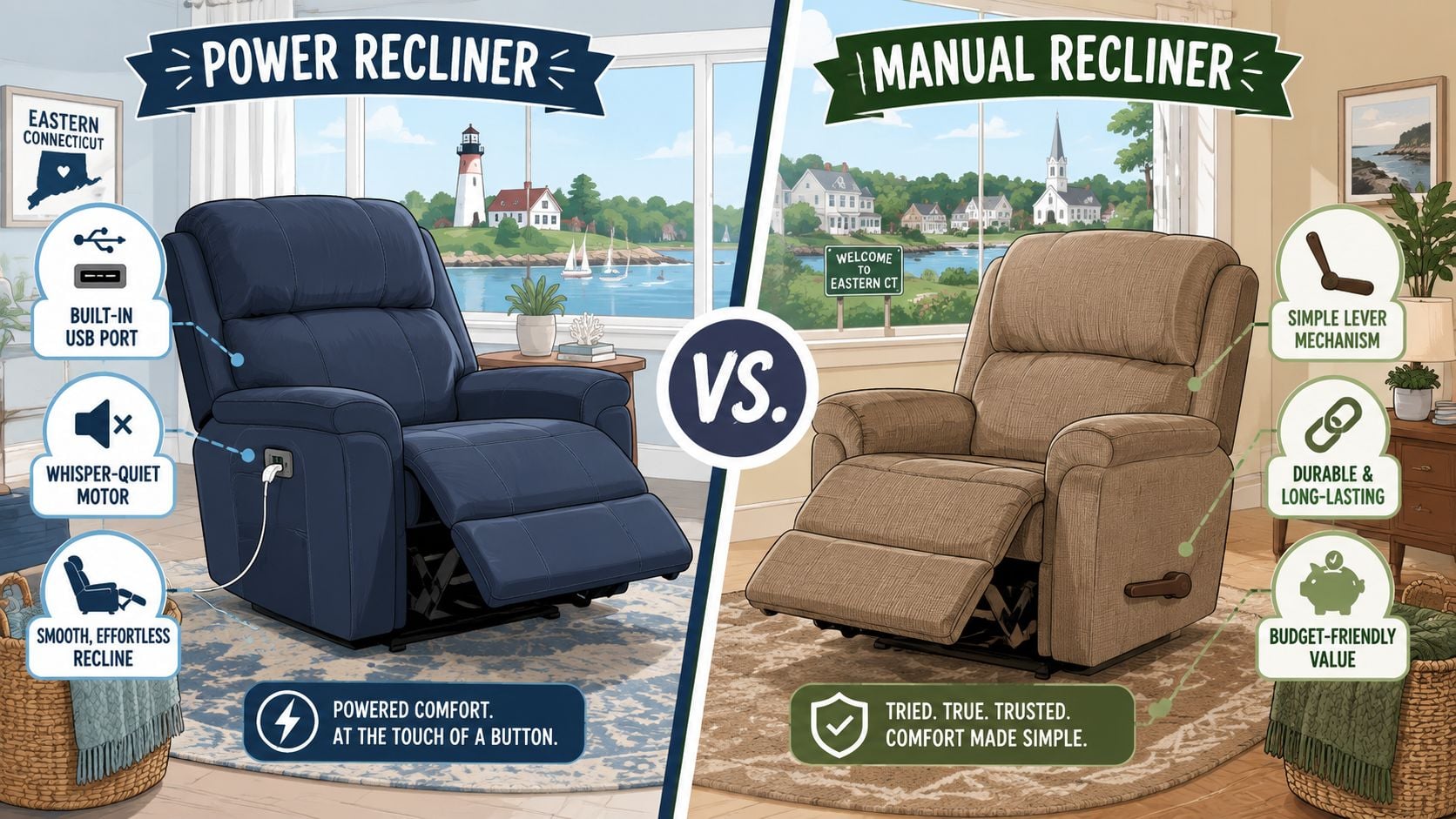
Power recliners have a clear edge when the priority is fine-tuned comfort. They allow the user to settle into a specific angle instead of choosing between a few broader stopping points. That's useful for reading, watching television, or easing pressure on the lower body during longer sitting sessions.
Manual recliners still work well for shoppers who like a simpler sit-back-and-relax feel. For many people, especially in a casual den or media room, that's enough. The chair opens, the footrest comes up, and the room keeps its easy rhythm.
Brand feel frequently carries as much weight as the mechanism. In better-built seating from names such as Flexsteel and BarcaLounger, cushioning, arm shape, and seat support can matter just as much as whether the chair is powered.
Cost and long-term value
Price is one of the most visible differences. Power recliners retail for $200 to $800 more on average than comparable manual recliner models, and that gap comes from the added motors, wiring, and advanced components used for touch-button operation, according to this pricing comparison on power and manual recliners.
That doesn't automatically make power the worse value. It depends on what the household needs.
- Power value: Better for shoppers who'll use the precision and ease every day.
- Manual value: Better for buyers who want comfort without paying for electrical components they may not use much.
- Household value: Better measured by years of satisfaction than by the ticket alone.
A room's overall furnishing plan matters too. Some buyers save in one area and customize in another. That's the same practical logic used when choosing between stock and custom options in dining or upholstery. A family may put more money into the seat used every evening and keep other pieces simpler.
Durability and maintenance
Here, the comparison gets more balanced.
Manual recliners generally appeal to shoppers who want fewer parts involved. Simpler systems often mean fewer things to troubleshoot. According to this retailer summary on recliner longevity, manual recliners typically have a longer mechanical lifespan due to fewer electronic components, with some models lasting over 20 years without significant repair, whereas power recliners may require motor or circuit board maintenance after 10–15 years of use.
Power recliners can still be excellent long-term chairs when the mechanism is well built and the chair is used as intended. They introduce another category of parts that may eventually need service.
Buying lens: If a shopper values fewer potential repair points above all else, manual usually feels safer. If daily ease matters more, power often earns its extra complexity.
Placement and room flow
Room layout often decides the winner before comfort does. A power recliner needs a nearby outlet or a power solution. According to this summary of recliner energy needs, power recliners draw approximately 10–20 watts of electricity during operation, while manual recliners need no electricity at all.
That matters in older homes where outlets aren't always exactly where the furniture wants to go. A manual chair can slide into a reading corner, a sunroom, or a spot away from the wall without the same planning.
Power models can still work beautifully in specifically designed layouts. They just reward intentional placement. In a living room with a clear furniture plan, that's rarely a problem. In homes where furniture gets rearranged often, manual usually offers more freedom.
Modern Features and Timeless Style
A recliner isn't just a motion piece. It's a visual anchor. In many living rooms, it sits where everyone can see it, so style matters almost as much as comfort.
Shoppers comparing power recliner vs manual often assume power looks more modern and manual looks more traditional. That's sometimes true, but the better way to think about it is function first, then silhouette, scale, and upholstery.

Where power models add convenience
Today's power seating often includes features that change how the chair works in everyday life, not just how it reclines. According to this overview of modern power seating features, modern power recliners often include features such as USB charging ports, adjustable headrests, and lumbar support that are not available on manual models, enhancing user convenience and comfort for tech-integrated living spaces.
That kind of convenience works especially well in spaces where the recliner doubles as a personal command center.
- Device-friendly seating: USB access helps in rooms where phones and tablets follow the user.
- More personalized support: Adjustable headrest and lumbar settings can help different body types share one chair more comfortably.
- Routine convenience: Small controls can matter a lot in homes where the chair gets heavy daily use.
Shoppers exploring these options often benefit from looking through different types of power reclining seating before deciding which feature set fits the room.
Why manual styles still win many rooms
Manual recliners still hold a major design advantage in homes where the goal is a softer, less technical look. Without powered controls or the expectation of nearby electricity, they often fit naturally into classic living rooms, studies, and mixed-use spaces.
They also pair well with broader customization plans. Many homeowners who value a coordinated interior prefer to choose upholstery, wood tones, and scale the same way they would with a sofa or dining set. That's why custom programs remain so relevant. With Canadel Custom Dining offering thousands of combinations and the F9 Custom Sofa series showing how custom furniture can shape a room, it makes sense that buyers want similar flexibility in reclining seating.
The best-looking recliner is usually the one that doesn't announce itself as a recliner from across the room.
Which Recliner Truly Fits Your Lifestyle
Most buyers don't need the “best” recliner in the abstract. They need the right recliner for the way the house runs every day. That's where the power recliner vs manual decision becomes clearer.

For nurseries and quiet spaces
Noise is one of the most overlooked differences. According to this nursery discussion on power and manual recliner noise, power recliners operate at 25–30 dB, while manual recliners generate 45–55 dB during lever activation. The same discussion notes that 68% of parents in baby-focused forums explicitly chose electric recliners to avoid waking infants.
That makes power a strong fit for nurseries, late-night feeding routines, and any room where abrupt sound feels disruptive. In a Plainfield or Norwich nursery, a quiet transition can matter more than a lower upfront cost.
For aging in place and easier movement
Power seating also makes more sense when the chair needs to support independence, not just relaxation. For older adults or anyone with limited strength, easier motion reduces friction every single day. Some households eventually move beyond a standard recliner and start looking at lift functionality.
Aging-in-place planning often includes more than one change to the home. Alongside entry access, bathroom safety, and flooring choices, seating plays a real role in daily comfort. Family Caregiving Kit's modification guide offers useful context for families thinking through that broader transition.
Shoppers weighing mobility support can also review what to look for in the best recliner for seniors to understand where standard power seating ends and lift assistance begins. Models from UltraComfort often enter the conversation when standing support becomes a key need.
For traditional rooms and flexible placement
Manual recliners still make the most sense in plenty of homes. They're often the better choice for a reading corner, a bonus room, or any layout where the chair may move over time. In older Eastern CT homes with fewer convenient outlets, that flexibility matters.
They also fit buyers who prefer furniture that feels straightforward. No cord management. No powered controls. Just a comfortable chair that reclines when needed and sits like a classic upholstered piece the rest of the day.
A simple decision framework helps:
- Choose power when quiet operation, easy movement, or precise positioning will improve daily life.
- Choose manual when placement freedom, mechanical simplicity, and a classic look matter most.
- Choose based on the primary user if one person will claim the chair most of the time.
A recliner earns its place when it supports the household's routine without asking the room to adapt around it.
Make Your Choice with Confidence at Gorins
Reading about recliners helps. Sitting in them tells the truth faster.
That's especially true with power recliner vs manual, because comfort isn't only about the mechanism. Seat depth, arm height, head support, and how easily the footrest meets the body all change the experience. A chair that sounds right on paper can feel completely wrong after five minutes.
For many shoppers in Norwich and across Eastern CT, the smartest move is to compare both side by side and test them the way they'll be used. Sit upright. Recline fully. Get back out. Repeat it more than once. That reveals whether the chair suits everyday life or just makes a strong first impression.
A practical shopping checklist helps:
- Test the exit as well as the recline: A chair that feels great going back but awkward coming forward won't age well in daily use.
- Check the room plan: Bring measurements and think about outlet access before falling in love with a power model.
- Think in household terms: If more than one person will use the chair, pick for the least comfortable user, not the most flexible one.
Those comparing options in person can also benefit from this recliner buying guide to narrow the field before visiting the floor. Promotional Financing with equal monthly payments can also make a larger comfort upgrade easier to manage when the right fit is a higher investment than expected.
Since 1936, a family-operated Norwich showroom has helped local shoppers weigh quality, value, and helpful service the same way. The same practical mindset applies whether the final choice is a simple manual model or a fully featured powered chair.
Frequently Asked Questions from Our Neighbors
Shoppers usually narrow the decision down to one or two practical concerns. These are the questions that tend to decide the purchase.
Is a power recliner slower to move
Yes, and for many people that's part of the benefit. According to this comparison of power and manual recline timing, power recliners typically take 8 to 12 seconds to fully recline from an upright position, and that controlled motion supports micro-adjustments instead of forcing the user into a single broad stop.
What happens if the power goes out
That depends on the model. Some powered recliners may offer battery backup options, while others need household power to operate normally. This is a smart question to ask before purchase, especially in homes where the recliner may be used by someone who relies on it for easier positioning.
For shoppers considering lift functionality as part of that conversation, this explanation of how lift chairs work helps clarify what powered assistance does.
Which type is easier to move or rearrange
Manual recliners are usually the simpler choice for households that rearrange rooms often. They don't require outlet planning, and their simpler construction often makes them feel less complicated to place in changing layouts.
Can both types be customized
Yes. Both power and manual recliners can be found in a range of fabrics, leathers, and silhouettes depending on the manufacturer and collection. That matters for buyers trying to match a recliner to existing upholstery, wood finishes, or a broader whole-room plan.
Many homeowners take the same approach they use elsewhere in the house. They look for comfort first, then coordinate the final look through available custom options, much like they would with a dining program or a made-to-order sofa.
Since 1936, Gorins Furniture & Mattress has helped Norwich and Eastern CT families create homes they love. From custom-designed Canadel dining sets to the latest in Tempur-Pedic, Serta, and Beautyrest comfort by feel for healthier sleep, the showroom combines a massive selection with the personalized care only a local, family-owned business can provide. Visit the Norwich showroom, take the online Style Quiz, or browse the Clearance section for value-driven savings.