Living Room Furniture Placement Your Complete CT Guide

A lot of living rooms in Eastern Connecticut start with the same problem. The sofa has arrived, the TV wall seems obvious, and yet the room still feels awkward. People cut through the seating area to reach another doorway, the coffee table ends up either too far away or too tight, and the whole space somehow feels crowded and unfinished at the same time.
That's why living room furniture placement matters more than is often acknowledged. A good layout doesn't just make a room look pulled together. It shapes how the room works every day, how guests move through it, where conversations happen, and whether the space feels calm or cluttered. Homes in Norwich, New London, Plainfield, Waterford, and nearby communities often bring a mix of challenges, from older narrow rooms to open-plan family spaces that need more structure than their walls provide.
Since 1936, local families have leaned on design guidance to make those decisions feel simpler. The right arrangement can make an ordinary room feel larger, warmer, and much more suited to daily life. It can also help investment-grade pieces look intentional instead of oversized.
Table of Contents
- The Blueprint for a Better Living Room
- Measure Twice Arrange Once Planning Your Layout
- Arranging Your Core Seating for Conversation and Comfort
- Placing Accent Furniture Rugs Tables and Your TV
- Solutions for Tricky Spaces Small and Open-Plan Rooms
- Bring Your Vision to Life in Norwich
The Blueprint for a Better Living Room
You walk into the room and feel it straight away. The sofa is on the largest wall, the television faces it, and yet the space still feels awkward to use. People cut across the seating area to get through, the best chair ends up stranded in a corner, and the room has no clear centre.
A better layout starts with function. Protect the natural route through the room first. Then decide what the seating should connect to, whether that is a fireplace, a media unit, a picture window, or the opening into the next part of the house. Guidance from established interior design sources consistently supports this order of decisions: circulation first, then a focal point, then seating arranged to support how the room is used.
That sequence is what gives a living room presence. In practice, it also helps avoid expensive mistakes, especially when clients in Norwich are choosing investment pieces that need to work for years, not one season. At Gorins, we often see rooms improve more from a better plan than from adding another piece of furniture.
Practical rule: A room looks more considered when people can move through it easily and the seating has a clear reason for being where it is.
The furniture itself matters here too. Universal layout principles are useful, but real rooms often need a more specific answer. A shallower sofa can protect a walkway in a tight terrace. A swivel chair can keep an open-plan room connected without blocking sightlines. A custom-sized sectional can define a conversation area cleanly where standard dimensions would crowd the space. Before choosing any large piece, use this guide on how to measure furniture for your room so the layout works on paper and in real life.
Leave wall styling until the main pieces are set. Art nearly always looks better when it relates to the seating group and the focal point, rather than filling empty wall space at random. For homeowners refining the room after the layout is settled, this guide to hanging art prints effectively is a useful next step.
A good living room does not depend on size. It depends on clear movement, a defined focal point, and furniture chosen to suit the room instead of fighting it.
Measure Twice Arrange Once Planning Your Layout
Professionals don't start with shopping. They start with a floor plan. Living room furniture placement works best when the room is mapped before any large piece is chosen, because scale mistakes are much harder to correct after delivery.

Start with the room, not the sofa
A practical workflow is to map the room to scale, preserve 30 to 36 inches for primary walkways, allow 18 to 24 inches behind chairs, keep about 14 to 18 inches between a sofa and coffee table, and place seating roughly 3.5 to 10 feet apart so conversation still feels easy, according to this measurement-first living room planning guide.
Those numbers matter because they solve real problems. Tight walkways make a room feel cramped even when the furniture is attractive. Seating that's too far apart weakens conversation. A coffee table that's placed without regard to reach or passage makes the room annoying to use.
Don't trust memory for measurements. A room that “seems big enough” often gets much smaller once doors swing, windows interrupt walls, and traffic paths are marked honestly.
One of the most useful habits is sketching the room with every fixed feature included. That means fireplaces, radiators, floor vents, low windows, arches, and any functional doorway. The layout should respond to those conditions instead of fighting them.
Make a simple planning checklist
Before choosing or rearranging anything, map these items:
- Overall room size. Measure each wall and note any irregular corners or bump-outs.
- Openings and clearance points. Mark doors, door swings, passageways, and windows.
- Architectural anchors. Include fireplaces, built-ins, and the wall most likely to hold media.
- Daily traffic routes. Draw the paths people already take from one part of the home to another.
- Current furniture dimensions. Width and depth matter. So does how much visual weight each piece carries.
For anyone working through the numbers before a purchase, Gorins has a practical resource on how to measure furniture for your room that helps avoid the most common fit mistakes.
This planning stage also reveals when a room needs fewer large pieces and when it only needs better placement. That distinction saves time, money, and a lot of frustration.
Arranging Your Core Seating for Conversation and Comfort
The center of the room is almost always the seating group. If that arrangement works, the room usually works. If it doesn't, no amount of styling can rescue it.
Why wall-hugging usually falls short
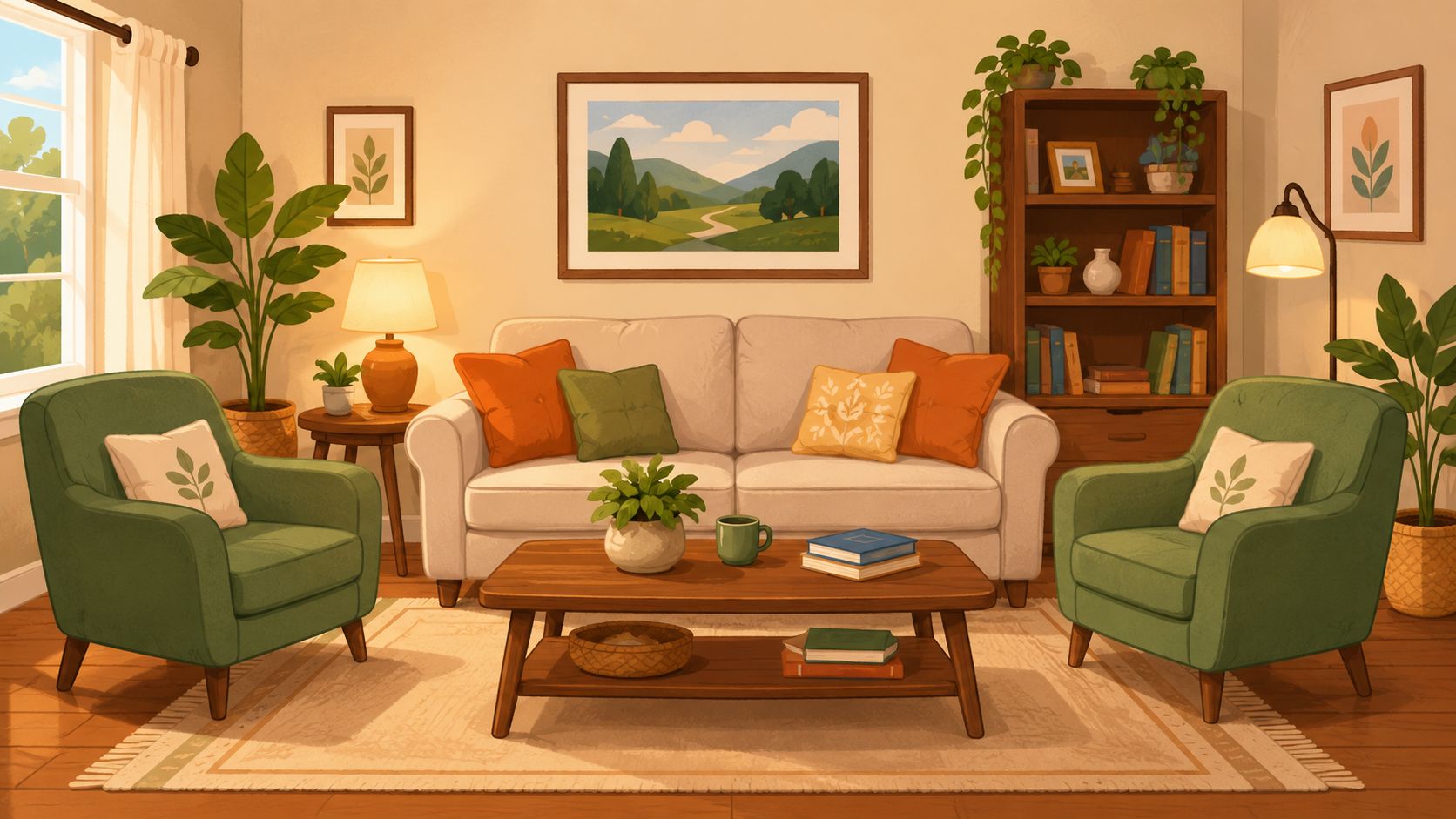
Modern living room placement has shifted from perimeter-based seating to conversation-centered zoning, with sofas and chairs grouped around a central coffee table and anchored by a TV or fireplace rather than lined around the edges, as described in this discussion of conversation-centered furniture layouts.
That shift makes sense in the way people use rooms now. Living rooms aren't just for formal sitting. They handle movie nights, everyday lounging, visiting with friends, and often some overlap with dining or workspace circulation. A sofa pinned hard to the wall with every other seat doing the same usually creates distance, not connection.
When a room feels unbalanced, pulling large pieces inward often fixes more than people expect. It gives the seating area a center. It also keeps the perimeter freer for movement.
Three seating patterns that work
These are the patterns that solve most living room furniture placement problems.
1. The L-shape
A sofa paired with one or two chairs creates a flexible conversation zone. This works well in many family rooms and in narrower spaces where a full symmetrical arrangement would feel too formal.
Pros
- Keeps one side more open for circulation
- Feels relaxed and easy to live with
- Adapts well to a TV anchor
Trade-offs
- Can feel visually light on one side if the rug is too small
- Needs careful table placement so the chairs don't drift
2. Facing seating
A sofa opposite chairs, or two sofas facing, gives the strongest conversation setup. It's especially useful when the room has a fireplace or centered focal wall.
Pros
- Feels balanced and structured
- Encourages face-to-face conversation
- Works beautifully in larger rectangular rooms
Trade-offs
- Needs enough width to avoid a squeezed center aisle
- Can become too formal if every piece is bulky
3. Floating sectional arrangement
A sectional placed away from the walls can define the room in open plans. It acts almost like an architectural line, separating living from dining or kitchen space.
Pros
- Excellent for zoning
- Creates a strong anchor in large rooms
- Makes open layouts feel intentional
Trade-offs
- A poorly sized sectional can dominate the room
- Back-of-sofa views need to be considered
For readers weighing less obvious options, these uncommon furniture arrangements that work wonders show how a room can improve once seating is treated as a composition instead of a row.
When custom seating solves the problem
Standard dimensions don't solve every room. Historic homes around Norwich often have shallow walls, off-center fireplaces, or doorways that interrupt the ideal sofa location. In those rooms, forcing a stock piece into place usually means the layout suffers.
That's where a custom-fit sofa or sectional becomes practical, not decorative. A custom option such as the F9 Custom Sofa series allows adjustments in configuration and styling so the seating fits the room instead of overwhelming it. Flexsteel also makes sense when the goal is a durable anchor piece with long-term value.
A seating group should invite people inward. If everyone looks perched at the edges of the room, the layout is still unfinished.
Placing Accent Furniture Rugs Tables and Your TV
Once the main seats are set, the supporting pieces decide whether the room feels polished or unresolved. Rugs define the zone. Tables control convenience. The media setup either supports the room or takes it over.
Rules of thumb that keep the room balanced
A strong rug plan starts under the seating group, not in the empty center. The rug should hold at least the front legs of the sofa and accent chairs, the sofa is often placed 3 to 5 inches off the wall for breathing room, and proportional rules like a sofa at about two-thirds of the wall length and a coffee table at about two-thirds of the sofa length help avoid scale problems, according to this living room rug and proportion guide.
That proportion rule is one of the fastest ways to judge whether a room feels “off.” A coffee table that's too small looks stranded. One that's too large blocks movement and makes seating feel trapped.
Side tables should support the seats beside them without jutting too far into circulation. Console tables also need restraint. A console behind a sofa shouldn't exceed the sofa back height, or the whole arrangement starts to feel top-heavy.
TV placement deserves its own discipline. The set should support comfortable viewing without becoming the only thing the room acknowledges. For homeowners working through mounting questions after the furniture plan is established, this pro installer's TV height guide is a helpful companion. A related room-planning tool from Gorins on sofa and television placement can also help align the seating zone with the media wall.
Brands such as Best Home Furnishings and Aspen Home often fit well into this layer of the room, especially for media consoles and occasional tables that need to add function without overpowering the seating.
Living Room Spacing Cheat Sheet
| Element | Recommended Spacing |
|---|---|
| Primary walkway | 30 to 36 inches |
| Space behind chairs | 18 to 24 inches |
| Sofa to coffee table | 14 to 18 inches |
| Seating to seating | 3.5 to 10 feet |
| Sofa off the wall | 3 to 5 inches |
Good accent furniture doesn't call attention to itself first. It makes the main seating feel complete and easy to use.
Solutions for Tricky Spaces Small and Open-Plan Rooms
Some rooms ask for more discipline than others. Narrow rooms, compact homes, and open-concept layouts all punish default placement habits. The most common one is pushing every piece to the perimeter.
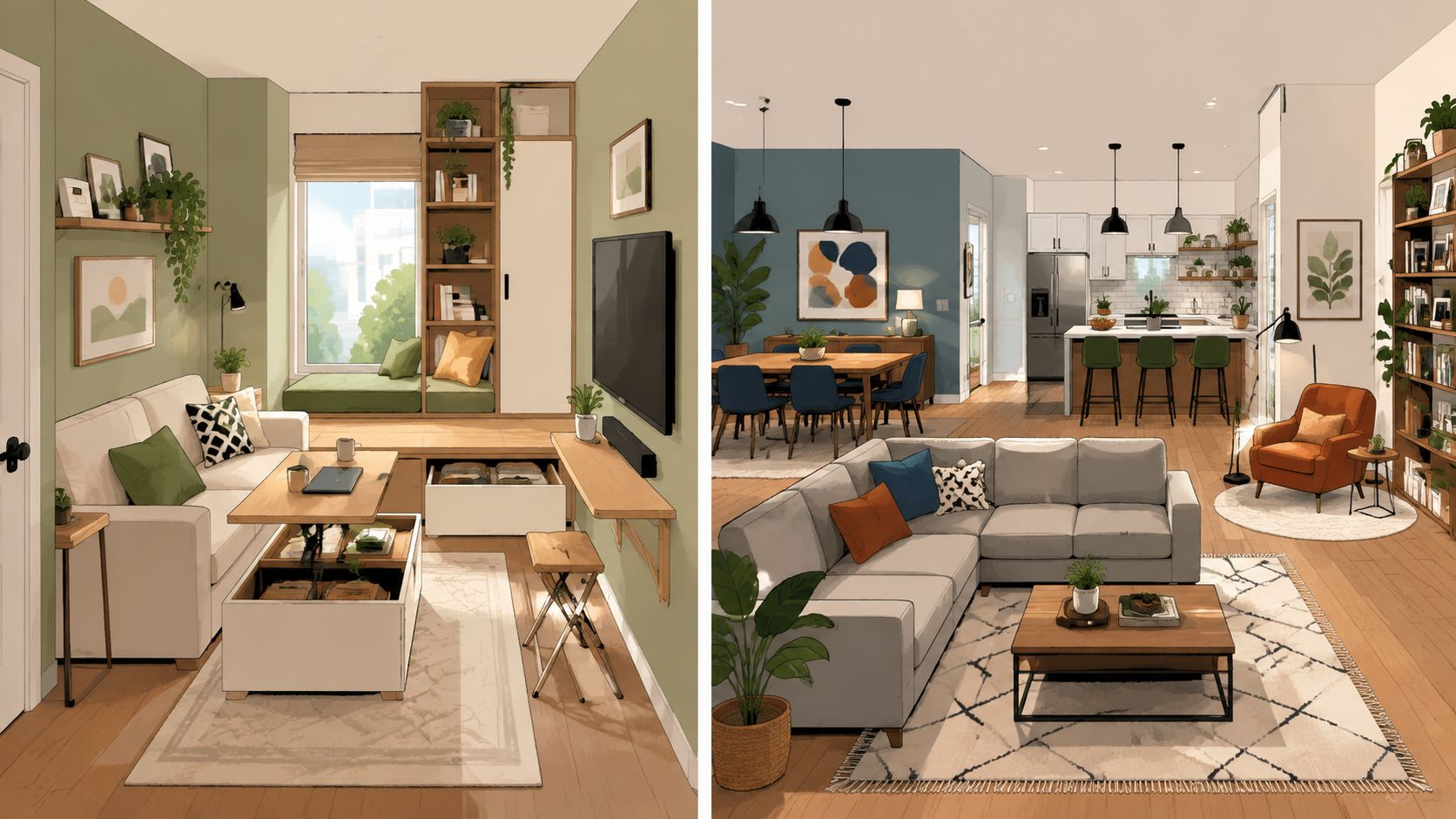
A frequently overlooked issue is the long, narrow living room. Recent guidance points out that these spaces aren't always improved by wall-hugging layouts, and instead often benefit from zoning, floating some pieces, and crosswise placement that makes the room feel wider while preserving flow, as explained in this guide to furniture spacing in narrow living rooms.
If your room is long and narrow
Try this:
- Float at least one major piece. A sofa slightly away from the wall can stop the room from reading like a hallway.
- Place furniture crosswise when possible. Turning the seating zone across the room instead of down its full length can visually widen it.
- Break the space into zones. One rug for conversation and another adjacent function can keep the room from becoming a single stretched strip.
If your room is small
Try this:
- Choose leggy, lighter-looking pieces. Furniture that shows more floor usually feels less heavy.
- Limit the number of bulky forms. One substantial anchor is often enough.
- Use fewer, better-sized pieces. A room packed with undersized extras often feels more crowded than one with a clear central grouping.
A small room doesn't need every wall occupied. It needs clear priorities.
If your room is open-plan
Try this:
- Let the rug define the living zone. The rug becomes the visual boundary where walls don't exist.
- Use the back of the sofa deliberately. It can separate living from dining without making the space feel chopped up.
- Coordinate adjoining areas. A custom Canadel dining set can help the dining side feel related to the living zone without looking matched in a rigid way.
For households working through connected family rooms, kitchens, and dining areas, these strategies for arranging furniture in an open-concept living space offer practical ways to create definition without building visual clutter.
Bring Your Vision to Life in Norwich
You get the sofa delivered, set it in place, and the room still feels off. The walkway pinches near the arm, the coffee table sits just a little too far out of reach, and the whole space looks less settled than it did in your head. That is usually not a style problem. It is a fit problem.
Good layouts come together when the furniture matches the room, the traffic pattern, and the way the household uses the space. In real homes, a few inches can change whether a room feels easy to live in or mildly frustrating every day.
The difference between “nice furniture” and a room that feels finished is usually the layout.
Since 1936, Gorins Furniture & Mattress has helped Norwich families and homeowners across Eastern Connecticut work through those decisions with practical guidance and well-made pieces. Custom furniture often solves the problems standard sizes cannot. A sectional may need a shorter return to keep a path open to the hallway. A sofa may need a specific depth so the room feels balanced instead of crowded. Dining furniture in an open-plan home may need the right finish and scale to relate to the living area without looking overly matched.

That is where local selection matters. At Gorins, customizable seating and case pieces give you more control over proportion, configuration, fabric, and finish, so you are not forcing a stock piece into a room it was never meant to fit. Universal design principles still apply. Clear movement paths, reachable surfaces, supportive seating, and balanced scale make a room work better for guests, kids, and anyone planning to stay in the home for years.
If you want to refine your plan before visiting the showroom, these living room layout ideas for different room shapes and seating goals are a useful starting point.
Promotional financing with equal monthly payments can also help when the project calls for a full seating group, storage, tables, and a coordinated update instead of one quick replacement. Visit Gorins Furniture & Mattress in Norwich to see room settings in person and get advice shaped around your room, not a generic floor plan.