Dining Room Table Protector Pad: Ultimate 2026 Guide

A lot of dining tables in Norwich do far more than host dinner. They hold school projects, birthday cakes, laptops, takeout containers, holiday platters, and the everyday wear that comes with family life. That's usually the moment homeowners start looking at a beautiful wood top a little differently. Not just as furniture, but as an investment that can be marked up faster than expected.
For families who've chosen a higher-quality dining set, especially a custom piece with a finish, shape, or extension system picked to suit the room, protection stops feeling optional. A dining room table protector pad becomes part of the ownership plan. It isn't glamorous, but it often decides whether the table still looks polished years later.
Table of Contents
- Protecting Your Centerpiece a Gorins Guide
- What Exactly Is a Dining Table Protector Pad
- Why Your Dining Table Deserves Protection
- A Guide to Protector Pad Materials and Styles
- Measuring for a Perfect Fit on Any Table
- Find Your Custom Pad at Gorins in Norwich
Protecting Your Centerpiece a Gorins Guide
A dining table often becomes the visual anchor of the home. It's where guests gather, where holiday meals stretch a little longer, and where a well-made piece earns its place every single day. That's why table damage feels so frustrating. A single hot dish, one spill that sits too long, or a rough project on the tabletop can change the surface in a way that's hard to ignore.

Families across Eastern CT run into the same tension. They want to use the table, not babysit it. But they also don't want daily life to chew through a finish they paid good money to bring into the room. A protector pad solves that tension better than most temporary fixes because it's built around preservation, not just decoration.
Since 1936, Gorins has helped local households choose furniture that's meant to last. That includes investment-grade dining pieces, custom options with thousands of combinations, and practical guidance that respects how people really live. A good protector pad fits right into that mindset. It protects the table without asking the family to stop using it.
Practical rule: The more a dining table has to serve as a meal space, workspace, and gathering spot, the more a fitted protector starts acting like furniture insurance.
What Exactly Is a Dining Table Protector Pad
A dining room table protector pad is usually a custom-fitted cover made to absorb heat, block spills, and prevent surface damage from regular use. Product descriptions in this category commonly emphasize heat resistance, waterproofing, and attachment systems that help the pad stay aligned on the table instead of shifting during use.
More than a cover
What separates a true table pad from a casual table covering is purpose. A cloth changes the look of the table. A protector pad is meant to stand between the tabletop and the abuse of real use. That includes serving dishes, dropped utensils, craft supplies, and the small impacts that leave dents or dull spots over time.
Many buyers think of these as old-fashioned accessories used only for formal dining rooms. That view is outdated. The category has expanded beyond dining tables into other household and work surfaces, including business tables, side tables, end tables, coffee tables, and even pianos, with some products using patented Quick-Lock clips or magnetic systems to stay put, as noted in this published overview of custom table pad covers.
Why custom fit changed the category
The biggest shift in the market has been the move away from generic covers and toward made-to-measure protection. That matters most when the table isn't a simple standard shape. A rectangular top with leaves is one thing. A custom dining table with rounded corners, a boat shape, or a beveled edge is another.
That's why a proper protector pad should be thought of as part of the furniture plan, especially when the dining set itself was selected with care. Homeowners comparing shapes, sizes, and daily-use needs can get useful context from this Gorins guide on how to pick the right dining room table.
A poorly fitted pad tends to telegraph its problems quickly. It slides, leaves edges exposed, bunches around corners, or becomes annoying enough that the household stops using it. A custom-fitted pad avoids most of that frustration.
- Better alignment: A fitted pad stays where the table needs protection.
- Cleaner edge coverage: It protects more consistently around corners and leaves.
- Longer usefulness: It's more likely to remain part of the routine instead of getting shoved into a closet.
Why Your Dining Table Deserves Protection
The case for a dining room table protector pad gets stronger the better the table is. On an inexpensive temporary table, a scratch may not matter much. On a solid wood or finely finished dining surface, damage affects both appearance and long-term value.
Heat and moisture are the real threats
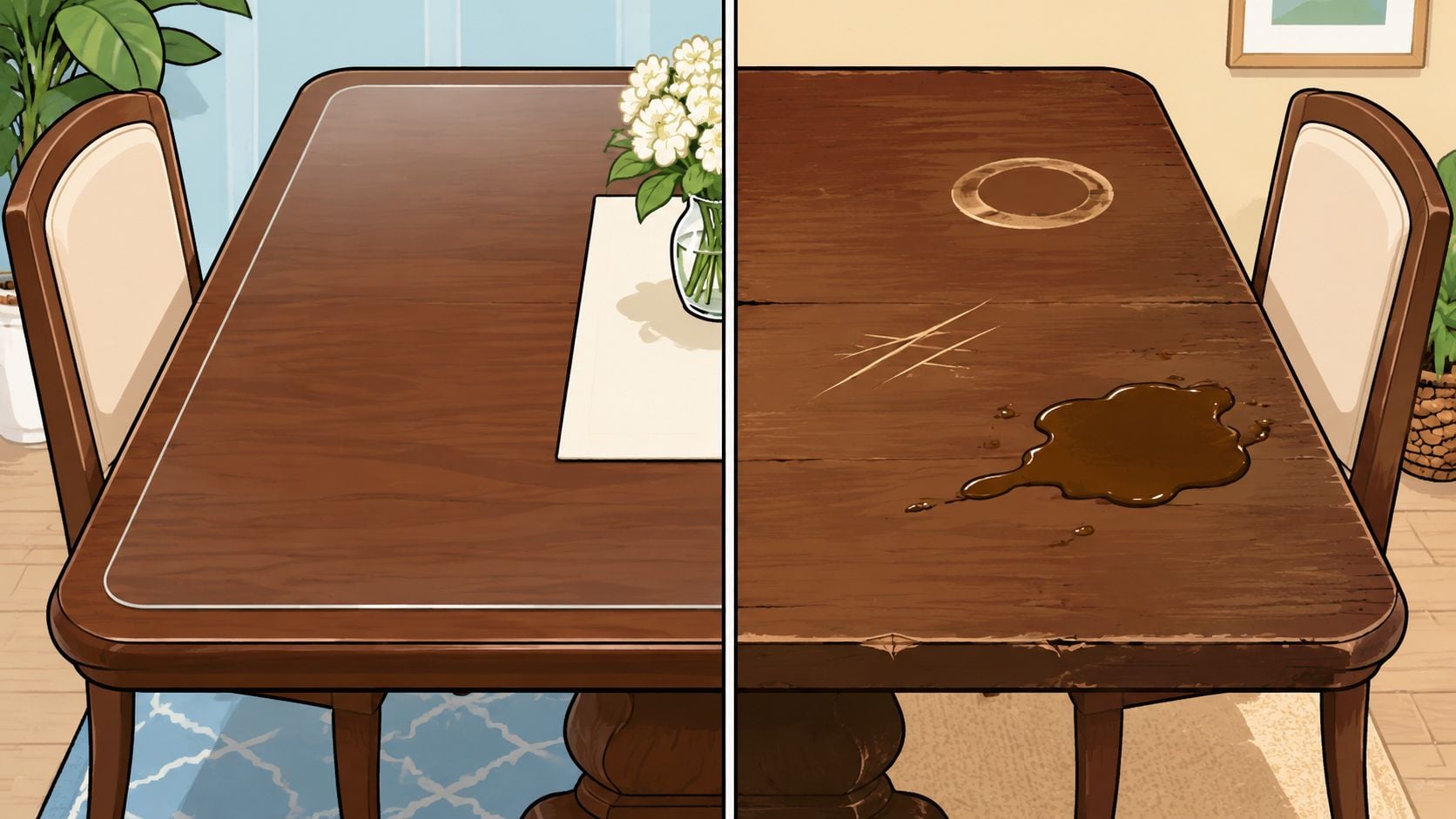
Heat is the performance test that matters most. One published manufacturer specification states that a table protector can guard the surface from heat up to 550 degrees while helping prevent the finish from softening, blistering, or changing color, and also describes quality pads as waterproof and heat resistant in the same product category discussion, as shown in this custom table pad heat rating reference.
That matters in practical terms. A casserole dish from the oven, a hot serving bowl, or a platter set down during a busy holiday meal can stress a finish quickly. The table may look sturdy, but many finishes are more vulnerable to direct heat than homeowners expect.
A dining table doesn't need a dramatic accident to show wear. Repeated small exposures usually do the damage.
Moisture is the other problem. Condensation rings, serving spills, and wet containers can seep into seams or sit on a finish long enough to leave marks. A waterproof pad creates time. That's often what saves the surface.
Where a pad earns its keep
A protector pad isn't only for formal entertaining. It's often more useful in ordinary weeks than on holidays.
- Homework and crafts: Pens, scissors, glue, and pressure from elbows or tools can wear a finish.
- Work-from-home overflow: Laptops, chargers, notebooks, and mugs turn the dining room into a desk.
- Family meals: Hot dishes and spills happen fastest when everyone's trying to sit down at once.
- Entertaining: More serving pieces on the table means more heat, moisture, and traffic.
For households already thinking about broader home protection, this guide on effective rug stain defense is also useful because it addresses the same practical issue from the floor up. Dining spaces take wear in layers, not one surface at a time.
A table pad also works best as part of a larger care routine. Gorins shares additional finish-protection guidance in its article on protecting wood furniture from scratches and stains. That kind of routine matters most for custom pieces such as Canadel dining tables, where the finish and shape were chosen for long-term enjoyment, not short-term convenience.
A Guide to Protector Pad Materials and Styles
Not every dining room table protector pad feels or performs the same. Some are built for maximum practical defense. Others lean toward a slimmer profile or a less noticeable look. The right choice depends on how the table is used, how often the pad comes on and off, and how much visual interruption the household is willing to accept.
Comparison of Table Pad Materials
| Material | Primary Benefit | Heat Resistance | Best For |
|---|---|---|---|
| Heavy-duty vinyl | Easy wipe-clean surface and spill defense | Commonly chosen when buyers want heat-resistant performance | Busy family dining tables |
| Felt | Soft contact against finished surfaces | Better as a backing or secondary layer than a stand-alone heat shield | Delicate finishes and underlayers |
| Foam core | Cushioning against dents and impact | Depends on full pad construction rather than foam alone | Multi-use tables with crafts or work |
| Silicone | Grippy, flexible protection with a thinner feel | Often selected for light-duty heat and slip control | Casual use and simpler table setups |
The table above reflects buying logic more than branding. Material names alone don't tell the whole story because construction matters. A layered pad can perform very differently from a single thin cover, even if both sound similar in a product description.
Choosing for real household use
For a family table, the most practical choice is usually a surface that wipes clean easily and doesn't punish the household for using it often. That's why heavy-duty, waterproof designs remain popular. They suit weeknight life.
For more design-sensitive rooms, some buyers want protection without making the table feel hidden all the time. In those cases, a thinner or less visually dominant option may make more sense, especially if the pad only comes out during meals or events. Homeowners who prefer a more transparent protective look sometimes compare pads with ultra clear glass options to understand the visual trade-off between full-surface visibility and removable cushioning.
Design note: The most protective option isn't always the most convenient one. Bulk, storage, and appearance all matter if the pad will be used often.
There's also no reason to choose in isolation from the rest of the home. A household that already prioritizes durable upholstery and easy-clean materials usually benefits from the same thinking at the dining table. That mindset carries through in this Gorins article on performance fabrics for spills splashing and shedding.
A few trade-offs are worth stating plainly:
- Thicker pads protect more aggressively, but they're bulkier to store.
- Slimmer protectors are easier to manage, but they may offer less cushion and less thermal delay.
- Decorative covers improve appearance, but they don't always replace a true protective pad.
- One-table households need versatility, so ease of removal matters almost as much as raw protection.
Measuring for a Perfect Fit on Any Table
Fit is where many table pad purchases go right or wrong. A dining room table protector pad only works as intended when it matches the table's usable surface closely. That's especially true for custom dining, where shape details are part of what made the table worth buying in the first place.
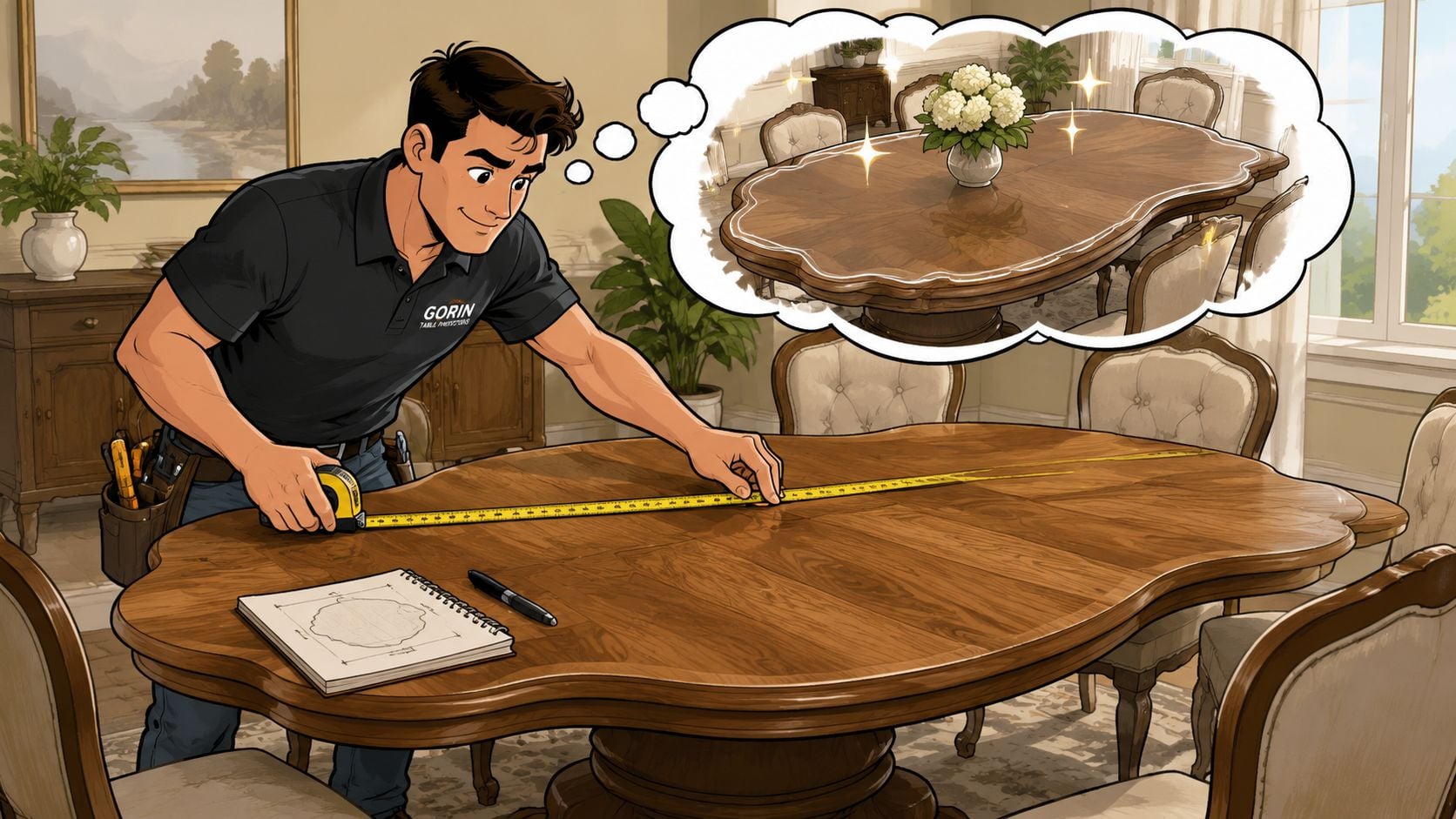
Manufacturers in this category instruct buyers to measure the flat surface of the table to 1/16 of an inch, and published pricing for custom table pad packages starts at $269 for a table pad only and $328 for a table pad plus one leaf, with larger configurations priced higher, according to this custom table pad measurement and pricing guide. That level of precision tells buyers something important. These products are built for exact fit, not rough estimating.
Start with the flat usable surface
The measuring point isn't the widest decorative flourish on the table. It's the flat area the pad will rest on.
Use this order:
- Clear the table completely. Remove runners, centerpieces, and anything that hides the true edge.
- Measure the tabletop surface itself. Follow the usable top, not the apron or base below.
- Record every dimension carefully. Width, length, and any change created by leaves should be written down immediately.
- Check twice. One rushed note can produce a pad that exposes an edge or overhangs awkwardly.
For standard rectangles and rounds, that process is manageable. For anything custom, it gets more technical fast.
How to handle leaves bevels and unusual shapes
Tables with leaves need special attention because the table may function in more than one size. A buyer needs to decide whether the pad should cover the everyday configuration, the extended configuration, or both. If the table is used both ways, each setup has to be accounted for accurately.
Beveled edges create another common mistake. The pad should usually be measured to the flat resting plane, not the outermost point of a decorative slope. Rounded corners also need care. A rough corner estimate can leave the pad looking homemade, even when the product itself is well made.
Non-standard shapes often include:
- Boat-shaped tops
- Oval tables
- Racetrack shapes
- Rounded rectangle designs
- Split-top tables with extension systems
The more customized the dining table, the less useful a one-size approach becomes.
This matters for households furnishing around custom programs such as Canadel Custom Dining, where shape, edge profile, and extension options may all be selected intentionally. Those details are exactly what make the table attractive, and exactly what make generic protection less reliable.
Anyone who wants a cleaner measuring process can use Gorins' general guide on how to measure furniture as a starting point for accuracy habits before ordering a custom accessory.
When to ask for help
Some tables are simple enough to measure at home with patience. Others aren't. If the top has unusual curves, leaf systems, specialty corners, or a shape that doesn't fit ordinary templates, expert help saves frustration.
A bad fit usually shows up in one of three ways:
- Edge exposure: The pad leaves vulnerable areas uncovered.
- Shift during use: The pad doesn't align cleanly and moves around.
- Storage annoyance: Multi-panel or custom-shape pads become cumbersome because the configuration wasn't thought through.
That's why custom-fit advice matters as much as the product itself. The measuring process should respect how the table is built and how the household uses it.
Find Your Custom Pad at Gorins in Norwich
A protector pad does its job best when the household can live with it easily. That means installing it carefully, wiping it clean after use when needed, and storing it flat or folded according to its construction so it keeps its shape over time.

Care and storage basics
A few habits make a difference:
- Set it down squarely: Alignment matters most at the edges and corners.
- Clean spills promptly: Even waterproof surfaces should be maintained, not ignored.
- Store with intention: Don't cram a fitted pad into a tight, awkward space if that will distort it.
- Match use to routine: A pad that's too cumbersome for daily life often ends up unused.
Local help matters with custom dining
One of the biggest challenges in this category is finding a pad that works for non-standard tables with leaves, bevels, or unique shapes. Published guidance in the category notes that in such cases, working with someone who understands custom dining pieces becomes valuable, as described in this discussion of custom table pad fit challenges.
For local shoppers, Gorins Furniture & Mattress can be part of that process when a dining table has custom details that make generic solutions less practical. Since 1936, the showroom has served Norwich and surrounding Eastern CT communities with a family-operated approach, including custom dining options with thousands of combinations and promotional financing with equal monthly payments available for qualifying purchases.
A custom dining table deserves protection that respects the way it was built. That usually means treating the pad as part of the furniture plan, not an afterthought.
Since 1936, Gorins Furniture & Mattress has helped Norwich and Eastern CT families create homes they love. From custom-designed Canadel dining sets to the latest in Tempur-Pedic sleep technology, they combine a massive selection with the personalized care only a local, family-owned business can provide. Visit the Norwich showroom, take the online Style Quiz, or browse the Clearance section at Gorins Furniture & Mattress to find a solution suited to your lifestyle.