Best Memory Foam Mattress Topper for Side Sleepers Reviewed


You wake with a sore shoulder, an aching outer hip, or a lower back that feels twisted, then blame the mattress for being too hard. A topper may help, but only if it changes the bed in the right way. The best memory foam mattress topper for side sleepers isn't the softest layer in the showroom. It's the one that cushions the shoulder and hip while keeping the pelvis from sinking low enough to pull the spine out of line.
| Sleep situation | Practical recommendation | Main reason |
|---|---|---|
| Firm mattress with shoulder and hip pressure | 2–3 inches of medium-soft to medium memory foam | Adds contouring without excessive sink |
| Slightly firm mattress that otherwise supports the body | 2 inches | Improves comfort while preserving the existing support |
| Exceptionally firm mattress | Consider up to 4 inches, cautiously | Adds more depth, but raises the risk of hammocking and heat |
| Soft or visibly sagging mattress | Replace the support surface rather than adding a thick topper | A topper can't correct structural sagging |
| Hot sleeper who changes position often | Compare memory foam with latex | Latex generally feels more breathable and responsive |
Why Side Sleepers Need a Different Approach to Mattress Toppers
A Norwich homeowner may go to bed feeling fine, then wake with one shoulder numb and the outside of one hip tender. The usual reaction is to search for a softer topper. That instinct makes sense, but softness alone can create a second problem. The shoulder may feel better while the pelvis drops too far, leaving the torso angled through the night.
Side sleeping concentrates much of the body's load at the shoulder and hip. A surface that's too firm creates concentrated pressure at those contact points. A surface that's excessively soft lets the hip and pelvis sink further than the shoulder, which can disturb neutral alignment. The right topper has to manage both problems at once.
A 2021 systematic review examined mattress research available through 2019 and included 39 qualified studies. Its overall conclusion was that medium-firm sleep surfaces generally support comfort, sleep quality, and spinal alignment, with advantages also reported for people with nonspecific low-back pain. The review of mattress research doesn't establish one universal topper thickness, density, or brand, so a sensible recommendation must account for the mattress underneath and the sleeper's body shape.
Softness isn't the target
Consider two beds. On the first, the mattress feels hard beneath the shoulder and outer hip, but the rest of the structure remains level. A moderate layer of conforming foam can move that bed toward a medium-firm feel. On the second, the mattress already dips in the middle. Adding a very plush topper may hide the dip briefly, but it won't restore support.
Practical rule: A topper should correct an overly firm surface, not disguise a mattress that has lost its structure.
The useful question is therefore not, “Which topper feels plushest in the first minute?” It is, “Does this layer relieve pressure while keeping the waist and pelvis supported?” Gorins' guidance on mattress topper benefits makes the same practical distinction. Memory foam can soften pressure at the shoulders and hips, but the result depends on how that foam works with the existing mattress.
A simple fit test
At a showroom or at home, the side sleeper should lie in the usual position for at least 10–15 minutes, as recommended by independent sleep guidance on topper selection for side sleepers. The shoulder and hip should settle enough to reduce pressure. The waist shouldn't feel unsupported, and the spine should look reasonably straight when viewed from behind.
A pillow matters too. If the topper changes how far the shoulder sinks, the gap between the shoulder and neck changes as well. A pillow tall enough to fill that space helps the neck stay aligned with the rest of the spine.
The Science of Pressure Relief and Spinal Alignment
Memory foam became associated with pressure relief because of its unusual response to load. During a 1960s project at NASA's Ames Research Center, engineer Charles Yost and colleagues developed a viscoelastic material for aircraft seating. NASA described the early material as “slow spring back foam”, because it flowed toward the contour of a body pressing against it and gradually returned to its original shape afterward. The technology entered commercial use in the late 1960s, and Yost formed Dynamic Systems, Inc. in 1969 to sell it as “temper foam.” NASA's account of the material's development explains why modern memory foam conforms so closely.
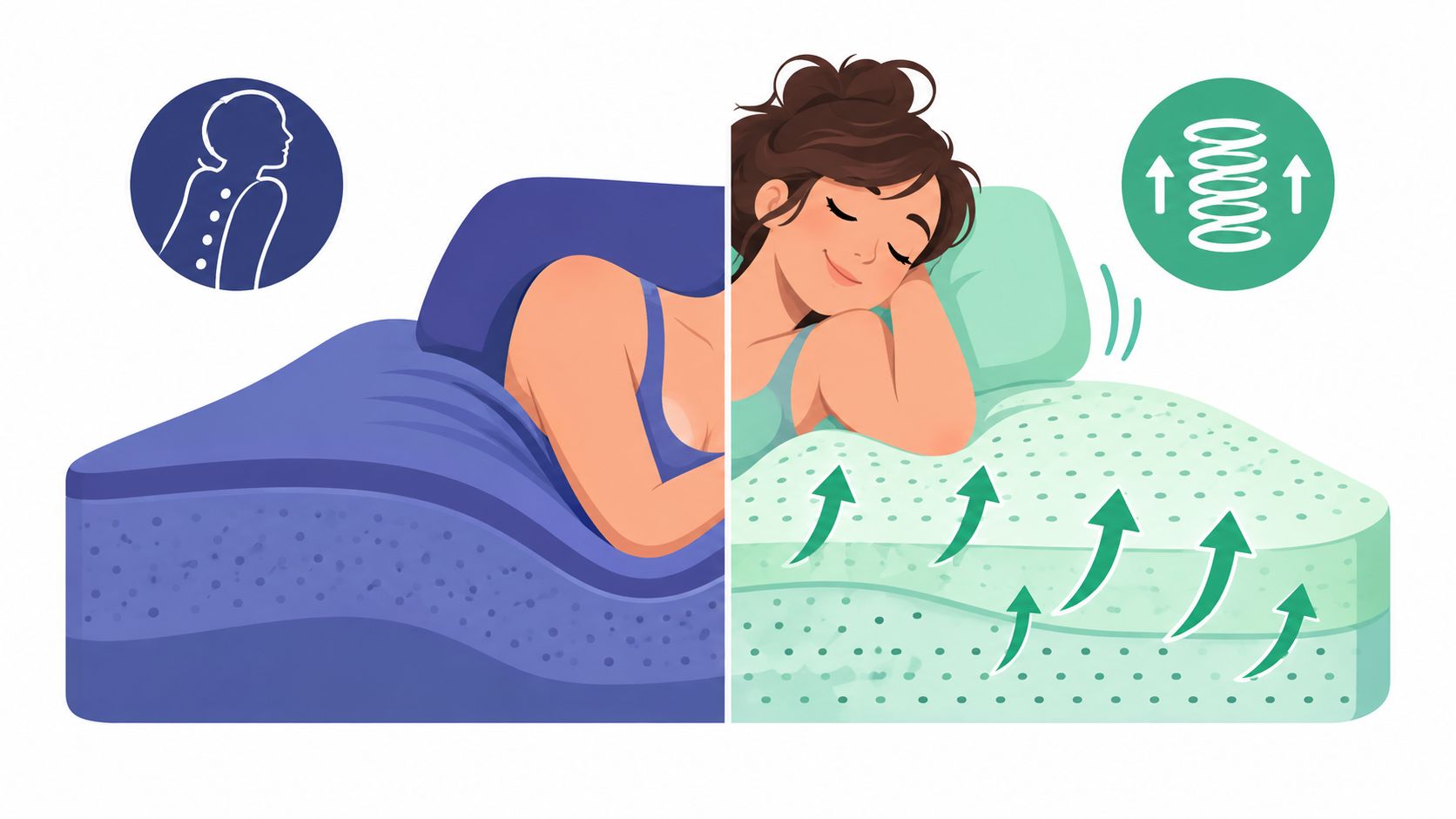
For a side sleeper, that localized conformity can spread load around the shoulder and hip instead of leaving it concentrated on a few hard contact points. This is why memory foam often suits someone whose mattress feels uncomfortably firm. Gorins also explains what memory foam mattresses are, including the contouring behavior shoppers notice when they lie on the material.
Pressure relief and alignment are separate tests
A plush shoulder impression doesn't prove that a topper supports the pelvis. Research on side-lying mattress design treats neutral alignment in the coronal plane as a key criterion. Viewed from the front, the spine should remain approximately straight rather than curving down toward the mattress. Instrumented pressure measurements can show how different surfaces change loading, and a separate clinical mattress comparison found meaningful differences in pelvic pressure among tested mattresses.
That distinction gives shoppers a better assessment than a quick sit on the edge of the bed:
- Shoulder comfort: The shoulder should sink enough to avoid sharp pressure or numbness.
- Hip cushioning: The greater trochanter, the bony outer point of the hip, shouldn't feel trapped against a hard layer.
- Waist support: The middle of the body shouldn't feel as though it is hanging above an empty gap.
- Pelvic control: The pelvis shouldn't drop so far that the lower back bends sideways.
- Movement: The sleeper should be able to change position without fighting a deep foam pocket.
A useful resource for people working on broader comfort and posture habits is this guide to gentle spine and shoulder relief. A topper can improve the sleep surface, but persistent pain, numbness, or weakness deserves clinical attention rather than a bedding adjustment alone.
Foam quality affects consistency
Higher-density memory foam generally provides more durable contouring. Very low-density foam may soften faster and offer less consistent support, even if it feels inviting when first unpacked. The best choice balances the material's ability to conform with a base mattress that still supplies structural support.
For side sleepers, the winning combination is pressure redistribution plus spinal neutrality. Maximum sink is not the objective. A topper should soften the contact points while stopping the pelvis from bottoming out against the mattress beneath it.
Choosing the Right Thickness and Density for Your Bed
Thickness changes how far the shoulder and hip can travel into the surface. More material isn't automatically more comfort. For most side sleepers, the most technically appropriate starting point is 2–3 inches of memory foam over a mattress that already has adequate structural support. That range gives the prominent joints room to compress while limiting excessive pelvic sink.
Match the depth to the mattress
A 2-inch topper suits a mattress that's only slightly too firm. It adds a modest comfort adjustment without completely replacing the bed's existing feel. This is usually the safer choice when the mattress already supports the pelvis well.
A 3-inch topper gives more room for the shoulder and hip to settle. It can make sense when the underlying surface feels distinctly firm but remains level and structurally sound. The sleeper still needs to check that the waist and pelvis aren't dropping too far.
A 4-inch topper deserves more caution. It may help on an exceptionally firm mattress, but the additional depth can increase the risk of a hammocking effect, heat retention, and difficulty changing position. It can also make the bed feel unstable if the mattress underneath is already soft. Gorins' mattress thickness comparison offers useful context for evaluating the total sleep system rather than judging the topper in isolation.
Density is the durability question
Density and firmness aren't interchangeable. Firmness describes how a material feels under pressure. Density helps indicate how much material is present and how consistently the foam may respond over time. A dense topper can still feel medium-soft, while a less dense product can feel firm at first and lose resilience more quickly.
When comparing labels, shoppers should look for:
- Consistent contouring: The foam should cushion the shoulder without collapsing under the hip.
- Stable recovery: The surface should recover after pressure is removed, especially for sleepers who change positions.
- Secure construction: The cover and fit should keep the topper from bunching or shifting.
- A sound base: No topper can turn a visibly sagging or damaged mattress into a supportive one.
A useful explanation of why foam construction matters appears in this discussion of foam quality from Lewis and Sheron Textiles. The larger lesson is straightforward. Investment-grade comfort comes from matching the foam's behavior to the condition of the bed, not from choosing the thickest label.
Test the whole body, not one sore spot
A side sleeper should lie normally, not perch on the edge or lie flat on the back. After the surface settles, the shoulder and hip should feel cushioned, the waist should feel supported, and the spine should appear reasonably straight from behind. If the sleeper develops morning low-back discomfort, persistent hip pain, or numbness, the setup needs to be reassessed.
Memory Foam vs. Latex for Cooling and Responsiveness
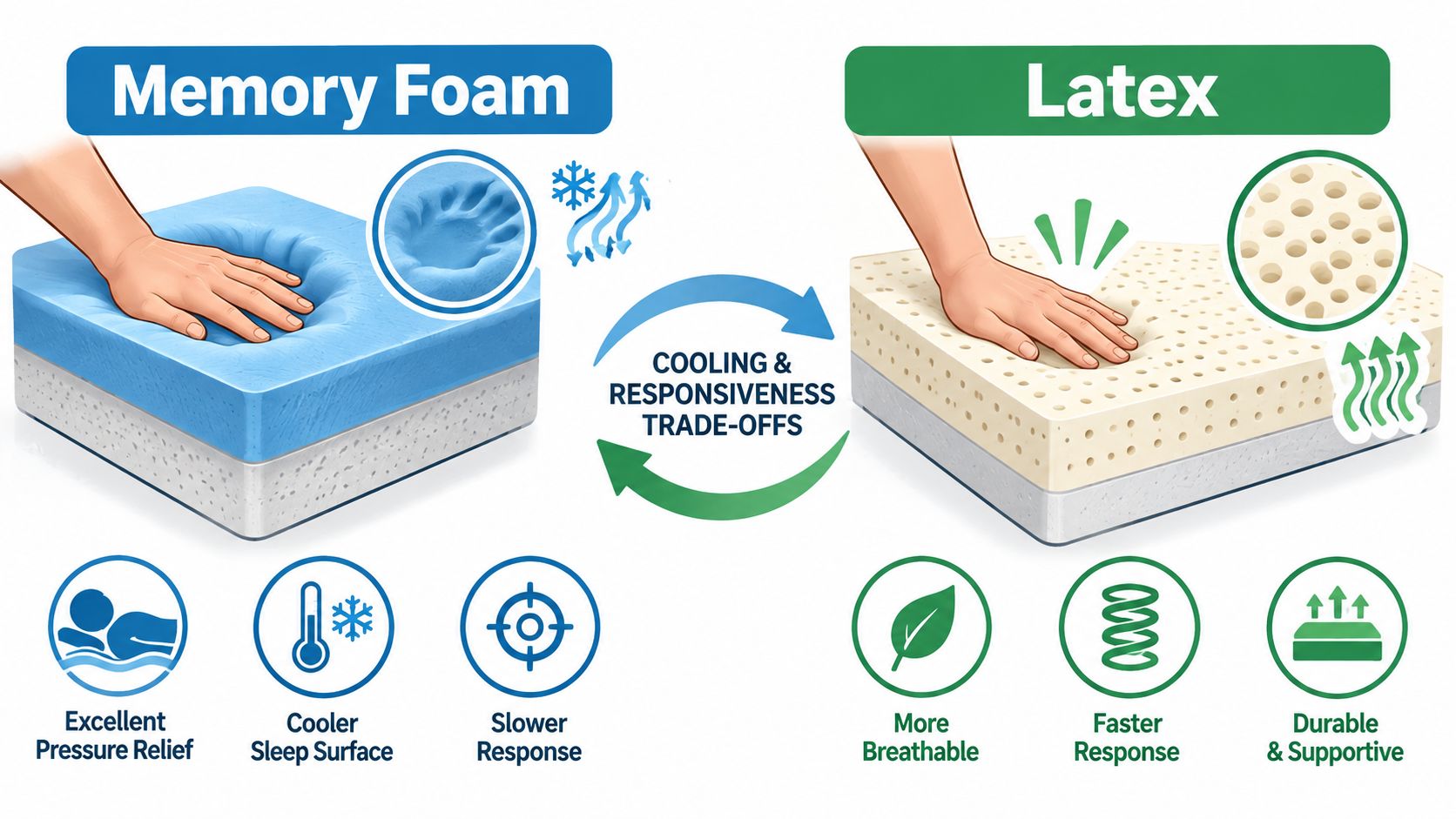
Memory foam and latex solve different comfort problems. Memory foam offers deeper contouring and a more settled, cradled sensation. Latex responds faster, allows easier movement, and generally permits more airflow. A hot side sleeper shouldn't treat “cooling memory foam” as an automatic solution, because close conformity can still retain body heat.
Comparative evidence reported that latex transfers heat roughly 20–30% faster than standard memory foam. In a small study of 30 hot sleepers, people using a ventilated latex topper had skin temperatures about 1.8°F lower than those using a gel-infused memory-foam topper during the early-morning sleep period. 73% of latex users reported fewer heat-related awakenings, compared with 40% of memory-foam users. The comparative material discussion provides the specific figures and also makes clear that the result isn't universal for every sleeper or construction.
Choose memory foam for contouring
Memory foam is the stronger choice when a side sleeper's main complaint is concentrated shoulder or hip pressure. It flows around body contours and can reduce the feeling of a hard surface pressing into the joints. It also limits the amount of movement transferred across the bed, which some couples appreciate.
The trade-off is a slower response. A conforming layer may make position changes feel deliberate rather than effortless. Thick foam can also feel warmer because it surrounds more of the body and restricts airflow around the contact area.
Choose latex for movement and airflow
Latex has a buoyant feel. Instead of allowing the body to sink gradually into a pocket, it pushes back more quickly and makes repositioning easier. That responsiveness suits sleepers who feel trapped in memory foam or who wake sweaty after spending much of the night in one position.
Latex isn't automatically the right answer for a sensitive shoulder or hip. Some side sleepers need the deeper pressure conformity that memory foam provides. Others prefer a resilient surface that prevents the pelvis from settling too far. A comparison of latex mattress benefits can help shoppers understand that material choice is about feel, airflow, and support together.
| Priority | More suitable material | Reason |
|---|---|---|
| Deep shoulder and hip conformity | Memory foam | Creates a closer contour around pressure points |
| Easier movement | Latex | Recovers faster and feels more buoyant |
| Heat sensitivity | Latex, generally | Transfers heat faster in the cited comparison |
| Strong motion isolation | Memory foam | Absorbs movement more closely |
| Balanced pressure relief with less sink | Responsive latex | Cushions while pushing back sooner |
Gel, perforations, and breathable covers may alter the experience, but they don't erase the underlying behavior of the foam. The material should be selected around the sleeper's primary problem, not a single marketing word.
Navigating Off-Gassing and Material Safety Concerns
A new foam topper may smell when it comes out of its packaging. That odor is commonly associated with volatile organic compounds, or VOCs, released from polyurethane foam. Odors are usually strongest immediately after unpacking. Most dissipate within hours, though traces can remain for days or weeks, particularly in predominantly synthetic foam. Sleep Foundation's off-gassing guidance explains why odor intensity and duration vary.
The practical answer isn't to declare every foam product unsafe, and it isn't to dismiss a sensitive sleeper's reaction. Available guidance indicates that emissions generally aren't known to pose serious health risks for most sleepers, but odors may temporarily irritate people with respiratory conditions or chemical sensitivities. Headache, nausea, or dizziness are reasons to stop using the topper until the air clears.
Air it out before sleeping on it
Unpack the topper in a well-ventilated room, not in a small closed bedroom. Open windows when practical, keep the door open, and allow the material to expand and air out before placing it on the bed. Sensitive users should allow extra airing time and shouldn't sleep on the topper while the odor remains bothersome.
A removable cover may improve handling and cleanliness, but it shouldn't be treated as a guaranteed barrier against emissions from the foam itself.
A discussion of off-gassing from Purified Air Duct Cleaning offers useful general context about why new synthetic materials can produce noticeable odors indoors. The same ventilation principle applies here. Room size, airflow, temperature, foam composition, and personal sensitivity all affect the experience.
Read claims with discipline
“Natural” and “non-toxic” are not interchangeable with independently verified testing. Before buying, the shopper should ask what the foam is made from, whether the product has relevant certifications, how the cover is constructed, and what the return policy says. A topper is a comfort product, not a guaranteed solution for emissions from the mattress underneath.
Hot sleepers should also avoid assuming that a perforated or gel-treated topper will eliminate heat retention. Those features may change airflow or surface feel, but close-conforming foam can still feel warm. The right decision combines pressure relief, ventilation, material information, and a realistic trial plan.
Expert Guidance and Financing Options at Gorins Furniture
Technical guidance works best when a shopper can test the complete sleep surface. A person searching for Mattresses Norwich CT may think the choice is merely between soft and firm. In practice, the relevant questions are more precise. Does the shoulder sink enough? Does the hip remain supported? Does the sleeper feel stable when turning? Does the topper improve a sound mattress, or is the mattress itself ready for replacement?
Gorins Furniture & Mattress was founded in 1936, when Samuel and Martha Gorin started the business in Norwich. Samuel was an accomplished upholsterer, while Martha handled finances, and the company later continued through Lester Gorin, the second generation, and Glen Gorin, the third. That documented history supports describing Gorins as a locally owned, family-operated business serving Norwich and surrounding Eastern Connecticut communities.
A showroom visit should answer practical questions
A useful consultation doesn't require a high-pressure pitch. It should help the shopper compare comfort by feel across sleep surfaces and understand how a topper pairs with the mattress beneath it. Gorins' Sleep Gallery includes Tempur-Pedic, Serta, and Beautyrest, with guidance centered on healthier sleep and the actual feel of the surface.
The same local design support extends beyond the bedroom. Canadel Custom Dining offers thousands of combinations of sizes, shapes, finishes, and fabrics. The F9 Custom Sofa series allows choices across details such as arm styles, back types, welt details, and cushion firmness. Those options matter because a home should reflect the household's lifestyle, not be built from a one-size-fits-all package.
Gorins also serves shoppers looking for a Furniture store Norwich CT, Custom Dining Norwich, or Living Room Furniture Eastern CT, including communities such as New London, Plainfield, Waterford, and nearby Eastern CT and Rhode Island areas. The showroom experience connects sleep comfort with broader home furnishing decisions without turning either into a rushed transaction.
Financing should be understood before signing
Promotional financing can make an investment in a mattress or bedroom setup more manageable, but the terms need careful reading. The Nest Credit Card legal terms list deferred-interest plans requiring payment in full within 6, 12, 18, or 24 months. They also list low-APR equal-payment plans at 5.99% APR for 48 months and 9.99% APR for terms from 24 to 72 months, along with waived-interest equal-payment plans for 24, 36, 48, 60, or 72 months. The official Nest Credit Card terms distinguish waived interest from deferred interest. Under deferred interest, interest accrues from the purchase date but isn't imposed if the promotional balance is paid by the deadline. Otherwise, the applicable purchase APR may apply.
That makes mattress financing guidance useful before a purchase. Shoppers should review eligibility, payment amounts, promotional deadlines, and the consequences of missed conditions. Equal monthly payments can lower the immediate barrier to investment-grade quality, but financing only works when the repayment schedule fits the household budget.
Since 1936, Gorins Furniture & Mattress has helped Norwich and Eastern CT families create homes they love, from comfort-focused Sleep Gallery choices to custom Canadel dining and F9 living room designs with thousands of combinations. Visit the Norwich showroom to test pressure relief by feel, discuss promotional financing and 5-Star Delivery, or browse the Clearance section for value-driven savings before choosing a topper or mattress.