Mattress Types Pros and Cons: Expert Guide


The most popular mattress advice is often the least useful: choose the firmest bed available, or pick a material that a generic chart labels “best.” Neither rule accounts for the sleeper's body, position, pressure points, or ability to move. A mattress that feels wonderfully cushioned to a lighter side sleeper may let a heavier stomach sleeper sink too far, while a hard surface can leave another sleeper with painful shoulder and hip pressure.
The practical question isn't which mattress type wins. It's whether a particular mattress keeps the spine reasonably neutral, distributes pressure, and makes turning and getting out of bed easy. That's the useful way to approach mattress types pros and cons, especially for shoppers comparing beds in Norwich, New London, Plainfield, Waterford, and surrounding Eastern Connecticut and Rhode Island communities.
This guide follows a simple local-showroom principle: test the physical fit before trusting the label. Readers wanting a broader planning resource can also consult this mattress buying guide for 2026, while Gorins' own mattress selection guidance helps organize the choices around feel, support, and sleep style.
Rethinking How We Choose a Mattress
A mattress material doesn't determine comfort on its own. Foam, latex, coils, hybrids, and air systems can all be produced with different firmness levels, support zones, and comfort layers. The construction label tells shoppers what sits inside the bed, but it doesn't tell them whether the surface will suit their shoulders, hips, waist, or preferred sleeping position.
That's why a lightweight side sleeper and a heavier stomach sleeper can have completely different experiences on the same model. The lighter sleeper may need enough cushioning for the shoulder and hip, while the heavier sleeper may need stronger resistance through the pelvis and abdomen. Height and body shape matter too, and firmness ratings aren't standardized across brands.
Three tests matter more than the label
A useful mattress evaluation has three parts:
- Spinal alignment: The body should rest in a reasonably neutral position rather than bending around a deep dip or being pushed out of alignment by an overly hard surface.
- Pressure distribution: Shoulders and hips need enough compliance to avoid concentrated pressure, particularly for side sleepers.
- Ease of movement: The sleeper should be able to turn, sit up, and get out of bed without fighting a deep, restrictive cradle.
Comfort still matters. A mattress can produce acceptable alignment and remain unpleasant if it feels too warm, too rigid, too enveloping, or too unstable at the edge. The right choice balances physical support with the way the sleeper uses the bed.
Practical rule: A mattress is a good fit when it supports the body without making the sleeper constantly notice the support.
For Norwich shoppers, in-person testing has a clear advantage. A showroom allows a sleeper to lie in the usual position, compare adjacent feels, check movement, and ask about foundations or adjustable bases. Online research can narrow the field, but it can't reveal how a person's own shoulder, hip, and pelvis interact with a surface.
The same approach helps when choosing bedroom furniture around the new bed. Gorins' local service model includes personalized guidance, while its broader home offering includes Canadel Custom Dining and the F9 Custom Sofa series, with thousands of combinations available for interiors designed to fit. The principle is similar: the right result comes from fitting the product to the household, not forcing the household into a standard template.
The Truth About Mattress Firmness and Back Pain
A hard mattress is not the safe default for back pain. The better question is whether the bed keeps your body in a neutral position without creating pressure points or trapping you in one posture.
That shift matters because one of the best-known trials on this topic found that medium-firm outperformed firm for adults with chronic, nonspecific low-back pain. In that study, participants using medium-firm mattresses had better improvement in pain while lying in bed and better disability outcomes after 90 days than those using firm mattresses. The technical report and trial details point to a practical conclusion shoppers can use right away. Very hard surfaces often miss the mark.
A later evidence review reached a similar place. It found that medium-firm mattresses generally reduced back pain and improved sleep quality compared with firmer options, and it did not identify one mattress material as the universal winner for every sleeper. Foam worked well in some cases. Waterbeds or air-overlay systems helped in some cases too. The NCBI evidence review reinforces the point that the feel of support matters more than the marketing category on the label.
Medium-firm is a starting point, not a command
For many adults with nonspecific low-back pain, medium-firm is the right place to begin. It gives you a sensible baseline for comparing support, comfort, and sleep posture without assuming that extra-firm must be healthier. A controlled-trials review found that medium-firm mattresses, along with self-adjustable models set to a similar support level, were generally the strongest choice for comfort, perceived sleep quality, and spinal alignment. The systematic review backs that up.
Still, “medium-firm” is only a range, not a prescription. Before choosing a comfort level, review how to pick mattress firmness for your body type and sleep style so you start with a better fit framework.
Your build changes the answer. Research on body characteristics and mattress firmness found that higher-weight sleepers tended to achieve more neutral spinal alignment on firmer surfaces, while lower-weight sleepers often aligned better on softer ones. Height mattered too, with shorter participants tending to do better on softer mattresses and taller participants tending to align better on medium feels. The study on body characteristics and mattress firmness is a good reminder that firmness labels are blunt tools. Your shoulders, waist, hips, and pelvis decide whether a mattress works.
Support and comfort must be checked separately
Many shoppers get it wrong here. They confuse “feels comfortable for two minutes” with “supports my body all night.”
A mattress can keep the spine reasonably level and still create sharp pressure at the shoulder or hip. The reverse is common too. A plush surface can feel lovely at first contact, then let the pelvis drop too far and leave the lower back working for support. If you sleep on your side, you need enough give at the shoulder and hip without letting the waist sag. If you sleep on your back, watch for excessive sink under the pelvis and a hollow feeling under the lumbar area. If you sleep on your stomach, pay close attention to the midsection, because too much sink there often aggravates the low back.
A mattress is one part of the picture, not the whole treatment plan. If symptoms are persistent or severe, get proper low back pain care instead of expecting a new bed to solve a medical problem on its own.
The takeaway is simple. Start with medium-firm, then judge the mattress by body fit, not by label. Firmness sets the range, and mattress construction decides how that support is delivered.
Comparing Major Mattress Constructions
Once firmness is treated as the primary fit variable, mattress construction becomes a tool for solving specific problems. Foam may absorb movement, coils may make movement easier, latex may feel buoyant, hybrids may balance cushioning and responsiveness, and air systems may offer adjustability. None of those features guarantees a good fit without testing.
The category comparison below uses the evidence-supported durability ranges available for the main constructions. The lifespan figures are average expected ranges, not promises, and actual service life depends on materials, construction, use, foundation support, and body weight. The durability methodology rates innerspring mattresses at approximately 5.5 to 6.5 years, foam at 6 to 7 years, latex at 7.5 to 8.5 years, and hybrids at 6.5 to 7.5 years.
Mattress Construction Comparison
| Mattress Type | Best For | Motion Isolation | Thermal Comfort | Expected Lifespan |
|---|---|---|---|---|
| Innerspring | Responsive feel, easier movement, sleepers who prefer stronger push-back | Usually lower than thick foam or closely conforming designs | Often good airflow, depending on comfort layers | Approximately 5.5 to 6.5 years |
| Memory foam | Pressure-sensitive sleepers and couples who prioritize motion control | Typically strong because foam absorbs movement | Can feel warmer for some sleepers, depending on design and airflow | Approximately 6 to 7 years |
| Latex | Buoyant support, easier turning, and shoppers prioritizing durability | Moderate, with more responsiveness than memory foam | Often breathable, though the full design still matters | Approximately 7.5 to 8.5 years |
| Hybrid | A balance of pressure relief, response, edge support, and airflow | Varies with coil design and comfort layers | Often more ventilated than all-foam construction, but foam can retain heat | Approximately 6.5 to 7.5 years |
| Air chamber | Adjustable firmness and couples with different preferences | Varies by system and settings | Adjustable systems can offer useful customization, but the surface and controls matter | Not assigned a comparable figure in the cited durability data |
Traditional innerspring mattresses commonly contain approximately 400 to 1,200 individual coils in a queen size, while common coil wire ranges from 12.5 gauge to 17 gauge. Lower-gauge wire is typically stronger, but independent testing found that advertised coil count alone doesn't significantly predict support or performance. The innerspring guidance is right to direct attention toward coil gauge, comfort layers, zoning, and actual feel rather than a single headline number.
Where each construction earns its place
- Innerspring: A sensible choice for shoppers who want push-back, ventilation, and straightforward movement. It can become uncomfortable when the surface is too hard or lacks enough cushioning at the shoulders and hips.
- Memory foam: Strong for pressure distribution and partner-motion control. Its close conformity can make turning harder for some sleepers and may feel warm.
- Latex: A responsive option for people who dislike a deep sinking sensation. It usually costs more than basic construction, but its rated durability range is the longest among the listed categories.
- Hybrid: Often the most practical compromise for couples and combination sleepers who want cushioning without losing movement. The trade-offs include weight, construction complexity, and possible heat retention from foam layers.
- Air chamber: Useful when two sleepers need different settings. Adjustability adds flexibility, but it also introduces mechanical components and maintenance considerations.
A broader air-bed discussion can help readers understand how adjustability affects the sleeping experience, particularly for couples with different comfort preferences. The Aspen Falls Wellness air bed guide offers that additional context. For a more focused construction comparison, shoppers can review hybrid mattresses versus innerspring mattresses.
A Showroom Testing Protocol for Better Sleep
A showroom test shouldn't be a quick sit on the edge followed by a decision based on the cover fabric. A few deliberate checks reveal far more about fit. The process works for foam, latex, hybrids, innerspring beds, and adjustable systems.
Start with the position used at home
Wear comfortable clothing and lie down in the position used most often. Side sleepers should check whether the shoulder and hip settle without sharp pressure, while back sleepers should notice whether the pelvis sinks too far. Combination sleepers need to change positions rather than judging the mattress from one still posture.
The body should feel supported without a pronounced gap or a forced arch. A hand placed beneath the lower back can offer a rough check, but it isn't a medical alignment test. The better question is whether the lower back feels supported while the pelvis remains level with the rest of the body.
Stay long enough to notice the surface
The so-called 15-minute rule is a practical showroom habit, not a clinical threshold. Remaining on a mattress for several minutes gives the comfort layers time to respond and lets pressure build or ease in the usual sleeping position. A surface that feels impressive for a few seconds may become restrictive once the sleeper settles.
During the test, shoppers should:
- Lie still: Notice pressure at the shoulders, hips, knees, and lower back.
- Turn naturally: Roll from side to back and back again. Excessive effort suggests the surface may be too conforming or soft.
- Sit at the edge: Check whether the edge feels stable when putting on shoes or rising from bed.
- Rise slowly: A mattress that makes standing difficult may not suit someone with mobility concerns.
- Repeat with a partner: One person should change position while the other remains still, then swap roles.
Movement test: If turning feels like climbing out of a shallow hole, the mattress is asking too much of the sleeper.
Couples shouldn't settle for a vague compromise if their bodies need different support. Split firmness, adjustable air chambers, or a zoned hybrid may provide a more precise solution than forcing both sleepers onto one feel. The right choice depends on whether the priority is alignment, motion isolation, mobility, or all three.
A local showroom also makes it easier to compare neighboring feels immediately. That side-by-side experience is more reliable than trying to translate an unfamiliar firmness scale from one manufacturer to another.
Matching Mattress Types to Specific Sleeper Profiles
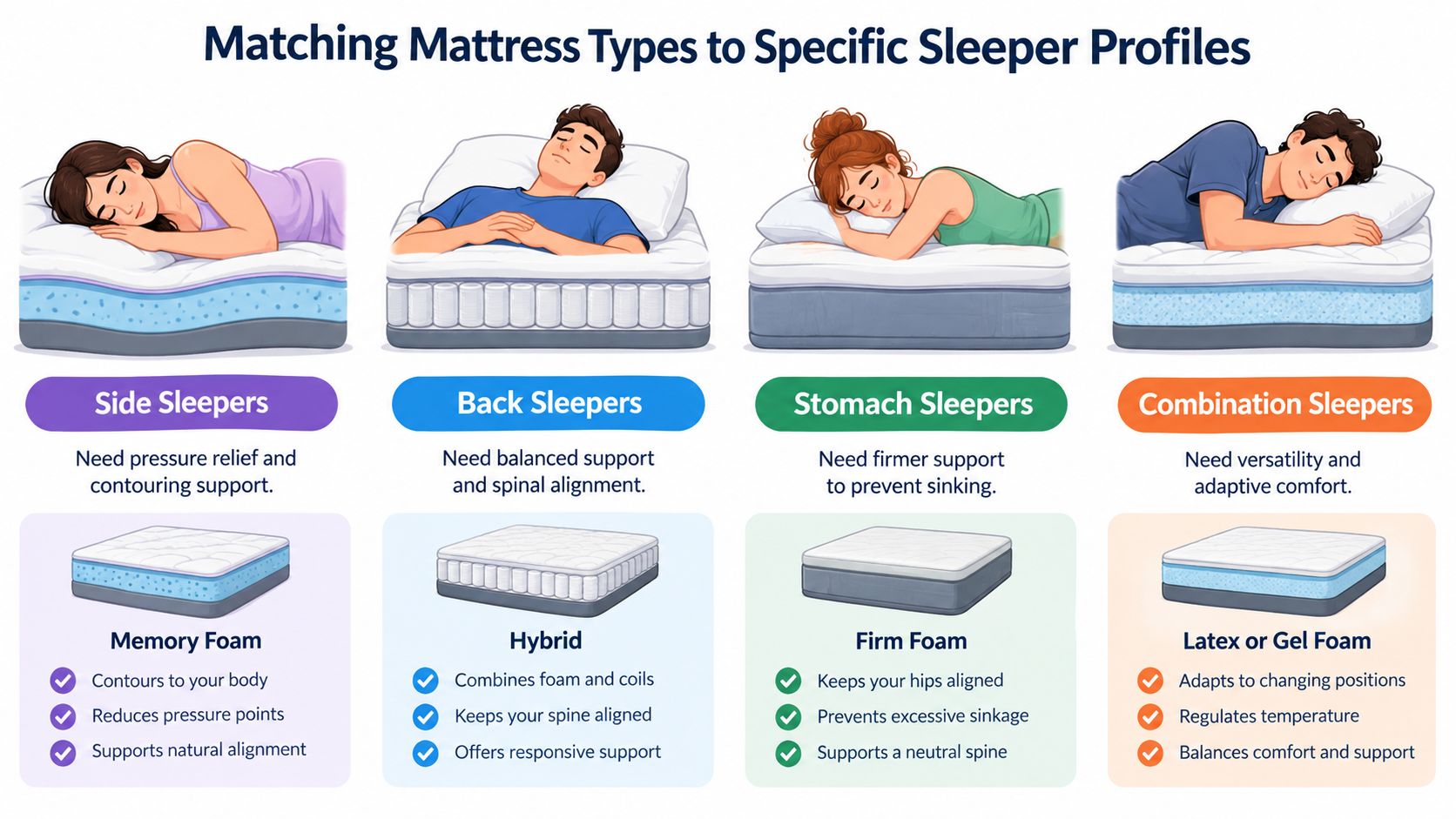
The most useful mattress recommendation starts with the sleeper's routine. A person who overheats needs a different set of priorities from someone who wakes whenever a partner turns, and a mobility-limited sleeper may value responsiveness over deep contouring.
The hot sleeper
A hot sleeper should start with thermal comfort rather than automatically choosing the firmest bed. Coil-supported constructions can allow more air movement, while dense foam may feel warmer for some people. Latex and responsive hybrids can be worth testing when the sleeper wants pressure relief without a heavily enveloping feel.
Temperature remains personal. A systematic review found insufficient evidence to establish one ideal mattress temperature for everyone, so cooling claims should be treated as design features to evaluate, not universal guarantees. The controlled mattress trial review supports testing the actual cover, comfort layers, and surface feel.
The restless combination sleeper
A combination sleeper needs mobility. Responsive latex, an innerspring surface, or a hybrid with a buoyant comfort layer can make position changes easier than a tightly conforming foam design. The mattress still needs enough cushioning to prevent pressure at the hips and shoulders, particularly when the sleeper spends part of the night on the side.
The pressure-sensitive side sleeper
Side sleepers should prioritize pressure distribution and then confirm alignment. A medium-firm mattress with suitable cushioning may offer a practical starting point, but a softer or firmer feel could fit better depending on body shape and weight. The shoulder shouldn't jam into the surface, and the waist shouldn't collapse toward the bed.
The Sleep Gallery at Gorins Furniture & Mattress includes Tempur-Pedic, Serta, and Beautyrest, giving shoppers distinct feel profiles to test. Tempur-Pedic can suit sleepers who value close contouring and motion control, while responsive Beautyrest hybrid designs may appeal to people wanting easier movement and coil support. Serta offers familiar construction choices for shoppers seeking a classic, adaptable starting point.
The couple with mismatched preferences
Couples should test movement separately from comfort. A 2025 study using the Boston Mattress Satisfaction Questionnaire found higher satisfaction among people sleeping on foam, hybrid, and air-filled-chamber mattresses than among those sleeping on all-spring mattresses, with air-chamber beds scoring highest for comfort, firmness, temperature, and overall satisfaction. The finding is useful, but it measures subjective satisfaction and doesn't establish one category as clinically superior or prove long-term durability. The 2025 mattress satisfaction study should be read as a reason to compare options, not as a universal ranking.
For a more personalised starting point, shoppers can use the body-type mattress guidance. The final decision still belongs to the couple's own alignment, pressure, movement, and temperature tests.
Investing in Your Health with Local Expertise
A mattress affects every night of rest, so purchase price is only one part of value. A poorly matched bed can lead to restless sleep, pressure discomfort, and frustration, while a properly fitted mattress can support a more comfortable routine. That makes investment-grade quality worth considering, but quality should mean appropriate materials and a reliable fit, not just a premium label.
Gorins Furniture & Mattress was founded in 1936 and remains a locally owned, family-operated business serving Norwich and Eastern Connecticut. The showroom's value is practical: shoppers can compare physical feels, discuss sleep habits, and make a decision without reducing the process to an online firmness score.
Service belongs in the buying decision
Delivery affects the outcome too. A mattress needs the correct foundation or base, careful handling, and clear care instructions. Gorins' 5-Star Delivery service is designed to bring the purchase into the home with professional handling, rather than leaving the customer to manage a bulky sleep system alone.
The same local approach extends beyond mattresses. Gorins offers Canadel Custom Dining and the F9 Custom Sofa series, where thousands of combinations allow households to tailor sizes, finishes, fabrics, arm styles, back types, and cushion firmness. That customization reflects a broader philosophy: furniture should fit the people using it.
A sensible investment: The right mattress is not the softest, firmest, or most expensive option. It's the one that fits the sleeper's body and routine well enough to earn nightly use.
Financial flexibility can also make an appropriate mattress easier to choose. Promotional Financing with equal monthly payments may lower the upfront barrier for a larger purchase, subject to credit approval and the applicable terms. Shoppers should review the full financing terms carefully, but they don't need to reduce the decision to the cheapest initial option if a better physical fit supports healthier sleep.
Readers considering the long-term value of the purchase can review why investing in a high-quality mattress matters. The strongest buying decision combines fit, construction, service, and a payment plan the household can manage.
Common Questions About Mattress Shopping
Does a new mattress need a break-in period?
Often, yes. The sleeper's body may need time to adjust to a different firmness, contour, or movement response, especially with a new memory foam or hybrid bed. The first impression matters, but it shouldn't be the only impression. If discomfort continues or the mattress clearly fails the alignment and pressure tests, the issue may be poor fit rather than adjustment.
What foundation does a modern mattress need?
The correct base depends on the mattress design. Some beds require a solid platform or compatible slatted foundation, while others can work with an adjustable base. The retailer should confirm support requirements before delivery, because an unsuitable foundation can affect feel, performance, and warranty terms.
Can the old mattress be removed?
Removal policies vary by retailer, product, and local service arrangement. The practical step is to ask before scheduling delivery and clarify whether removal includes the old foundation, adjustable components, or only the mattress. Keeping the old bed ready for collection prevents confusion on delivery day.
What should Norwich shoppers do next?
The clearest path is to identify the main complaint, test the likely construction, and compare the feel in the usual sleep position. Shoppers can take the online Style Quiz, browse the Clearance section for value-driven savings, or visit the Norwich showroom for face-to-face guidance.
Since 1936, Gorins Furniture & Mattress has helped Norwich and Eastern CT families create homes they love, from custom-designed Canadel dining sets to the latest Tempur-Pedic sleep technology. Visit Gorins Furniture & Mattress to compare mattress types by feel, alignment, pressure relief, and mobility, then arrange local guidance and 5-Star Delivery for a healthier sleep investment.