Pillow Top vs Euro Top Mattress: A Practical Norwich Guide


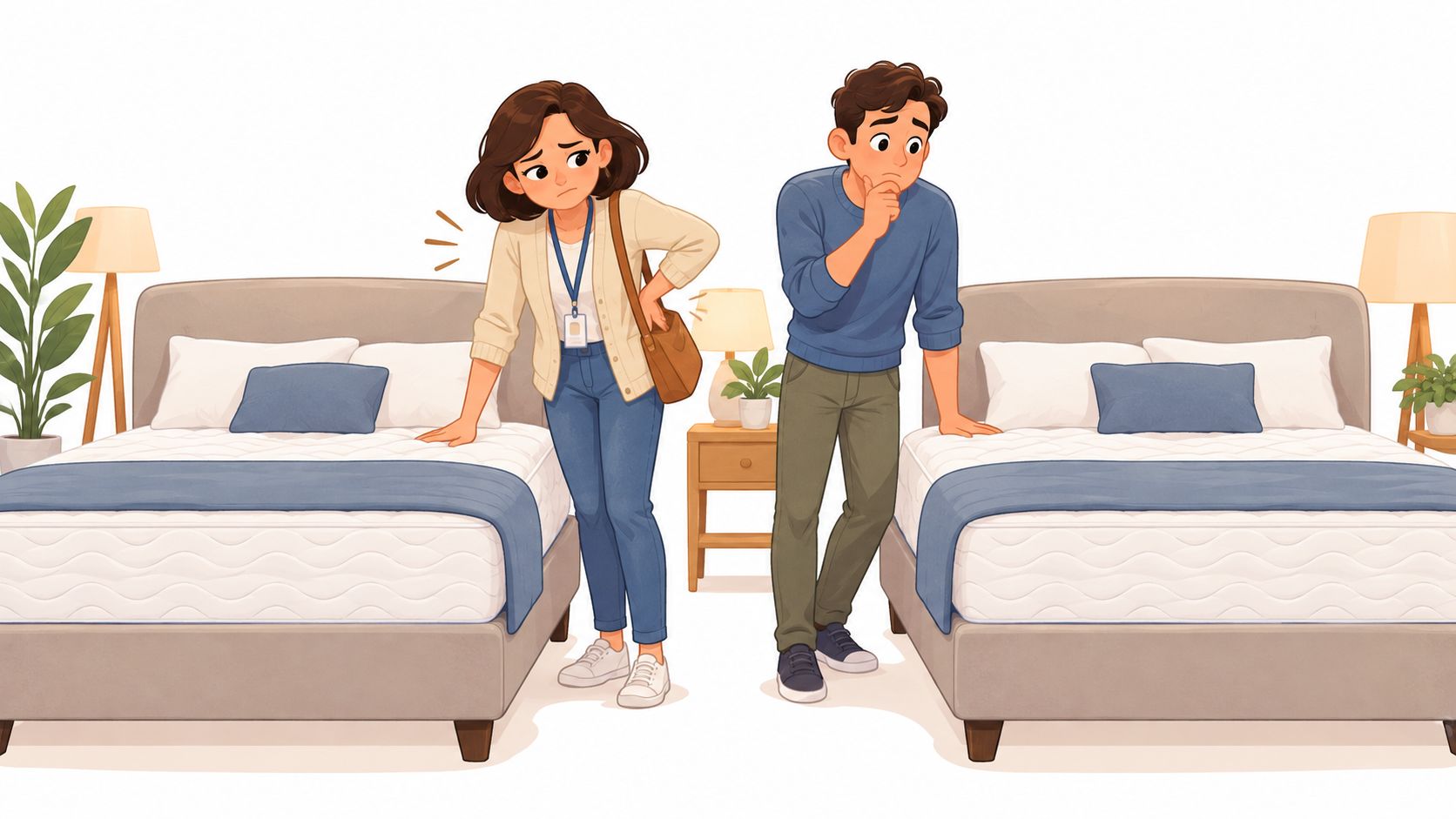
A Norwich couple can spend ten minutes in a mattress showroom, lie on two beds that look almost identical, and still leave unsure which one will support them better. One partner may want a soft surface for shoulder and hip pressure, while the other wants easier movement and a steadier edge. That is the pillow top vs Euro top mattress decision. The label matters, but the support core, comfort materials, sleep position, and edge construction matter more.
Why Norwich Shoppers Are Choosing Between Two Top Panels
At the Sleep Gallery in Norwich, a back-pain teacher from Franklin and her side-sleeping partner might stand between two Beautyrest World Class beds that look nearly identical from three feet away. The visible difference can be small, but the construction beneath the cover changes how each mattress receives the body.
A pillow top is a separately attached cushioning panel stitched above the mattress surface. It creates a raised, upholstered profile, with a visible seam or slight gap near the mattress edge. A Euro top uses additional comfort padding beneath a continuous outer cover. The material is stitched flush with the mattress perimeter, so the sidewall reads as one continuous piece. Mattress construction histories describe the pillow top as a separate raised panel and the Euro top as a more integrated variation.
The distinction isn't a firmness rating. Either style can contain foam, fiber, latex, wool, or other padding, and either can be built around coils or another support system. A plush Euro top can feel softer than a firm pillow top, so shoppers should test the complete mattress instead of judging the name.
Four questions make the showroom comparison useful:
- Support system interaction: Does the comfort layer cushion the body while the core prevents excessive pelvic sink?
- Scaling and edge behavior: Does the mattress feel stable when a sleeper moves toward or sits on the perimeter?
- Sleeper profile fit: Does the surface suit the sleeper's position, body shape, movement, and temperature preference?
- Durability: Will the comfort materials retain their shape under the household's nightly use?
The Norwich floor is the right place to test these differences because matched comfort levels can appear in both constructions. A shopper shouldn't choose between “soft” and “firm” labels alone. The better decision comes from lying in a normal sleeping position, checking spinal alignment, and comparing how the surface behaves near the edge.
Where the Pillow Top and Euro Top Labels Came From
Pillow top and Euro top describe upholstery formats, not standardized performance grades. Mattress-industry histories place the rise of the pillow-top appearance in the 1970s, when manufacturers added substantial surface padding for a softer, more luxurious feel. The Euro top developed as a more integrated design, with comfort material secured beneath a continuous cover. The historical development of mattress design places these formats in that broader shift toward added surface cushioning.
The visual distinction is clear on the Norwich showroom floor. A pillow top has a raised panel and visible seam, so its comfort layer looks added onto the mattress. A Euro top places the padding beneath the cover, producing a flatter profile and cleaner border. That construction changes how the outer comfort material reaches the edge, which affects sitting stability and usable sleeping space.
Shoppers can review this guide to what a Euro-top mattress is before visiting the Gorins showroom. Use the label as a starting point, not a verdict. Both designs can contain foam, fiber, latex, wool, or other padding, and both can use coils or another support core.
The useful comparison rests on four practical checks:
- Support system interaction: Does the comfort layer cushion the body while the core controls pelvic sink?
- Scale and edge behavior: Does the surface remain stable when a sleeper turns, moves outward, or sits near the perimeter?
- Sleeper profile fit: Does the build suit the sleeper's position, body shape, movement, and temperature preference?
- Durability: Will the comfort materials hold their shape under the household's nightly loading?
A mattress can have a plush Euro top or a firm pillow top. The top name cannot predict alignment, support, or long-term value by itself. At Gorins, lie in a normal sleeping position, check whether your spine feels level, and test the perimeter before choosing. That showroom process gives the construction label useful context, alongside the mattress scale, foundation, and support system beneath it.
How Each Construction Feels Under Real Sleeping Conditions
Lie on a pillow top and the first sensation is usually softness under the shoulders and hips. A Euro top tends to feel more unified from the center of the mattress to its outer edge. The difference becomes useful only when you connect it to movement, perimeter stability, and the support system underneath. Construction references also connect these builds with different edge transitions and surface responses, as shown in this construction comparison.
| Feel Criterion | Pillow Top | Euro Top |
|---|---|---|
| Comfort-layer integration | Separate upper cushion with a more pronounced surface feel | Integrated padding with a steadier transition to the border |
| Initial feel | Plush and immediately cushioning | Even, structured cushioning |
| Sink depth | Often deeper at the surface | Often shallower and more controlled |
| Edge seating | Softer transition near the perimeter | More continuous feel near the edge |
| Turning ease | Can feel more enveloping | Usually allows easier movement across the surface |
| Motion response | Varies, and the separate panel may transmit movement differently | Generally more consistent because the comfort layer is integrated |
The pillow top response
Choose a pillow top when you want the surface to feel obvious as soon as you lie down. Its added cushion can soften contact at the shoulders and hips, which suits shoppers who dislike a hard first impression. The trade-off is a more enveloping feel. A separate upper panel can compress differently from the mattress body, especially when you sleep close to the perimeter or change position often.
Test that distinction at the Gorins showroom. On a Tempur-Pedic TEMPUR-ProAdapt Medium, lie on your side, then roll toward your back. The right question is whether the material relieves pressure without making movement feel slow. A pillow top that feels luxurious for a minute can become tiring if your hips sink too far or the surface resists repositioning.
A Serta Perfect Sleeper Luminous Sleep set gives you a different showroom check. Notice whether the upper cushion feels plush while the support core keeps your pelvis from dropping. The top panel creates the first impression, but the core determines whether your body remains supported after the initial comfort fades.
The Euro top response
A Euro top usually feels squarer and more orderly. Its comfort materials meet the sidewall in a cleaner transition, so the surface can feel denser and more consistent from the middle toward the edge. That makes it a practical choice for sleepers who sit on the side of the bed, use more of the mattress width, or want a less enveloping surface.
Showroom rule: Judge the whole mattress, not the label. Coil design, foam density, reinforcement, foundation, and mattress scale still control the final result. A soft Euro top can feel plusher than a firm pillow top.
Motion transfer requires a partner test. Lie still while the other person rolls, changes position, and sits near the edge. Compare the actual sensation on the Tempur-Pedic and Serta examples rather than predicting it from the top style. For a separate look at comfort trade-offs, read this pillow-top mattress comparison.
Matching the Top Style to Your Sleep Position and Body
A mattress should be selected around the sleeper's pressure points and alignment, not around the top panel's appearance. Softer comfort layers can reduce localized pressure, but excessive softness can increase body displacement and make repositioning less stable. In one pressure-distribution study, medium firmness produced lower maximum occipital pressure at 14.2 kPa, compared with 22.8 kPa for soft firmness and 18.5 kPa for firm firmness. The study illustrates why the plushest surface isn't automatically the best pressure-management design.
| Sleeper Profile | Best Construction | Recommended Sleep Gallery Model |
|---|---|---|
| Side sleeper with shoulder or hip pressure | A cushioning surface with resilient support beneath | Tempur-Pedic TEMPUR-ProAdapt Medium |
| Back sleeper needing a stable pelvic position | A balanced top over a supportive core | A matched medium-feel Beautyrest or Serta model |
| Stomach sleeper concerned about hip sink | A flatter, more uniform Euro-top feel | A supportive Euro-top configuration |
| Heavier combination sleeper | Integrated comfort materials with strong perimeter support | Beautyrest Black C-Class |
| Couple with different movement preferences | A responsive surface with controlled motion | Serta Perfect Sleeper |
| Sleeper who wants immediate plushness | A pillow top with suitable underlying support | A Beautyrest Silver pillow-top configuration |
Side sleepers and pressure relief
Side sleepers need enough room for the shoulder and hip to settle without forcing the spine out of line. A thicker pillow top can provide that immediate cushioning, but a well-designed Euro top can also relieve pressure if its comfort material is sufficiently resilient and the core supports the pelvis.
The practical test is simple. Each sleeper should lie on the side in the normal position and check whether the shoulder feels compressed, whether the waist is supported, and whether the hips sink farther than the upper body. The model name matters less than that body response.
Back and stomach sleepers
Back sleepers should focus on a surface that fills the lumbar curve without letting the pelvis drop. A pillow top isn't automatically unsuitable, but excessive loft or low-resilience padding can make the body feel trapped. Stomach sleepers generally need especially careful pelvic support, which makes a flatter Euro-top configuration worth testing.
The same rule applies to couples. A partner who moves frequently should test turning ease rather than assuming the top style will determine motion transfer. Foam type, density, coil arrangement, and the base underneath influence the result.
Heat and material choice
Top style alone is a weak predictor of overnight temperature. A randomized crossover study conducted in 2025 tested a specialized high-heat-conductivity topper during 32°C conditions. Heat exposure reduced total sleep time by about 24.8 minutes, while the conductive topper increased total sleep time by 21.4 minutes versus the control mattress. The study included 15 healthy young adults, so it doesn't establish that every Euro top sleeps cooler than every pillow top. Its practical value is showing why foam type, density, quilting, fibers, airflow, bedding, and room temperature all need consideration.
Lifespan, Shape Retention, and Long-Term Care
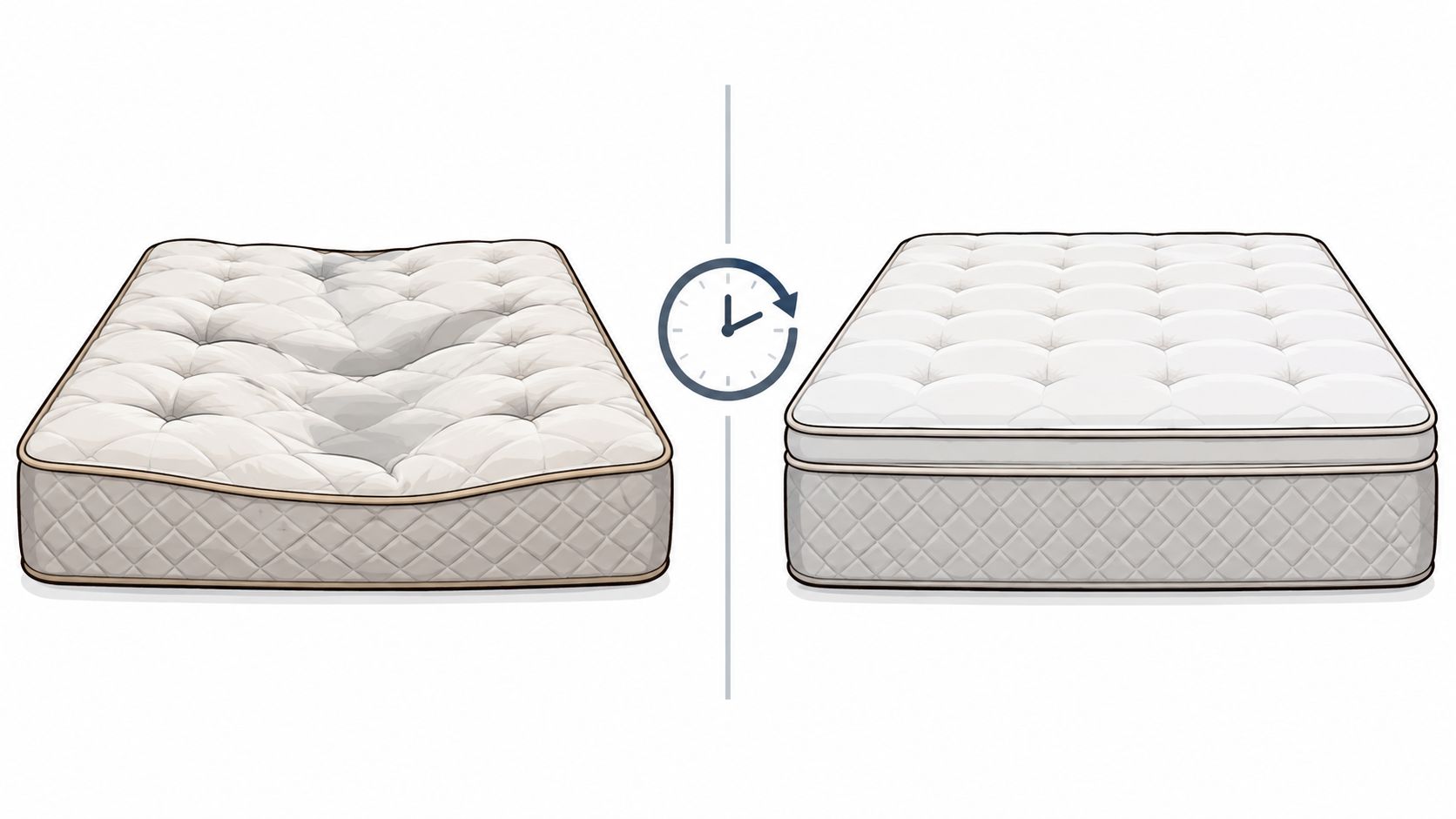
Durability is where construction becomes a value decision. Independent mattress comparisons commonly estimate 5 to 7 years for pillow-top mattresses and 8 to 10 years for Euro-top mattresses, though those figures are benchmarks rather than warranties. The comparison also emphasizes that sleeper weight, nightly use, foundation support, rotation, ventilation, and moisture exposure can change the result.
A pillow top has a separately distinguishable comfort layer that can soften, shift, or develop impressions under repeated loading. A Euro top is upholstered flush with the cover and extends toward the edges, creating a more integrated surface. That construction can improve shape stability, but foam density and the support core still determine whether the mattress holds up.
What shortens service life
Nightly use by two adults creates more compression cycles than occasional guest-room use. Body weight, humidity, moisture, ventilation, foundation condition, and the density of the comfort materials all affect visible wear.
Care helps, but it can't rescue a poor match. A household should protect the surface from moisture, maintain a properly supportive foundation, avoid repeatedly sitting in the same spot, and follow the manufacturer's rotation guidance. Before buying, shoppers can use this mattress lifespan guide to frame the purchase around materials and warranty coverage rather than the top label.
The long-term buying question
The right question is not just whether a pillow top or Euro top lasts longer. It is whether the comfort layer retains enough resilience for the sleeper's body and whether the foundation supports the mattress evenly. A Euro top is the stronger starting point for shoppers prioritizing a clean profile and potentially longer surface stability. A pillow top remains a sensible choice for shoppers who value immediate plushness and are prepared to inspect the materials carefully.
Why the Support Core Matters More Than the Top Label
The top panel doesn't determine spinal alignment. The support core does most of that work, while the comfort layer controls how the body meets the support system. Springs, foam density, latex content, total thickness, and foundation design can change the result more than the words pillow top or Euro top.
A systematic review found that medium-firm mattresses generally performed better than very firm or very soft surfaces for comfort, sleep quality, and spinal alignment, particularly among people with nonspecific low-back pain. The review supports evaluating the complete firmness profile rather than treating a top style as a back-pain solution.
Three useful showroom tests
Lie on the side in the normal position. Stay long enough to notice shoulder and hip pressure. The body should feel cushioned without the pelvis dropping sharply below the shoulders.
Sit near the edge. Check whether the outer comfort material collapses or whether the perimeter remains stable enough for getting in and out of bed.
Check the lumbar curve. A Sleep Gallery associate can observe alignment while the sleeper lies on the back. The mattress should fill the lower-back curve without forcing the pelvis upward or allowing it to sink excessively.
A shopper can run those tests on a Serta hybrid and a Beautyrest pocketed-coil model with the same top designation and still feel a major difference. The core, reinforcement, comfort material, and foundation pairing explain that variation.
For shoppers who want to understand the support layer more clearly, this pocket-coil mattress guide provides useful terminology. The strongest purchase decision comes from asking about the actual coil system, foam density, comfort-layer thickness, edge reinforcement, and warranty exclusions.
Your Next Step at the Norwich Showroom
The comparison becomes straightforward when shoppers test both constructions in the same visit. The Sleep Gallery floor at 2 Chapman Lane, Gorins Plaza, Norwich, CT, places Beautyrest, Serta, and Tempur-Pedic sleep options within a hands-on setting. The goal isn't to pick the mattress with the most luxurious-looking panel. It is to find the surface that keeps the body comfortable and supported through normal movement.
A practical showroom routine
- Run a side-lying pressure check. Spend five minutes on each style, using the same pillow and normal sleeping position. Notice shoulder pressure, hip pressure, and whether the waist feels supported.
- Test partner movement. One person rolls and changes position while the other stays still. Judge the actual disturbance instead of assuming either construction will isolate motion better.
- Compare edge seating. Sit near the perimeter, stand up, and lie close to the edge. A stable edge matters for couples, mobility, and use of the full sleep surface.
- Ask for an alignment check. A Sleep Gallery associate can inspect the lumbar area and the relationship between the shoulders, hips, and pelvis.
Associates should also answer direct construction questions:
- What materials and densities are used in the comfort layer?
- How does the support core manage the lumbar and hip areas?
- Does the foundation meet the mattress requirements?
- What does the warranty exclude?
- Is the comfort exchange policy available for the selected model?
A shopper who wants additional preparation can review this mattress selection guide before arriving. The store also provides delivery planning, including 5-Star Delivery, and financing programs may include equal monthly payment options for qualified buyers. Any exchange, delivery, warranty, or financing terms should be confirmed with an associate before purchase.
Gorins Furniture & Mattress has served Norwich and Eastern CT since 1936 as a locally owned, family-operated business. Its Sleep Gallery includes Tempur-Pedic, Serta, and Beautyrest, while its broader home offering includes Canadel Custom Dining and the F9 Custom Sofa series, with thousands of combinations available across custom furniture choices. Promotional financing with equal monthly payments can help qualified shoppers manage an investment in healthier sleep, while the Style Quiz and Clearance section offer additional ways to begin.
Visit Gorins Furniture & Mattress in Norwich to test pillow-top and Euro-top mattresses side by side, compare support cores, and ask an associate to check alignment. Shoppers can also take the online Style Quiz or browse the Clearance section before booking a 5-Star Delivery appointment for a personalized sleep solution.