
Adjustable Base Mattress Reviews for Better Sleep


A bedtime routine in Norwich can reveal the weakness of a flat mattress quickly. One person wants to read with the head propped up, a partner wants the legs raised after a long day, and neither wants to disturb the other by stacking pillows or shifting the whole bed. That's why shoppers are searching for adjustable base mattress reviews that explain daily use, mattress fit, noise, service, and total value instead of repeating a list of massage presets.
The right review should answer a practical question: will this base make life easier for the household using it every night? For homeowners and renters in Norwich, New London, Plainfield, Waterford, and surrounding Eastern Connecticut and Rhode Island communities, that answer depends on the mattress, the room, the sleeper, and the support available after delivery.
Why Adjustable Base Mattress Reviews Matter Now
The adjustable bed has moved well beyond novelty. One market estimate placed the global adjustable beds and mattress category at USD 6.24 billion in 2021, with a projection of USD 13.34 billion by 2030 and an 8.8% CAGR from 2022 to 2030. A later estimate placed the category at USD 10.7 billion in 2024 and projected USD 27.33 billion by 2035, with an 8.9% CAGR over that forecast period. Those figures come from separate market estimates, but they point in the same direction: shoppers now face a broad category with varied designs, prices, and feature packages. (Global adjustable beds and mattress market estimates)
A Norwich shopper comparing bases may be choosing between simple head elevation and a more advanced system with foot articulation, massage, wireless controls, USB charging, under-bed lighting, or app access. Reviews matter because a feature only earns its place when it works reliably at bedtime, during reading, while elevating tired legs, or when a sleeper wants relief from pressure created by a flat position.
Consider a couple in a compact Eastern Connecticut bedroom. One partner sleeps mostly on the back and wants a supportive raised position, while the other reads before sleep and prefers a different head angle. A good review helps them ask whether a split configuration makes sense, whether the controls are intuitive in low light, and whether the mattress can flex without fighting the base.
A useful review should describe the routine, not just the remote.
That practical filter matters more than a dramatic product description. Gorins Furniture & Mattress has served the Norwich area as a locally owned, family-operated business since 1936, giving shoppers a place to compare feel and movement in person rather than relying on a screen alone. Online research still helps, but local guidance can expose the details marketing pages often skip, including setup, compatibility, service, and whether a premium feature will be used.
For readers tracking comfort alongside broader wellness questions, AI-powered symptom relief app reviews can provide a separate resource for evaluating digital tools. That information doesn't replace professional medical advice, but it can help shoppers think more clearly about which sleep concerns belong to the mattress and base, and which deserve clinical attention.
What Adjustable Bases Actually Do for Sleep and Lifestyle
An adjustable base is a powered foundation that changes the mattress position beneath the sleeper. The head section rises for reading, television, or a more upright rest position, while the foot section lifts to support leg elevation. The base and mattress work as a system, but they aren't the same product. A base controls position, while the mattress determines pressure response, support, temperature, and feel.
The movement can be substantial. One compatibility guide describes an adjustable base bending the mattress at two points, with the head section rising up to 70 degrees and the foot section up to 45 degrees. That range explains why a rigid mattress can become the wrong partner, even when the base itself operates correctly. (Adjustable base movement and compatibility)
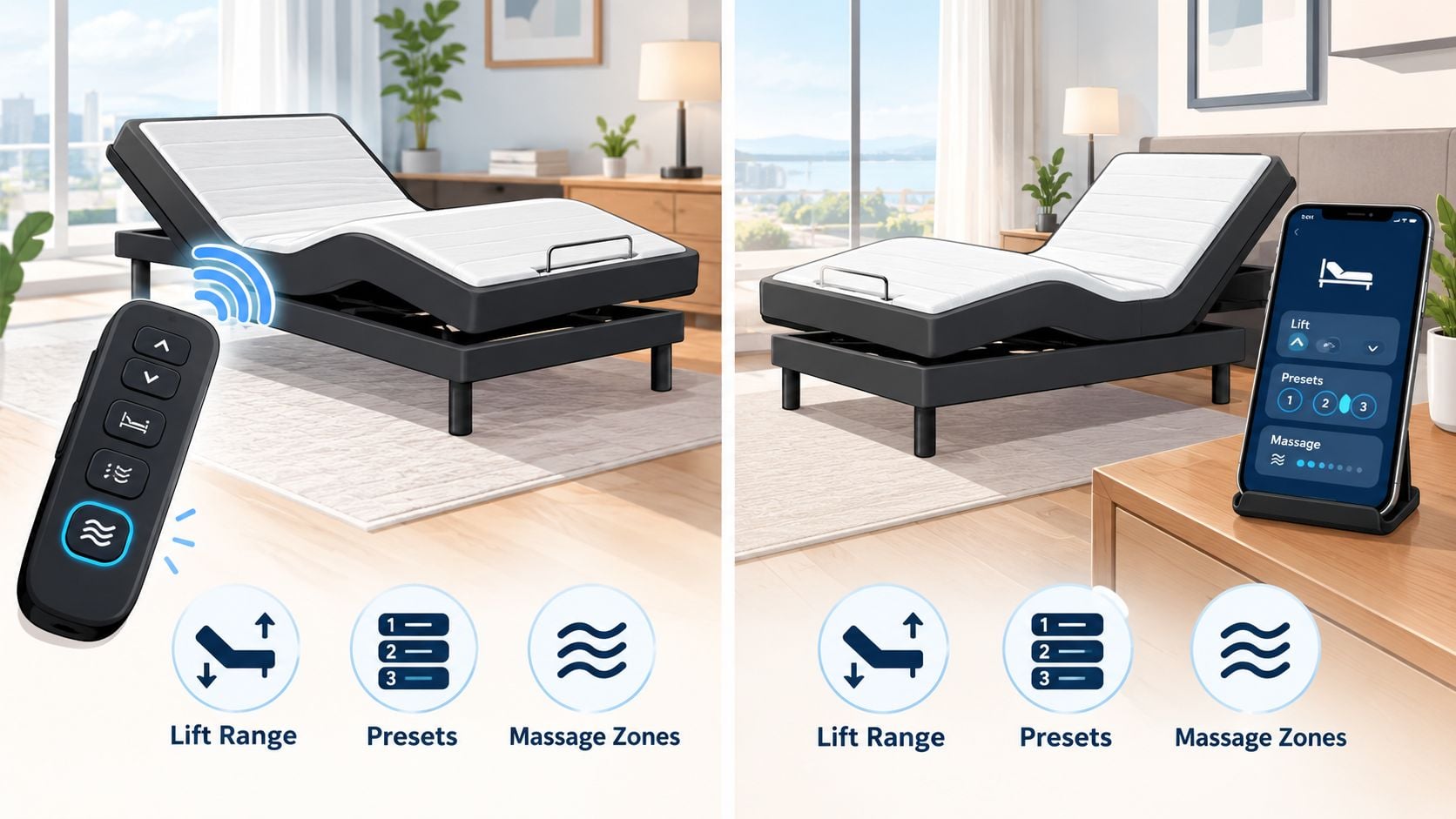
The positions that earn their space
Zero gravity generally places the upper body and legs in a raised relationship intended to reduce the feeling of weight across the mattress. Anti-snore presets raise the head area slightly, which some sleepers find more comfortable than lying completely flat. Neither position should be treated as a guaranteed treatment, but both can be useful household settings when they match a sleeper's comfort needs.
A wall-hugger design moves the sleeper backward as the head rises, helping keep a nightstand, lamp, or reading material within reach. That feature matters in smaller Norwich bedrooms where every inch around the bed affects convenience. Massage, positional memory, under-bed lighting, and USB ports add more flexibility, but they should remain secondary to stable movement and mattress compatibility. (Common adjustable bed features)
The category's growth has changed what reviews need to measure. Buyers are no longer comparing one standardized foundation. They're comparing how a base handles reading, recovery after a demanding day, changing sleep positions, shared-bed preferences, and everyday controls.
The Sleep Gallery at Gorins brings that decision back to comfort by feel and healthier sleep, with recognized names such as Tempur-Pedic, Serta, and Beautyrest available for comparison. Shoppers can also review the adjustable bed base selection while considering how the foundation and mattress will function together.
How Expert Reviews Compare Key Features That Matter Daily
The strongest adjustable base mattress reviews separate attractive extras from features that change the bedtime routine. A base may advertise a long list of settings, but a useful assessment asks whether the motor moves smoothly, whether the remote makes sense without a manual, and whether the sleeper can return to a preferred position quickly.
The daily feature test
- Head and foot lift: Reviews check whether both sections move independently and whether the range feels useful under a real mattress load. Head elevation supports reading and upright relaxation, while foot lift can make leg elevation more comfortable.
- Presets: Zero-gravity, anti-snore, and memory positions save time when they're easy to reach. Presets matter less when the remote requires repeated searching or the stored positions don't suit the household.
- Massage zones: Separate zones and adjustable intensity offer more control than a single undifferentiated vibration setting. Massage is a comfort feature, not a substitute for a mattress that fits the sleeper.
- Remote and app control: Wireless remotes should have clear buttons and dependable response. App control can be convenient, but it shouldn't make basic movement harder.
- USB ports and lighting: Charging ports help keep a phone nearby, while under-bed lighting can reduce the need for a bright overhead light during nighttime movement.
- Leg adjustment: Adjustable-height legs affect room clearance, entry height, and how the bed looks beside existing furniture.
| Feature | What Reviews Test | Why It Matters Daily |
|---|---|---|
| Head and foot articulation | Independent movement, range, and stability | Supports reading, leg elevation, and position changes |
| Preset positions | Access to zero-gravity, anti-snore, and memory settings | Reduces repeated manual adjustment |
| Massage | Zone control and intensity response | Adds relaxation without replacing core support |
| Remote or app control | Button layout, connection, and response | Makes adjustments practical in darkness |
| USB charging | Port placement and access | Keeps devices within reach |
| Under-bed lighting | Visibility and control | Helps with nighttime movement |
| Adjustable legs | Height options and stability | Improves room fit and entry comfort |
| Premium movement | Lumbar, hi-lo, tilt, and expanded presets | Serves shoppers needing more specialized positioning |
One expert-tested premium model with separate head and foot adjustment, wireless remote or app control, three massage intensity levels, USB ports, under-bed lighting, and adjustable-height legs received 4/5 for remote design, 4/5 for adjustments, 3/5 for ease of use, and 4/5 overall. Those scores show why feature depth and usability must be judged together.
The best feature is the one a sleeper can operate easily at the moment it's needed.
Premium designs may add lumbar support, hi-lo lift, tilt, or several stored positions. Those upgrades can make sense for shoppers with specific mobility or positioning needs, but a reader who only wants a comfortable head angle may gain more from a quiet, simple control system than from a crowded feature list. A mattress comparison guide can help separate the base's movement from the feel delivered by the mattress itself. (Mattress brand comparison guidance)
Motor Quality Smoothness and Noise Tested Like a Pro
A base can have every popular preset and still disappoint if the motor feels jerky, sounds harsh, or struggles beneath the mattress. Expert testing therefore treats movement as measurable performance rather than a quick showroom impression.
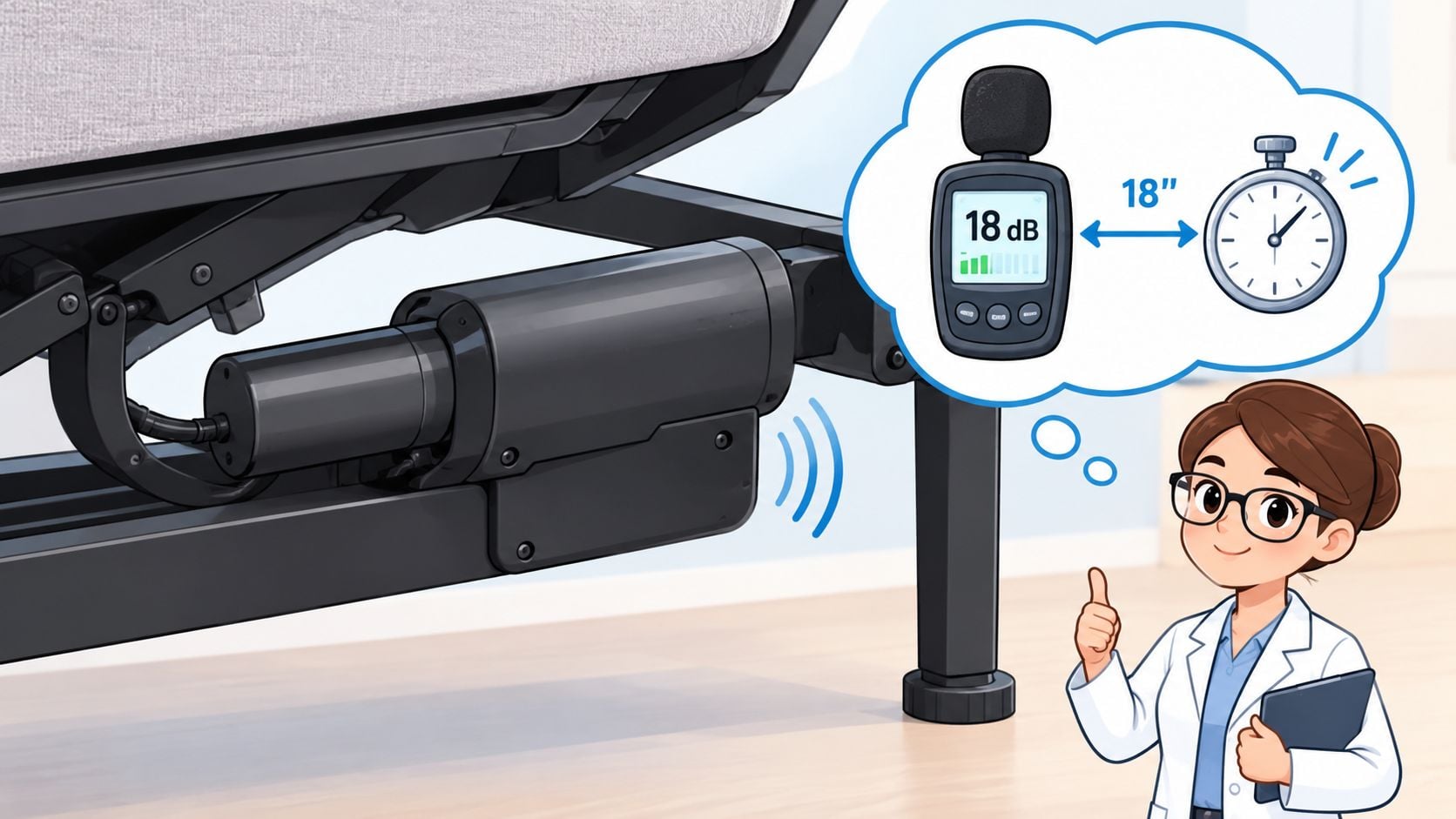
One testing method weights motor noise and smoothness at 25%, using a decibel meter positioned 18 inches from the motor and timing head-lift travel under a real mattress load. The same framework also evaluates position range and presets, massage quality, construction, warranty, convenience features, and value. (Adjustable bed testing methods)
What smooth movement tells a shopper
A smooth motor should begin and stop without an abrupt jolt. Under load, the base should raise the mattress consistently rather than hesitate, vibrate excessively, or make the sleeper feel every mechanical transition. A timed head lift gives reviewers a repeatable way to compare movement, while a sound reading provides more useful information than phrases such as “whisper quiet.”
That doesn't mean the lowest sound reading automatically identifies the right base. Build quality, warranty terms, parts availability, and ease of control still determine whether the system remains useful after the novelty fades. A premium base that operates but creates difficult service calls may be a poor long-term value.
Consumer satisfaction data offers helpful context. A long-running independent owner-review source reported 87% overall satisfaction for adjustable bed bases. The same source reported annual U.S. adjustable-base shipments exceeding 3.5 million units in 2021, market penetration of 12% of total mattress sales in 2022, and North American share of about 42% of the global market in 2022. Those figures indicate that adjustable bases have become a high-adoption product class, not an experimental accessory. (Owner satisfaction and market adoption data)
Reliability belongs in the review
Serviceability deserves the same attention as massage. Complaint records for one major adjustable-sleep-system brand include 187 total complaints in the last three years, while consumer comments mention repeated control-box replacement and significant out-of-pocket costs. That record doesn't establish the performance of every brand, but it shows why shoppers should ask about common replacement parts, warranty labor, control boxes, remotes, and the process for diagnosing a failed motor. (BBB complaint record for an adjustable sleep system brand)
A practical showroom test should include several movement cycles, not just one demonstration. The associate should explain what the warranty covers, who handles service, and whether the household can obtain replacement controls without replacing the entire foundation.
Mattress Compatibility and Thickness Rules You Cannot Ignore
The most expensive adjustable-base mistake often happens before the motor ever moves. A shopper chooses a foundation, then pairs it with a mattress that bends poorly, sits too high, or restricts the intended positions. The result can be reduced comfort, awkward articulation, or a return process that becomes more complicated than expected.
Memory foam and latex are usually the safest starting points because they flex readily with the foundation. Flex-rated hybrids can also work well when their construction allows repeated bending. Traditional innerspring mattresses with rigid border wires or interconnected coils can resist movement, deform, or fail to conform properly. (Mattress materials for adjustable bases)
A compatibility check before purchase
- Identify the mattress construction. Ask whether the model is designed for adjustable-base use. Don't assume that a mattress labeled hybrid will flex in the same way as another hybrid.
- Check the thickness. One consumer guide warns that mattresses over 14 inches may not articulate well or conform to the base's angles. Thickness isn't automatically a quality problem, but it is a movement consideration. (Mattress thickness and adjustable-base guidance)
- Test the bend. In a showroom, observe the mattress while the head and foot sections rise. The surface should follow the base without excessive buckling or a visible gap.
- Read the return terms. Confirm whether the mattress, base, or both can be returned if the pairing feels wrong. The terms may differ by product.
- Decide whether split movement matters. Couples with different elevation preferences may benefit from independent sides, but a split setup also changes sheet selection, controls, and room planning.
- Check smart features last. App or sensor integration can be useful, but it can't correct a mattress that doesn't flex correctly.
The Sleep Gallery gives shoppers a chance to compare Tempur-Pedic, Serta, and Beautyrest by feel while discussing how each mattress may perform on an adjustable foundation. That hands-on approach is more reliable than selecting a mattress by firmness label alone, because comfort and flexibility are separate decisions.
An old mattress also creates a practical disposal question. Before a replacement arrives, households can review Renue Systems Four Points mattress disposal as one option for handling the outgoing bed responsibly. For shoppers comparing compatible models, the mattress guide for adjustable bases keeps the foundation and mattress decision connected.
Price Tiers Warranty and Financing Options Compared
Adjustable-base pricing makes more sense when the tiers are compared by use rather than label. An entry design may focus on dependable head and foot elevation. A mid-level base may add better controls, presets, lighting, charging, or massage. A premium model can bring more specialized movement such as lumbar adjustment, hi-lo lift, or tilt.
What each tier should accomplish
Entry level suits a sleeper who wants basic elevation for reading, relaxation, or leg support and doesn't need extensive automation. The priority should be stable movement, a sensible remote, mattress compatibility, and clear warranty coverage.
Mid-range is the practical choice for many households. It can add convenience features that get used regularly, such as memory positions, independent movement, massage zones, USB ports, or under-bed lighting. The buyer should still reject features that complicate operation or add cost without serving a real routine.
Premium makes sense when specialized positioning, advanced controls, or couple-specific flexibility has a clear purpose. A premium base should offer more than decorative technology. It should deliver smoother operation, stronger construction, useful adjustment range, and service terms that justify the investment.
Warranty language needs careful reading at every tier. Shoppers should ask whether coverage applies to motors, electronics, remotes, frames, labor, and replacement parts. They should also ask who handles the claim and what happens if a control box or motor fails after the initial purchase period.
For Eastern Connecticut households balancing a mattress and foundation purchase with other furnishing needs, Promotional Financing with equal monthly payments can lower the immediate barrier to investment-grade quality, subject to approval and applicable terms. That option supports affordable luxury without encouraging shoppers to chase the cheapest base and replace it after avoidable service problems. Gorins also offers broader furniture planning, from the Canadel Custom Dining partnership to the F9 Custom Sofa series, where thousands of combinations allow a home to be set up for its owners. A useful explanation of payment planning appears in whether financing a mattress makes sense.
Situational recommendations
- For a wellness-focused sleeper: prioritize smooth head and foot movement, mattress compatibility, and a position that feels comfortable for the individual routine.
- For a nightly reader: choose a wall-hugger design if bedside access matters, then test the remote in a dim environment.
- For couples with different needs: consider independent adjustment only after confirming that both sides can use compatible mattresses and bedding.
- For a value-conscious homeowner: choose the simplest tier that delivers the needed positions, then put the remaining attention on warranty and serviceability.
How to Test Bases In Store and Choose With Confidence in Norwich
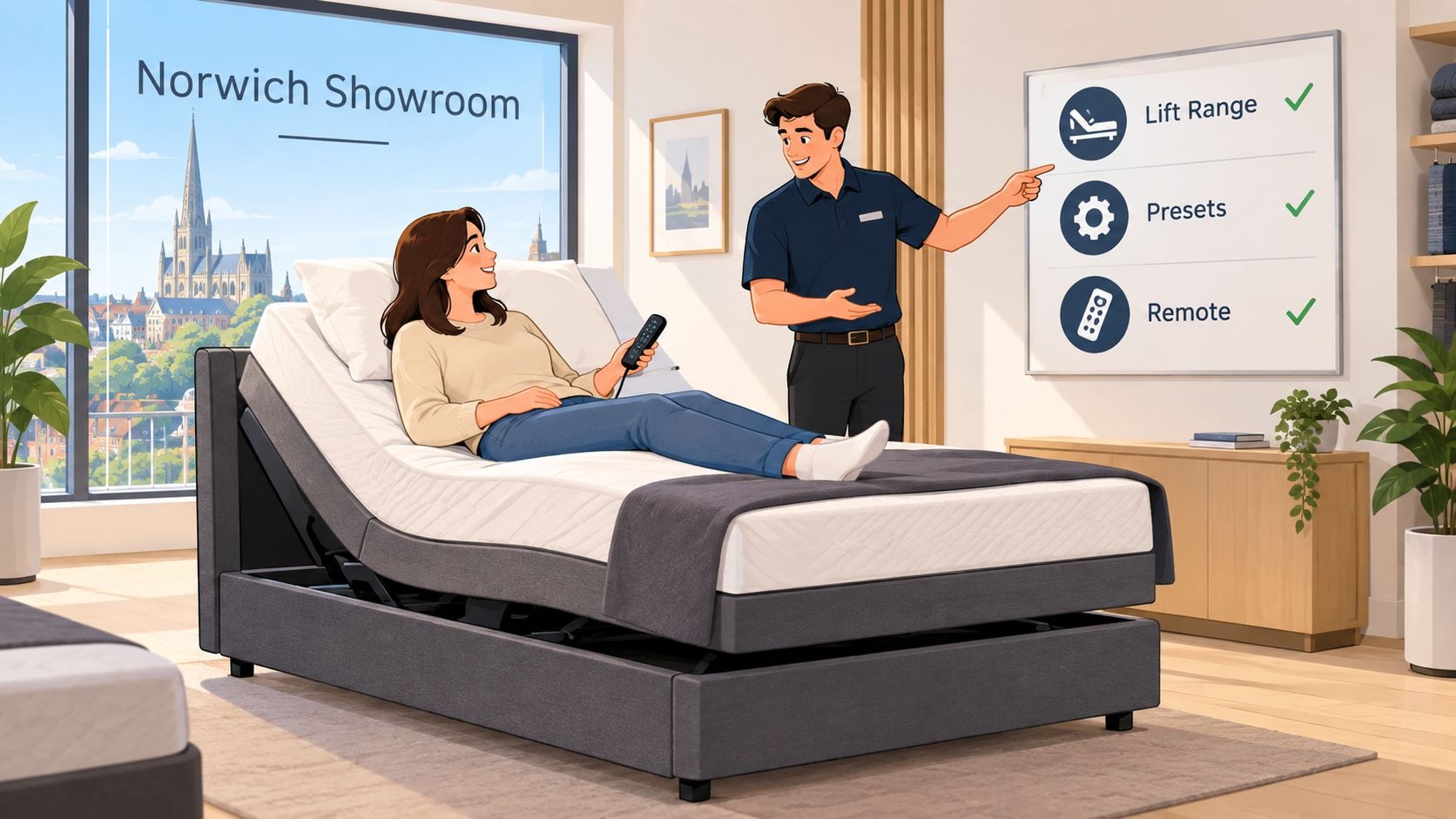
Online reviews narrow the field, but a base earns its place through the body's response. A Norwich showroom visit should feel like a practical test, not a rushed demonstration.

Six checks worth making
- Lie down normally. Start in the household's usual sleep position before raising anything. Notice whether the mattress cushions pressure points and supports the body.
- Raise the head. Try a reading angle, then return to flat. Watch for hesitation, jolting, or excessive motor sound.
- Lift the legs. Check whether the foot section feels supportive rather than cramped. A partner should try the same movement if the household has different body proportions.
- Test every control. Use the remote without coaching. If an app is included, see whether basic movement remains simple.
- Try the extras. Test massage intensity, USB access, lighting, memory settings, and any wall-hugger movement that affects the nightstand.
- Ask service questions. Confirm delivery, setup, mattress pairing, removal options, warranty handling, replacement parts, and the details of Gorins' 5-Star Delivery service.
A local consultation also helps shoppers compare mattress feel instead of relying on category labels. A Purple mattress on an adjustable base, for example, deserves the same practical questions as any other mattress pairing: does it flex comfortably, does the surface feel right when raised, and does the base support the household's actual routine? (Purple mattress and adjustable base guidance)
Gorins Furniture & Mattress has served Norwich, New London, Plainfield, Waterford, and surrounding Eastern Connecticut and Rhode Island communities since 1936 as a locally owned, family-operated business. Beyond the Sleep Gallery, the showroom offers furniture guidance for living rooms, dining rooms, and bedrooms, including custom options through Canadel and the F9 series, with a focus on quality, value, and helpful service.
Gorins Furniture & Mattress offers in-store adjustable-base testing, mattress matching, trusted Sleep Gallery brands, Promotional Financing with equal monthly payments, and local 5-Star Delivery service. Visit Gorins Furniture & Mattress in Norwich to test the movement in person, take the online Style Quiz for guidance, or browse the Clearance section for value-driven savings.