Lift Chairs with Battery Backup Explained

Battery backup on a lift chair usually gives the user one controlled move back toward upright, not a day of normal reclining without wall power. One documented rechargeable class is rated for about 15 recline cycles, while a basic disposable pack may only support one emergency exit.
That correction matters because the common advice, choose a model that lists battery backup and the outage problem is solved, skips the key question. Can the chair rise from the position where the user sits, who can operate the control, and what happens after that single move? Lift chairs with battery backup should be judged as safety equipment, not as a checkbox next to fabric and cupholders.
What Battery Backup Can and Cannot Do
A lift chair is a powered recliner with a lifting base that tilts up and forward to help someone reach a near-standing position. It's built for transfers, not only for leaning back. When household power stops, that distinction becomes the whole story.
The chair may still hold someone safely, but the motor can't finish a recline, lower a footrest, or help with standing unless stored power takes over. Shoppers often assume battery backup means the chair keeps working through an outage. That assumption is where trouble starts.
One safe exit is not hours of use
The Pride Mobility lift chair owner's manual describes backup batteries that may provide only enough power to return the chair to an upright or semi-upright position, with users needing to act quickly because runtime is short. That's an emergency egress feature, not an uninterruptible power supply for the living room.
A reader comparing power recliner and manual recliner operation should ask a narrower question for every model. Which movement stays available, can it rise from full recline, and are heat, massage, USB charging, and extra motors off during backup use?
Three kinds of lift chair backup
| Backup type | What stays available | Runtime clue | Best fit |
|---|---|---|---|
| Disposable 9-volt | Return toward upright or semi-upright if the control is held | Often one use, then replace; about six months even if unused | A basic emergency exit |
| Built-in rechargeable pack | Limited lift or recline cycles, not whole-house power | Example class about 15 recline cycles and about 4 hours to recharge | Short outages with automatic charging |
| Approved external station | Only what the chair maker approves | Set by the station capacity and maker approval, not the chair label | Longer outages, never improvised adapters |
The first row suits a household that wants a simple exit path and will replace cells on schedule. The second suits short interruptions when the chair stays plugged in and charged. The third belongs in a longer outage plan only when the chair manufacturer approves that exact setup.
A chair advertised with battery backup can still be the wrong primary outage plan for someone who lives alone.
For a user with limited transfer strength, the safe test isn't reading a feature line. A Norwich floor test should show the outage movement before anyone treats that checkbox as protection.
How the Backup System Works
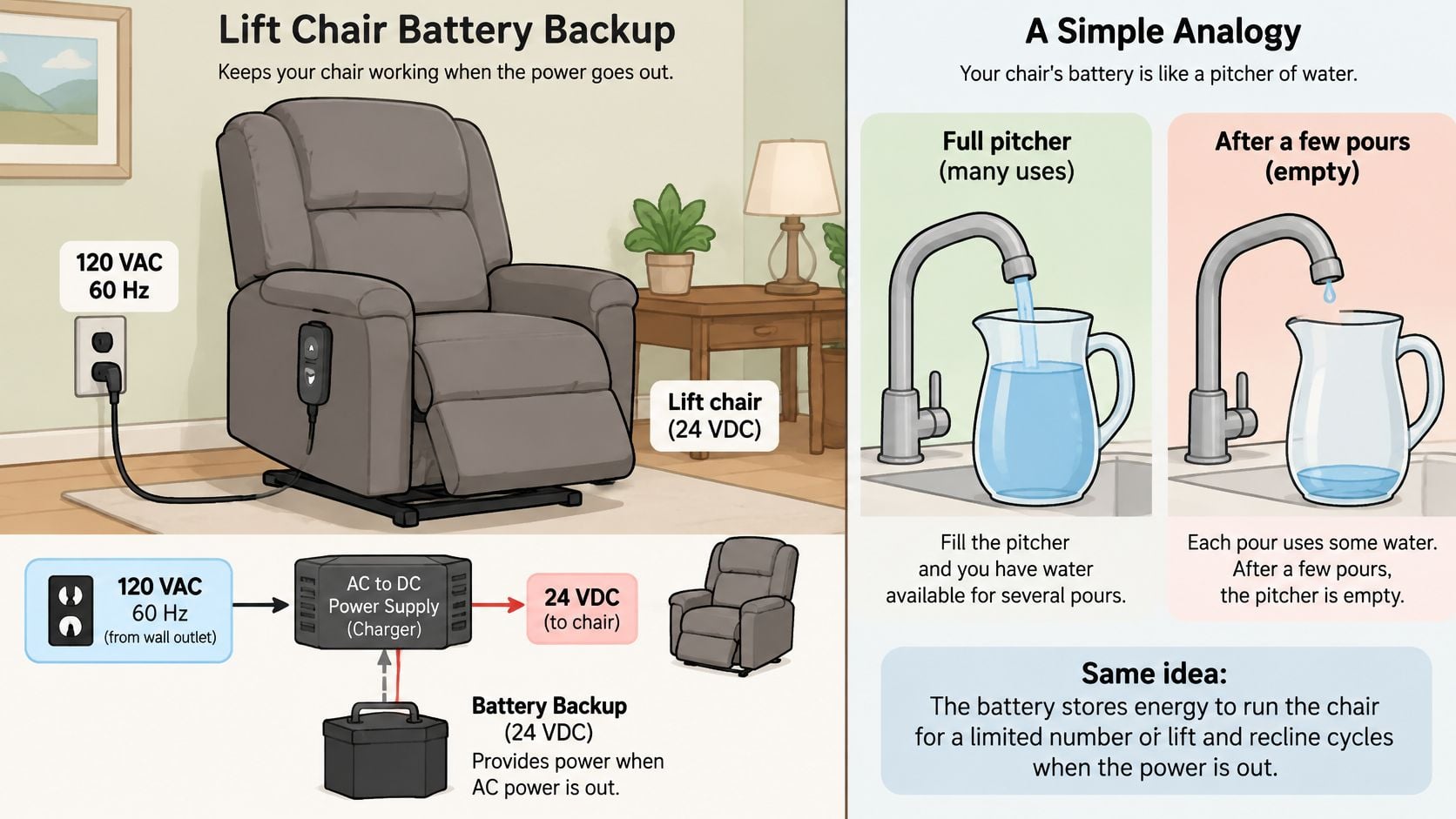
Think of wall power as a kitchen tap and the backup battery as a small pitcher beside the sink. The tap can keep flowing. The pitcher holds a few pours, then it's empty.
That picture explains why lift chairs with battery backup behave so differently from a chair plugged into a live outlet. The battery stores a limited reserve for positioning. It doesn't replace the electrical supply to the home.
The numbers behind one documented system
The technical power-recliner manual specifies 120 VAC, 60 Hz input, a 24 VDC chair supply, and maximum input current of 3.7 A. Its rechargeable backup is rated for approximately 15 recline cycles and requires about 4 hours to recharge, according to that manual.
Those figures describe one class of chair, not every model on a showroom floor. They're still useful because they turn a vague promise into a measurable limit. A shopper can ask whether another chair's count means recline cycles or full lift-to-stand movements.
A plain explanation of how lift chairs work helps here because lift, recline, and footrest extension don't all ask the motor for the same work. Occupant weight also changes energy use, so a published cycle count shouldn't be treated as identical for every body.
An outage in order
- Power drops: Household electricity stops and the motors lose their normal supply.
- Control is held: The user or caregiver presses the hand control with steady pressure instead of tapping it in short starts and stops.
- Reserve drives one job: The battery powers the movement the manual allows, often a return toward upright.
- Extra cycles spend the pitcher: Another recline, lift, or footrest move uses more of the finite reserve.
- Recharging starts again: Once power returns, the chair stays plugged in so the pack can recover.
Steady pressure matters for comfort too. A stop-start transfer can leave sore hips or knees bearing weight at awkward angles. Households managing that kind of soreness sometimes review product pairings for joint discomfort as part of a broader comfort routine, while keeping the chair itself focused on a smooth, planned rise.
Why a weak pack can hide in plain sight
The same manual states that the battery should remain connected while the chair is plugged in because charging is automatic during normal operation. It also warns that allowing charge to fall below 30% can permanently reduce capacity, which is stated in the technical power-recliner manual guidance summarized here.
That creates a confusing failure. The chair may recline normally on wall power for months while its emergency reserve slowly shrinks. When the outage arrives, the backup looks broken even though the everyday motor still works.
Practical rule: Leave a rechargeable lift chair plugged in during normal use unless the manual for that model says otherwise.
Why Outage Safety Changes the Chair
A lift chair doesn't sit in isolation during a storm. It sits in a household that may also need light, a charged phone, food, water, and a person who can help if a transfer goes slowly.
That's why outage safety changes how the chair should be chosen. The battery is one small part of readiness, not the plan by itself.
What older households reported
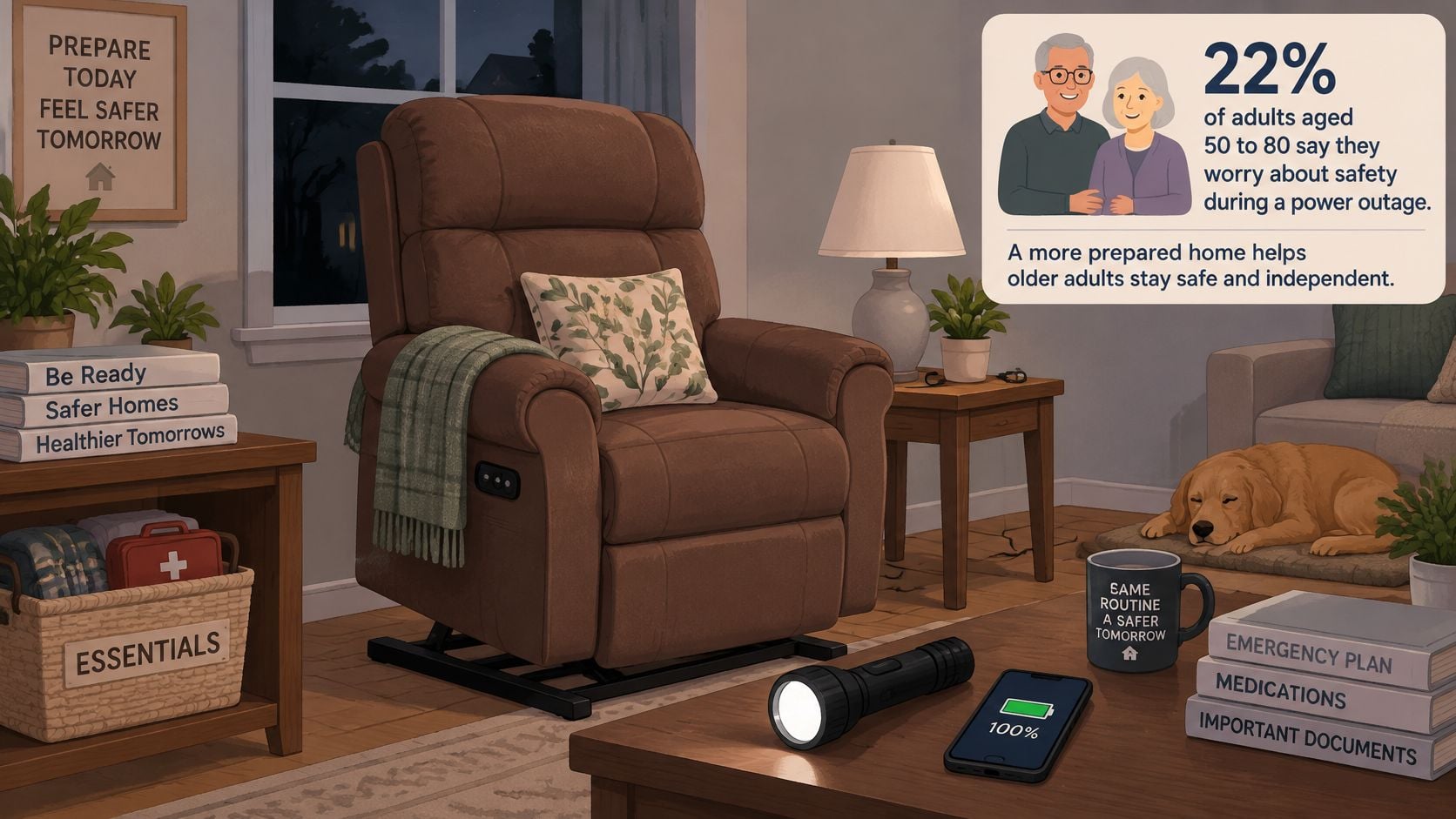
The University of Michigan National Poll on Healthy Aging report found that 22% of adults aged 50 to 80 said they had experienced an emergency or disaster during the previous year, including a power outage lasting more than one day. The same report found 73% reported experiencing at least one such event during their lifetime.
Supplies were uneven in that poll. It reported 55% kept a seven-day supply of food and water, 45% had a portable battery or solar cellphone charger, 43% had a battery-powered or hand-crank radio, 29% had a stocked emergency kit, and 27% had a generator.
Confidence ran ahead of equipment for many households. The report found 69% felt very confident they could care for themselves and their families during an outage lasting more than a day, even though generator ownership and stocked kits were far less common.
Confidence is lower when mobility equipment is involved
A separate 2020 nationally representative survey published in PMC covered 2,256 U.S. adults aged 50 to 80 and found mobility-aid use was associated with lower confidence in handling a power outage lasting more than 24 hours, with an odds ratio of 0.65 and a 95% confidence interval of 0.45 to 0.93. The same study found electricity-dependent equipment use was associated with lower confidence, with an adjusted odds ratio of 0.66 and a 95% confidence interval of 0.47 to 0.94.
Those findings don't measure lift-chair ownership specifically. They do point to a real gap for neighbors in Norwich, New London, Plainfield, and Waterford who depend on powered help to stand. Families reviewing home safety adaptations for aging parents can place the chair alongside lighting, communication, and caregiver access rather than treating it as a stand-alone fix.
The practical reading is calm and simple. Many homes won't have a generator when the lights go out, so the chair battery should be planned as continuity for essential movement. A phone within reach, a named helper, and a longer power strategy still belong in the household plan.
Specs That Separate a Real Backup
Two chairs can carry the same battery-backup label and offer very different exits. One creeps toward semi-upright. Another completes a fuller rise from recline.
A floor checklist prevents that label from doing all the talking. Each question below needs a written answer beside the model name before price enters the conversation.
Backup specs to verify before you buy
| Question to ask | Pass standard | Red flag |
|---|---|---|
| Which movement works in an outage? | Rise from full recline, or a stated return to upright | Only the words battery included |
| How many cycles? | A stated count, labeled lift or recline | No number at all |
| How does it recharge? | Automatic while plugged in; about 4 hours in the documented class | Disposable cells with no replacement plan |
| What if charge runs low? | Guidance that under 30 percent can cut capacity | No low-charge warning |
| Do comfort features stay on? | Heat, massage, and USB explicitly on or off | Assumed to keep working |
| Will size and weight fit? | Capacity above the user, with a clear transfer path | Sized only for an average body |
| Can someone else run it? | Caregiver can press and hold the control | Control that is hard to reach |
| Can you see it work? | Outage-style demo before purchase | A checkbox with no demonstration |
Read the cycle count like a contract
A cycle count only helps when the movement is named. A recline cycle, a footrest cycle, and a full lift-to-stand cycle aren't interchangeable, and a heavier occupant can spend the reserve faster.
The roughly 15-cycle example works as a benchmark for asking better questions, not as a promise for every chair. Shoppers reviewing lift chairs for seniors should write down whether the count is recline only or includes the standing transfer the user needs most.
Comfort features belong in a separate column
Heat and massage feel important during a normal evening, so shoppers often assume they'll stay available during an outage. That assumption should never pass without the manual. Unless the maker says otherwise, treat heat, massage, USB ports, and extra motors as off on backup power.
- Movement first: The backup should protect the exit before it protects convenience features.
- Control access counts: A caregiver should be able to reach the control and hold it steadily while standing in a safe spot.
- Room path matters: The chair needs clearance to recline and a stable route for the user after standing.
Weight capacity needs a margin over the user's current weight, not an exact match. Seat width, depth, and height also affect whether feet land flat and whether the lift feels stable. A chair that fits poorly can make a technically working backup hard to use.
Floor question: "Show the backup movement from the position used for sleeping or watching television, not only from upright."
That request separates a real emergency exit from a thin claim. If the answer stays vague, the shopper hasn't learned enough to compare safety.
Brands Worth Sitting In at Gorins
Paper specs narrow the field. Sitting in the chair finishes the lesson.
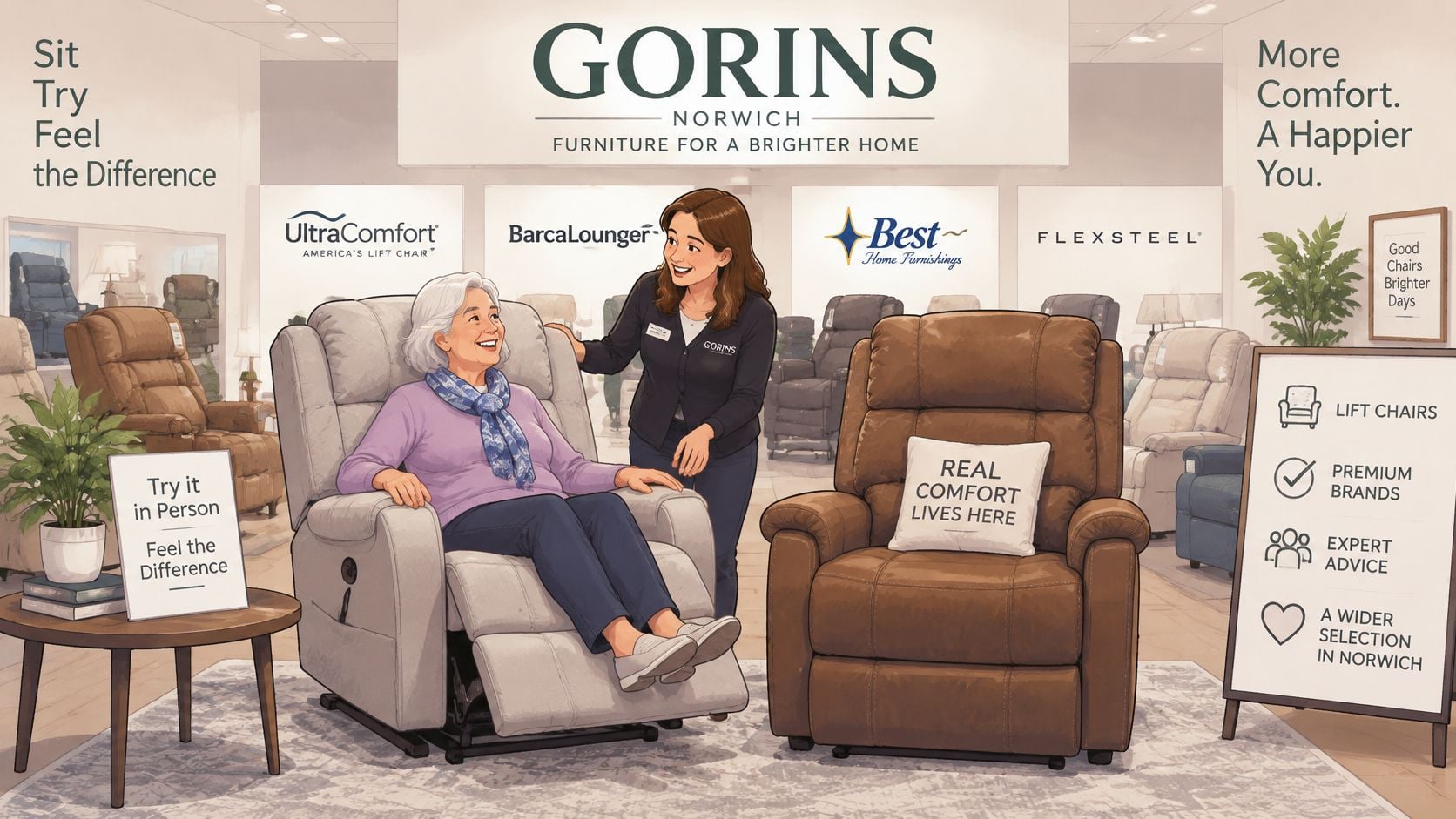
A Norwich shopper can ask for UltraComfort and BarcaLounger specialty lift seating, and also sit in Best Home Furnishings and Flexsteel comfort chairs on the floor. The point isn't collecting brand names. It's running the same tests on each chair so the answers stay comparable.
Test one is the standing transfer
The user should complete a full lift to standing at normal speed. Feet should land securely, arms should have support, and the chair shouldn't tip the user so far forward that balance becomes the next problem.
A caregiver who'll help at home should stand where that help would happen. If the control cord, side table, or chair arm blocks a safe position, the room layout needs attention before delivery day.
Test two is the real resting position
Next, the chair should recline the way the user naps or watches television. A short showroom sit in an upright pose won't reveal pressure behind the knees or a footrest that feels too short.
- Footrest support: Heels and calves should feel supported without a sharp edge behind the legs.
- Lumbar feel: The lower back shouldn't collapse into a hollow when the backrest reclines.
- Seat fit: Hips should sit back fully while feet can still reach the floor in the seated position.
- Exit path: The space in front of the chair should stay clear for standing and turning.
Fabric, cushion feel, and chair size are investment-grade quality decisions because the user may spend long stretches in the same seat. A chair suited to your lifestyle should fit the body first and the room's color palette second.
Test three is the outage explanation
An associate should explain that specific chair's backup in plain terms. Is it a disposable 9-volt exit pack or a built-in rechargeable reserve? Can it rise from fully reclined, how many movements does it claim, and which comfort features switch off?
Say a shopper likes two chairs equally for comfort. One gives a clear outage demonstration and a manual with a stated cycle count. The other offers only a feature tag. The first chair has given the household something it can plan around.
Lift chairs with battery backup shouldn't be ranked by unnamed internet lists when a local sit test can answer fit and exit questions directly. Write each answer beside the model name, then compare only the chairs that passed the standing transfer and the outage explanation.
Financing and Finding One in Eastern CT
Payment comes after fit and backup performance, not before them. A lower monthly number doesn't fix a chair that traps its user in recline.
Gorins Furniture & Mattress offers Promotional Financing through the Nest Credit Card issued by Comenity Capital Bank and partnerships with TD Bank, including no-interest-if-paid-in-full plans and equal monthly payments, subject to credit approval. The calm way to compare those offers is to separate two structures shoppers often blend together.
Equal payments are not deferred interest
A representative furniture-credit disclosure describes a fixed-payment structure with 36 equal monthly payments at a stated promotional APR, with a minimum purchase amount and approved-credit requirement. That structure gives the buyer a set payment count, though the APR and qualifying threshold still depend on the specific offer.
The same disclosure states that no-interest-if-paid-in-full terms can lead to interest charged from the purchase date if the promotional balance is not fully paid by the deadline. It also warns that the required minimum payment may not be enough to eliminate a promotional balance before that deadline.
"No interest" doesn't automatically mean interest disappears no matter when the balance is paid.
Shoppers should read the promotional duration, purchase threshold, APR, and credit approval terms on the offer in front of them. A household comparing lift chair cost and payment options can then judge value and Affordable Luxury by the full obligation, not by the first monthly figure.
Where the chair comes from matters after delivery
The Norwich showroom serves Norwich, New London, Plainfield, Waterford, and surrounding Eastern CT and Rhode Island communities. That local reach matters for Living Room Furniture Eastern CT because a lift chair may need placement help, control instruction, or service after it's in the home.
5-Star Delivery and a local service department give the buyer a place to call if the chair needs adjustment. Readers seeking a lower entry price can ask about current promotional terms and browse clearance for Value without chasing an unnamed discount.
As a Furniture store Norwich CT shoppers can visit in person, Gorins lets the user test the exit before financing is signed. That order, fit first and payment second, protects both safety and budget.
Keep the Backup Ready Then Visit Norwich
A backup that worked on delivery day can fail years later if nobody owns the routine. The fix is a one-page household checklist kept with the manual, not a memory that the chair once had batteries.
Guidance on lift chair battery maintenance from Family CareWise states that common 9-volt systems use non-rechargeable batteries, may need replacement after each use, and can have a roughly six-month replacement interval even when unused. That same guidance supports testing twice yearly, labeling the compartment, and recording the last replacement date.
The twice-yearly backup routine
- Test the movement: Run the outage procedure twice a year so the user and caregiver know what the chair will do.
- Label and date it: Mark the battery compartment and write the replacement date where a helper can find it quickly.
- Store the kit together: Keep the manual, spare batteries if the system uses them, and emergency contacts in one place.
- Keep communication close: Place a phone or alert device within reach of the seated position.
- Rehearse steady pressure: Practice holding the control smoothly for one planned rise.
- Protect rechargeable packs: Keep the chair plugged in during normal operation when the model charges that way.
Proper lift chair installation and setup is also the right moment to confirm cord placement and backup access. A battery compartment blocked by a wall or heavy side table won't help during a stressful outage.
A prolonged outage still needs a separate plan. Backup batteries provide limited operation, and a portable power station should be used only when it's compatible with the chair and approved by the manufacturer. A manual assistance plan remains essential after the first successful rise.
The local next step is straightforward. Visit the Norwich showroom to sit in UltraComfort or BarcaLounger seating and ask for the outage demo, take the online Style Quiz when the whole room is changing, or browse clearance for value-driven savings.
Since 1936, when Samuel and Martha Gorin began the family business, Gorins has operated as a locally owned, family-operated store for Norwich and Eastern CT families. The wider showroom reaches from Canadel Custom Dining and the F9 Custom Sofa series, each with thousands of combinations, to the Sleep Gallery's Tempur-Pedic, Serta, and Beautyrest comfort by feel for healthier sleep.
Visit Gorins Furniture & Mattress to test lift chairs with battery backup in person, ask for the outage demonstration, and compare the exact movement, cycle count, and recharge routine for each model. The Norwich team can help match chair fit, Promotional Financing with equal monthly payments, and 5-Star Delivery to the home's safety plan.