Best Mattress for Adjustable Base: Expert Picks 2026


A lot of neighbors in Norwich reach the same point the same way. The adjustable base is already picked out, the delivery date is close, and then the main question shows up. What mattress works effectively on it?
That question matters more than most shoppers expect. A mattress for adjustable base use has to do more than feel comfortable in a flat position. It has to bend, recover, support the body at changing angles, and keep doing that night after night without fighting the frame underneath.
That's where a little expert guidance saves a lot of frustration. Since 1936, this locally owned, family-operated business has helped Eastern CT families make smart home investments with less guesswork. In the sleep category, that means translating showroom comfort into practical decisions about healthier sleep, long-term durability, and the kind of fit that's suited to your lifestyle.
Table of Contents
- Upgrading Your Sleep with an Adjustable Base
- Understanding Mattress and Base Compatibility
- Mattress Thickness Firmness and Construction
- Memory Foam vs Latex vs Hybrid Mattresses
- The Split King Question What Couples Need to Know
- Expert Guidance and Financing in Norwich
Upgrading Your Sleep with an Adjustable Base
A common scenario looks like this. A homeowner finally decides to move beyond a flat bed because reading in bed is uncomfortable, snoring has become an issue, or mornings start with a stiff back. The adjustable base solves one problem right away, but it creates another. The old mattress may not be built to move with it.
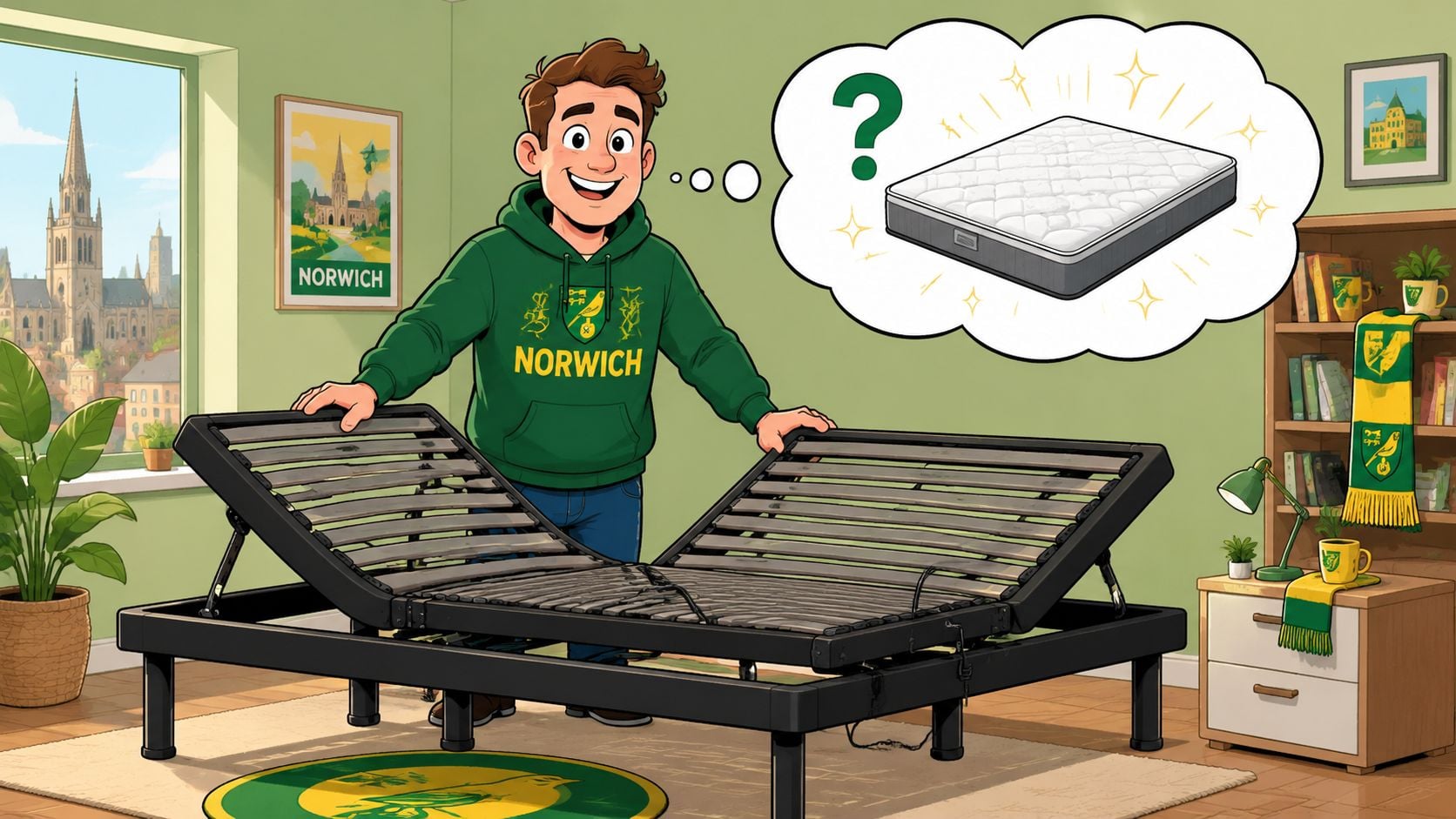
That's why this purchase works best as a system, not as two unrelated pieces. The frame changes position, so the mattress has to follow those curves without bunching, cracking, or lifting away from the surface. Shoppers who want a quick overview of common adjustable base benefits often start with comfort features, but the mattress decision is what determines whether those features feel good every night.
The category keeps growing because more households are looking for that kind of customized rest. The adjustable bed market is growing rapidly, with queen sizes accounting for nearly 40% of the market in 2025, according to adjustable bed market research from Mordor Intelligence. That trend reflects a simple reality. People want more control over how they sleep.
What makes shoppers nervous at first
Most shoppers worry they'll buy the wrong thing and ruin the base, void the mattress warranty, or end up with a bed that feels awkward once the head or feet rise. That concern is understandable, but it's usually manageable.
An adjustable frame is a motorized foundation, not the mattress itself, and approximately 90% of modern mattresses work with adjustable bases when the construction is suitable, as noted in this adjustable bed FAQ from Mattress Firm. That broad compatibility gives shoppers a strong starting point, especially when they're choosing among current foam, latex, and many hybrid designs.
A good adjustable setup shouldn't feel complicated in daily use. It should feel natural the first night and dependable years later.
For anyone comparing features, sizes, and compatible sleep surfaces, the available adjustable bed base options help narrow the field before stepping into the showroom.
Why in-person testing still matters
Specs matter, but feel still matters too. The Sleep Gallery approach centers on comfort by feel because two mattresses can both be compatible and still feel completely different once adjusted. One may cradle the shoulders better in a reading position. Another may feel steadier under the lower back with the feet raised.
That's where local guidance becomes useful. Our neighbors in Norwich, Plainfield, New London, and Waterford don't just need a mattress that bends. They need one that supports how they sleep.
Understanding Mattress and Base Compatibility
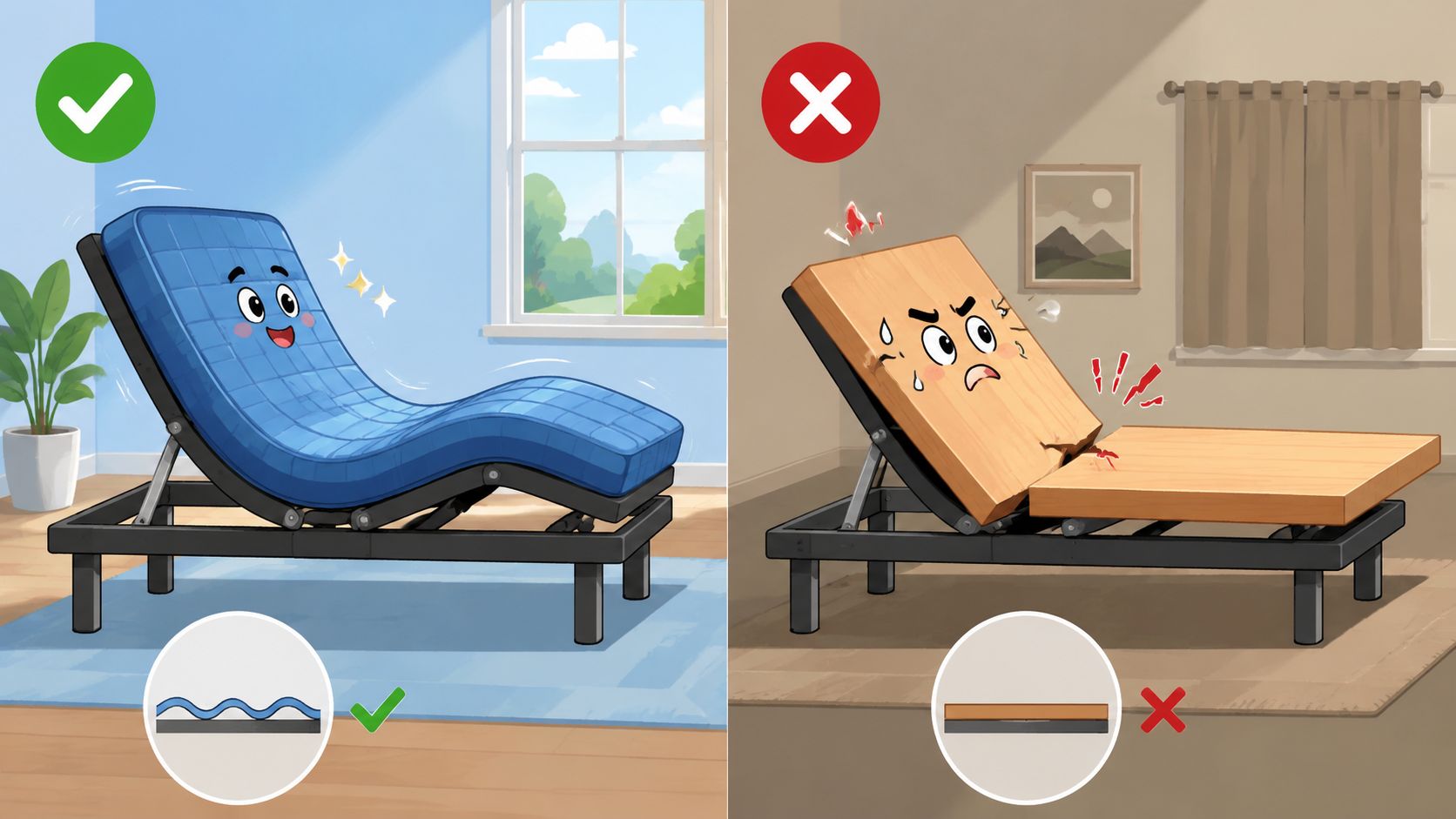
A simple way to understand compatibility is to compare two objects. A rubber mat bends with the surface under it. A wood board resists movement and leaves gaps. A mattress for adjustable base use needs to behave much more like the rubber mat.
Why flexibility matters
The head and foot sections of an adjustable base create hinge points. When the base rises, the mattress has to bend smoothly at those points. If it can't, the mattress may bridge, which means it lifts away from the frame contour and leaves empty space beneath part of the body.
That gap changes how the bed feels. Pressure relief gets worse. Support becomes uneven. Over time, the internal materials may wear in the wrong places because the mattress is fighting the frame instead of moving with it.
Industry experts confirm that most memory foam, latex, and hybrid mattresses are compatible with adjustable bases because they're flexible, while traditional innerspring models are generally not recommended because their rigidity can lead to damage and uneven support, as explained in Sleep Number's adjustable bed frame guide.
A simple compatibility checklist
When shoppers want to quickly screen a mattress, these questions help:
- Can it bend cleanly at the head and foot sections? If the mattress resists movement, it's a warning sign.
- Does the build rely on rigid interconnected coils? Traditional innerspring systems often struggle here.
- Does the profile look overly tall or stiff? Thick, rigid builds can create lifting and poor contouring.
- Is it designed as a non-flip mattress? Fixed-orientation models usually make more sense for adjustable use.
- If it's a hybrid, are the coils individually wrapped? Independent movement matters.
Practical rule: Compatibility isn't only about mattress category. It's about whether the inside of the mattress can flex repeatedly without stress damage.
One area where shoppers often get confused is thickness versus true support. A taller mattress can look more luxurious on the floor, but that doesn't guarantee better performance on a moving base. A quick look at mattress thickness comparisons helps translate showroom appearance into real-world adjustability.
What usually goes wrong
A mattress can feel fine lying flat in a store and still perform poorly on an adjustable frame at home. That happens when the comfort layers feel soft on top, but the deeper support core is too rigid to articulate.
Shoppers can avoid that mistake by asking one direct question before buying. Was this mattress built to flex on an adjustable base without damaging its internal structure? That answer matters more than a generic label like plush or firm.
Mattress Thickness Firmness and Construction
Most shopping mistakes happen in three places. The mattress is too thick, too stiff in the wrong way, or built with materials that don't move independently. That's why these details deserve more attention than brand slogans or showroom first impressions.
Thickness is the first filter
Thickness affects how well a mattress follows the base shape. Too thin, and the bed may not provide enough support over time. Too thick, and the mattress may resist bending at the hinge points.
The safest working range is usually 8 to 12 inches. A profile in the 10 to 12 inch range often gives the strongest balance of support and flexibility. Mattresses above 14 inches often lack the pliability needed to contour cleanly, which can lead to bridging and internal stress. For adjustable bed frames, the ideal thickness also falls in the 8 to 12 inch range, with thicker models often flexing less effectively, according to the National Council on Aging's adjustable bed guide.
Firmness changes how the mattress moves
Firmness isn't just about comfort preference. It also affects how the sleep surface responds when the base lifts.
A mattress can be supportive without feeling board-stiff. That distinction matters. Some firm models still articulate well because the materials are elastic and layered properly. Other mattresses feel supportive in the center but become resistant at the bends because the core is dense and rigid.
A useful way to think about it is this:
- Soft models can contour easily, but support has to stay stable when the base changes angle.
- Medium feels often balance body cushioning with easier movement on the frame.
- Very rigid builds can reduce contouring and make the base work harder than it should.
Construction decides long-term performance
Construction is where “compatible” becomes “worth owning.” For a hybrid mattress to work on an adjustable base, it must use pocketed coils that flex independently. The mattress should be able to bend 45 degrees without damage, and the ideal thickness is 10 to 12 inches to balance support and flexibility.
That coil detail matters more than many shoppers realize. A hybrid with individually wrapped coils can articulate smoothly because each spring responds on its own. A traditional continuous wire unit acts more like a connected grid. It resists movement, transfers stress through the structure, and can shorten the useful life of the mattress on a movable base.
In practical showroom terms, that's why construction quality matters with brands such as Beautyrest and Serta. A hybrid may look similar from the outside, but the inside determines whether it behaves like an investment-grade mattress or a short-term compromise.
The phrase “hybrid mattress” isn't enough by itself. The shopper still needs to know what kind of coil system sits inside.
Quick decision guide
For a mattress for adjustable base use, this short test helps narrow the field:
- Start with profile. Eliminate anything obviously too tall or too thin.
- Check the support core. Foam, latex, or pocketed coils usually make more sense than rigid wire grids.
- Ask about bend tolerance. If the mattress can't handle repeated articulation, it's the wrong match.
- Lie on it with elevation. Flat comfort doesn't tell the whole story.
The same principle shows up across other furniture categories too. Customized fit beats generic fit. It's the same reason custom programs like Canadel Custom Dining and the F9 Custom Sofa series matter in the showroom. Thousands of combinations are possible because the right fit changes how a product performs in everyday life.
Memory Foam vs Latex vs Hybrid Mattresses
Once compatibility is clear, shoppers usually narrow the choice to three categories. Memory foam, latex, and hybrid mattresses all can work well on an adjustable base, but they feel and respond differently.
How each type behaves on an adjustable base
Memory foam usually offers the most body-contouring feel of the three. It handles articulation well because the material compresses and rebounds without relying on rigid internal parts. That makes it especially appealing for people who want pressure relief around the shoulders, hips, and lower back. In the Sleep Gallery, this is one reason many shoppers gravitate toward Tempur-Pedic.
Density matters here. To improve durability on an adjustable base, a memory foam mattress should use a comfort layer density of at least 3.5 pounds per cubic foot and base foam density of at least 2 pounds per cubic foot to reduce premature sagging at the bend points, according to this adjustable mattress buying guide.
Latex feels different. It's responsive rather than slow-moving, and many sleepers like that lighter, more buoyant sensation when the base changes position. Latex also tends to spring back quickly, which can make repositioning easier during the night. For shoppers who dislike the deeper “hug” of memory foam, latex often feels more natural.
Hybrid mattresses combine foam comfort with coil support. On adjustable bases, they work well when the coil system is built correctly. That means individually wrapped coils, not a rigid connected unit. For many households, a well-made hybrid offers a middle ground. It can feel easier to move on than memory foam while still giving better pressure relief than a very traditional spring feel. This is often where shoppers start exploring premium hybrid options such as Stearns & Foster.
For readers who want a broader plain-language overview before narrowing down features, this outside guide to mattress types is a useful companion. A more focused look at what a hybrid mattress is helps connect the category to adjustable-base shopping.
Some sleepers choose by feel first and construction second. For adjustable bases, the better order is the reverse. Start with compatible construction, then choose the feel that suits the body.
Mattress Type Comparison for Adjustable Bases
| Mattress Type | Flexibility | Pressure Relief | Durability | Best For… |
|---|---|---|---|---|
| Memory Foam | High | Excellent | Strong when foam density is appropriate | Sleepers who want close contouring and reduced pressure at raised angles |
| Latex | High | Very good | Known for resilient performance | Sleepers who want responsiveness and easier movement on the surface |
| Hybrid | Moderate to high when built with pocketed coils | Very good | Strong when coil design is adjustable-friendly | Shoppers who want foam comfort with a more supportive, balanced feel |
A practical way to choose among them
A sleeper who spends time reading or watching television in bed may prefer a foam-forward model that cushions the lower back and shoulders in a raised posture. A sleeper who changes positions often may prefer the quicker response of latex or a responsive hybrid. A couple with different preferences may lean hybrid if one partner wants support and the other wants pressure relief.
That's why “best” is the wrong word in a showroom. The better question is which material fits the body, sleep style, and adjustable use pattern.
The Split King Question What Couples Need to Know
Couples often assume one king mattress is the simplest answer. On a flat foundation, that logic works. On an adjustable setup with independent movement, it can create a comfort problem right down the middle.

Why one mattress can become a problem
When one side of a dual-adjustable base rises and the other stays flatter, a single mattress has to bend in two different ways at once. That can create a center hinge effect or a gap sensation that neither person notices in the store but both notice at home.
A 2025 study found that 41% of couples using a single mattress on an adjustable base reported center gap discomfort and sleep interruptions. That problem rarely gets enough attention in standard buying guides, even though it affects nightly comfort in a very direct way.
This issue gets more complicated when partners have opposite habits. One may want the head raised for reading. The other may want the feet raised after a long day. A shared one-piece mattress limits those choices because one sleeper's adjustment changes the surface for both.
When a split king makes more sense
A split king uses two Twin XL mattresses side by side. Each side moves independently, which means each sleeper gets personal positioning without distorting the entire bed surface.
That setup tends to make the most sense when:
- Sleep preferences differ. One partner likes a flatter profile, the other wants elevation.
- Body types aren't the same. Different support needs are easier to solve with two mattresses.
- Motion sensitivity matters. Separate surfaces reduce the feeling of someone else's adjustment.
- Comfort complaints have a pattern. If the middle of the bed already feels like a compromise, a split configuration often removes that compromise.
Couples don't need the same mattress to share the same bed. They need two sleep surfaces that work together cleanly.
For households trying to balance two comfort styles, this look at finding a mattress that works for two sleepers helps frame the tradeoffs more clearly.
A split setup isn't mandatory for every couple. But when each side of the base is meant to do something different, it's often the cleaner and more comfortable solution.
Expert Guidance and Financing in Norwich
The technical side of mattress shopping matters because the wrong match can cost money and sleep quality at the same time. A 2025 industry report noted that 34% of adjustable base warranty claims are due to incompatible mattress stiffness from overly thick or rigid mattresses. That's the kind of mistake a short showroom test can help prevent.

What to test in the showroom
The most useful in-person test isn't lying flat for thirty seconds. It's trying the mattress in an inclined position and paying attention to how the body feels at the shoulders, lumbar area, and knees.
A shopper can ask practical questions such as:
- Does the mattress stay in contact with the base as it rises?
- Does the lower back feel supported in a reading position?
- Does the surface feel stable or does it bunch up near the hinge points?
- Is the construction foam, latex, or pocketed-coil hybrid?
This is also where the Norwich showroom experience becomes valuable. Gorins Furniture & Mattress carries adjustable-base-compatible options within a Sleep Gallery that includes Tempur-Pedic, Serta, and Beautyrest, allowing shoppers to compare comfort by feel rather than trying to decode online product descriptions. That same personalized guidance reflects the broader brand philosophy seen across custom programs like Canadel Custom Dining and the F9 Custom Sofa series, where thousands of combinations let shoppers tailor products to the way they live.
Turning a better sleep setup into an affordable investment
A quality mattress and adjustable base can be an investment-grade upgrade, but it doesn't have to feel unreachable. Promotional Financing with equal monthly payments gives families a practical way to spread out the purchase while still choosing the right construction now instead of settling for a poor fit. Financing details are available through Gorins financing options.
Since 1936, this family-operated Norwich business has focused on quality, value, and helpful service for Eastern CT and nearby Rhode Island communities. That local support matters long after purchase, especially when delivery, setup, and fit questions come up.
Since 1936, Gorins Furniture & Mattress has helped Norwich and Eastern CT families create homes they love. From custom-designed Canadel dining sets to the latest in Tempur-Pedic sleep technology, they combine a massive selection with the personalized care only a local, family-owned business can provide. Visit today to experience quality, value, and 5-Star Delivery service.
For neighbors ready to find the right Gorins Furniture & Mattress sleep setup, the next step is simple. Visit the Norwich showroom to test adjustable-friendly mattresses in person, take the online Style Quiz for more personalized guidance, or browse the Clearance section for value-driven savings.