Reclining Sofa with Lumbar Support: A Practical Guide

A Sunday evening in Norwich can expose a sofa's weaknesses quickly. After a long shift, a reader settles in for a second episode, raises the footrest, and expects relief. Instead, the lower back loses contact with the cushions, the pelvis rolls backward, and a dull ache appears before the programme ends.
A reclining sofa with lumbar support should prevent that sequence, but the phrase doesn't guarantee a good fit. The useful question isn't whether a sofa includes a lumbar cushion. It's whether the seat depth, recline angle, and lower-back contact work together for the person sitting in it.
Since 1936, Gorins Furniture & Mattress has helped Norwich and Eastern CT families make practical furnishing decisions through a locally owned, family-operated business. The same showroom approach applies to reclining furniture, from Flexsteel and Best Home Furnishings to BarcaLounger and Craftmaster. Support needs to be felt, tested, and matched to the household's lifestyle.
What a Reclining Sofa With Lumbar Support Really Means
A regular recliner can feel comfortable for a few minutes while upright. The problem often appears as the back tilts. The backrest moves away from the lower spine, the lumbar cushion stops meeting the natural inward curve, and the sitter compensates by rounding the pelvis or sliding forward.
A purpose-built reclining sofa treats the lower back as part of the motion system. Its frame geometry, seat-to-back relationship, and cushioning are designed to keep the lumbar area supported while the torso reclines. That doesn't mean every model suits every body. It means the sofa has been built around a more deliberate support principle.
The difference between extra padding and real support
A loose pillow can fill a gap, but it may shift, flatten, or push the user too far forward. Lumbar-conscious construction places support in the frame or backrest where the lower spine needs it, rather than relying only on a soft accessory.
The seat also matters. If the cushion is too deep, a shorter sitter may not reach the backrest without slouching. If it's too shallow, the thighs lose support and the knees may sit too close to the front edge. A sofa can have generous padding and still fail both tests.
A useful explanation of the mechanism appears in what a power recliner does, especially for shoppers deciding whether powered adjustment offers enough control to justify the added complexity.
The three-part fit problem
A supportive reclining sofa needs three elements to agree:
- Seat depth: The cushion should let the sitter reach the lumbar zone without forcing the knees against the edge.
- Recline angle: The backrest should create a supported posture rather than just flattening the torso backward.
- Lumbar contact: The lower-back support should remain present as the sofa moves from upright to reclined.
Practical rule: A lumbar feature only counts as useful support if it stays in the right place while the sofa moves.
That's why a reclining sofa with lumbar support belongs in its own category. It isn't merely a standard recliner with an extra pillow. It's a coordinated seating system, and the best choice depends on the relationship between the furniture and the person using it.
How Lumbar Support Interacts With Recline Angle
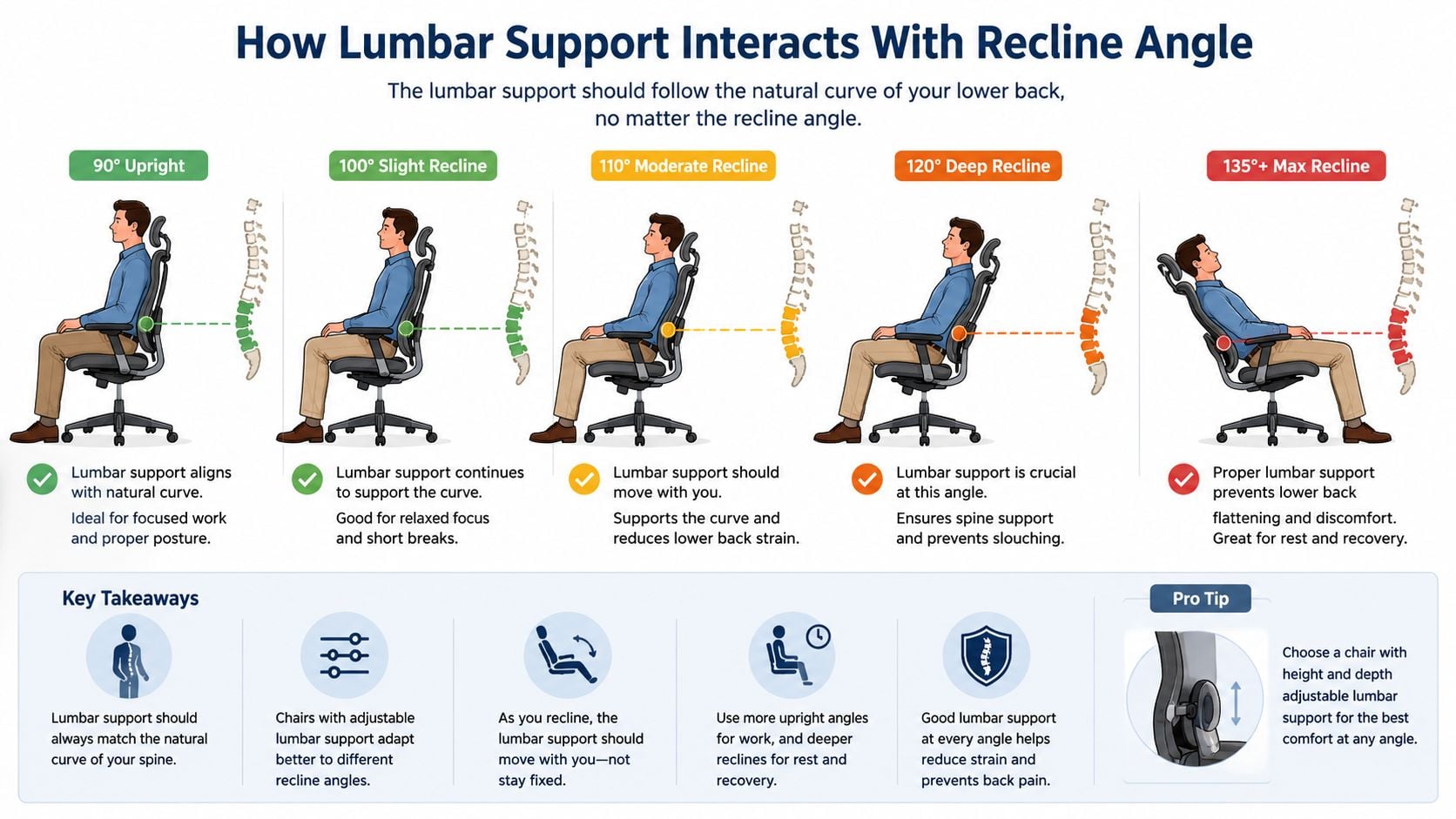
The lumbar region is the lower section of the spine, just above the pelvis. It naturally curves inward, a shape called lordosis. A well-fitted seat doesn't force that curve into a rounded position, but it also shouldn't press aggressively into it.
Reclining changes the way the body shares weight with the sofa. In an upright posture, more load can collect around the seat and the base of the spine. As the torso reclines, the backrest should accept more of the body's weight, provided the lumbar area remains supported.
Ergonomic guidance identifies supported recline angles of about 110° to 130° as a useful comfort range for reducing lumbar disc pressure, back-muscle activity, and discomfort, according to Cornell University ergonomics guidance. The angle alone doesn't solve the problem. The sofa must also fit the user's proportions.
Why the seat pan and backrest must cooperate
When the backrest reclines but the seat remains fixed, the pelvis can slide or rotate backward. The sitter then loses the natural lower-back curve, even if the sofa has a thick lumbar cushion.
A better mechanism coordinates the seat and backrest, allowing the body to settle into the motion instead of making the spine chase the cushions. The footrest should support the legs without pulling the hips forward or causing the pelvis to tuck underneath the torso.
A sofa that supports the lower back at approximately 115° can feel very different from one that only feels supportive near 100°. The difference isn't a matter of marketing language. It changes how the backrest meets the spine and how the body distributes weight.
The distinction between powered and manual movement is covered in power recliner versus manual recliner guidance. Powered controls can make small angle changes easier, but a manual mechanism can still provide excellent support if its geometry matches the sitter.
What to feel during a long sit
A full-film test reveals more than a quick showroom sit. At several positions, the lower back should still feel gently held, without a hollow gap or a hard pressure point. The head, pelvis, and feet should also remain relaxed rather than fighting the mechanism.
A useful reclining sofa doesn't demand constant cushion rearrangement. It gives the sitter a stable supported range, then allows small adjustments when the activity changes from conversation to reading or television.
Engineering Features That Support the Lower Back
A reclining sofa can feel soft and still leave the lower back unsupported. The useful question is mechanical: does the feature change the angle, placement, or pressure between the lower back and the backrest? If it only adds storage, sound, vibration, or extra padding, it may improve convenience or feel without changing lumbar loading.
Research on seating ergonomics found that lumbar support increased lumbar lordosis. Another study reported that a supplementary backrest reduced peak back pressure by 35% and average pressure by 20% compared with a standard chair, as summarized in this PubMed-indexed research. The lesson applies to sofas as well. Cushion thickness matters less than where contact occurs and whether it remains steady as the sitter reclines.
Features with a meaningful mechanical role
A built-in lumbar pillow creates consistent contact when its height matches the sitter's lower back. Its fixed shape can become a limitation if the pillow presses too high, leaves a hollow below it, or loses contact as the backrest changes angle.
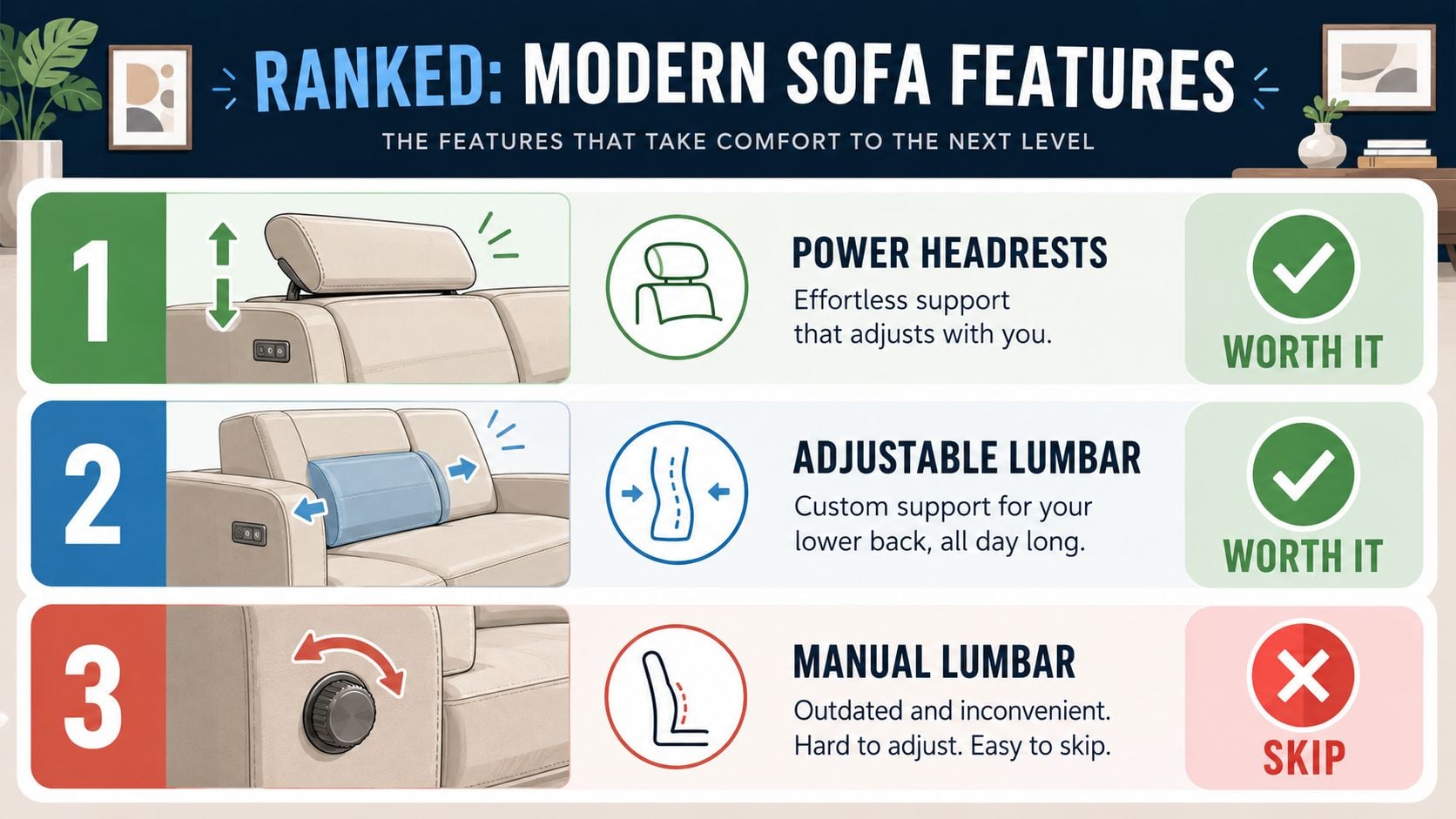
An adjustable lumbar system gives the user more control. A manual knob or power control can increase pressure to fill a gap, then reduce it when the support feels too firm. That adjustability is useful when people with different body shapes share the same sofa.
A power headrest supports the head and neck rather than the lumbar spine. By helping keep the head aligned over the torso during recline, it may reduce the urge to push the chin forward or curl the neck toward the chest.
An articulating footrest also affects lower-back comfort. It supports the legs as the backrest moves, helping the hips remain settled. If the legs rise while the seat geometry pulls the hips forward, the pelvis may tuck and reduce the benefit of the lumbar contact above.
Shoppers refining an office or reading chair can also review setting up your ergonomic chair for practical guidance on positioning and contact points.
| Feature | Impact on Lumbar Loading | Best For |
|---|---|---|
| Built-in lumbar pillow | Adds steady contact, but may not track every body through motion | Sitters who suit the fixed shape |
| Adjustable lumbar tension | Changes pressure and helps fill or reduce the lower-back gap | Households with different body types |
| Power headrest | Supports the head and neck while the torso reclines | Television viewing and reading |
| Articulating footrest | Helps keep the hips and legs supported during movement | Users who recline for longer periods |
| Decorative bolster | Adds visual structure or side comfort, but may not alter lumbar position | Style-led purchases |
| Thin fiber fill | Creates softness without necessarily changing spinal geometry | Cushion feel rather than engineered support |
A pressure-distribution study found that reclining can shift peak pressure away from the sitting bones and toward the back. In the studied seating setup, added lumbar support combined with a femur-upward recline reduced localized ischial stress, as reported in this PubMed research. Coordinated contact matters more than the number of visible features.
For a broader review of mechanism types, materials, and operating choices, the ultimate recliner buying guide can help narrow the showroom shortlist. Prioritize features that maintain lower-back contact across the motion range. Convenience features such as extra buttons or ambient lighting should rank lower.
How Gorins' Featured Brands Approach Lumbar Comfort
Different manufacturers solve the same comfort problem through different motion styles and construction choices. A shopper with a short torso may need a different backrest shape from a taller shopper, while someone who changes positions often may value adjustability more than a fixed cushion profile.
The showroom comparison should focus on how the sofa behaves under the sitter, not only on fabric, colour, or motor count.
Four distinct approaches
Flexsteel uses a Blue Steel spring seat paired with high-resilience foam. That combination is intended to create a resilient seat platform, so the lumbar area continues to receive support as the back reclines. It suits shoppers looking for investment-grade construction and a more structured feel rather than a loose, sink-in seat.
Best Home Furnishings brings a different emphasis. Articulating headrests and a manually adjustable lumbar zone give the sitter a way to fine-tune pressure. This can work well for a household where one person wants noticeable lumbar firmness while another prefers a lighter touch.
Craftmaster builds many recliners around a higher seat back. That dimension can matter for taller shoppers whose lumbar area sits above the point where a shorter backrest's cushion break would land. A higher back doesn't automatically guarantee support, but it can create a more suitable starting geometry for a longer torso.
BarcaLounger leans into power recline and infinite-stop positioning. Instead of restricting the user to a few fixed positions, the mechanism lets the sitter pause where the lower back feels most consistently supported. That approach may suit theatre-style seating users who spend substantial time watching films or programmes.
| Brand | Motion Style | Lumbar Approach | Best For |
|---|---|---|---|
| Flexsteel | Structured power or manual reclining formats | Resilient seat construction with tailored support | Shoppers prioritising durability and controlled cushioning |
| Best Home Furnishings | Adjustable power features and articulating headrests | Manually adjustable lumbar pressure | Users who want to dial in support |
| Craftmaster | Reclining formats with supportive high-back proportions | Higher backrest geometry | Taller sitters needing more back height |
| BarcaLounger | Power recline with fine positioning | Precise angle selection for lumbar contact | Theatre-style use and frequent position changes |
Specific floor models can vary by collection, upholstery, and current availability. The reclining sofa brands guide provides a useful starting point, but an in-person test remains important because a brand's general design approach still has to match the individual body.
A showroom designer can also compare frame feel, cushion response, arm height, headrest position, and the way each mechanism begins and ends its motion. Those details often reveal more than a product label.
Measuring Your Body and Room Before You Shop
A sofa can pass through the front door and still fail the body-fit test. Before visiting a Norwich showroom, shoppers can collect a few measurements that make the first conversation much more productive.
The body routine starts with the current chair. Sit normally, then measure from the seat surface to the base of the neck for torso length. Next, measure from the hip crease to the back of the knee for thigh length. These measurements help indicate whether a seat depth around 20, 22, or 24 inches is likely to support the legs without pushing the sitter away from the lumbar zone.
Body measurements that affect support
- Torso length: A longer torso may need a taller back and a higher lumbar placement.
- Thigh length: This helps identify whether the seat supports the legs without pressing into the knees.
- Seated reach: The sitter should reach the backrest without sliding forward or placing a cushion behind the waist.
- Foot position: In a reclined posture, the feet should meet the footrest without the pelvis tucking underneath.
The numbers are starting points, not a substitute for sitting in the actual sofa. Cushion compression, arm height, back angle, and upholstery feel can change the effective fit.
Room measurements that prevent surprises
Tape the sofa's upright footprint first, then mark the fully reclined path. Wall clearance often falls between 4 and 8 inches, depending on the mechanism, so the back of the sofa should never be measured as though it will remain fixed against the wall.
Doorways, stair landings, tight turns, and lift access all belong in the plan. A sectional can fit the living room beautifully and still fail at a stairwell turn. Guidance on fitting furniture through a doorway offers a useful checklist for measuring the delivery route.
Also check the space in front of the sofa. A reclined back or extended footrest can interfere with a coffee table, side table, walkway, or sightline into the room. The room measurement guide helps Norwich, New London, Plainfield, and Waterford shoppers prepare the layout before selecting upholstery.
Trends Worth Paying For and Trends You Can Skip
A feature-rich reclining sofa may look impressive on a showroom floor, yet more technology doesn't automatically mean better lumbar support. Prioritize features that change body position or preserve lower-back contact. Convenience features can come later.
Features that earn attention
Power articulating headrests can improve neck comfort as the torso reclines. They are useful for television viewing because the head can stay supported without pushing the chin forward.
Genuine adjustable lumbar tension deserves close attention. Increasing or reducing pressure gives the sitter more control than a fixed cushion, as long as the lumbar zone remains aligned with the lower back through the movement range.
Wall-hugger mechanisms can suit compact Norwich rooms. They allow the sofa to recline with limited rear clearance, preserving floor space. The mechanism still needs to protect the three-part fit: suitable seat depth, a comfortable recline angle, and lumbar contact that remains present as the sofa moves. Space-saving design cannot replace a body-fit test.
A zero-gravity preset may feel relaxing, but it is still one preset position. Its usefulness depends on whether the seat depth and support placement suit the person using it.
Features that may be secondary
Built-in massage motors can create a pleasant sensation, but vibration does not reposition the spine or close a lumbar gap. USB ports, cup holders, hidden footrests, heating, and sensor-driven adjustments may improve convenience, yet seat geometry should guide the purchase first.
Recent trend coverage highlights movement toward zero-wall mechanisms, modular layouts, integrated charging, hidden footrests, power recline, heating, massage, and sensor-driven adjustments in recliner design. These features can suit specific lifestyles, but they should not be confused with clinical support.
A reclining sofa can support a comfortable posture, but it should not be marketed or purchased as a guaranteed medical solution. A clinical review also concluded that chair interventions are not recommended for reducing low back pain or discomfort unless stronger evidence changes the picture. That caution belongs in any showroom conversation.
Use this priority order:
- Confirm seat depth and back height.
- Test continuous lumbar contact through movement.
- Choose adjustable lumbar pressure if multiple users need different settings.
- Add headrest or wall-hugger features when they solve a real room or posture issue.
- Treat massage, charging, and storage as lifestyle extras.
Testing a Sofa on the Norwich Showroom Floor
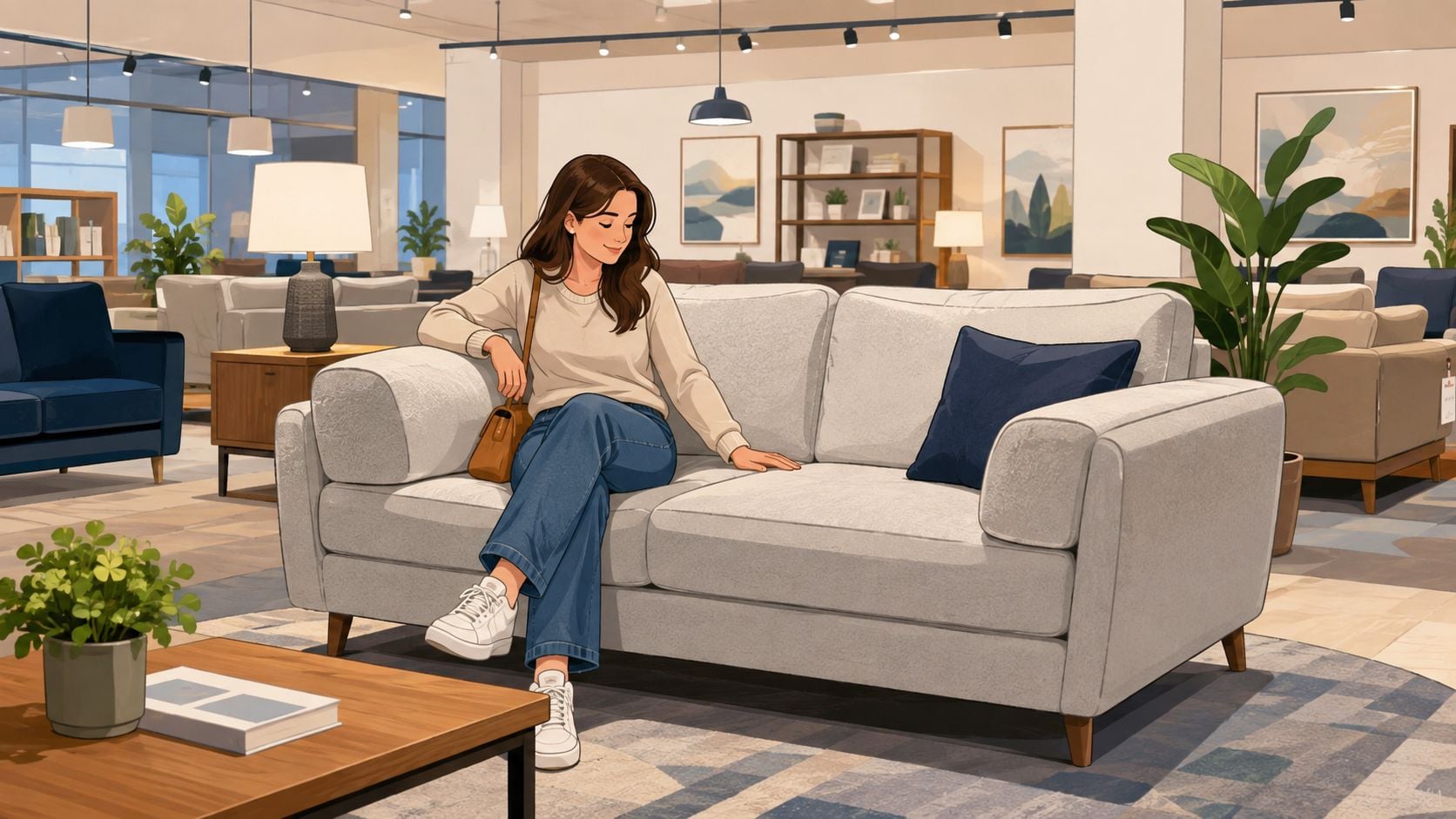
A showroom test should resemble the sofa's real job. A quick sit can reveal appearance and first-touch softness, but it won't show whether lumbar contact disappears halfway through the recline.
The Style Quiz can be started online before the visit. That gives shoppers a narrowed shortlist, so the Norwich showroom appointment can focus on fit rather than scanning every reclining model on the floor.
A practical floor test
- Sit upright first: Place the hips fully against the backrest and check whether the lumbar zone meets the lower spine without a gap.
- Move gradually: Recline through several positions rather than jumping straight to the end. A hand placed behind the lower back can reveal whether support disappears as the sofa moves.
- Check the headrest: The head should rest naturally, without the chin being pushed toward the chest.
- Keep the feet connected: The feet should reach the footrest without the pelvis sliding or tucking forward.
- Stay seated: A sitter should remain in the model for at least three minutes before judging it. Early softness can change as the body settles.
- Listen and observe: The mechanism should move smoothly, while the sofa should remain stable and quiet enough for normal household use.
Gorins staff can answer practical questions about warranty coverage for the reclining mechanism and frame, upholstery options for homes with children or pets, and the in-house delivery radius. Those details matter because moving parts and active households create different ownership demands.
Promotional Financing can also lower the barrier to an investment-grade sofa. Available plans may include equal monthly payments, subject to approval and the terms disclosed at purchase. Promotional financing disclosures commonly require equal payments over a defined term, and the applicable account structure depends on the agreement, as explained in consumer-finance repayment rules. Shoppers can also ask about no-interest promotional periods and lease-to-own alternatives when spreading the cost is part of the household plan.
Bringing It All Together for Better Evenings at Home
The useful test is the evening test. A reclining sofa with lumbar support should make a long film, a post-work pause, a reading session, or a Sunday nap easier on the body without requiring a cushion adjustment every few minutes.
The decision becomes clearer when shoppers rank needs before they shop. If spinal comfort comes first, seat depth, recline geometry, and lumbar contact should lead the shortlist. USB ports, cupholders, hidden footrests, massage, and heating can follow only after the primary fit works.
A simple decision framework
For structured durability, Flexsteel's Blue Steel spring seat and resilient foam approach may appeal to shoppers who prefer controlled cushioning and a precise feel.
For adjustable pressure, Best Home Furnishings offers a useful direction where articulating headrests and manually adjustable lumbar support allow the sitter to change the feel.
For taller bodies and custom upholstery, Craftmaster's higher seat-back proportions and custom-order possibilities may deserve attention. Gorins also offers the F9 Custom Sofa series, with thousands of combinations across details such as arms, backs, welt treatments, and cushion firmness.
For theatre-style positioning, BarcaLounger's power recline and infinite-stop movement can suit households that want to pause at a precise angle rather than choose from limited settings.
The right choice may be a simpler model with a better body fit rather than the sofa with the longest feature list. Research on recline and lumbar support supports that conclusion, while also showing that results depend heavily on body dimensions, posture, and angle, not on the presence of a lumbar label alone.
For broader home planning, Gorins' Canadel Custom Dining partnership also offers thousands of combinations for dining spaces, while the Sleep Gallery includes Tempur-Pedic, Serta, and Beautyrest, with guidance centred on comfort by feel and healthier sleep. Those categories matter when a living room, dining room, and bedroom are being furnished as one project designed for your lifestyle.
The next step is practical. Bring the body and room measurements, complete the Style Quiz, and visit the Norwich showroom with one or two finalists in mind instead of trying to evaluate the entire floor at once.
Since 1936, Gorins Furniture & Mattress has helped Norwich and Eastern CT families create homes they love, with reclining sofas, custom-designed Canadel dining sets, the F9 Custom Sofa series, and a Sleep Gallery featuring Tempur-Pedic, Serta, and Beautyrest. Visit Gorins Furniture & Mattress in Norwich to test lumbar support in person, ask about Promotional Financing with equal monthly payments, and compare value-driven options for Norwich, New London, Plainfield, Waterford, and surrounding Eastern CT and Rhode Island communities.