Custom Dining Chair Cushions: How to Choose and Order


A Sunday dinner in a Norwich home has a way of exposing weak dining cushions. The pads slide toward the floor, the front edge loses its shape, and a fabric that looked smart in the showroom starts showing wear where children, pets, and everyday meals put the most pressure. Replacing the same generic pad rarely fixes the underlying problem.
Custom dining chair cushions work better when the dimensions, foam, fastening method, and upholstery are chosen for the actual chair and the people using it. The right order starts with the seat platform, not a color swatch. It also considers whether the chair is used for a quick meal or a long family gathering, and whether the fabric can handle repeated cleaning.
When a Standard Pad Stops Being Enough
A Norwich-area family hosting Sunday dinner may notice the trouble all at once. Three children and a dog have used the dining chairs daily, and the old cushions now slide, sag, and show worn patches. One pad tapers beyond the front rail, another has torn ties, and the foam feels flat before the meal is finished.
The homeowner has two choices. A replacement from a large retail shelf may be quick, but it can repeat the same mistakes. A made-to-measure cushion can be sized to the seat, filled for regular use, and upholstered in fabric selected for the household rather than chosen only because the color looks right.
The failures that matter
Several problems point toward custom work:
- Poor front-edge support: A cushion that extends or tapers past the seat rail can shift every time someone stands.
- Weak fastening: Ties that tear quickly leave the cushion dependent on friction alone.
- Premature compression: Soft, unsuitable foam can bottom out under a heavier sitter and lose its shape through repeated meals.
- Pilling at the welt: Fabric and welting receive constant contact, especially at the front corners and edges.
- Wrong proportions: Excess thickness can crowd the table, while insufficient thickness leaves the chair hard and unforgiving.
Before ordering, the buyer should ask four practical questions:
- Is the seat square, rectangular, rounded, trapezoidal, or notched around a splat?
- How much thickness can the chair accept without pushing the sitter into the table apron?
- Does the seat have a flat bottom, a recessed centre, or a shaped contour?
- Will people sit for a few minutes, or remain at the table for two hours?
Dining cushions have historically relied on a relatively thin foam profile because dining seating needs support without excessive bulk. Replacement guidance commonly places upholstery foam around 2 to 3 inches, with 1.5 to 2 inches used for firmer chairs and 3 to 4 inches for softer, thicker pads, as outlined by Foam Mill's upholstery guidance. Modern makers also cut cushions in precise increments and pair them with tie-on or non-slip backs, which makes the product closer to fitted upholstery than a generic seat pad.
For homeowners considering care as well as replacement, guidance on when to clean upholstered furniture offers a useful reminder. Fabric maintenance should be planned before the next cushion is ordered, not after spills have already set. The process can begin with Gorins' custom order starting guide, then move to measurements, foam selection, and fabric testing.
Measuring Your Chair the Right Way
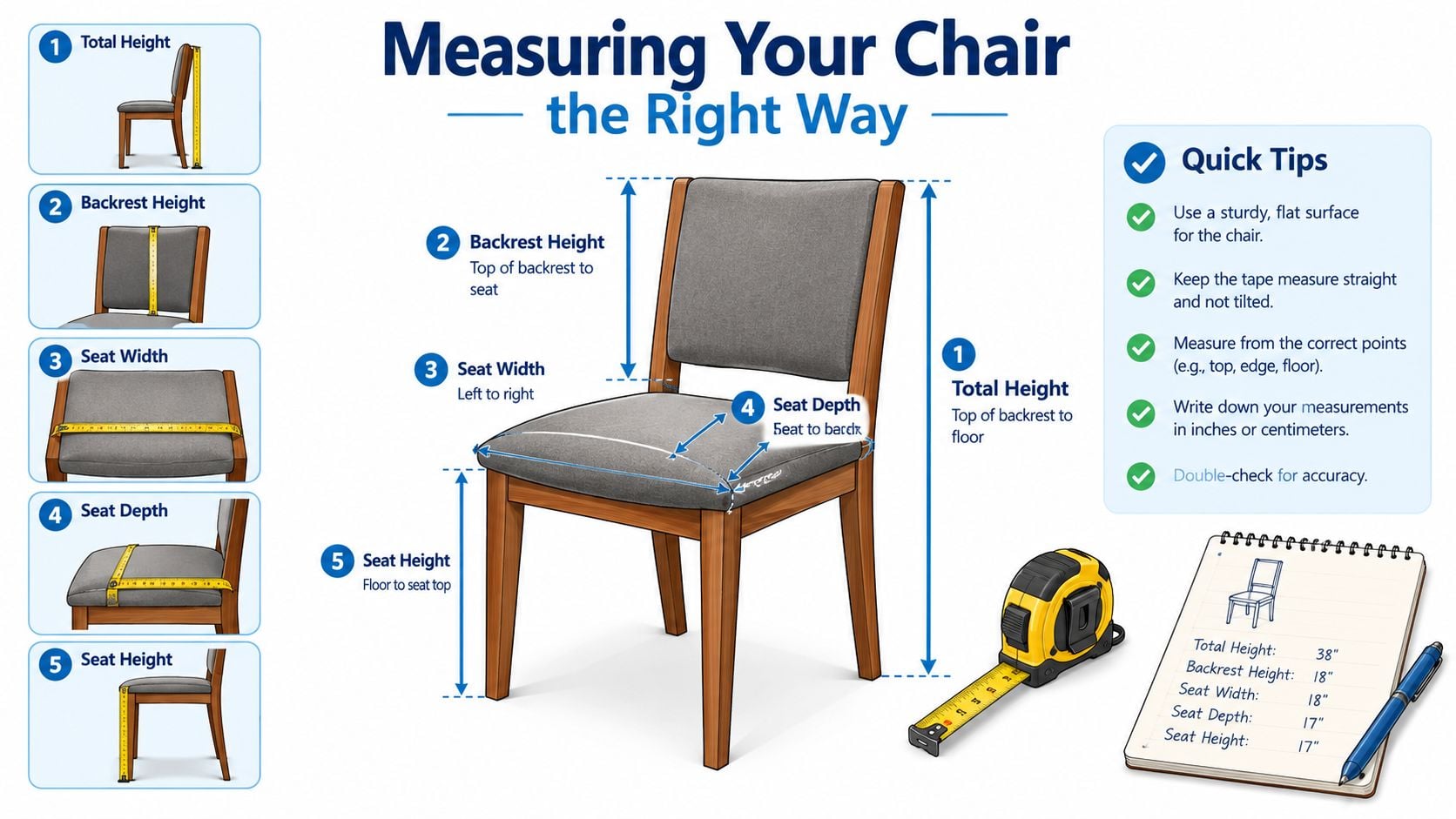
A custom cushion is only as good as the seat information behind it. The old cushion is a poor measuring template because years of use can stretch the cover, compress the foam, and soften the corners.
Measure the seat pan
Place the chair on a level surface and measure the seat pan, not the cushion being replaced.
- Width first: Measure across the widest usable part of the seat, from side to side.
- Depth second: Measure from the front rail to the back rail, following the seat platform rather than the old pad.
- Corner shape last: Record whether the front corners are square, rounded, angled, or interrupted by a splat or post.
Made-to-measure cushions commonly vary across dimensions, shape, thickness, and material, with square, rectangular, and trapezoidal forms among the usual choices. Thickness options can include 4 cm, 6 cm, and 8 cm, according to made-to-measure chair cushion specifications. The practical choice depends on the chair frame, the table height, and the desired sitting posture.
Check the shape beneath the cushion
A flat seat pan accepts a straightforward cushion. A bowl-shaped seat, recessed centre, or slight crown needs closer attention because the finished cushion may sit differently from one corner to the next. The fitter should also check whether the cushion must stop inside the frame, overlap a rail slightly, or clear a decorative apron.
Most dining chairs look balanced with a relatively modest cushion profile. A thicker pad can alter how far the sitter reaches toward the table, so the frame should be checked before a plush specification is selected. The goal isn't maximum thickness. It's a cushion that supports the sitter while preserving the chair's proportions.
Photographs help a custom shop confirm the order. A top-down image shows the outline, while a side view reveals the relationship between the seat, table, apron, and desired thickness. Keeping a tape measure visible in both photographs gives the showroom a useful reference alongside the written dimensions. Homeowners can also review Gorins' furniture measuring guidance before taking those images.
Practical rule: Measure every chair individually when the frames appear even slightly different. A matching dining set can still contain small variations in seat shape or rail position.
Choosing Foam Density and Firmness
Dining foam has two separate performance measures. Density, expressed in pounds per cubic foot, indicates how much material is packed into the foam. ILD, or Indentation Load Deflection, describes firmness by measuring the load needed to compress the foam by 25 percent, as explained in the foam density and application guide.
Density affects durability, but it doesn't tell the whole comfort story. Independent upholstery guidance recommends approximately 2.5 to 3.0 lb/ft³ density with 35 to 45 ILD for custom dining chair and bench cushions, with thickness adjusted to the frame depth, according to custom upholstery foam recommendations. That specification is aimed at reducing the familiar pancake effect in seating used every day.
Read the numbers together
The following comparison uses practical categories for discussing options at the showroom. The listed density and ILD bands are editorial decision ranges, not a substitute for the supplier's exact specification sheet.
| Foam Type | Density (lb/ft³) | ILD Range | Best For | Watch Out For |
|---|---|---|---|---|
| Everyday seating foam | 2.5 to 3.0 | 35 to 45 | Daily dining chairs and benches | A very firm feel may not suit a shallow or rigid chair |
| Firmer chair specification | Around 2.5 to 3.0 | 35 to 45 | Larger users or seats needing stronger resistance | Excess firmness can feel unforgiving |
| Layered construction | Base selected for support | Tuned by layer | Support underneath with softer initial contact | The stack must be tested as a complete cushion |
| Softer topper approach | Depends on core | Adjusted through topper | A less rigid first sit | A soft upper layer can't correct an unsuitable core |
A chair used twice a day needs more than a pleasant first impression. High-resilience foam can offer a lively, supportive sit. A memory foam topper may soften the surface, but it can make a dining cushion feel slow to recover and can change how easily the sitter rises. A down-wrapped core offers a relaxed, luxurious feel, yet it needs more maintenance and may not suit a household that wants a firm, consistent platform.
Pressure distribution matters too. Laboratory testing found that re-entrant foam at 2 to 4 lb/ft³ produced lower maximum seating pressure than conventional foams of similar density, while layered constructions performed differently depending on the applied load. The research is available in this seat cushion pressure-distribution study. The useful lesson is simple. Density alone can't guarantee comfort, so a buyer should ask for supplier testing or sit on comparable constructions before approving the specification.
For readers comparing comfort more broadly, Gorins' guidance on how to pick mattress firmness offers a related framework. The same principle applies here: firmness is a feel decision, while density is a durability decision.
Picking a Fabric That Holds Up
A dining cushion's fabric must survive more than visual inspection. The important signals include abrasion resistance, weave tightness, fibre content, cleanability, and moisture management. A beautiful colour won't compensate for a loose weave that pills at the piping or a surface that absorbs every spill.
Double rubs provide a practical starting point. Upholstery guidance places 15,000 to 30,000 double rubs in the light residential range and 30,000 to 60,000 or more in the stronger range for higher-traffic homes, as detailed in this durable upholstery fabric guide. A family dining room with children and pets should generally move toward the higher end rather than treating the minimum as a target.
Match construction to household use
Tight woven performance fabrics usually handle friction and cleaning better than loosely structured decorative cloth. Solution-dyed fibres can help retain colour in a bright breakfast nook, while a treated natural blend may still be suitable when the household accepts more careful cleaning. Printed polyester and bonded constructions require close inspection at seams and welted edges because surface wear can become visible there first.
| Household Type | Minimum Double Rubs | Recommended Fibre | Notes |
|---|---|---|---|
| Occasional dining use | 15,000 | Treated natural blend or durable woven fabric | Prioritise appearance and cleaning instructions |
| Regular family meals | 30,000 | Tight woven performance blend | Check stain response and seam strength |
| Children, pets, and daily spills | 30,000 or more | Performance fabric with strong moisture management | Sample the fabric at the welt and front edge |
| Bright, sunlit dining area | 30,000 or more | Colour-stable solution-dyed construction | Confirm the manufacturer's care requirements |
The fabric should be tested against the existing chair finish before cutting. Place the sample on the seat, then check it under the room's actual lighting rather than relying on showroom lighting alone. The fitter should also confirm grain direction, pattern scale, seam alignment, and whether the chosen welt will create a clean edge around the shape.
A broader cotton linen fabric UK guide can help homeowners understand how natural fibres differ in texture and care. For practical upholstery decisions, the question remains whether the fabric suits the chair's workload. The best-looking sample is not automatically the best dining-room choice.
That matters because upholstery performance includes more than abrasion. Material testing has examined softness, flexibility, heat transfer, thermal resistance, and moisture management across 11 parameters, while separate research has found that padding can support durability, comfort, and air permeability. A cushion should therefore be judged as a complete seating system, not as foam covered in a decorative textile.
The upholstery fabric guide from Gorins provides another useful starting point before a showroom appointment.
Why a Norwich Showroom Matters for Custom Work
Custom dining chair cushions should be treated as an extension of the chair, not as a loose accessory ordered in isolation. A cushion can have attractive fabric and respectable foam yet still sit badly if its template ignores the rails, corner shape, or seat contour.
At a Norwich showroom, the buyer can put the chair and the proposed cushion specification into the same conversation. Gorins Furniture & Mattress offers Canadel Custom Dining programmes where dimensions, finishes, fabrics, and configurations can be selected as part of the order. Furniture customisation platforms can produce thousands of combinations by varying these elements, as described in this parametric furniture configurator overview.
What a hands-on appointment reveals
A showroom visit allows the homeowner to:
- Compare firmness in person: Different foam constructions can be judged under real body weight rather than guessed from a label.
- View fabrics in proper context: Samples can be held against wood finishes and examined under the showroom's varied lighting.
- Confirm edge details: Piping, welt, corner treatment, and fastening choices can be considered alongside the chair shape.
- Coordinate the whole room: A cushion order can be matched to dining tables, chairs, finishes, and future upholstery decisions.
The advantage isn't just convenience. It reduces the risk of ordering a cushion whose thickness crowds the table or whose corners conflict with the chair frame. It also gives the homeowner a place to discuss whether an individual cushion replacement makes sense or whether a coordinated custom dining programme is the more sensible investment.
Financing can be relevant when cushion work is bundled with a new dining set. Equal-monthly-payment promotional financing is commonly structured at 0% APR, with the purchase divided across the promotional term when the account terms are met, according to Synchrony's explanation of promotional financing. Some programmes calculate the payment by dividing the promotional purchase by the number of months and rounding up to the next whole dollar, as explained by CareCredit's equal-payment guidance. Credit approval and offer terms apply, so the written agreement should be read carefully.
For Eastern Connecticut homeowners searching for Custom Dining Norwich, the practical benefit is a decision made with the actual chair, fabric, and seating feel in view. That's a better basis for investment-grade quality than buying by photograph alone.
From Order to Delivery Without Surprises
A well-managed custom order follows a clear sequence. The buyer shouldn't leave the showroom with a vague promise that the cushion will “fit.” The specification needs to be written down, checked, and approved before production begins.
Build the order in stages
Start with the chair. A showroom visit is preferable, but measured photographs can help when the chair can't be transported. The images should show the seat from above and the side, with dimensions visible and any unusual contour clearly identified.
Approve the specification sheet. It should record the exact length, width, corner radius, thickness, foam density, and fabric SKU. If the cushion includes piping, ties, a non-slip backing, or a special notch, those details should appear on the same document rather than remain an informal conversation.
Confirm the financial terms. The buyer should understand the deposit, the remaining balance, the promotional financing conditions if used, and the point at which the order becomes committed. Custom work needs a clearer paper trail because the finished item is made for a particular chair.
Check the production timing. Custom lead times depend on fabric availability and production scheduling, and rush options are limited. The showroom should provide the current expected window rather than rely on a generic promise.
Inspect before the first meal
Delivery is part of the order, not an afterthought. The team should inspect the cushions on arrival, check the covers, confirm the dimensions against the chair, and look for problems with piping, corners, or fastening before the family starts using them. A fit concern is easier to resolve when the cushion is still new and the chair remains unused.
For local households, a coordinated service such as white-glove furniture delivery can help keep the final stage organised. The delivery team can place the cushions correctly, check how they sit on the chair, and flag an issue for the showroom rather than leaving the homeowner to diagnose it alone.

A sensible handover checklist includes:
- Shape: Corners and notches align with the seat frame.
- Thickness: The sitter reaches the table comfortably without excessive forward movement.
- Cover: The fabric sits evenly, with the grain and pattern facing correctly.
- Edges: Welt or piping follows the perimeter without loose sections.
- Movement: Ties or non-slip backing keep the cushion positioned during normal use.
- Comfort: The foam supports the sitter without immediate bottoming-out.
Gorins was founded in 1936 and remains a locally owned, family-operated business serving Norwich, New London, Plainfield, Waterford, and surrounding Eastern Connecticut and Rhode Island communities. Its custom programmes include Canadel Custom Dining and the F9 Custom Sofa series, while the Sleep Gallery covers comfort by feel with brands such as Tempur-Pedic, Serta, and Beautyrest for healthier sleep. Promotional Financing, clearance value, and 5-Star Delivery service are also part of the wider showroom offering.
Gorins Furniture & Mattress can help Norwich-area homeowners measure a chair, select suitable foam and upholstery, and coordinate custom dining pieces through its Canadel programme. Visit Gorins Furniture & Mattress in the Norwich showroom to start the order, take the online Style Quiz for direction, or browse the Clearance section for value-driven savings.