Is a Sectional Better Than a Sofa? a 2026 Guide


A sectional is not automatically better than a sofa; the right choice depends on room size, at least 36 inches of main walking clearance, and whether people need to lounge or stand up easily. More connected seating is useful only when the furniture leaves enough room for everyday life.
The familiar advice that a sectional saves space misses the harder questions. Can the chaise switch sides after a move? Will each module get around the stair landing? Can the person who needs the most support leave a seat without scooting across cushions?
For our neighbors in Norwich and surrounding Eastern Connecticut communities, those answers matter more than a catalog's seat count. A good living room should accommodate the grocery run, the visiting relatives, and the person getting up after a long film, not just look inviting in a photograph.
The Room Verdict
A sectional looks like extra seating until it blocks the path to the kitchen. A sofa looks plain until it leaves every doorway and walking route clear. The room decides which one works.
As a starting point for planning, rooms under 200 square feet tend to suit shallower configurations with a short return, rooms of 200 to 300 square feet can suit a mid-size L, and rooms above 300 square feet accommodate larger chaise or multi-module designs more easily. That same planning logic calls for at least 36 inches of clear walking space, with 42 to 48 inches more comfortable in high-traffic areas.
Which Piece Wins by Situation
| Situation | Better choice | Why it wins |
|---|---|---|
| Room under 200 sq ft | Sofa or short-return sectional | Keeps floor area and the main path open |
| Room of 200 to 300 sq ft with 36 in clearance | Mid-size L-shaped sectional | Adds connected seats without crowding |
| Room above 300 sq ft | Larger chaise or multi-module sectional | Lounge space fits with less crowding |
| Frequent moves or two seating zones | Standard sofa | One piece relocates between walls or rooms |
| Group movie nights in an open room | Sectional with chaise | Continuous seating and a dedicated lounge |
| Limited mobility or hard sit-to-stand | Firmer sofa or shallow modular seat | Easier exit than a deep, soft chaise |
These room-size categories are starting points, not permission slips. A generous room with doorways on opposing walls may have less usable seating space than a smaller room with an uninterrupted corner. The location of the path matters as much as its width.
Seat count alone overstates usable seating. A corner cushion may be a favorite lounging spot but an awkward place for adults who want to sit upright with feet on the floor. Count the places household members would choose, not the cushion divisions.
Measure the Footprint Before Counting Seats
According to the Room Redesign furniture dimensions guide, a standard three-seat sofa commonly measures 83 to 94 inches wide and 33 to 37 inches deep, while a corner sectional may measure 98 to 118 inches along its long side and 37 to 41 inches deep. Those are comparison ranges, not substitutes for the dimensions of a specific model.
A sofa generally occupies a straight run. A sectional extends seating into another direction, so checking only its longest side misses the part most likely to interfere with movement.
For another useful reference, The Decor Mag's living-room guidance describes a typical chaise sectional at approximately 112 by 80 inches and recommends 36 inches beyond the chaise end for passage. That projecting end deserves its own measurement on the floor plan. Tape it on the floor. Walk past it with full hands.
Use painter's tape to outline the outside edges, including arms and the chaise tip. Then walk the room while carrying a laundry basket. Open the nearby door completely, pull out the dining chair beside the living area, and approach the window as someone would to adjust a shade.
Practical rule: Furniture fits only when people can use the room around it. An outline inside the walls isn't enough.
Protect the Routes People Actually Use
The Homes & Gardens living-room layout guide recommends approximately 36 inches for a main walkway, about 30 inches for secondary paths, or 24 inches in constrained situations, plus 14 to 18 inches between seating and a coffee table. A secondary-path allowance should not become an excuse to narrow the household's busiest route.
Keep these different spaces distinct. The gap used to reach a coffee table is not the same as the passage from the front door to the kitchen. A sectional can leave an attractive seating area while forcing everyone else to thread through it.
A practical measuring worksheet should record:
- Room boundaries: Wall lengths, usable corners, radiator covers, and changes in floor level.
- Openings: Door swings, window access, and any passage that must remain unobstructed.
- Furniture envelope: Overall width, depth, chaise projection, arms, and connector allowances.
- Daily access: Outlets, lamps, storage doors, and the route to frequently used seating.
- Carry-in route: Exterior doors, hallway turns, stairs, landings, and the largest individual component.
Popularity does not settle the decision. In its 2024 findings, Consumer Insights Now, reported by Home News Now, found 35% of surveyed consumers planned to purchase a sectional, compared with 22% planning a standard sofa or sofa-chair-loveseat grouping.
Those intentions describe shopping preferences, not a guarantee of fit. Compare the complete furniture envelope, including walking routes, rather than trust the sofa or sectional label.
Seating Depth and Getting Up
A deep seat feels wonderful during a film and frustrating when it is time to stand. Comfort combines settling in, sitting with support, and leaving without a struggle.
Sectionals gather people along connected seating, which suits shared lounging. That shape explains the appeal, but it does not mean every household benefits from the deepest available cushion. Seat count matters less than whether each person can sit supported and exit with ease.
Test the Seat Under a Person's Weight
Compressed seat height is the useful measurement: the height of the seat while someone is sitting on it. Advertised overall height may describe the back, not where the person's hips rest. Gorins' guide to average sofa seat height helps distinguish the measurements that affect everyday sitting.
The person who will use the seat should sit against the back rather than perch at the front edge, then notice whether feet rest comfortably while the back stays supported. Try the normal sit-to-stand movement without relying on momentum. Confirm the arm position and stability suit that person's usual movement.
Test the corner or chaise position, not only the easiest display seat. A firmer, higher-resilience cushion generally preserves usable sitting height better than a very soft lounge cushion. If someone must slide forward repeatedly before standing, the seat is not supporting that task well.
Preserve an Accessible Place in the Group
A 2025 scoping review on interior design and older adults emphasizes clear spatial planning and layouts that accommodate mobility aids, including a 150-centimeter turning radius. That recommendation deserves attention when a chaise occupies the open area beside the seating.
The best lounge seat and the easiest seat to leave don't have to be the same seat.
A modular arrangement may allow a shallower, firmer seat beside the walkway and a deeper lounge module elsewhere. Where standing remains difficult, a suitable recliner or lift chair may deserve the accessible position rather than treating every seat as interchangeable.
Renters should also consider whether the comfortable seat would remain usable after a move. A supportive spot locked into the wrong corner will not help if the next room puts its exit against a wall. Aim for shared seating with a dependable way out, not maximum depth throughout.
Style Flexibility and Modular Layouts
A sofa is a continuous piece that can anchor a wall or float within a room. A sectional combines coordinated units into a more directional arrangement, commonly an L or U. That shape can define a gathering zone, but it also establishes where people face and where they enter.
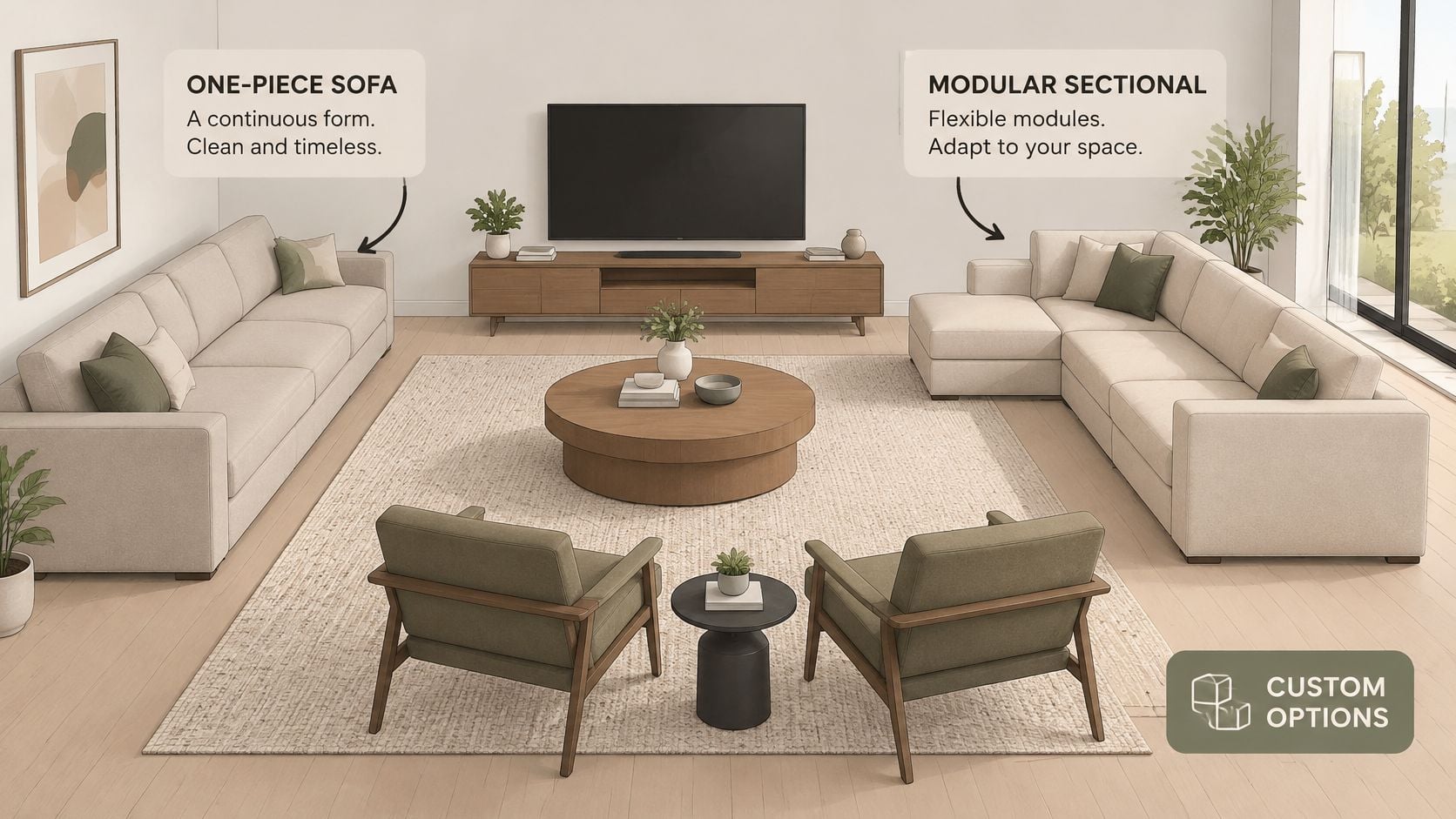
The important distinction isn't sofa versus sectional. It's fixed, reversible, or modular, because those constructions offer different options when the room changes.
Know What Can Actually Move
- Fixed-left or fixed-right: The chaise or return stays on its designated side. A future doorway location can make that orientation impractical.
- Reversible chaise: The lounge position can change sides if the model is designed for it. Buyers should have the change demonstrated, including cushions, base, and finished appearance.
- Modular construction: Separate units can be rearranged or expanded within the system's design. Connectors, finished sides, and compatible components determine which arrangements are possible.
A fixed sectional commits to an orientation. A modular sectional offers choices only where its components and connectors support them.
DataIntelo's sectional-sofa market report projects 7.2% annual growth for modular construction through 2034, compared with 5.5% for L-shaped sectionals. Those are market projections, not evidence that any particular modular design will suit a particular home.
A compact modular arrangement can offer connected seating without committing to an oversized configuration. Still, a sofa plus a movable chair may be more adaptable when the room must serve conversation, television, and occasional guests.
Match the Silhouette to the Building
In an Eastern Connecticut cape, a tall back can compete with low windows. In a condo, oversized rolled arms may occupy space better used for sitting. In an open great room, an exposed sectional back becomes part of the view from adjoining spaces.
Compare arm scale, back height, and visual weight, not just upholstery color. Track arms can produce a more structured outline; rolled arms create a different profile and should be measured at their widest point. Neither style fixes an unsuitable footprint.
Gorins' examples of different ways to arrange a sectional couch can help households sketch alternatives before committing. The useful test is whether another workable layout exists if the television moves or an adjoining area changes function.
Delivery deserves the same scrutiny. Small modules may be easier to handle than a continuous sofa, but a bulky corner unit can still fail at a landing. Obtain component dimensions and plan the turn, not just the doorway opening.
Fabric Wear and True Cost
A Norwich household with two dogs and a sunny south window will wear out fabric faster than a guest room that sits empty most weeks. Construction details like joined frames, cushion support, seam placement and connector hardware explain that difference better than whether the tag says sofa or sectional.
Laboratory abrasion methods include the Wyzenbeek test, reported in double rubs under ASTM D4157, and the Martindale test. Scores describe rubbing resistance in a lab. They do not predict how pet claws, sunlight, clothing hardware or cleaning routines will affect a specific living room.
Compare the Same Performance Specification
Ask for the exact test method and rating in writing, then ask what cleaning code applies to that cover. Fabric weave, protective finishes, light exposure and daily habits all change how long upholstery looks presentable.
A construction comparison should include:
- Frame and suspension: How the frame is joined and what supports the cushions.
- Cushion core: The support material, firmness, wrapping, and replacement options.
- Seams and exposed edges: Particular attention to the chaise edge and frequently used seat fronts.
- Sectional connections: Corner joints, connector hardware, and access for adjustment or replacement.
- Care and warranty: Cleaning code, exclusions, and available service provisions.
Gorins' guide to the best upholstery fabrics gives a starting point for matching material choices to household use. The final choice should fit the actual cleaning routine, not only a pleasing swatch.
For maintenance planning, J.G. Carpet Cleaning LLC's guide to sectional care for Connecticut homeowners is a useful companion resource. Keep any cleaning approach compatible with the upholstery cleaning code and manufacturer directions.
Calculate Value From Usable Seats and Service
A practical cost comparison starts with equivalent specifications. Comparing a basic sofa with a heavily customized sectional does not isolate the value of the layout.
- Match the build. Compare fabric performance, cushion support, frame construction, and warranty terms.
- Divide by usable seats. A corner nobody chooses carries less value than an upright seat used every evening.
- Identify future service costs. Ask whether a worn cushion, damaged connector, or affected upholstery section can be replaced separately.
- Name what the higher price buys. Better joinery, replaceable components, or more suitable support can justify an investment. Size alone does not.
More upholstery and additional connectors create more components to maintain. Replaceability may still prevent a small problem from becoming a whole piece replacement, while softer fill often needs attention sooner when daily users compress the same lounge position repeatedly. The written specification remains the clearest way to compare competing quotes fairly.
Which Piece Fits Your Household
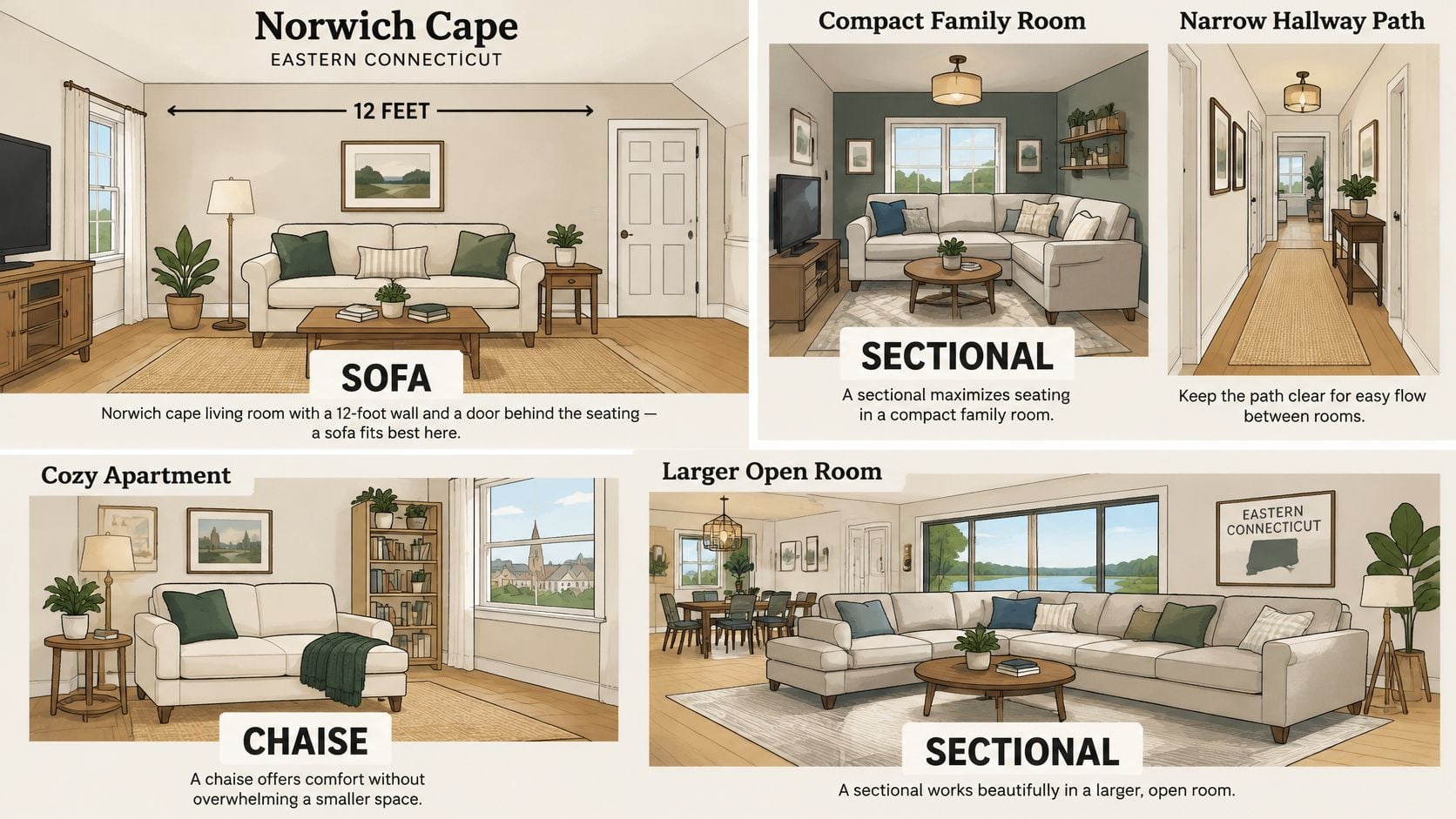
A Norwich cape with the living room door opening behind the seating tells the truth fast. A sofa keeps the path to the kitchen readable. A projecting chaise forces a detour through the conversation, so check how many inches stay open past the chaise tip for daily traffic.
In a New London or Waterford family room built for games and films, an L shape pulls everyone into the same zone. That shape only works when the taped outline still leaves a comfortable main walkway and no regular seat sits at a strained angle to the television.
Rooms That Change With the Calendar
A Plainfield household that hosts holidays, makes room for a tree, and opens a guest bed needs parts that move. A sofa with light accent chairs clears that seasonal footprint with far less effort than a fixed U. Measure with the guest bed fully open, then decide.
A couple that lounges together each evening and rarely rearranges can reasonably choose a chaise sectional. Comfort still depends on exit ease. If the usual upright seat is so deep that feet barely reach the floor, standing becomes a chore.
Add a dog that claims one cushion, and the math shifts again. One washable throw in that spot, plus a firmer neighboring seat that stays easy to get up from, prevents the whole piece from becoming the dog bed. For households balancing children, pets, and visitors, Gorins' guide to choosing kid-friendly and pet-friendly furniture helps connect material selection with daily habits.
Households With Different Physical Needs
In a multigenerational home, place the firmer, supportive seat near the walkway and keep deep lounging farther back. Everyone gathers together, and nobody has to use the same cushion depth.
A household's worst day is a better furniture test than its best-looking photograph.
Moving day, a crowded Sunday, and standing after a long film expose different weaknesses. Seat count matters less than reversibility, a clear delivery path, and a seat you can leave without help.
Measure Then Visit the Norwich Showroom
A sectional looks larger in a showroom than it will in a narrow hallway. Bring the room worksheet from the earlier sections, with the wall length, depth limit and narrowest turn already filled in, and use the visit to test the two decisions that paper cannot settle. Sit down and stand up from each candidate seat without using your hands. Then confirm the delivery path for that exact configuration.
Gorins Furniture & Mattress's step-by-step guide to measuring a room for furniture delivery shows how to record door swings, stair turns and fixed obstructions before you arrive.
Bring a Decision-Ready Checklist
- Reuse the worksheet. Bring the completed wall, depth and walkway numbers rather than remeasuring in the aisle.
- Mark the exit seat. Note which position must stay shallow and firm for easy standing, and test only seats that meet that depth.
- Record the stated maximum component size. Ask for the width and length of the largest sofa section or sectional module and write it next to the narrowest turn on your sketch.
- Write down performance details. Record cushion firmness, cleaning code and connector type for the finalists.
- Compare the complete investment. Evaluate usable seats and expected wear rather than choosing by shape alone.
Make the Showroom Test Personal
Gorins Furniture & Mattress guides customers from start to finish in customizing sofas, chairs, tables, and many other furniture items. Its design quizzes help identify personal style across living room, bedroom, dining room, and home office spaces.

The in-stock inventory covers sofas, sectionals, recliners, loveseats and accent chairs, while custom-order programs allow choices in fabrics, finishes, colors and configurations. Many bedroom, dining, and living room collections offer those options, so a small sofa and a large sectional can be compared in similar materials. For households also considering sleep, the Sleep Gallery includes Tempur-Pedic, Serta, and Beautyrest, with comfort evaluated by feel rather than labels alone.
Visitors can sit and stand in alternatives side by side, then discuss the carry-in plan and delivery service. Promotional financing with equal monthly payments, subject to credit approval, is available for qualifying purchases, and the Clearance section advertises savings of up to 70% off.
Since 1936, Gorins Furniture & Mattress has served Norwich and Eastern Connecticut from its family-owned showroom. Shoppers bring measurements, test seat depth and exit ease in person, and review in-stock and made-to-order choices with staff before deciding.
Gorins Furniture & Mattress offers personalized guidance for comparing sofas, sectionals, and custom configurations designed to each household's layout and comfort needs. A visit to Gorins Furniture & Mattress in Norwich, with room measurements in hand, makes it possible to test the seats and discuss delivery access before choosing. The online Style Quiz offers a starting point, while the Clearance section provides value-driven options for shoppers whose measurements already identify a suitable fit.