Power Reclining Sofa and Loveseat Sets: A Buyer’s Guide


It's a weeknight in a Norwich living room, and the two people on the sofa want different things. One stays upright for the film. The other wants the footrest up after a long day on their feet. A shared manual lever makes that split awkward. Someone leans forward, pulls hard, and often moves both seats at once.
Power reclining sofa and loveseat sets look like the fix. They are, when the motors, the floor plan, and the person who has to stand back up all line up. They aren't, when a low seat, a blocked footrest, or a control out of reach turns a feature list into a daily annoyance.
Homeowners from Norwich, New London, Plainfield, Waterford, and nearby Rhode Island towns hit this mismatch often. The set with the most buttons can be the least usable one for a given person. Run the tests below before anyone pays.
What Power Reclining Means for a Sofa and Loveseat
A power reclining sofa or loveseat uses electric motors to move its backrest and footrest. A button, remote, or console replaces the manual lever. In a matched set, the sofa and loveseat share a coordinated look, but their seats may move together or independently.
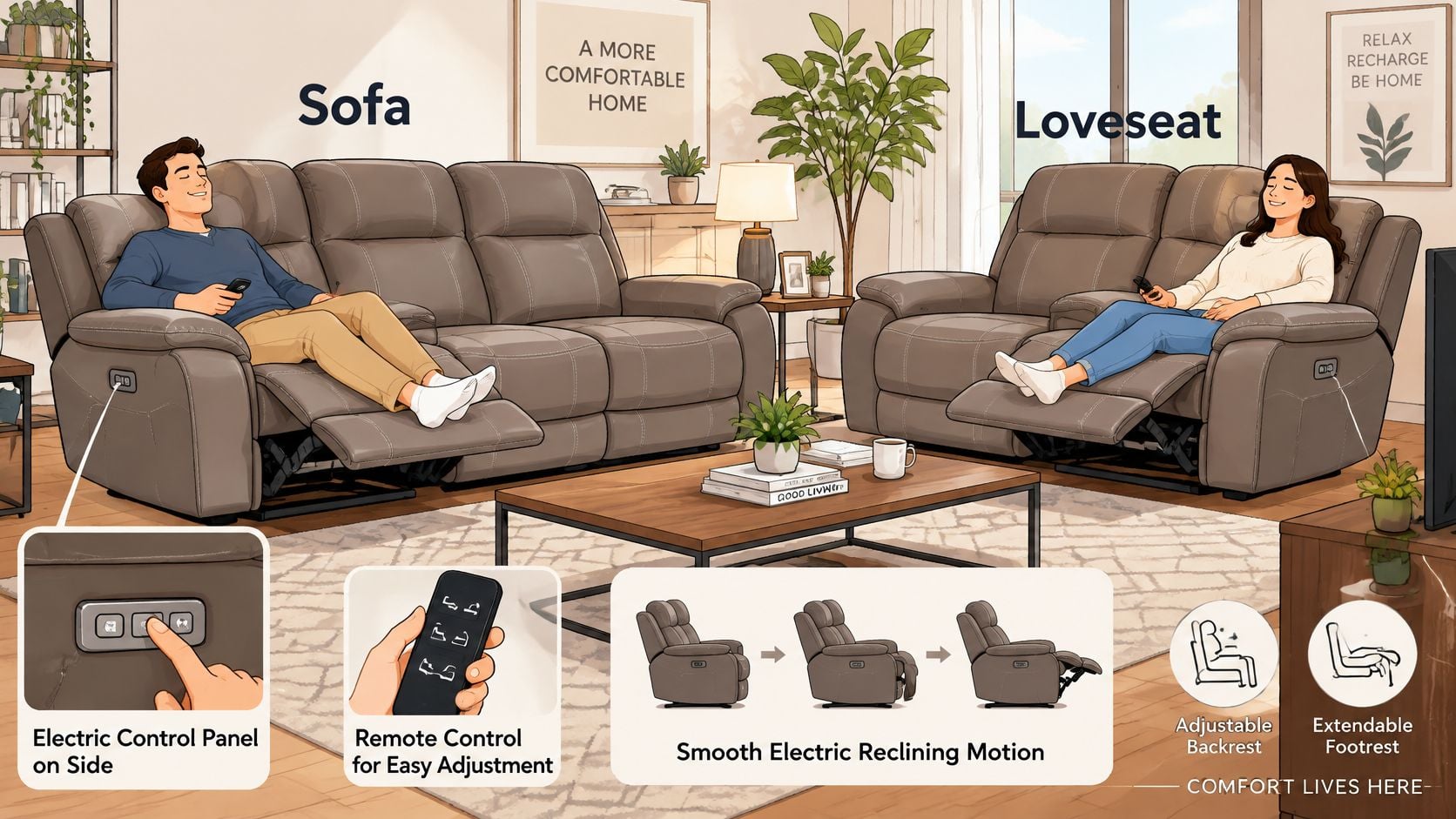
Check how each person gets in and out of the seat, not just how comfortably they recline. Have everyone sit on both pieces and try the controls. A loveseat can feel shorter in the seat or higher at the arm than the sofa beside it, even when the fabric matches. Test whether the arm, seat height, and control position work for the person who will use that spot.
What the carton usually holds
- Sofa and loveseat: two pieces with a coordinated look and motion style.
- Motor layout: one shared motor, or separate motors for reclining seats.
- Control: an arm button, handheld remote, or small console.
- Support add-ons: a power headrest, lumbar support, or both, if the seat is built for them.
Motors change how the seat moves, not why people recline. A person can adjust posture and leg support while sharing a seating group, a practice reflected in The Henry Ford's account of how reclining furniture works.
Gorins Furniture & Mattress is family-owned and has served Norwich since 1936. Visit the showroom to try the sofa and loveseat together, including the controls and the effort required to stand back up. A set with more powered adjustments can still be harder to use if its controls or seating position do not suit the person sitting there.
Motor and Layout Options Compared
| Configuration | How It Moves | Best For | Trade-off |
|---|---|---|---|
| Single motor, shared recline | One motor moves both seats together | Couples who recline at the same time | Both seats move when one is adjusted |
| Dual motor, independent seats | Each seat has its own motor and control | Couples with different comfort needs | More controls and more motors to verify |
| Power headrest or lumbar add-on | Motorized head or lumbar support adjusts separately | Neck, back, or lumbar comfort needs | Extra moving parts to check for safety |
| Wall-hugger power recline | Seat moves forward before it reclines | Rooms where the set sits close to a wall | Needs the manufacturer's clearance and a tested layout |
Single motor, shared recline. One motor drives both seats on the same path. The build is simpler, and the price is usually lower. It suits a household that reclines together for a film and sits upright together afterward. It fails the weeknight split. Press one control and the other person moves too.
Dual motor, independent seats. Each reclining seat has its own motor and its own control. One person can drop into a deep recline while the other stays upright for a laptop. That is the layout most two-person Norwich rooms need. The cost is real. There are more switches, more wiring, and more motors to hear, watch, and warranty. A plain comparison of power recliners versus manual recliners helps before anyone adds a second motor they will not use.
Power headrest or lumbar add-on. These motors move support, not the whole seat. A headrest can meet the back of the head. A lumbar pad can fill the lower back once the footrest is out. They help necks and backs. Each added motor is another part that can rub, stall, or fail, so it belongs on the safety list, not only on the comfort list.
Wall-hugger power recline. The seat slides forward, then the back tilts. The set can sit closer to a wall than a standard power recliner. Tight Norwich parlors and apartments benefit. The mechanism still needs the clearance printed for that model, plus a layout someone has opened fully in the room, not only on a drawing.
USB ports, zero-gravity presets, and under-seat lighting change price and convenience. They don't change the basic motion. Skip them until the motor layout is right.
Three questions pick the row. Do both sitters recline at the same time? Does one seat need a deeper recline than the other? How close will the set sit to a wall? Same-time use points to a shared motor. Different postures point to independent seats. A wall within a few inches points to wall-hugger, and only after the printed clearance is in hand.
Sizing and Room Layout Checks Before You Buy
Measure the room and the walking path before anyone debates fabric. A handsome set that blocks the route to the kitchen is the wrong set.
| Measurement | Target | Why It Matters |
|---|---|---|
| Wall clearance behind a recliner | Manufacturer-specified minimum | Lets the back recline without pinning against the wall |
| Walkway past the set | 30 to 36 in | Keeps traffic moving around the furniture |
| Reclined footprint | Reclined depth from the spec sheet | Shows whether the footrest reaches a wall or table |
| Sofa and loveseat width and depth | Measured separately for each piece | Dimensions vary within a matched set |
| Delivery route | Doorway and stair widths | Confirms each piece can reach the room |
Wall clearance is not a guess. Use the minimum on that model's spec sheet, then add nothing "extra" that steals the walkway. A 30 to 36 inch path past the closed set keeps people moving. The number that surprises buyers is the reclined footprint. The open footrest is deeper than the upright depth, sometimes by a foot or more.
Tape the floor, then open the seat
Lay painter's tape around the upright sofa and loveseat. Recline each seat to the position people will use. Check the tape against walls, the coffee table, and the walkway. In one Norwich living room, the loveseat looked fine until the footrest stopped inches from the coffee table. Upright, the room worked. Open, it didn't.
Practical rule: Record sofa width, sofa depth, loveseat width, and loveseat depth as four numbers. A matched set is not one footprint.
Older homes in New London and Plainfield often have narrow doors and tight stair turns. Measure every doorway and landing on the delivery path, and ask whether the pieces can come in separately. Reclining sofa dimensions are worth reading before the drive, then checked against the tape, not instead of it.
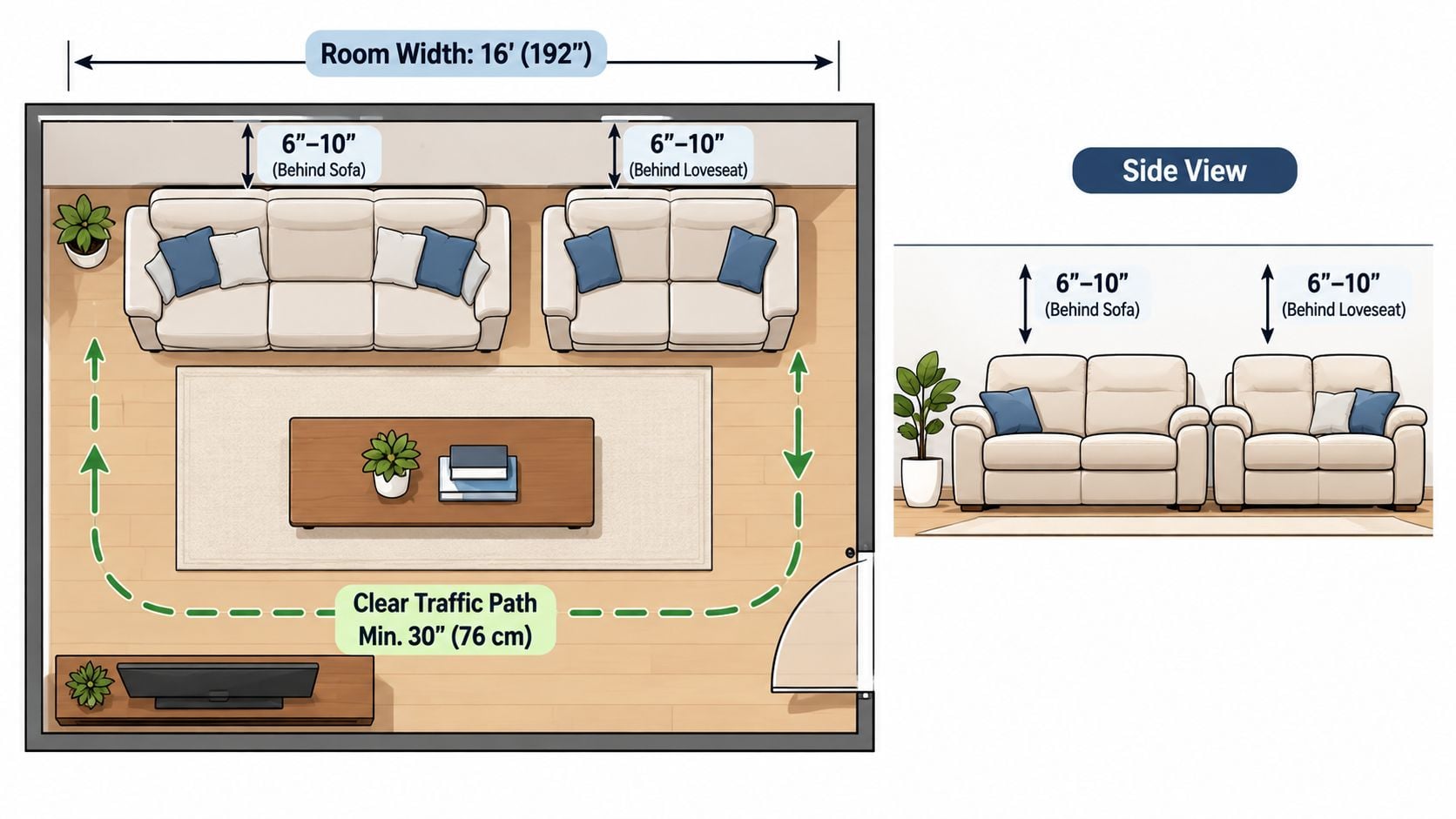
Write these down before a showroom visit. Room width. Wall-to-wall distance on the seating wall. Narrowest door width. Stair or landing width if there is one. The clearance target for each reclining seat, copied from the spec sheet. Those numbers keep the conversation about fit.
Testing the Recline Angle for Real Comfort
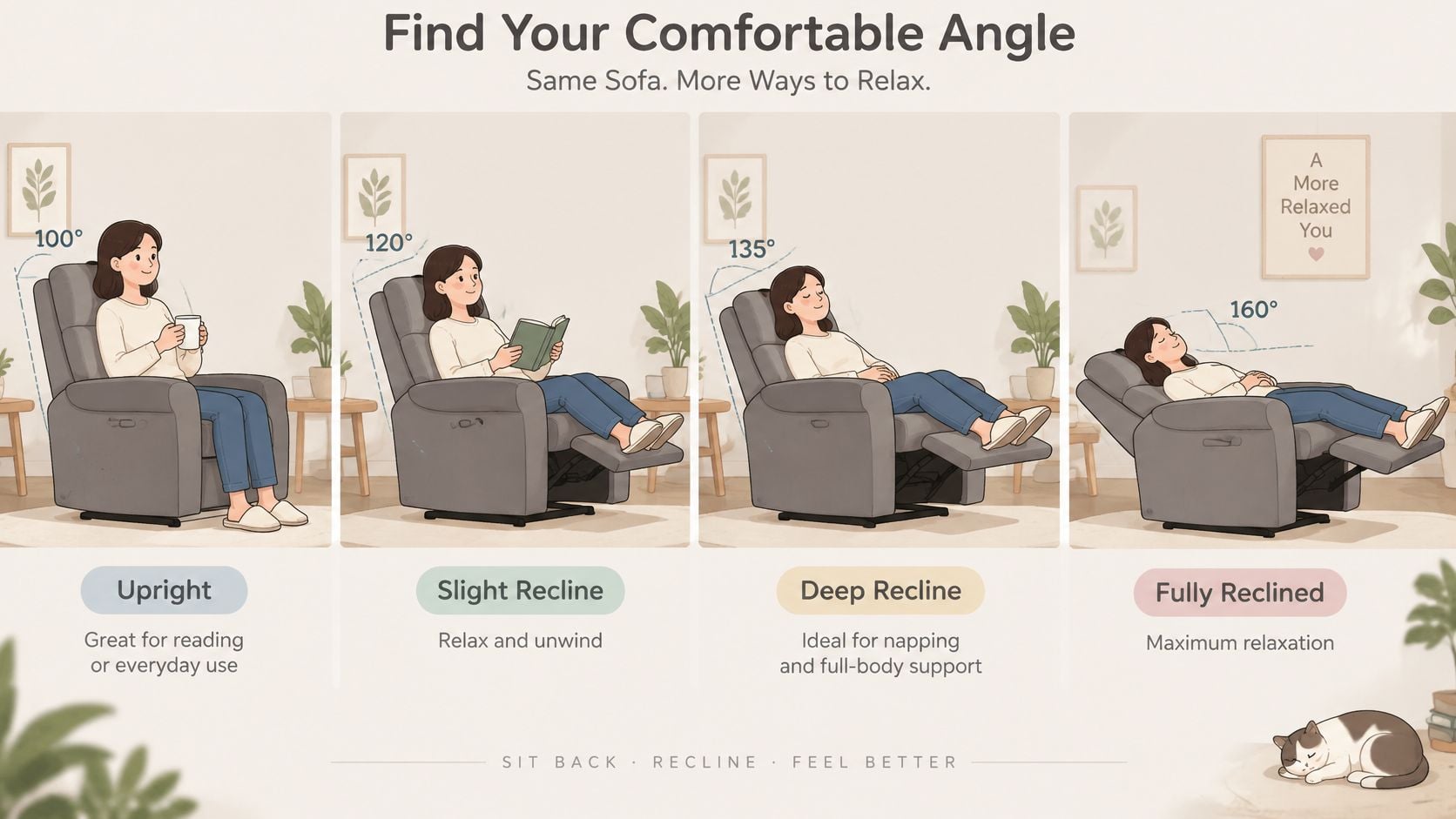
The angles decide how the body rests. A seat can look inviting and still leave the back unsupported or the knees uncomfortably high once it reclines. Test the movement in person, and judge the sofa and loveseat seat by seat.
A peer-reviewed study of young adults paired comfort ratings with EEG-based relaxation measures and found the strongest relaxation response and favorable comfort ratings near a 125° backrest and a 60° footrest. The BioResources recliner-angle study tested backrest positions from 110° to 130° and footrest positions from 0° to 90°. The backrest measurement corresponds to about a 122° conventional seat-to-back included angle. These results offer a useful reference, not a setting that suits every body.
A moderate recline supports the trunk, while raising the feet reduces the load on the lower legs. Your own comfort depends on how the seat fits your body, so try each position rather than choosing by angle alone.
Use this checklist in the showroom:
- Sit in every seat. The sofa and loveseat may support you differently.
- Test each stop. Try upright, mid-recline, and fully open using that seat's control.
- Check head support. The headrest should meet your head without pushing your chin toward your chest.
- Check lower-back support. With the footrest extended, your lumbar area should not feel hollow.
- Check your knees. Fully reclined, they should not sit above your hip line.
A 5-foot-2 sitter and a 6-foot-1 sitter can get different hip and knee angles from the same seat. Have both try it, then test the transfer: stand up and sit down from each recline position. A feature-rich set can still be the wrong choice if the controls, seat position, or effort needed to rise make it hard for someone to use.
A plush upright cushion can lose lumbar support when the footrest extends.
Safety, Frame, Fabric and Warranty Checks
A power sofa and loveseat introduce several moving pinch points. Check the full set before paying, starting with paperwork and then the mechanisms.
Ask for documentation showing that the complete model, not just its motor or adapter, was tested to UL 962. The UL 962 standard covers motor-operated furniture rated up to 600 V AC, including stability, strength, fire resistance, electrical parts, and injury hazards. The U.S. Consumer Product Safety Commission identifies UL 962 as addressing reclining mechanisms and stability. Keep the model documentation with your purchase records.
Check that mechanisms, gears, belts, pulleys, and motors are guarded from hands, paws, and small toys during normal use. Children, pets, and people with limited mobility may be near those gaps, so look beneath and around each seat.
Operate each seat on its own. Listen for rubbing or grinding, and release the button to confirm the motor stops promptly. A mechanism that continues moving after release is a reason to reject that sample.
Plan cord routes away from walkways and footrest movement. Follow the maker's specified wall clearance, and keep carpet, toys, and trapped cords clear of the mechanism.
Frame, cloth, and the paper trail
Ask what the frame is made from and how its joints are built. Kiln-dried hardwood, engineered wood, and metal are all used in this category. The joint matters too: screws into a solid rail and staples into a soft panel do not provide the same support.
Choose upholstery for the way the room is used, not just its showroom color. Compare performance fabric, leather, and blends by abrasion rating, cleaning code, and suitability for children or pets. Review these upholstery fabric choices before settling on a covering. Footrests can drag grit onto nearby rugs. For a wool rug in that path, follow safe wool rug washing in Birmingham to avoid felting the fibers during cleaning.
Read the warranty by component. The terms should distinguish frame, upholstery, and motors or electronics. Ask what covers motor failure, who handles a service call in Eastern CT, and whether labor is included. Get the answers in writing before you pay.
Keep a short record of what you checked:
- Complete model name and its UL 962 documentation.
- Written frame, fabric, and motor coverage, including the process for a motor failure.
- Cord route and required wall clearance for each piece.
- Any seat that rubbed, made noise, or failed to stop promptly during the showroom test.
Accessibility Scorecard for Standing and Transfers
A motor takes the pull and the body-weight shift off a manual recliner. It still leaves a low seat, a soft front edge, or a button out of reach able to strand someone. Run the transfer as a test on the showroom floor with the person who will use the set. A salesperson's smooth demo does not count.
Function and adjustable positioning are what shoppers now expect from motion furniture. Independent reporting places motion upholstery at 15% of responding retailers' sales, and nearly 20% reported category growth above 3% in the period covered by Furniture Today's motion-furniture coverage. Those figures say nothing about limited grip, a stiff shoulder, poor balance, or trouble standing.
| Check | What to Test | Pass Signal |
|---|---|---|
| Seat height | Stand up without pulling on the arms | Standing takes one smooth movement |
| Edge support | Sit on the front edge and shift weight | Seat feels firm and does not sink |
| Control reach | Operate controls from the seat | Buttons are reachable and easy to grip |
| Transfer space | Step in front of the seat and turn | Room for a walker or caregiver |
| Footrest clearance | Extend the footrest fully | No contact with walls or foot traffic |
| Power outage | Ask what happens without power | Manual release or clear written instructions |
A low seat fails without warning. A plush cushion that feels good at 8 p.m. can sit too low at 7 a.m., when standing has to happen without hauling on the arms. Edge support is the same test from the front of the cushion. If the nose of the seat collapses, transfers get harder.
Controls on the far arm fail the person who sits there when reach or grip is limited. Large buttons with a clear up and down beat a tiny remote that slides between cushions. Transfer space is the floor in front of the seat. A walker or a caregiver needs room to turn without catching the extended footrest.
Outages belong in the test. Ask how the seat returns, or stays safe, with no power. A manual release, or written steps a caregiver can follow in the dark, is a pass. An unclear answer is a fail.
If standing from the seat stays hard even with the motor working, compare that set with a chair built to raise the sitter. Lift chairs for older adults are a different product from a power reclining sofa. When a caregiver is already lifting someone clear of the furniture, hoist advice from Cream Home Care is the right next read. A sofa trial can't settle a hoist decision.
The fullest feature list can be the worst match if the seat is low, the buttons are fussy, or there is no room to turn.
Simpler geometry that this person can enter, adjust, and leave beats a triple-motor showpiece they can't stand up from.
Budgeting a Set as a Long-Term Investment
Plan a power reclining set as a multi-year purchase. The Bureau of Labor Statistics reported that average annual spending by all U.S. consumer units on household furnishings and equipment was $2,414 in 2024, down 3.7% from $2,508 in 2023 and 10.6% from $2,701 in 2021, according to the 2024 Consumer Expenditure Survey.
| Measure | Value | Change |
|---|---|---|
| Household furnishings and equipment, 2024 average annual spend | $2,414 | Down 3.7% from 2023 |
| Household furnishings and equipment, 2021 average annual spend | $2,701 | 2024 is down 10.6% from 2021 |
| Furniture category mean annual expenditure, all households | $648.24 | 2024 mean across all consumer units |
| Average quarterly furniture expenditure, households that bought furniture | $1,103.20 | Quarterly mean among households that reported a purchase |
The $648.24 figure is an annual mean across all consumer units, while $1,103.20 is the quarterly average for households reporting a furniture purchase. Both figures are reported in the 2024 Consumer Expenditure Survey. A coordinated power set can make up a substantial single purchase within a year when overall furnishings spending has eased. Set a budget around the whole purchase, then compare what each set provides for daily use.
What moves the price
- Motor count. A shared motor can cost less than separate motors at each reclining seat.
- Independent versus shared recline. Separate controls add parts and let two people choose different positions.
- Headrest or lumbar motors. These comfort options add to the base mechanism.
- Fabric or leather grade. Cover quality affects cost and how well the upholstery holds up to use.
- Frame and joints. Compare the frame material and how its joints are fastened.
- Customization. A made-to-order cover or configuration may cost more than a stock floor sample.
Judge value by the fit, frame, and warranty coverage for the motor, as well as the purchase price. A lower-priced set can cost more over time if it needs early replacement. For a wider look at price bands, browse affordable living room furniture sets.
Add the set price, delivery, and accessories to your budget. Keep room for practical extras, such as a cord cover or rug pad. If financing is part of your plan, calculate the monthly payments from the full total and read the approval terms before placing the order.
Test Your Shortlist at the Norwich Showroom
Bring your room measurements, then have the person who will use the set operate it and stand up from it. Check whether the seat height, arm support, and recline movement work for that person. A set with more powered features can be harder to use if its controls or transfers do not suit the user.
Ask about the F9 Series and which custom choices are available on power reclining models. Gorins guides customers through customizing sofas, chairs, tables, and other furniture. The 2116-01 Sofa and 2116-02 Loveseat are customizable, too, and you can visit the store to design and choose their look. Both are listed as stationary Decor Rest pieces, so confirm that their configuration meets your needs before treating them as power reclining options.
If you are considering a special order, ask which fabric and configuration choices are available and whether they apply to the model you are considering. Request the written warranty and check what it covers for the frame, upholstery, and reclining mechanism. Gorins offers promotional financing options, subject to approval. Its home delivery fee is $89.00, so include that in your budget.
Gorins carries Tempur-Pedic, Serta, and Beautyrest mattresses, as well as power-adjustable bases. If you are furnishing a bedroom as well, compare comfort in person and ask about the base features that matter to you.
Bring your shortlist and measurements to the Norwich showroom, and test the controls and standing transfer yourself. Choose the set that fits the room and the person using it, not the one with the most features. Visit Gorins Furniture & Mattress to explore the options.