Hybrid Mattress for Stomach Sleepers: What to Look For


In 2024, 12% of U.S. adults reported that they usually sleep on their stomachs, according to SSRS's nationally representative poll of 3,364 adults. That's a common enough position to deserve more useful advice than just buying the hardest bed. A good hybrid mattress for stomach sleepers needs to manage the whole sleeping setup, including pelvic support, surface pressure, pillow height, and heat.
Why Stomach Sleeping Strains a Mattress
When a stomach sleeper wakes with a stiff lower back, one possible cause is the pelvis settling farther into the mattress than the chest. That uneven support can hold the lower back in an exaggerated arch, even if the shoulders feel comfortable.
A mattress that lets the body's middle sag works like a hammock, bending the sleeper around its lowest point. A surface that keeps the hips more level works more like a plank, though a plank offers far too little cushioning.
Support without hard pressure
The mattress has to resist excessive sinking under the pelvis and abdomen while cushioning the chest, shoulders, hips, and knees. A harder surface may limit sinking but create uncomfortable pressure elsewhere.
Experimental and computational work on mattress stiffness found that hard surfaces increased contact pressure and changed lumbar curvature, while softer surfaces also altered spinal loading. The findings do not establish one firmness for every stomach sleeper. They do show why surface hardness alone is a poor buying rule.
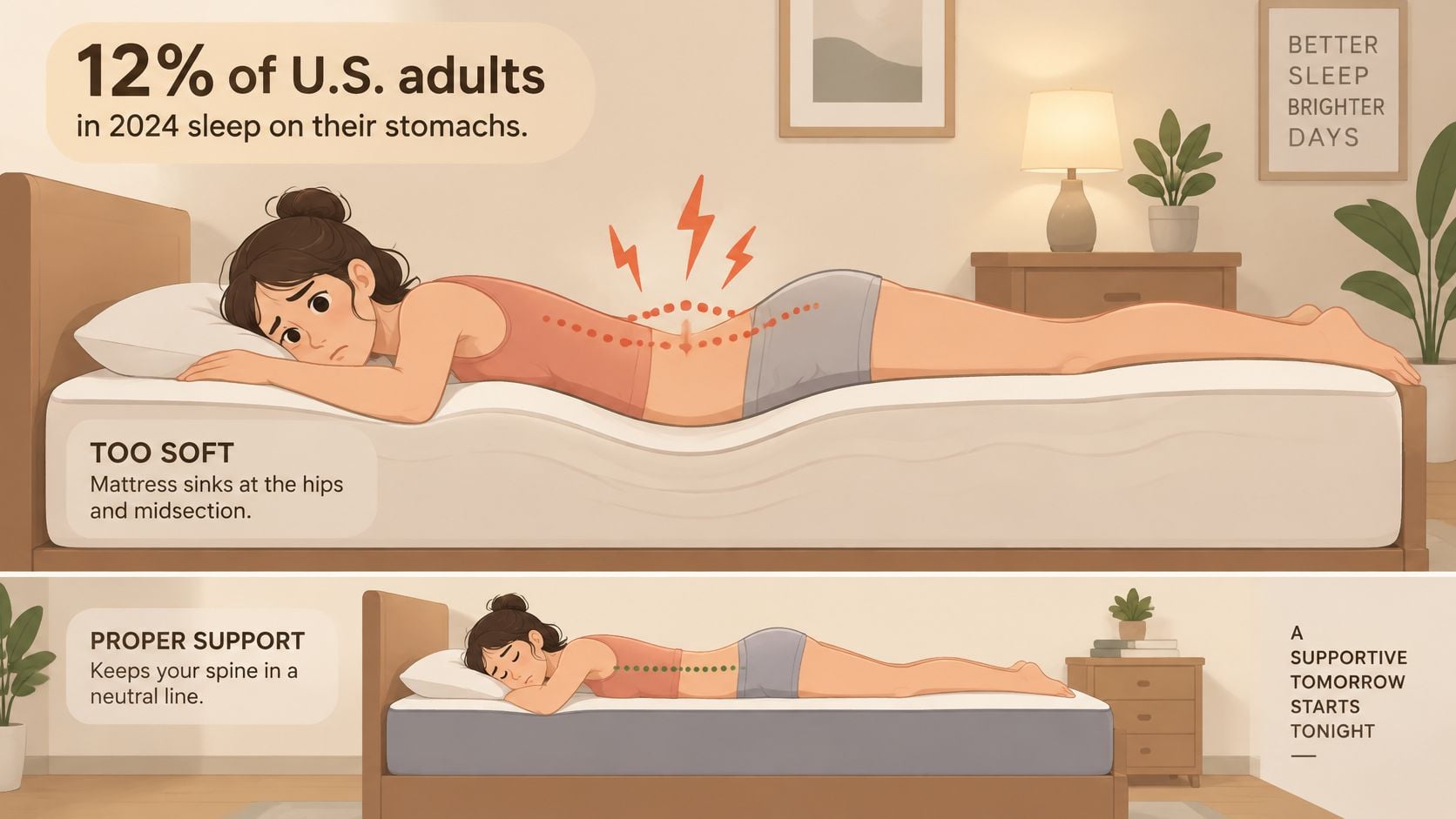
Practical rule: A comfortable first impression is not enough. Check whether the middle of the body stays supported after you settle into the mattress.
Ask whether your body can rest without a pronounced hip dip or concentrated pressure; the firm label tells you little. A hybrid is worth considering because you can assess its cushioning separately from the spring support beneath it.
Judge the whole setup, not just the mattress: hips broadly level, pressure tolerable, and no need to brace against the surface. A pillow that lifts the head too high can also affect neck comfort, so include pillow height in your assessment.
How a Hybrid's Layers Work Together for Stomach Sleepers
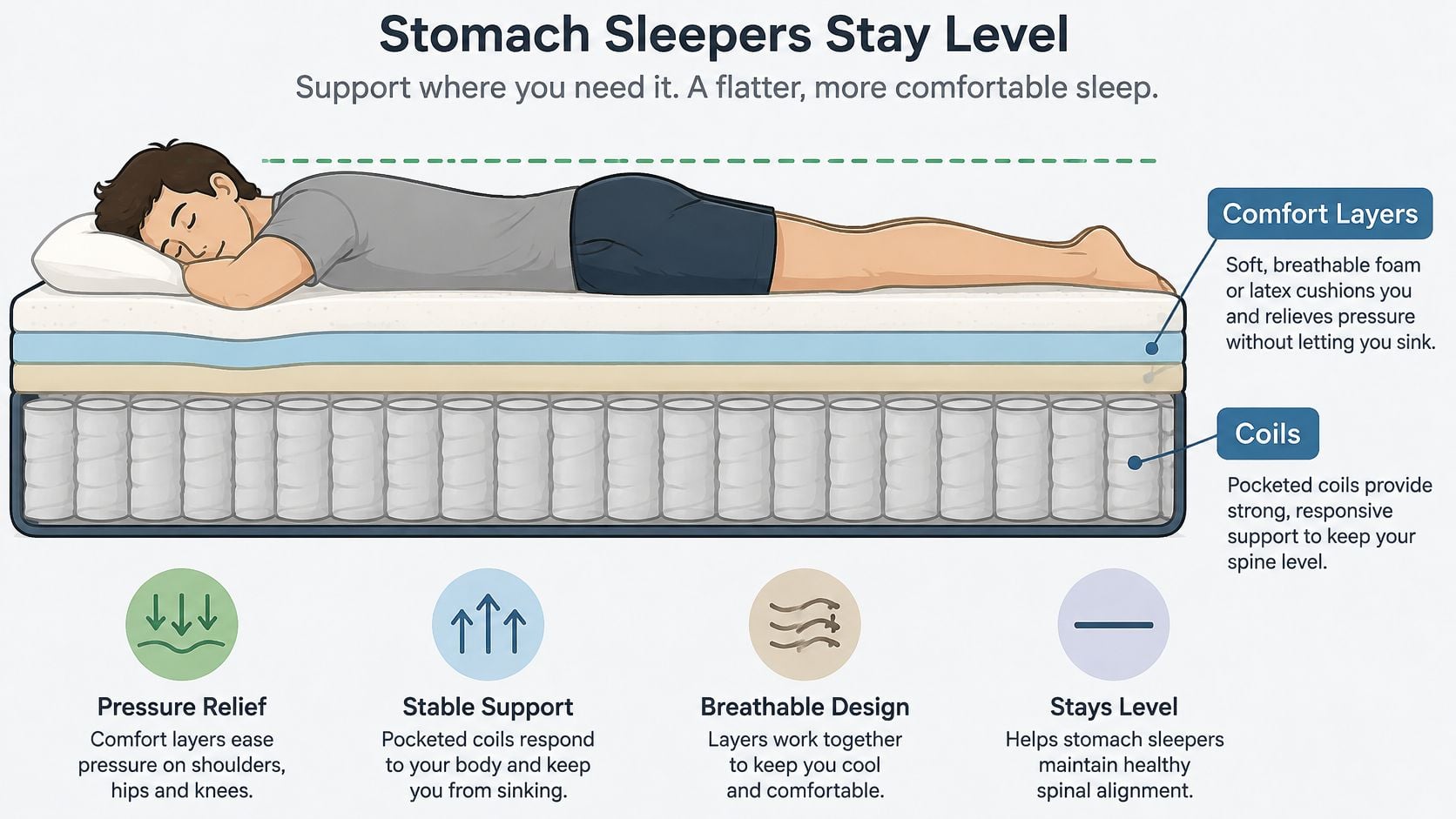
A hybrid combines a coil-based support core with comfort materials such as foam or latex. In a pocketed-coil design, the springs respond locally beneath different parts of the body rather than behaving as a single rigid platform.
The National Council on Aging's hybrid mattress guide describes the practical value of combining cushioning with spring support. For stomach sleepers, the important distinction is that the upper layers manage contact pressure while the deeper structure controls how far the body settles.
What the body meets first
The comfort layer spreads load across the torso. Foam may provide a more contouring sensation, while latex can offer a more buoyant feel. Neither material automatically makes the finished mattress suitable for prone sleeping.
Beneath it, the transition layer moderates the move from soft cushioning to firmer support. Its job is especially important when the sleeper's abdomen compresses the upper material more than the legs or shoulders.
The pocketed-coil core supplies progressive resistance as weight compresses the mattress. Space around the springs also permits airflow, although the cover, comfort materials, protector, and bedding still influence warmth. A breathable interior can't compensate for every heat-retaining layer placed above it.
Where a promising construction can go wrong
A thick, yielding top can allow the pelvis to descend too far even when the spring unit underneath feels substantial. At the other extreme, sparse or rigid cushioning can concentrate pressure at the ribs and hips, encouraging the sleeper to twist away from discomfort.
The balanced starting point is a moderately conforming surface over a stable support platform. A medium-firm feel is a sensible candidate to test, not a guarantee of fit. Gorins Furniture & Mattress's explanation of what a hybrid mattress is can help shoppers distinguish this construction from other mattress types.
Before comparing models, useful specifications include comfort-layer thickness and density, transition-layer composition, available coil information, and the manufacturer's tested firmness. Coil count alone doesn't describe the finished sleeping experience.
Hybrid layers and the job each does for a stomach sleeper
| Layer | Job for a stomach sleeper | Warning sign in store |
|---|---|---|
| Comfort layer (foam or latex) | Relieves chest, shoulder and hip pressure | Too thick or soft: hips sink and the lower back arches |
| Transition layer | Limits how far the body travels before the coils engage | Missing or thin: sinkage feels abrupt |
| Pocketed coil core | Gives progressive resistance and holds the pelvis level | Too soft for body weight: pelvis hammocks down |
| Top cover | Manages heat and moisture across the night | Non-breathable cover traps heat overnight |
These are inspection cues, not automatic pass-or-fail specifications. The complete mattress still needs an actual lying-down test.
Matching Firmness to Body Profile and Position
Every stomach sleeper needs a very firm mattress is an appealing rule because it sounds simple. It also overlooks the pressure discomfort a very hard surface can create. The clinical review on mattress selection and low-back symptoms supports a more nuanced approach, including evidence that medium-firm surfaces can outperform very firm ones for pressure distribution, sleep quality, morning stiffness, and nonspecific low-back pain.
The distinction between firmness and support matters here. Firmness describes how the surface feels. Support describes whether the mattress maintains a suitable resting alignment under the sleeper's actual weight and shape.
Body shape changes the result
A 2019 University of Lancashire study involving 59 healthy participants compared three visually identical mattresses with soft, medium, or firm spring units beneath the same gel-foam comfort layer. No single firmness suited everyone: higher-weight participants aligned more neutrally on firmer surfaces, lower-weight and shorter participants tended to align better on softer surfaces, and taller participants aligned better on medium firmness.
Those results shouldn't be treated as a stomach-sleeper sizing chart. They establish a more useful principle: people load the same mattress differently. The study abstract also reports greater spinal deviation on softer mattresses among participants with larger hip circumferences, while noting that overall differences weren't statistically significant.
A lighter sleeper may barely compress a firm top, leaving the ribs and knees carrying uncomfortable pressure. A heavier sleeper may compress that same top enough to need stronger resistance beneath the pelvis. Height and weight can also point in different directions, which is why personal testing matters more than assigning everyone a category.
Firmness direction by body profile
| Body profile | Firmness and support direction | Basis |
|---|---|---|
| Higher body weight | Firmer coil support resists pelvic sag | Lancashire study |
| Lower body weight | Softer surfaces aligned better; keep the comfort layer moderate | Lancashire study |
| Shorter height | Softer surfaces aligned better | Lancashire study |
| Taller height | Medium firmness gave more neutral alignment | Lancashire study |
| Larger hip circumference | Softer surfaces increased spinal deviation; favor firmer hip support | Same study's subgroup findings |
| Mixed stomach and side sleeping | Medium-firm is a starting point for prone support and shoulder comfort | Controlled-trial review, applied cautiously to mixed sleeping |
Mixed sleepers need a compromise
A mattress that feels acceptable facedown can press sharply into the shoulder after a turn onto the side. Mixed sleepers should compare their normal positions rather than buying for the posture they assume they maintain all night. A medium-firm candidate with controlled shoulder cushioning is often a more practical starting point than extra-firm.
A systematic review discussed in the mattress and sleep-position literature favored subjectively medium-firm, self-adjusted mattresses for comfort, sleep quality, and alignment. That broad finding doesn't prove that every medium-firm hybrid suits every combination sleeper.
Position-specific evidence needs similar care: a 2011 side-sleeping experiment recorded average frontal-plane alignment angles of 12.66° on soft, 8.9° on firm, and 4.10° on custom-made surfaces, with smaller angles closer to neutral. Those are side-sleeping findings, not prone-sleeping targets, but they illustrate why individualized support can matter more than maximum hardness.
Firmer isn't automatically better. The right direction is the one that improves alignment without creating a new pressure problem.
The Gorins guide to matching a mattress to body type provides another starting point for an in-person comparison. The final decision still needs tolerable pressure and comfortable positioning throughout the sleeper's usual movement pattern.
How to Test Spinal Alignment in a Showroom
A quick sit on the edge mostly reveals how the mattress feels under concentrated seated weight. It doesn't reveal how the torso settles during stomach sleeping. A useful showroom visit recreates the sleeping position closely enough to expose obvious mismatches.
Gorins Furniture & Mattress's knowledgeable sleep specialists help customers compare comfort preferences, sleep position, support needs, and budget. Customers are encouraged to try different comfort levels in person and compare mattresses side by side, rather than choose from a label alone.
A repeatable lying-down routine
Bring the usual pillow and wear comfortable clothing. Bulky coats, rigid waistbands, and unfamiliar pillows make comparison harder. A familiar pillow also gives the specialist a clearer starting point for evaluating the complete setup.
Lie facedown in the normal sleeping position, including the usual arm placement. Allow enough time for the body to settle, rather than getting up after the first impression. Notice whether the initial cushioning becomes a deeper dip or remains controlled.
Check the space beneath the waist. Sliding a hand underneath can reveal a pronounced unsupported gap, but this isn't a diagnostic measurement. The specialist should consider the gap alongside body shape, pelvic position, and the sleeper's comfort.
Have the specialist assess whether the hips sit noticeably below the shoulders. Clothing and natural body curves make visual checks imperfect, so the sleeper's sensation matters too. A feeling of hanging through the middle deserves attention even when the surface looks fairly flat.
Repeat near the edge without balancing on it. This checks the part of the mattress used when sharing a bed or sleeping close to the side. A noticeable change in support should be part of the comparison, not dismissed because the center felt comfortable.
Try a thinner pillow or no pillow while keeping the mattress unchanged. This separates head-height discomfort from the mattress's support characteristics. It's especially useful when the hips feel comfortable but the neck feels pushed upward.
Compare another model with a similar stated firmness. Pay particular attention to the ribs, pelvis, and knees, then turn onto the side if that's a normal nighttime position. Similar labels can conceal quite different pressure and sinking sensations.
What counts as a useful result
A good result feels uneventful: even contact through the hips and waist, no sharp pressure point, and comfortable breathing. The sleeper shouldn't need to tense the abdomen, lift the chest, or keep shifting to escape an uncomfortable spot.
Showroom checkpoint: A mattress deserves further consideration when the sleeper can relax into the normal position without compensating for the surface.
The Gorins mattress shopping guide helps organize the broader buying decision. During the visit, brief notes about pressure, movement, and pillow choice make side-by-side comparisons more reliable than remembering which bed initially felt softest.
A showroom test can identify an obvious mismatch. It can't establish that a mattress will treat pain or guarantee an uninterrupted night.
Morning Pain Problems and How to Fix Them
Morning lower-back stiffness can have several possible triggers: a sinking pelvis, a raised head, pressure around the ribs, or overheating. Match the adjustment to the symptom before deciding the mattress needs replacing.
The AARP guide to mattresses for stomach sleepers discusses the mattress and pillow as a pair. If your neck feels strained while your hips feel comfortable, try a thinner pillow or no pillow while keeping the mattress unchanged. This helps distinguish head-height discomfort from a support problem.
Change the component that matches the symptom
Use these suggestions as troubleshooting steps, not diagnoses. Bedding adjustments may not address pain with another cause.
Morning symptoms, likely causes and adjustments
| Symptom | Likely cause | Adjustment |
|---|---|---|
| Lower back aches on waking | Hips sinking and lumbar arch | Check whether the pelvis sinks; compare a firmer hybrid, then assess pillow height separately |
| Neck stiff while hips feel fine | Pillow too thick, forcing neck rotation and extension | Try a thinner pillow or none; check head height |
| Hot or sweaty overnight | Warm bedding or room, or a comfort setup that feels too warm | Try lighter bedding and a breathable protector |
| Shoulder pain when turning to the side | Surface too firm for side sleeping | Look for more give at the shoulder while keeping the hips supported |
| Pressure at hips and knees | Comfort layer too thin or rigid | Compare a surface with more responsive cushioning over a transition layer |
| Hips sink below shoulders | Comfort layer too soft or thick | Check coil support and compare a firmer hybrid |
If your hips seem to dip, a flat, soft support beneath the pelvis can be a short-term trial. Stop if it creates a pressure ridge or makes breathing uncomfortable. It is not a repair for a visibly sagging mattress.
For discomfort around the back of the ribs, read about common causes of back rib pain for context beyond mattress pressure. The Gorins guide to mattresses for back pain can help frame a support discussion, but neither resource replaces an assessment.
Change one variable at a time and note how you feel on waking. Seek clinical advice if pain repeatedly interrupts sleep, spreads into the legs, or continues worsening over several weeks.
Choose Your Hybrid at the Norwich Showroom
A stomach sleeper's mattress test should answer two questions: do the hips stay level, and does pressure remain tolerable? Compare those points while lying in your usual position, rather than choosing by firmness label alone. The Gorins Furniture & Mattress Norwich showroom offers a place to compare options in person.
Compare construction and everyday needs
The Beautyrest Black Hybrid Series One Medium uses Triple-Stranded Pocketed Coil Technology. The TEMPUR-Adapt Medium Hybrid uses materials that isolate movement to help minimize disruptions from partners, pets, or kids. These features address different needs, so check both support and comfort as you lie on each mattress.
Gorins recommendations draw on answers to the Your Sleep Style quiz and the expertise of trained sleep specialists. They can help you consider sleep position, support needs, comfort preferences, and budget. Gorins also offers promotional financing, subject to credit approval.
Bring a familiar pillow if you can. Its height affects how your neck and upper body settle, while the mattress determines how much your hips sink. Compare two hybrids side by side, then consider whether your bedding and warmth preferences suit the setup.
For a wider home update, Canadel Custom Dining and the F9 Series offer custom-order options. One-on-one consultations can help with those choices, too.
- Visit the Norwich showroom and try different comfort levels side by side.
- Take the online Style Quiz to help clarify your preferences.
- Bring your usual pillow and compare two hybrids in your normal sleep position.
For mattress guidance and in-person comparisons, visit Gorins Furniture & Mattress in Norwich.