Pillow Top Mattress vs Regular: How to Choose

The familiar advice to choose a pillow top for comfort and a regular mattress for support leaves out the most important detail: softness and support aren't opposites. A cushioned surface can sit above a stable core, and a flat-looking mattress can still feel soft. The useful question is whether the finished mattress cushions shoulders and hips without letting the pelvis sink too far.
For shoppers comparing a pillow top mattress vs regular construction, a careful lie-down test tells more than the label. The right choice should suit the sleeper's body, sleeping position, temperature preferences, and expectations for long-term value.
Pillow Top Versus Regular at a Glance
Neither design is automatically better. A pillow top describes added upholstery, not a firmness grade or a health upgrade. A regular mattress lacks that distinct attached pillow panel, but it doesn't necessarily lack cushioning.
Pillow top versus regular mattress at a glance
| Criterion | Pillow-top mattress | Regular mattress |
|---|---|---|
| Construction | Extra foam, fiber, or cushioning attached above the coil or foam core | Sleeper sits closer to the primary comfort and support layers |
| Initial feel | Generally softer at first contact, with more give at shoulders and hips | Often a firmer, more direct feel of the underlying layers |
| Pressure relief | Added cushioning can soften shoulder and hip pressure | Comfort-layer materials set the relief; a firm surface can create side-sleeping pressure points |
| Alignment risk | Pelvis can sink if the top is too thick or soft | A very firm surface can load shoulders, pelvis, and sacrum |
| Heat | Added upholstery can retain warmth and humidity, particularly with some polyurethane foams | Less extra upholstery, but covers and foams still matter |
| Price posture | Compare written quotes for the same core with the added top specified | Compare core, brand, and comfort materials rather than assuming the label means a lower price |
What the label leaves out
The table describes common construction differences, not promises about every model. A firm pillow top can feel more supportive than a soft regular mattress, while a well-cushioned regular model may relieve pressure without a raised panel.
Individual responses matter. In an RTI mattress study, 128 healthy adults tested seven mattresses for approximately four weeks each, and firmness significantly affected 9 of 11 key sleep measures, yet participants differed considerably in which mattress produced their best sleep.
That finding makes a useful shopping rule: compare actual surfaces rather than buying a category. A side sleeper's shoulder pressure deserves more attention than a decorative seam, and a stomach sleeper's pelvic position matters more than overall mattress height.
Practical rule: A mattress label can narrow the search, but the sleeper's body should make the final decision.
A manageable shortlist should include different finished feels, not just different appearances. In the Norwich showroom, shoppers can compare a moderately cushioned pillow top against a regular medium-firm model and judge which feels comfortable without becoming unstable.
How the Comfort Layer Sits on the Core
A mattress makes more sense when its layers are considered from the bottom upward. The support core provides the underlying structure, while the layers above it shape how gradually the sleeper meets that resistance.
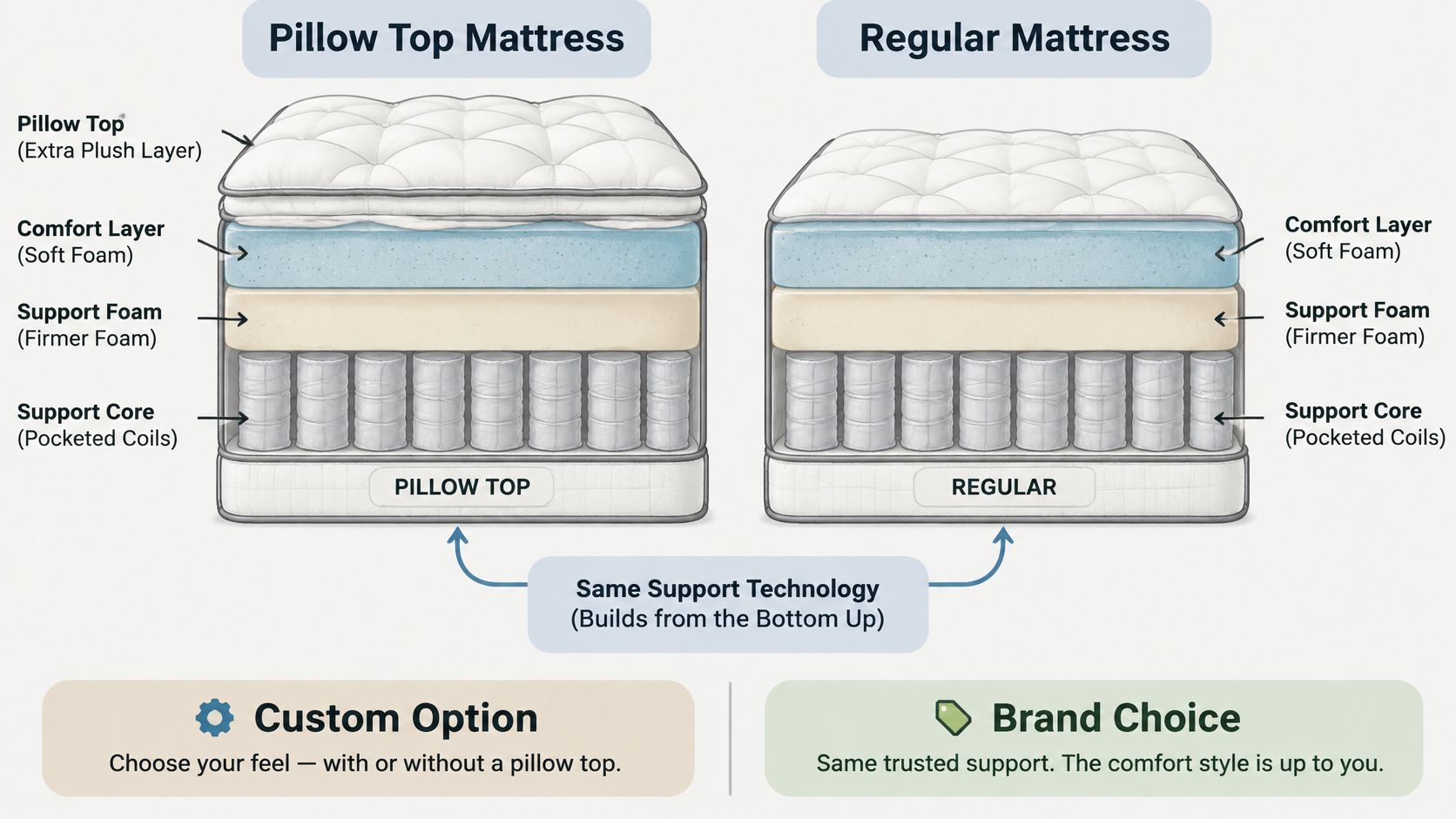
The construction illustration shows why a raised top and a flat top can conceal similar support systems.
From support core to sleeping surface
The core may use innerspring coils, individually pocketed coils, or supportive foam. Above that, transition materials soften the change between the supporting structure and the more yielding surface. Comfort materials and the cover complete the sleeping surface.
On a pillow top, an identifiable padded panel sits above the main mattress body. On a regular tight-top design, the cover and comfort materials are integrated more closely with the mattress beneath them.
- Support core: Ask what supplies the underlying resistance, not just whether the surface feels plush.
- Transition materials: Check whether the change from cushioning to support feels gradual or abrupt.
- Comfort panel: Ask what the padding contains and how thick each layer is.
- Cover: Notice its texture and stretch, since the cover contributes to the finished feel.
The distinction between hybrid and innerspring mattress construction is separate from the distinction between pillow-top and regular upholstery. Shoppers should identify both the core and the top rather than treating either label as a complete specification.
What an added panel doesn't change
Attaching cushioning doesn't automatically change coil gauge, support-foam density, perimeter reinforcement, or motion isolation. Those features still need separate checks. A plush panel may soften first contact without making the entire mattress equally soft.
A hand press can help locate the firmer layers beneath the padding, but it can't reproduce the load of a reclining body. The more useful comparison happens after the sleeper settles into a normal position.
Single-sided construction also matters. A mattress designed with a sleeping surface on only one side shouldn't be flipped onto its underside to refresh the cushioning; rotation and care should follow the manufacturer's directions.
The Gorins Sleep Gallery includes Tempur-Pedic, Serta, and Beautyrest, allowing Norwich shoppers to compare construction through comfort by feel rather than a catalog photograph. The aim is to identify a suitable combination of surface cushioning and underlying resistance, not to select the tallest mattress.
Pressure Relief Without Letting the Pelvis Sink
Pressure relief means spreading contact forces so a shoulder or hip doesn't carry an uncomfortable concentration of weight. Support means resisting the body's load enough to maintain a comfortable position. A mattress needs both, but adding more softness doesn't automatically improve both.
For a side sleeper, some shoulder and hip immersion can help the torso settle comfortably. Trouble starts when the pelvis drops disproportionately, or when the sleeper must tense muscles to avoid feeling folded into the surface.
Medium-firm is a starting point, not a prescription
A systematic review of mattress firmness and sleep outcomes examining 24 controlled-trial articles found that subjectively medium-firm mattresses, including self-adjusted designs, were generally most favorable for comfort, sleep quality, and spinal alignment. Its practical lesson is balance, not a requirement to choose an unyielding surface.
A separate 2021 systematic review examined 39 qualified studies published through 2019 and likewise favored medium-firm surfaces for comfort, sleep quality, alignment, and nonspecific chronic low-back pain, including greater improvements in pain and disability than other firmness levels. Neither finding establishes that an attached pillow panel is a treatment for back pain.
Firmness is the feel of the finished mattress, not the appearance of a thick top.
A very firm regular mattress can create another problem: insufficient give beneath prominent contact areas. A sleeper may feel well supported while sitting upright yet develop shoulder discomfort after lying on the side. The relevant test must reproduce the sleeping position rather than the position used to tie shoes.
Turn the evidence into a body test
The practical assessment accompanying the pressure-relief mattress selection guide should focus on what the sleeper feels and how easily the body moves.
- Allow settling: Remain in the usual sleeping position long enough for the initial showroom impression to fade.
- Check side-sleeping posture: Have a companion look from behind for an obvious bend through the torso, rather than expecting the spine to look ruler-straight from every angle.
- Check back-sleeping comfort: Notice whether the pelvis feels held or continues dropping after the upper body settles.
- Turn naturally: Rolling shouldn't require pushing out of a deep hollow.
- Separate discomforts: Localized shoulder pressure and an unsupported lower back call for different adjustments.
A plush pillow top earns its place when it reduces contact pressure while the mattress remains stable. If added softness removes pressure but creates a hammock-like position, a firmer core or thinner comfort layer is a more sensible next comparison.
Persistent or worsening back pain also deserves clinical assessment. Mattress shopping can address comfort and fit, but it shouldn't substitute for investigating symptoms.
When Softness Turns into Early Sagging and Value
A pillow top changes the comfort layer, not the mattress's firmness category or its expected lifespan. Its value depends on whether that layer keeps its cushioning over time while the core continues to support the sleeper.
The Sleep Like the Dead consumer-experience analysis, also cited by The Strategist, reports owner experiences with sagging during the first three years. The figures are survey reports, not predictions for any individual mattress.
Durability signals worth asking about
| Signal | Pillow top | Regular mattress | What to ask |
|---|---|---|---|
| Reported sagging or compression within the period surveyed, according to the owner-experience analysis | At least 30 percent of owners | 17 percent of owners | Treat these survey figures as a warning, not a guaranteed lifespan |
| Separate comfort component | Added upper layer can compress first | Comfort materials sit closer to the core | Foam density and layer thickness |
| Body impression versus lost support | A visible impression alone doesn't establish failure; sinking hips deserve attention | Excessive firmness can create pressure, but soft regular models can also sag | Whether the body still rests comfortably |
| Warranty focus | How impressions in the pillow panel are treated | How coil or foam breakdown is defined | Measurement method and excluded impression depth |
| Adjustability later | Attached comfort is harder to replace separately | A removable topper can be swapped if the underlying mattress remains suitable | Whether replacement comfort fits the budget |
| Price | Quote the core and attached comfort layers | Quote a comparable core and comfort specification | Get written quotes that specify both |
Inspect materials before judging thickness
The reported figures are a reason to ask about construction, not to reject every pillow top. Foam density, layer thickness, sleeper weight, foundation support, and permitted rotation practices can all affect how the mattress holds up.
A shallow impression and a loss of comfortable support are different things. Warranty coverage may depend on a measured indentation threshold, while a sleeper may notice uncomfortable softening without seeing a deep depression. Compare the warranty definition with how the mattress feels during sleep.
- Ask for layer specifications: Material names alone don't reveal density or thickness.
- Confirm the foundation: An unsuitable base can undermine an otherwise appropriate mattress.
- Read impression exclusions: Ask how an indentation is measured and what documentation a claim requires.
- Check care requirements: Confirm whether rotation is permitted and whether the build is single- or double-sided.
Consider replaceable comfort
A regular mattress paired with a removable topper gives you the option to replace the comfort layer separately if the core remains suitable. Compare the topper's replacement cost with the cost of replacing the complete mattress.
A removable topper won't necessarily feel like a factory pillow top. Separate components can shift or change how the cover and underlying mattress respond, so test the combination together. The guide to how long a mattress should last can help distinguish maintenance questions from signs that replacement deserves consideration.
For value-conscious households, compare usable comfort, clear material specifications, and how easily the comfort layer can be replaced. Mattress height and the lowest price alone won't show whether the surface will suit you over time.
Why Some Pillow Tops Sleep Warmer
Thermal comfort starts in the small space between the sleeper and the mattress. A comfortable bedroom temperature doesn't guarantee a comfortable sleeping surface if heat and moisture accumulate beneath the body.
A mattress-material study published in the Journal of Home Economics of Japan found that polyurethane foam could increase bed-climate and microclimate temperature and humidity. Under its test conditions, participants reported a more humid sensation and a stronger desire to cool the mattress on polyurethane foam than on camel-hair mattresses.
Compare materials, not silhouettes
That result doesn't establish a universal hotter-or-cooler ranking between pillow-top and regular mattresses. A dense foam comfort layer can sit beneath a flat cover, while an attached pillow panel can contain materials with different airflow and moisture behavior.
Cover fabric, ventilation, body immersion, bedding, and room conditions all influence the experience. A cooling description is incomplete unless the salesperson can identify what the mattress uses to manage temperature.
- Comfort filling: Ask whether the upper layers contain foam, fiber, or another cushioning material.
- Air pathways: Ask how the construction allows air movement around the comfort layers.
- Cover construction: Feel whether the fabric is breathable and whether a protector changes its character.
- Temperature-regulating features: Request a material explanation rather than relying on a cool initial touch.
A cool touch isn't an overnight guarantee
In a polyurethane-foam thermal-engineering experiment, low-density foam combined with phase-change material improved heat absorption and temperature stability compared with configurations lacking those features. That's evidence about a tested construction, not proof that every mattress marketed with similar language will feel cool throughout the night.
A showroom trial can reveal immediate clamminess or an uncomfortable amount of body enclosure. It can't reproduce a full night under the household's usual bedding, so return or comfort-exchange terms deserve attention too.
For hot sleepers: The useful question is what touches the body and how that assembly handles warmth and moisture, not whether the mattress has a raised edge.
The cooling mattress guide for hot sleepers provides a useful basis for discussing these construction details. For a Norwich bedroom that already feels warm, the comparison should include the planned protector and bedding as well as the mattress itself.
Which Sleeper Should Pick Which Mattress
| Sleeper | Start with | Watch for | Skip if |
|---|---|---|---|
| Side sleeper | Moderately cushioned pillow top over a stable medium-firm core | Shoulder and hip pressure, comfortable spinal alignment | The top lets the torso sag |
| Back sleeper | Regular medium-firm or a thinner pillow panel | Lumbar comfort without a hard feel | The surface feels board-hard or hammock-soft |
| Stomach sleeper | Thinner comfort layer or firmer regular build | Pelvic sink and uncomfortable lower-back positioning | A thick plush top lets the hips drop |
| Heavier sleeper | Firmer core with modest cushioning | Deep compression of the upper layers | Soft foam supplies little underlying resistance |
| Lighter or shorter sleeper | Softer surface or lightly cushioned pillow top | Pressure points on a very firm regular mattress | Firmness is chosen only because it sounds healthier |
| Taller sleeper | Medium firmness as an initial comparison | Alignment through the torso | Extra plush is chosen for appearance alone |
| Couple with different weights | Address the greater support need, then test cushioning acceptable to both | Edge stability and motion transfer | A shared very soft surface leaves either partner unsupported |
These are starting points, not body-type prescriptions. The comparison chart provides a visual reminder that sleeping position and finished firmness should be considered together.
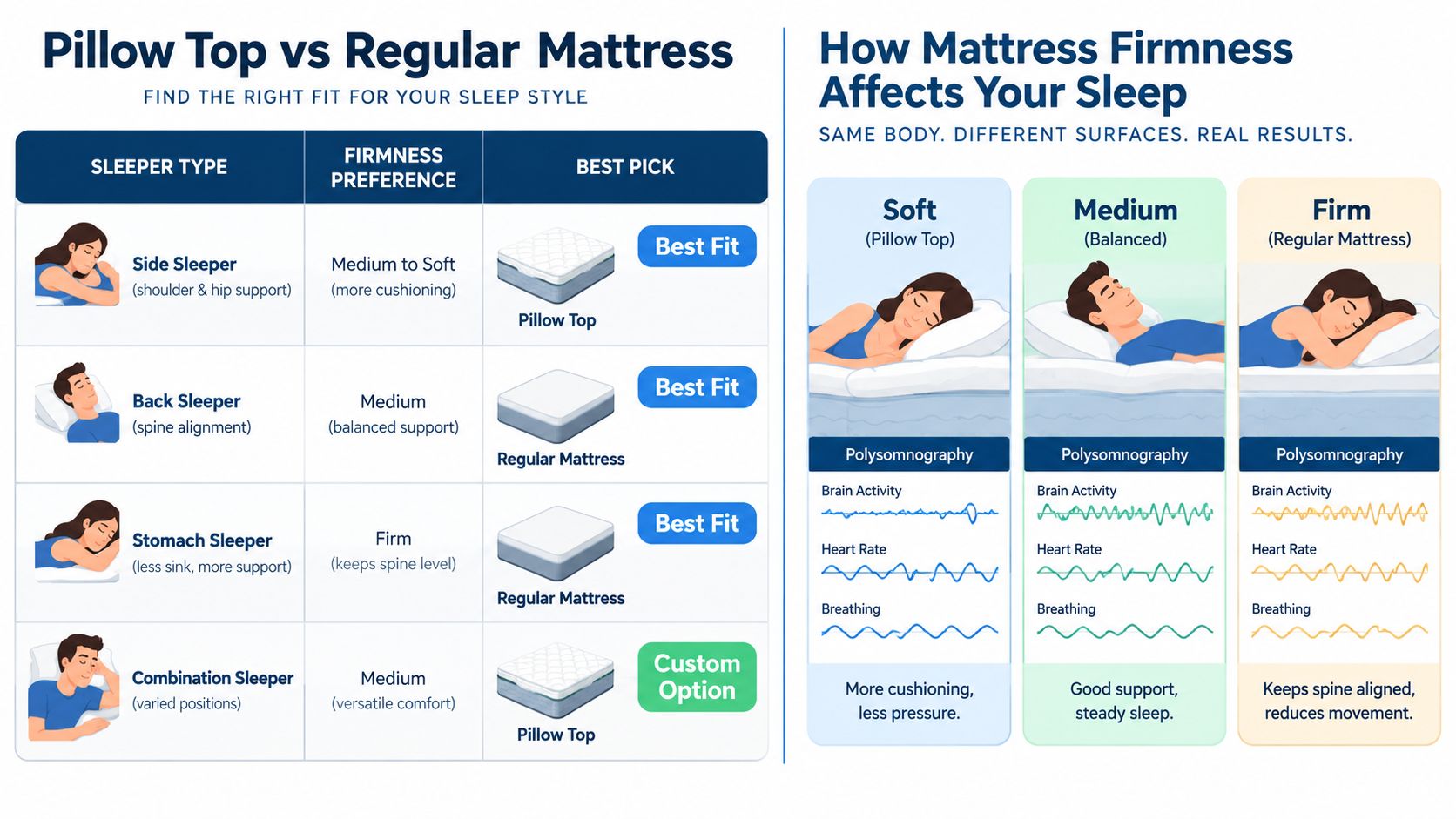
Why medium deserves a place on the shortlist
In a polysomnography study comparing mattress firmness, soft, medium, and firm surfaces measured 32.6, 64.6, and 83.8 HA, respectively, and sleep latency was shorter on medium at 7.71 ± 1.31 minutes, compared with 12.42 ± 1.94 minutes on soft, with a significant mattress effect of p < 0.05. The study also reported more favorable sleep-efficiency and spindle-activity indicators on medium.
Those results don't translate into a universal showroom firmness scale. They support treating a pillow top as a pressure-relief modification rather than an automatic sleep-performance upgrade.
Body size changes how a sleeper engages the layers. A 2019 spinal-alignment study abstract found that heavier participants aligned more neutrally on firmer mattresses, while lower-weight and shorter participants often benefited from softer surfaces and taller participants aligned better on medium firmness.
Test the shared bed as a shared bed
Consider a side-sleeping couple sharing a queen mattress, with one partner substantially heavier than the other. The lighter partner may appreciate a plush panel immediately, while the heavier partner reaches the softer layers and feels less stable.
A firmer core with modest cushioning may satisfy both, but neither partner should have to accept persistent discomfort. They should lie down together, roll independently, sit near the perimeter, and check whether getting out of bed feels controlled.
If a shared compromise fails, separately adjustable comfort deserves consideration instead of adding more softness. The guide to choosing a mattress for sleeping style can help organize that conversation around actual sleeping habits.
Confirm the Feel at the Norwich Showroom
A showroom comparison can help answer a specific question: does the pillow top ease pressure without making the surface feel unstable? For shoppers in Norwich, New London, Plainfield, Waterford, and nearby communities, start by naming what feels wrong on the current mattress, such as shoulder pressure, difficulty turning, overheating, or a sense of sinking.
Ask to compare pillow-top and regular surfaces with their construction explained. A mattress label alone does not tell you how its comfort layer will feel under your body.
Bring a repeatable comparison plan
Use the same routine for each mattress. That makes differences easier to notice.
- Lie in your usual position: Use your normal pillow arrangement where practical, and stay long enough to settle into the surface.
- Check movement: Roll, change positions, and sit at the edge.
- Ask about construction: Find out what the comfort layer is made of, how impressions are handled under the warranty, and what foundation the mattress requires.
- Notice temperature: Pay attention to the cover and how warm the surface feels beneath your torso.
- Write down the result: Note what improved and what still felt uncomfortable before trying the next mattress.
Gorins Furniture & Mattress also offers Canadel custom dining and F9 custom living-room furniture, with choices in finishes, upholstery, and seating details.
A visit does not need to settle every furnishing decision. For a mattress, focus on the surface that feels comfortable while still supporting you steadily. Ask for the mattress specifications, payment terms, and delivery arrangements in writing before deciding.
Visit Gorins Furniture & Mattress in Norwich to compare pillow-top and regular surfaces, take the online Style Quiz for furnishing direction, or browse the Clearance section for value-driven options.