Recliner vs Sofa: How to Choose the Right Seat


Adults in the United States spend an average of 6–8 hours sitting each day, according to an American Heart Association scientific advisory. That makes living-room seating a daily tool, not just a decorating choice. In the recliner vs sofa decision, a recliner primarily supports one person changing posture, while a standard sofa supports shared, mostly upright seating.
Why This Seat Choice Matters Every Day
Say a household uses the living room differently after dinner. One person settles into a book and wants supported legs; another prefers sitting upright while talking with visitors. Buying whichever piece feels softest during a quick showroom visit won't necessarily serve either person well.
The useful questions are more concrete. Does the seat support the body without making standing difficult? Does the furniture fit when every moving part opens? Will its cushions, upholstery, and mechanism be practical to maintain over ten years?
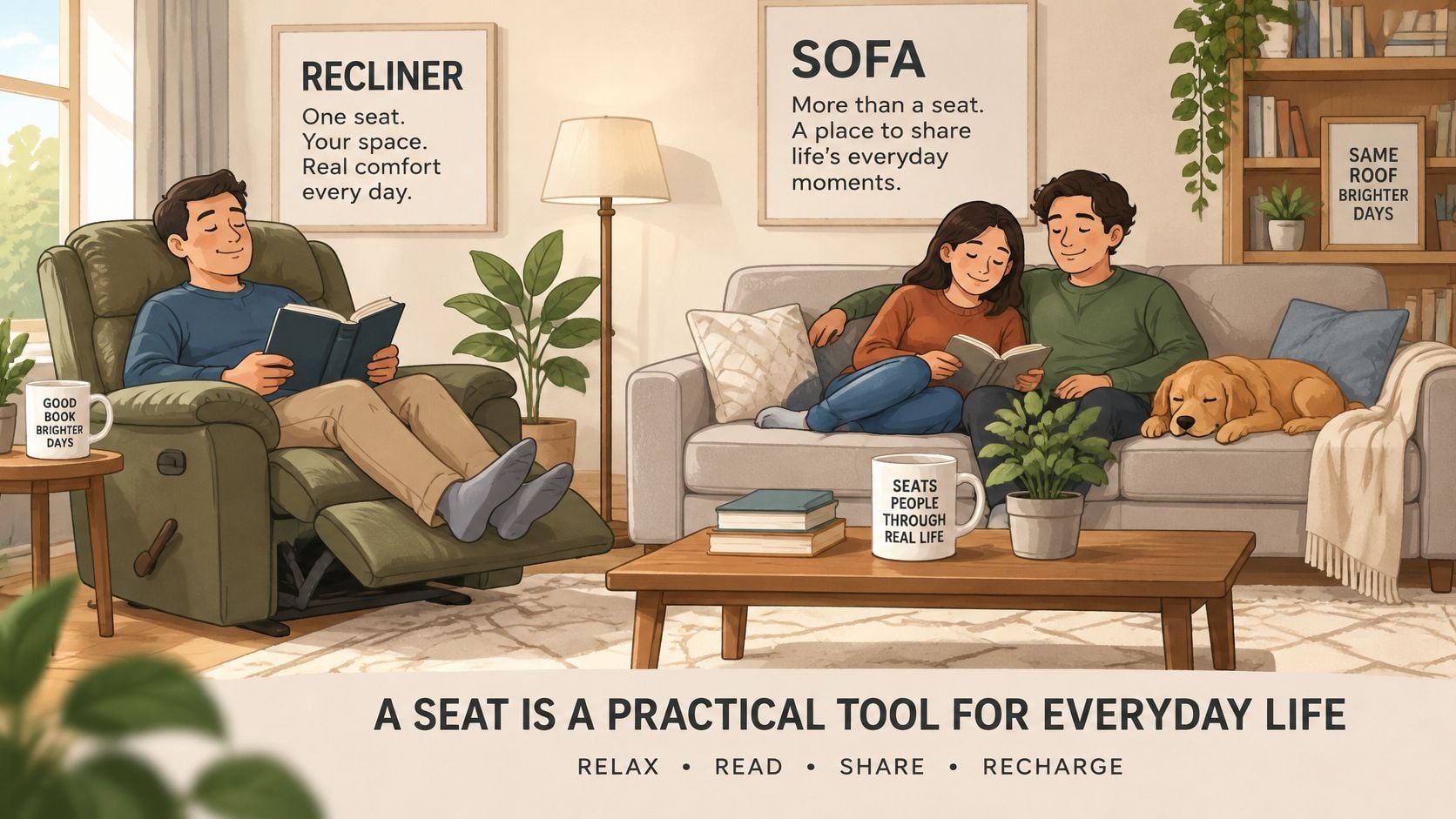
Start with the household's main activity
A recliner is the stronger starting point for a dedicated reading or television seat. A power lift chair deserves consideration when getting upright is the harder task. A sofa makes more sense when guests, conversation, and sitting together take priority.
Neither choice automatically solves every comfort problem. A deep sofa can leave a shorter person perched away from its backrest, while an oversized recliner can put its headrest and footrest in the wrong places.
- Individual support: Match the chair to its primary user rather than choosing the largest available model.
- Shared seating: Consider the people who regularly sit together, including differences in height.
- Daily movement: Leave space for standing and walking, not merely space for the furniture.
Local guidance without a rushed decision
Locally owned and family-operated since 1936, Gorins offers a Norwich showroom where shoppers can compare seating categories in person. That side-by-side experience helps turn a vague preference into a practical choice.
A comfortable seat should support daily life without encouraging uninterrupted sitting.
Neither a sofa nor a recliner replaces getting up for a short walk during long sessions. The snapshot below separates their everyday jobs before comfort, room layout, and serviceability enter the decision.
Recliner vs Sofa at a Glance
| Criterion | Recliner | Standard sofa |
|---|---|---|
| Typical width | 30–40 in | 72–90 in |
| Typical depth, closed | 35–40 in | 32–40 in |
| Typical height | 38–42 in | 30–36 in |
| People seated | 1 | 2–3 |
| Best daily job | Solo lounging, reading, TV, leg elevation | Conversation, guests, shared TV |
| Posture change | Back and footrest articulate | Fixed unless it is a reclining sofa |
| Extra clearance | Footrest in front; some backs need wall space | Usually the frame only |
| Style path | Fabric, leather, power, swivel; lift-chair alternatives | Arms, backs, welts, cushion feel; custom options |
| Price drivers | Frame construction, manual or powered mechanism, upholstery grade | Frame construction, size, upholstery grade, customization |
Typical dimensions are broad planning ranges from Friendly Furniture Movers' furniture-measurement guide. Check the specifications of the exact model before ordering.
Width isn't the whole footprint
A recliner may take less wall width, but its closed depth doesn't show how much room it needs in use. The footrest extends toward a coffee table, and some models need space behind the back. Measure the chair both closed and fully open, then check that the open footrest won't block a walking route.
A standard sofa uses a longer stretch of wall, but its footprint stays more predictable because it has no opening footrest. Leave room to stand, reach nearby tables, and move between seats. Arms also matter: wide arms take up floor space without adding sitting room.
Style choices follow different paths
Recliner choices begin with how the seat operates. Manual or powered controls, swivel movement, control placement, and head support affect everyday use; upholstery and silhouette shape how the chair fits the room.
Sofa customization starts with the overall form. The F9 Custom Sofa series offers thousands of combinations in details such as arms, backs, welts, fabric, and cushions. A narrower arm changes the sofa's footprint, while a different back or cushion choice changes how it supports the sitter.
- A reclining sofa is a separate choice: It combines shared seating with moving sections, so check its open footprint and service requirements.
- A lift chair serves a different task: Its rising function helps with standing, rather than just changing a recliner's position.
- Compare prices using matching specifications: Identify the size, frame, upholstery grade, controls, and custom options before comparing quotes.
Price depends on those specifications, so a quote for one upholstery grade or mechanism cannot be compared fairly with a different configuration. Match the features first. Then weigh the purchase against how well the seat fits the room, supports its regular users, and can be maintained over time.
Comfort Fit and Pressure Through the Day
A review of seating-interface studies reports a 61% reduction in seat forces in one experiment when the backrest reclined fully to 90° compared with upright sitting. The same review describes an experiment in which a 30° recline significantly reduced average seating pressure. These results reflect specific test conditions, so they don't predict how every retail recliner will feel.
Reclining shifts some support from the sitting bones and buttocks toward the back, including the lumbar and thoracic regions. A soft cushion alone doesn't redistribute pressure in the same way.
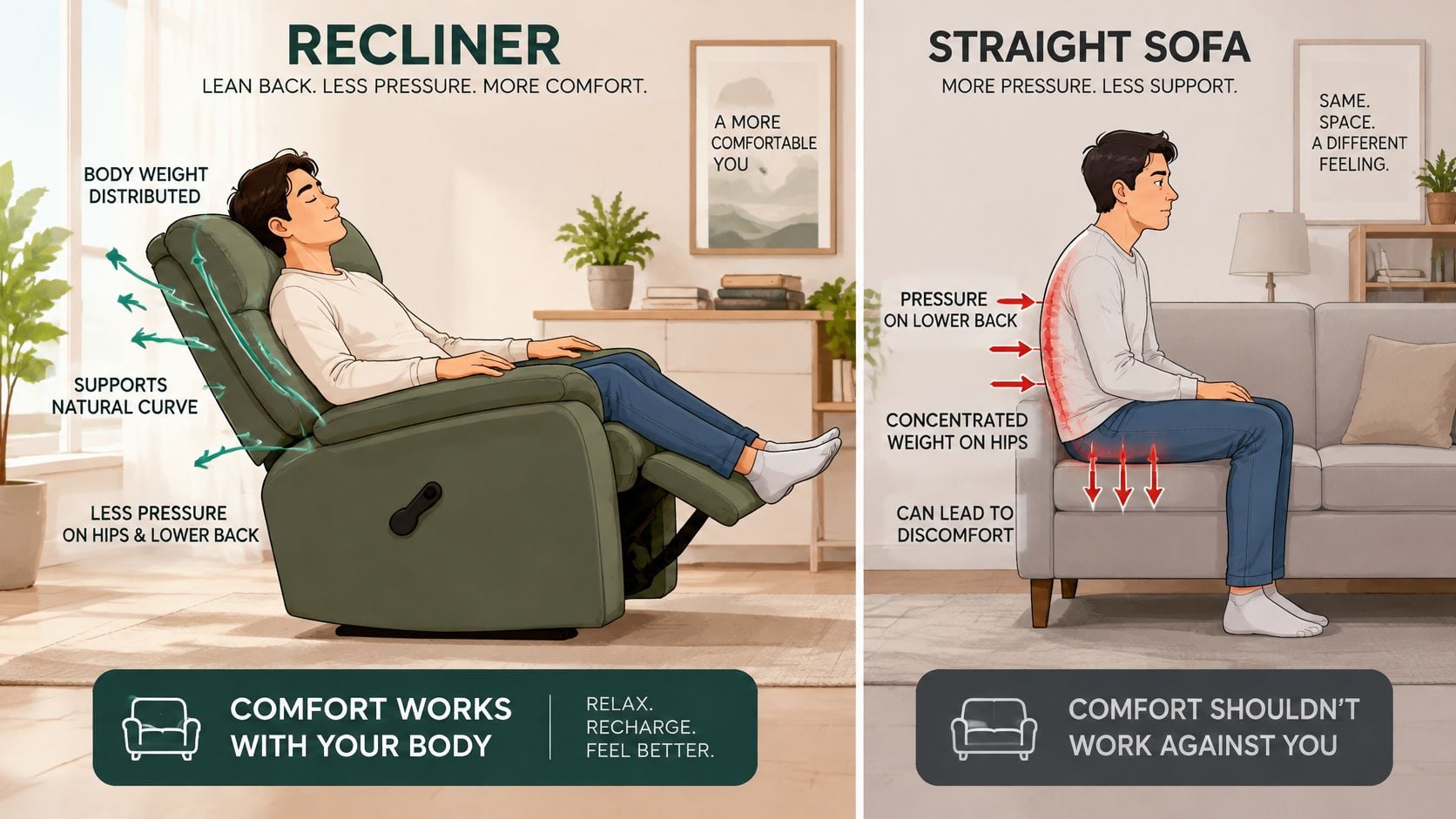
Follow the support through the movement
A well-fitted recliner maintains support as its seat, back, and footrest move. With a poor fit, the sitter may slide, feel clothing pull against the upholstery, or notice pressure gather at the lower back.
Compare upright, partial, and near-full recline. Support should feel broad and comfortable at each position, rather than turning into a hard pressure point.
- Lower back: The lumbar support should feel supportive, not intrusive.
- Thighs: Check that the seat supports the upper legs without leaving a gap.
- Head and neck: The headrest should support the head without pushing the chin toward the chest.
- Calves: The footrest should support the lower legs, with the heels resting comfortably.
- Transitions: The chair should move in a controlled way without making the sitter brace or reposition repeatedly.
Pressure redistribution is a possible benefit of reclining. The right model is the one that fits the person, and adjustment count is secondary.
For a sofa, check that the sitter's back reaches the backrest while their feet remain supported. Gorins' guide to average sofa seat height helps put the seat's height in context, alongside the fit of the cushions.
Separate comfortable rest from treatment claims
Comparing Flexsteel and Best Home Furnishings pieces at the Norwich showroom can help shoppers notice differences in firmness, contour, and operation. Choose the model that fits the person and supports their preferred sitting positions.
For recurring discomfort, SunnyBay's resource on ways to build a daily pain relief routine offers ideas about everyday habits. Furniture affects positioning; it does not diagnose a condition or replace professional care.
Nighttime rest calls for a separate mattress comparison. The Sleep Gallery's Tempur-Pedic, Serta, and Beautyrest options let shoppers compare comfort by feel. A living-room chair and its brand name are not medical solutions.
Floor Space Once the Footrest Opens
The reliable measuring tool is painter's tape, not the apparent size of a chair in a catalog photograph. A tape outline makes it easier to notice a blocked doorway, a squeezed table, or a footrest that reaches into the main route through the room.
Gorins' room-measuring guide can help organize the dimensions before a showroom visit. The critical addition for reclining furniture is the operating envelope: every area occupied as the furniture moves.
Measure in a useful order
- Record the available wall and walking route. Note the clear wall width, nearby door swings, heating outlets, and the route people use. A walkway should accommodate the household's needs, including mobility equipment where applicable.
- Tape the closed footprint. Use the specific model's width and depth. Include projecting arms or controls rather than measuring only the base.
- Extend the outline to full recline. Get the open dimensions and required wall clearance from the specification sheet or a showroom floor sample. Mark both the footrest's reach and the back's movement.
- Check the delivery route. Measure door openings, stair turns, landings, and elevator access. Ask which components can be removed for delivery rather than assuming the back or legs detach.
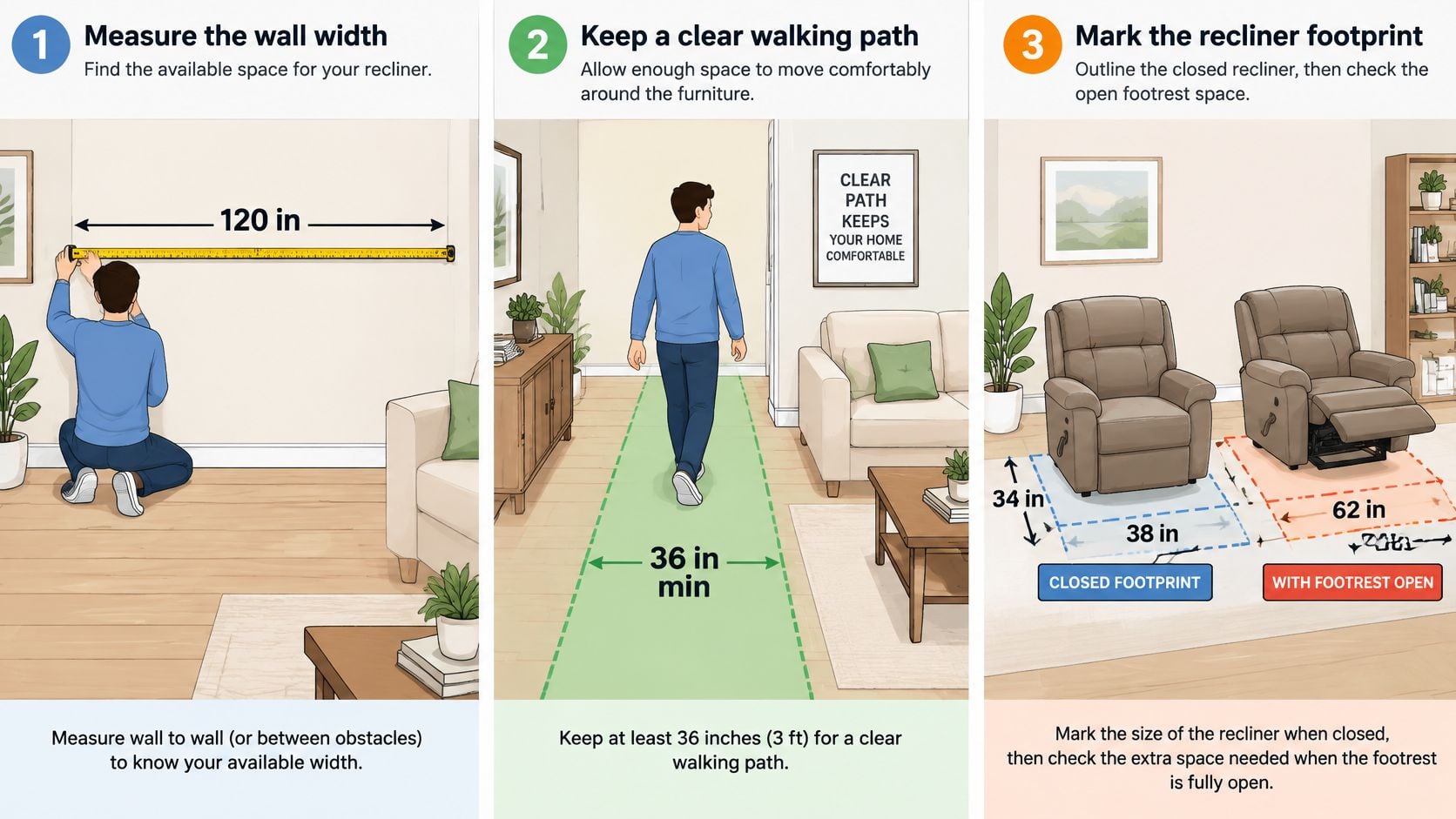
Test a layout, not just a chair
Consider a hypothetical narrow room with a sofa along the long wall. A 36-inch-wide recliner angled opposite it might leave a workable route around the seating group, provided its fully extended footrest stays outside that route. Adding another recliner could eliminate the same passage, even though each chair fits individually.
This example doesn't establish a universal room size. It shows why furniture count, orientation, and movement must be tested together.
A sofa can define the conversation area in an open family room in Norwich, New London, or Waterford. A recliner usually works better near the edge of that group than directly across the room's main traffic line.
- Limited wall space: Start with a recliner or chair-and-a-half, then confirm the usable seat and open footprint.
- A long gathering wall: Consider a sofa that anchors the room without crowding adjacent openings.
- A middle footprint: A small reclining sofa may suit the household, but every moving section still needs clearance.
Practical rule: Buy from the fully open footprint, not the catalog photo.
Power cords also need a planned route. They shouldn't cross a walkway or become pinched beneath moving furniture, and a nearby table should remain reachable without leaning across an opening mechanism.
Which Seat Matches How You Live
The right seat is a fit decision: check how your body rests, how easily you stand, and whether the seat suits the way your household uses the room.
| Situation | Lean toward | Confirm in the showroom |
|---|---|---|
| One person, long TV or reading sessions | Recliner | Head, lower back, and calves stay supported in partial and full recline |
| Couple or guests most evenings | Sofa | Seat depth lets each person sit with their back against the backrest |
| Older adult or difficulty standing | Power lift chair assessment | Suitable seat height, stable arm support, and a controlled rise |
| Open family room, mixed use | Sofa plus a recliner | Recliner sits outside the main conversation line |
| Designed, made-to-order look | Custom sofa or styled recliner | Fabric, arm shape, and cushion feel suit the room |
Standing deserves its own test
A study of older adults' seating needs included 437 valid respondents aged 60–75 and identified low sofa seats and inadequate armrests as obstacles to standing from a seated position. A higher seat or rising assistance may reduce the effort, but the right height still depends on the person.
Age alone doesn't determine whether a lift chair is needed. Watch how the sitter moves: difficulty bringing the body forward, repeated pushing against soft arms, or pulling on nearby furniture can all signal that standing takes extra effort.
A standard recliner adjusts sitting posture. A power lift chair also assists with the move toward standing, so assess its controls, lifting motion, and final position in person. The feet should settle securely, and the person should feel steady as the chair rises.
- Arm support: The sitter should reach a stable surface to grip or push against.
- Foot placement: Feet should move into a secure position for standing.
- Control access: Buttons should be easy to understand and reach without twisting.
- Caregiver needs: If someone helps daily, have that helper attend the fitting.
Mixed households need different seats
A family room can support more than one preferred posture. A sofa suits conversation, while a recliner set slightly outside the main grouping gives one person adjustable support without putting the chair in the way of the gathering.
For households with children or animals, consider fabric and the safety of moving parts as well as appearance. Gorins' guide to kid-friendly and pet-friendly furniture can help with upholstery choices. Keep children and pets clear before operating a reclining mechanism.
Coordinated seating doesn't require matching pieces. A sofa and recliner can share a color family or texture while keeping distinct shapes. Farmhouse World's living room decor guide offers ideas for combining seating with rugs, lighting, and accessories.
Customization can also help connect adjoining rooms. The Canadel Custom Dining partnership offers thousands of combinations for households coordinating their spaces. Shoppers comparing Canadel options in Connecticut can use finish and fabric samples to connect rooms without making every surface match.
Choose the seat that fits your household's routines, bodies, and room, not the one that feels plushest at first.
Price Durability and Ten Year Value
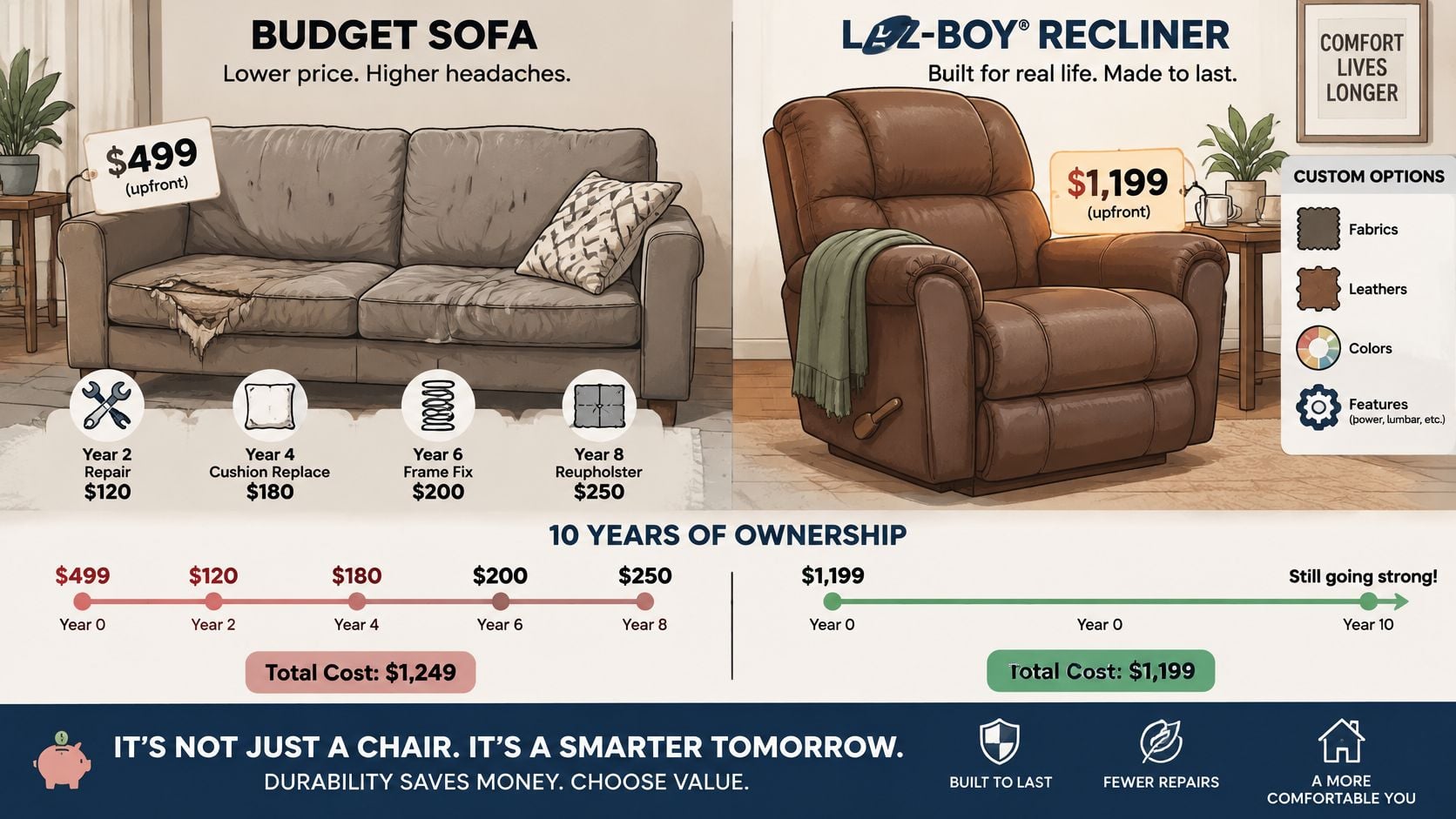
Over ten years, value depends on more than the price tag. A seat's frame, cushions, upholstery, and any moving or electrical parts all affect what it takes to keep the piece in service.
A furniture ownership and circularity paper reports a 2024 survey of 4,216 respondents across Germany, Italy, India, and South Africa. It discusses how repair price and perceived repairability influence repair decisions, and how convenient reuse and disposal options can affect furniture's useful life.
Compare what can wear or fail
A standard sofa usually has fewer moving components, but its frame, cushion cores, suspension, seams, and upholstery can still wear. Reupholstery may not be economical, so ask whether cushion cores and covers can be replaced before assuming the sofa will be easy to renew.
A recliner adds a mechanism, and powered models also have electrical components. Those parts create more potential repair needs, but a frequently used chair can still be good value when replacement components and service are available.
The illustration shows one possible ownership scenario. Without product-specific purchase prices, repair costs, or lifespan guarantees, it cannot establish a universal winner.
Ask service questions before ordering
- Warranty coverage: Which parts, labor, transport, and service visits are covered, and for how long?
- Local repairs: Who diagnoses a problem, and does service take place at home or elsewhere?
- Replacement components: Can the mechanism, motor, control, or power supply be ordered separately?
- Cushion access: Do covers unzip, and can worn cushion cores be replaced?
- Future moving: Can the piece pass through the next doorway or stairwell without damage?
- End-of-use options: Could the furniture be repaired, resold, donated, or responsibly removed?
Fabric affects upkeep, too. Gorins' guide to upholstery materials explains how material choice relates to cleaning and care. Follow the care instructions for the selected fabric or leather rather than treating all upholstery alike.
Investment-grade quality means identifiable construction and support, not merely a higher price. Gorins offers Promotional Financing with equal monthly payments, subject to approval and confirmed terms. Clearance can also offer value when the floor sample fits the body and room, and its service expectations are clear.
Over a decade, the better investment is the seat the household can keep in use, repair, move, or responsibly replace without unnecessary difficulty.
Test the Seat Before You Order
A showroom trial can reveal whether a seat fits the person and the way they use it. Sit as you would at home, then check how easily you can stand and, for a recliner, how much room it needs when open.
Gorins' guide to choosing a new sofa or chair can help you prepare focused questions. Bring room measurements and wear shoes similar to those you use at home.
Follow a deliberate showroom sequence
- Sit back fully. Give yourself time to notice discomfort. On a recliner, try the full range of movement and check each position.
- Test support during an activity. Hold a book or look toward an imagined television position. Check whether your shoulders relax and your head feels balanced.
- Stand up more than once. Notice whether you can move forward and rise without pulling on a side table. Compare how the arms support you.
- Check your room notes. Ask an associate to compare the open footprint, delivery route, and power access with your measurements.
- Compare stock and made-to-order options. A custom sofa or special-order recliner is worth considering when it addresses a specific need, such as a particular fabric, shape, or firmness.
Include delivery and support in the decision
Ask how Gorins' 5-Star Delivery and post-purchase service apply to the piece you choose. If you're considering promotional financing, review the terms alongside the fit and features.
Gorins is a locally owned, family-operated showroom serving Norwich, New London, Plainfield, Waterford, and surrounding Eastern Connecticut and Rhode Island communities. Its offerings include custom Canadel dining options and a Sleep Gallery with Tempur-Pedic products.
Shoppers across Norwich and eastern Connecticut can get in-person guidance on seating, custom dining, and the Sleep Gallery at Gorins Furniture & Mattress. Visit the Norwich showroom to compare recliners and sofas by fit, take the online Style Quiz to narrow your style choices, or browse the Clearance section.