Mattress Shopping Guide: Firmness, Materials and Warranties


Adults aged 18 to 60 are generally advised to get at least 7 hours of sleep per night, yet CDC data from the 2014 Behavioral Risk Factor Surveillance System covering 444,306 adults found that 34.8% reported less than 7 hours. That's the context for any honest mattress shopping guide. A mattress can't fix a late schedule or a noisy room, but pain, pressure, heat, and a partner's movement are fixable, and they decide whether time in bed becomes actual rest.
For our neighbors in Norwich, the practical order is simple. Start with firmness as a personal test result, not a label. Then compare materials, size, warranty fine print, and trial costs. A bed that feels fine for ninety seconds can feel very different after a month, once comfort layers break in and a soft spot at the hips shows up in the morning.
Match Firmness to How You Sleep
Short sleep is common enough that comfort shouldn't be treated as a luxury preference. Support, pressure relief, temperature, and motion isolation deserve the same attention as price, because a mattress that reduces nighttime disturbance helps protect the sleep opportunity most adults already struggle to get.
Use the table below as a starting hypothesis, not a verdict. Body weight, an old injury, and how much time someone spends in a secondary position can move the right answer one step softer or firmer.
Starting Comfort Level by Sleeper Profile
| Sleeper profile | Starting comfort level | What to check first |
|---|---|---|
| Side sleeper | Plush or Medium | Shoulder and hip pressure relief |
| Back sleeper | Medium | Lower back support and spinal alignment |
| Stomach sleeper | Medium-Firm or Firm | Hips that do not sink |
| Combination sleeper | Medium | Quick response when changing position |
| Chronic low-back pain | Medium-Firm | Pelvis that does not hammock downward |
| Couples with different habits | Medium | Motion transfer and edge support |
Side sleepers put concentrated weight through the shoulder and hip. Those points need to settle enough that the spine stays level, which is why Plush or Medium is the usual starting range. A surface that's too firm pushes back, pinches the shoulder, and often sends an arm numb. Shoppers in that position can narrow options further with guidance tailored to side sleeping positions, then confirm the feel in person.
Back sleepers need the lower back filled in without a gap under the lumbar curve. Medium usually does that work. Stomach sleepers need the opposite protection, enough resistance so the hips don't drop and arch the lower back, hence Medium-Firm or Firm. Combination sleepers should start at Medium and pay attention to response, because a slow, deep contour can make turning feel like work by 2 a.m.
What the First Lie-Down Should Tell You
For chronic low-back pain, firmer isn't automatically healthier. A mattress can feel hard on top while still letting the pelvis hammock downward, and that combination helps nobody. Separate surface softness from underlying support every time.
First check: the spine feels neutral, the hips don't sink below the shoulders, and the shoulders aren't pinched upward.
Gorins Furniture & Mattress stocks Plush, Ultra-Plush, Medium, Firm, and Extra Firm, so shoppers can move one step at a time instead of jumping from very soft to very hard. In the Norwich showroom, that starting point gets paired with Style Quiz results and a proper lie-down. Couples should test motion transfer separately from firmness, since a compromise feel can still fail if every turn travels across the bed.
Compare Mattress Types and Materials
Construction decides how a mattress handles heat, movement, and pressure over years, not just on night one. The table gives the scan. The paragraphs after it give the trade-offs worth testing.
Mattress Constructions Compared
| Construction | How it feels | Strengths | Watch-outs |
|---|---|---|---|
| Memory foam | Contouring, slower response | Pressure relief and motion isolation | Can trap heat |
| Gel memory foam | Contouring with a cooler surface | Temperature management claims | Cooling varies by sleeper and room |
| Hybrid | Layered, springy and supportive | Support with airflow and bounce | Heavier to move; confirm base compatibility |
| Innerspring | Firm and responsive | Airflow and strong edge support | Less pressure relief; more motion transfer |
| All-foam | Varies by density | Lightweight and easy to move | Density drives durability |
Memory foam, including Tempur-Pedic models, contours closely around shoulders and hips and isolates motion well. That close contour is exactly what many side sleepers want, and anyone comparing contour depth against medical pressure needs can use DME Superstore's pressure relief mattress guide as a useful reference for how pressure relief is described. The trade-off is heat retention and a slower response when changing position. Hot sleepers should test memory foam under a blanket, not just with a hand press.
Hybrids, including Serta and Beautyrest designs, layer coils or pocketed springs under foam or latex. They typically offer more lift, airflow, and bounce than all-foam beds, which suits combination sleepers and couples who move a lot. Shoppers weighing that lift against a traditional spring feel can review how hybrid and innerspring constructions differ before testing both side by side.
Innerspring mattresses feel responsive and breathe well, and many have a firmer edge for sitting or getting dressed. They usually transfer more motion and give less pressure relief at the shoulder and hip. A thinner comfort layer over coils can feel great to a back sleeper and punishing to a side sleeper, so position testing matters more than coil marketing.
Gel memory foam adds cooling claims, but cooling depends on the sleeper, the room, bedding, and the full material stack, not only the label. All-foam models are lighter on stairs, yet foam density drives durability, so shoppers should ask for it directly.
- Adjustable base compatibility: confirm it before falling for a model.
- Edge support: sit and roll where sleep happens.
- Listed materials: ask whether foam and coil details are disclosed.
The Norwich showroom carries foam, gel memory foam, memory foam, and hybrid types, which makes side-by-side comparison possible in one visit.
How to Test a Mattress Before You Buy
A brief showroom impression misleads because pressure points take time to complain. Shoulders rarely object in minute two. They object at minute twenty, and again at 5 a.m.
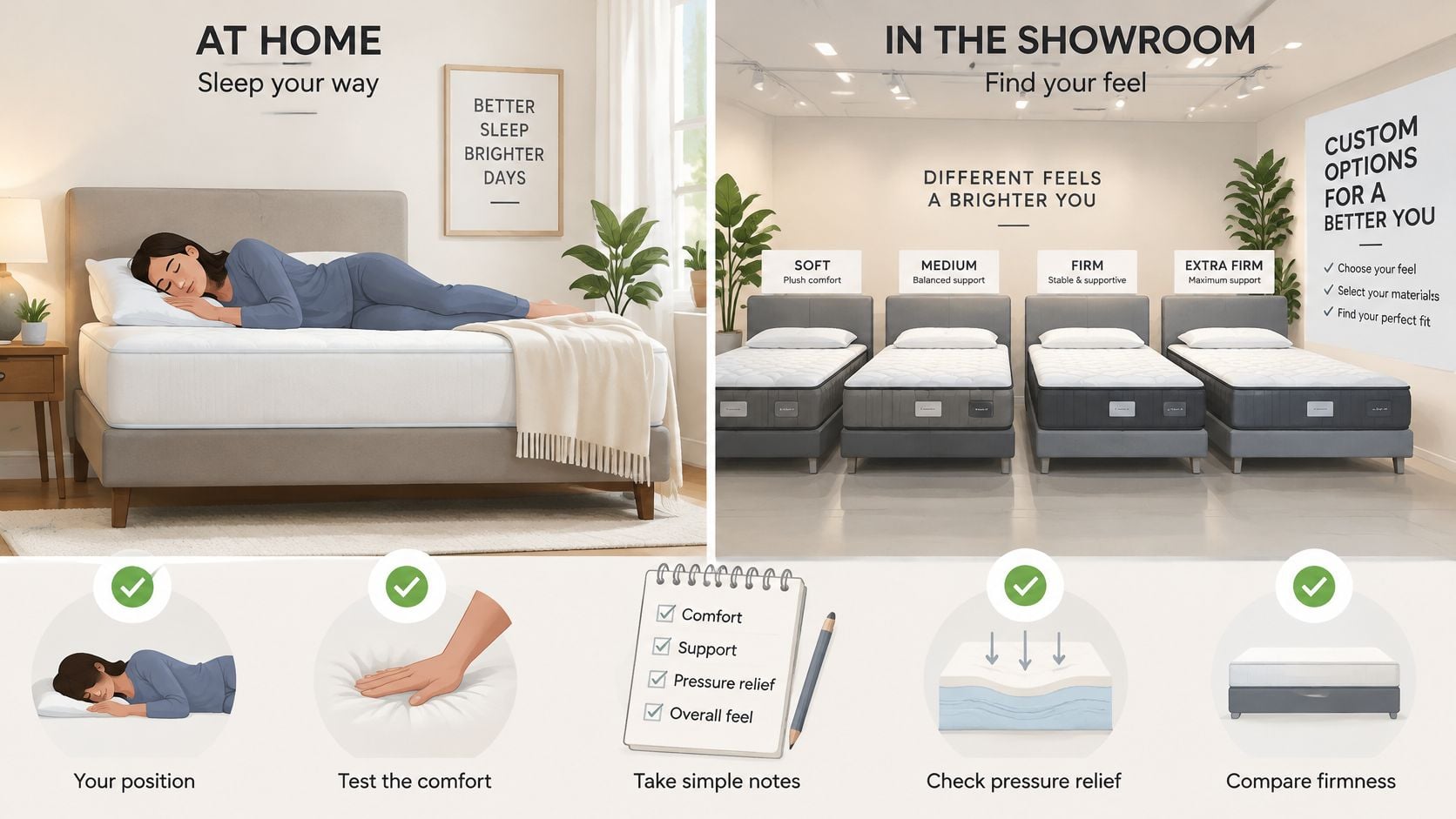
Evidence backs a longer, personal method. In a controlled home study reported by RTI Press, 128 healthy adults used seven mattresses for approximately four weeks each, and firmness significantly affected 9 of 11 key sleep and daytime-function measures. The mattress producing the best outcomes varied substantially among individuals. The least-firm option was consistently linked to poorer sleep and more pain, while the firmest also produced more pain than many alternatives.
A Seven Step Test That Works in the Showroom and at Home
- Shortlist three or four mattresses across a moderate firmness range. Testing only one label, such as firm, proves nothing about whether a step softer would sleep better.
- Lie in the usual sleep position for 10 to 15 minutes, ideally with the usual pillow. Pillow height changes neck and shoulder alignment, so a showroom pillow can distort the result.
- Check pressure and alignment separately. Side sleepers assess shoulder and hip pressure. Back and stomach sleepers check whether the lower back is supported and the pelvis stays level.
- Test the edge. Sit on it, roll toward it, and get up from it. Weak edges shrink the usable surface, which couples feel first.
- Test motion transfer with a partner. One person stays still while the other lies down, turns, and gets up. Shoppers who wake easily can explore mattresses built for motion isolation and then repeat this test on those models.
- Record the top two choices and confirm terms before paying. Ask about the break-in period, pickup terms, restocking charges, refund method, and any minimum trial duration.
- Track results at home for at least two weeks. Note morning pain, nighttime awakenings, perceived sleep quality, and daytime energy. A simple phone note each morning beats a vague memory at day thirty.
The right mattress usually isn't the one that feels most dramatic in the store. It's the one a sleeper wakes up in without thinking about the mattress at all.
At Gorins Furniture & Mattress, customers are encouraged to try different comfort levels in person and compare mattresses side by side. The sales team is described as a no-pressure team that helps customers explore styles, comfort options, room layouts, and finishes. That pacing matters, because rushing a ten-year purchase into a two-minute test is how regret gets delivered.
One more detail separates good testing from guessing. Shoes come off, coats come off, and the test happens in the position used at home, not flat on the back for every model. A stomach sleeper who only tests on the back will learn almost nothing.
Sizes, Budget and Financing Options
Size is a lookup, not a guess. Measure the room, the frame, the bedroom door, and the walkway before falling for a king that leaves no room to make the bed.
Standard Mattress Sizes and Where They Fit
| Size | Best for |
|---|---|
| Twin, 38 by 75 inches | Single sleepers, kids and dorms |
| Twin XL, 38 by 80 inches | Taller single sleepers |
| Full, 54 by 75 inches | Single adults and guest rooms |
| Queen, 60 by 80 inches | Most couples in standard bedrooms |
| King, 76 by 80 inches | Couples who want space and restless sleepers |
| California King, 72 by 84 inches | Tall sleepers in rectangular rooms |
A queen suits most couples in a standard bedroom in Norwich, New London, Plainfield, or Waterford. A king earns its footprint when one partner is restless, a child or pet joins at night, or both sleepers run hot and want separation. A California King trades width for length, so tall sleepers gain legroom while couples lose a little side-to-side space. Full size works for a single adult or guest room but feels tight for two adults night after night.
Leave clearance on at least two sides for walking and sheet changes. A mattress that fits the frame but blocks a door swing or dresser drawer will annoy its owners daily. Adjustable bases, foundations, and box springs also need measuring, since height changes how easy it is to get in and out of bed.
Budget as Value, Not Just a Price Tag
Frame budget as investment and value, suited to your lifestyle, rather than the cheapest sticker. Between tiers, money usually buys better materials, more considered layer counts, stronger support systems, better covers, and longer warranty coverage. It doesn't always buy a better match, which is why testing still comes first.
Set one number that includes the foundation or adjustable base, plus a protector and pillows if those need replacing. Knowledgeable sleep specialists at Gorins Furniture & Mattress help customers find the right mattress based on comfort preferences, sleep position, support needs, and budget.
Promotional Financing with equal monthly payments can lower the barrier on an investment-grade quality bed. Shoppers should ask about the plan terms and whether a no-interest offer applies if the balance is paid in full, subject to credit approval. Anyone weighing that route can read whether financing a mattress makes sense before visiting.
Warranty and Trial Terms to Compare
Don't trust the headline warranty number by itself. Consumer Reports guidance on warranties says the mattress warranties it collects, covering roughly one-third of the mattresses it tests, are most commonly 10 years, while some extend from 12 to 25 years and a small number are lifetime warranties. Its testing expert considers 10 years or longer an ideal warranty duration. A warranty still isn't a guaranteed replacement schedule, and that distinction saves shoppers real frustration.
Read These Terms Before Signing
- Term and prorated coverage: coverage may shrink in value over time, so a long headline can mean partial help later.
- Exclusions: normal softening, comfort preferences, and stains are often not covered.
- Sagging threshold: a dip must reach a measured depth before a claim applies, even if the bed already feels wrong.
- Required foundation: an unsuitable or sagging base can void coverage and make a new mattress underperform.
- Trial length and minimum nights: some trials require a break-in period before a return is accepted.
- Pickup, restocking, and refund method: ask who pays, whether there's a fee, and whether money returns to the card or as store credit.
Shoppers can compare those points against Gorins warranty information and bring specific questions to the showroom. Gorins Furniture & Mattress treats each purchase as an investment-grade decision, and its service department is available for post-purchase questions.
A longer trial only helps if it's used. Sleep on the bed, log mornings, and don't protect a failing purchase out of optimism. The trial-cost layer matters too. A mattress returned after weeks of use generally cannot be resold as new, and returns drive extra production and waste. Ask whether returned units are donated, refurbished, recycled, or landfilled, and how local disposal works in Eastern CT.
The best warranty is the one a shopper can understand in ten minutes, without a magnifying glass or a second phone call.
Compare trial policies by length, cost, and pickup terms together. A generous night count with expensive return pickup may be worse value than a shorter, clearly explained local policy.
Signs It Is Time to Replace Yours
Set the seven-year rule aside as a deadline. It's a repeated slogan, not a measurement of a specific bed.
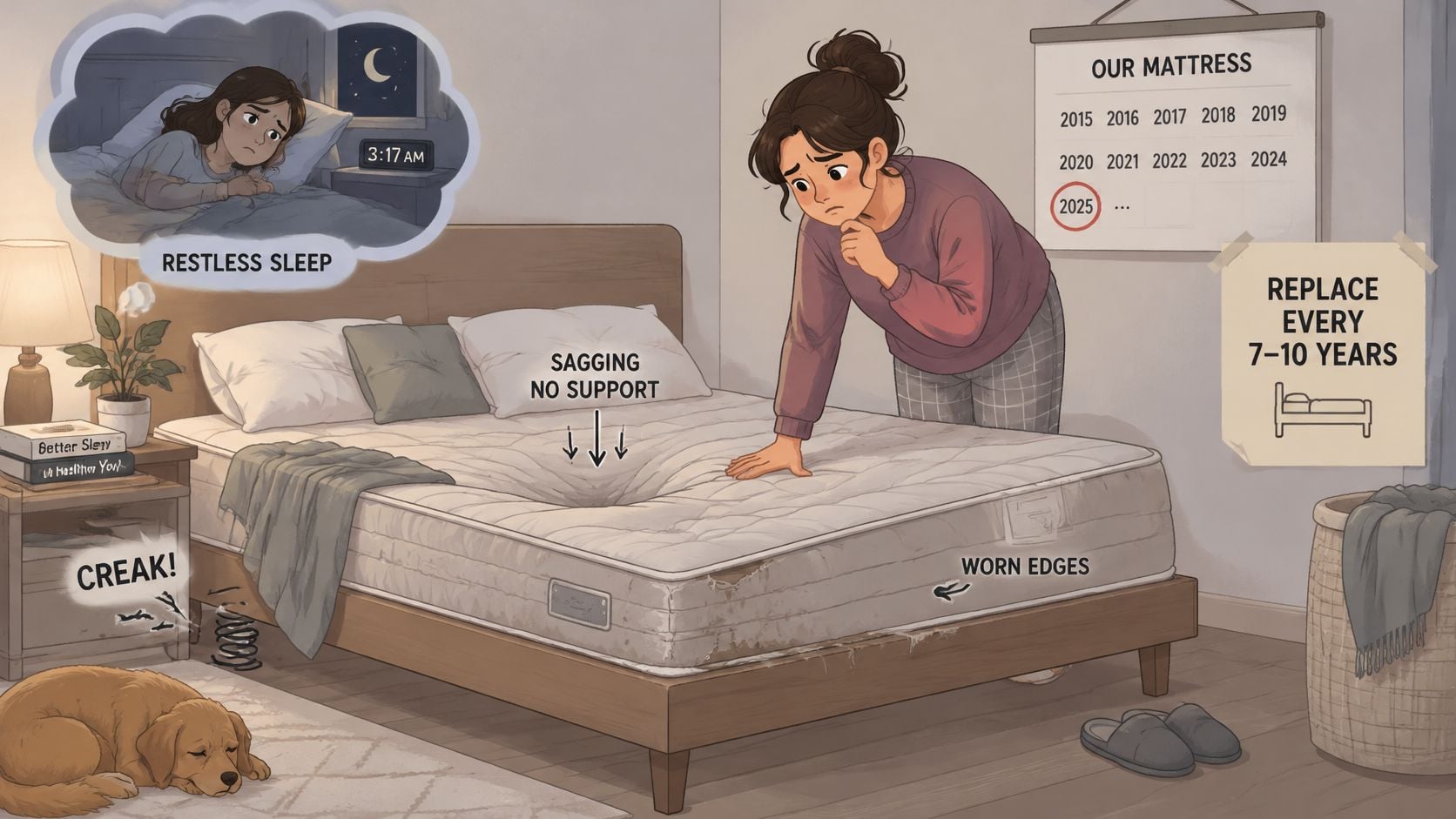
Actual replacement behavior runs longer. Industry research summarized in an independent sleep-information source on mattress lifespan reports a reported average replacement cycle of 9.6 years in 2023. The same summary reports millennials averaged 6.5 years before replacement, whereas baby boomers and older adults averaged 11.7 years. Those figures describe consumer behavior rather than a guaranteed physical lifespan, so age alone shouldn't decide a purchase.
Replacement Signals Worth Acting On
- Visible sagging: a body-shaped dip remains after the sleeper gets up.
- Persistent loss of support: the middle feels hammocked even after rotating the mattress.
- New pressure discomfort: shoulders or hips ache in a way they didn't a year ago.
- Morning aches that ease after rising: pain that fades once upright points back at the sleep surface.
- Better sleep elsewhere: a hotel or guest bed consistently produces a better morning.
One signal alone can have another cause. Two or three together, night after night, make a strong case. Check warranty terms before deciding, because a measurable defect may be covered while normal softening isn't.
Labeling deserves a quick check on any replacement too. In the United States, federal textile-product rules prohibit misleading labeling and require disclosure when previously used stuffing is incorporated into an upholstered product, mattress, or cushion. Transparent labeling is a basic trust test for any seller.
Rule out a fit problem before declaring a mattress finished. A failing foundation can make a sound mattress sag, and a wrong firmness level can create pain in a bed that is structurally fine. If a proper base or a different pillow height fixes the discomfort, the current bed may have years left. If the dip is visible with nobody on it, no pillow will rescue it.
Your Next Step at the Norwich Showroom
A productive visit takes less preparation than most shoppers expect. Bring a sleep position, a rough budget, the current pillow, and a few notes about pain or heat. Those four items give a sleep specialist something real to work with.
The Norwich, CT store has two dedicated mattress showroom areas with over 60 mattresses to choose from, including Tempur-Pedic, Serta, Beautyrest, and Wolf Mattress. That range makes it practical to test two or three comfort levels side by side in the Sleep Gallery, choosing comfort by feel in pursuit of healthier sleep rather than buying from a label.
A Simple Plan for This Week
- Start online if that's easier. Take the online Style Quiz for a first recommendation, then treat it as a shortlist to verify in person.
- Lie down properly in the showroom. Test in the usual position, compare neighbors one step softer and firmer, and check edges and partner movement.
- Confirm the full purchase picture. Ask about foundation fit, warranty terms, trial terms, and Promotional Financing with equal monthly payments.
Delivery and setup are free of charge when a purchase includes a mattress priced at $599 or more, which removes one logistical headache for households across Norwich and surrounding Eastern CT and Rhode Island communities. Value-driven shoppers can also browse the Clearance section for savings on pieces that fit the bedroom.
The rest of the home can follow the same personalized approach. The Canadel Custom Dining partnership and the F9 Custom Sofa series allow thousands of combinations, so a dining set or sofa can be built around a household's lifestyle the way a mattress is matched to a sleeper. Brands such as Flexsteel and Best Home Furnishings sit alongside those custom programs in the showroom.
Since 1936, Gorins Furniture & Mattress has helped Norwich and Eastern CT families create homes they love. From custom-designed Canadel dining sets to the latest in Tempur-Pedic sleep technology, we combine a massive selection with the personalized care only a local, family-owned business can provide. Visit us today to experience quality, value, and our 5-Star Delivery service.
Visit Gorins Furniture & Mattress to test over 60 mattresses in the Norwich showroom, compare Tempur-Pedic, Serta, and Beautyrest by feel, and talk through size, warranty, and financing with a local sleep specialist. Bring a pillow and a sleep position, take the Style Quiz first if starting from home, and leave with a bed matched to actual mornings, not a showroom guess.