Stay Cool Pillow Guide: Materials and Sleep Benefits

The pillow gets flipped to its cool side before midnight, then flipped again an hour later. By morning, the sleeper is arranging towels, opening windows, or searching for a cooler spot while the neck receives little consistent support. For households in Norwich and across Eastern Connecticut, a stay cool pillow can help, but the useful question isn't whether it feels chilly at first touch. The better question is whether it manages heat, supports the sleeper's position, and remains hygienic over time.
The Science Behind a Restful Sleep Temperature
A warm pillow can turn a normal night into a cycle of brief awakenings. Heat builds around the head and neck, the sleeper changes position, and the pillow's surface feels comfortable for a short time before becoming warm again. That pattern can also overlap with broader sleep-maintenance concerns, so readers dealing with repeated nighttime waking may benefit from this resource on sleep maintenance insomnia causes.
The body naturally adjusts its temperature as sleep begins and continues. A cooler head and neck environment can support that transition, while trapped warmth and moisture can make comfort harder to maintain. A cooling pillow shouldn't be treated as a cure for every sleep problem, but it can serve a practical role by helping remove excess heat from the area that stays in contact with the pillow for hours.
What the clinical evidence adds
An older clinical study provides a useful historical marker for the category. Researchers compared a pillow containing a special cool medium made from sodium sulfate and ceramic fiber with a standard polyester pillow in a bedroom maintained at 27°C, about 80.6°F, and 55% relative humidity. During the latter half of the overnight trial, rectal and forehead skin temperatures and heart rate were significantly lower in the cooling-pillow group, and every subject judged that pillow better for deeper sleep. The study is indexed through the category background described by this cooling pillow research overview.
That finding matters because it connects head cooling with measurable physiological changes under controlled conditions. It doesn't mean every product will perform identically, and it doesn't promise that a pillow will remain cold until morning. It does show that the principle behind cooling bedding has been examined beyond simple advertising language.
Practical rule: A pillow that feels cool for a few minutes may be pleasant, but sustained heat dissipation is the feature that matters after the sleeper has been in bed for hours.
Room temperature, blankets, sleepwear, mattress materials, and humidity all influence the result. A useful guide to sleeping cooler at night can help address the wider sleep environment, because even a well-designed pillow can't overcome heavy bedding that holds warmth around the entire body.
Comparing Cooling Technologies and Materials
Cooling materials don't all manage heat in the same way. Some absorb warmth, some encourage airflow, and some change how the surface handles heat when the sleeper first lies down. The feel also varies, from contouring and dense to buoyant and soft, so temperature control needs to be considered alongside support.
| Material | Cooling Mechanism | Best For | Durability |
|---|---|---|---|
| Gel-infused memory foam | Absorbs and spreads heat through a cooling layer or gel-infused core | Sleepers who prefer contouring support | Can be durable, but the foam core usually needs careful spot cleaning |
| Shredded latex | Creates space for airflow while providing responsive support | Sleepers who want ventilation and a springier feel | Often holds its shape well, though construction and cover quality matter |
| Breathable down alternatives | Uses a soft, airy fill to reduce dense heat buildup | Plush-feel sleepers who prefer compressibility | Can require regular reshaping and may perform differently as fill shifts |
| Phase-change fabrics | Absorbs excess heat at the surface as the sleeper makes contact | Sleepers focused on first-contact coolness and surface regulation | Depends on fabric construction, care instructions, and long-term coating performance |
Gel memory foam
Gel-infused memory foam can absorb warmth and distribute it rather than allowing one small area to become a hot spot. Solid foam often provides stable contouring, which can suit sleepers who want the head and neck to feel cradled. Its limitation is airflow. A dense core can still feel warm if the cover, ventilation channels, or surrounding bedding don't allow heat to escape.
Shredded foam changes that equation by leaving more open space inside the pillow. The fill can be adjusted in some designs, but loose components may shift and require occasional reshaping.
Latex and down alternatives
Shredded latex has a more responsive feel than memory foam. It compresses under the head but returns more quickly, and the open structure can support airflow through the core. This makes it a useful option for sleepers who dislike the sinking sensation of dense foam.
Down alternatives offer a softer, more traditional pillow feel. Their cooling performance depends heavily on how the fill is distributed. Baffle-box construction can limit large pockets where warmth collects, while a pillow that clumps may lose both comfort and airflow.
Phase-change fabrics
Phase-change covers are designed to absorb excess heat at contact. They can make the surface feel noticeably cooler when the sleeper first lies down, but surface coolness isn't the same as all-night cooling. Room conditions, body heat, and the pillow's inner core still determine how long that sensation remains useful.
For a broader look at bedding choices for warm sleepers, the cooling bedding guide offers a helpful way to assess the pillow alongside sheets, protectors, and other layers.
Matching Pillow Types to Your Sleep Style
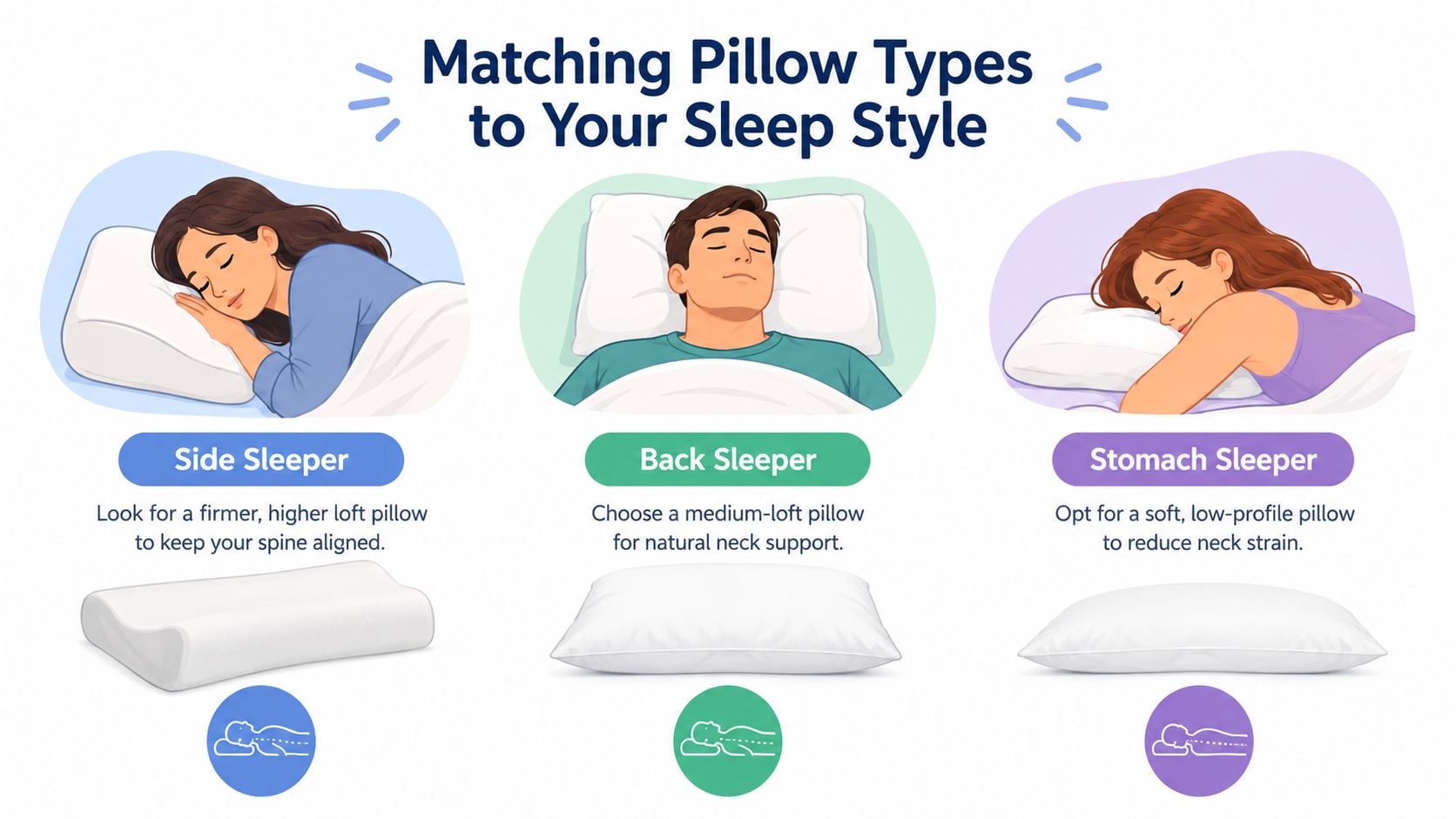
A cooling pillow that doesn't support the neck can create a new problem while solving a temperature complaint. The correct choice starts with sleep position, then moves to loft, firmness, and material response.
Side sleepers
Side sleepers usually need enough height to fill the space between the shoulder and the mattress. A pillow with a higher loft and firmer structure can help keep the neck closer to a neutral line. Dense shredded latex or solid gel memory foam may suit sleepers who want the pillow to resist collapsing during the night.
A very soft pillow can compress beneath the head, leaving the neck angled downward. That can encourage repeated repositioning, which also moves the sleeper away from the pillow's most breathable area.
Back sleepers
Back sleepers often need a middle-ground loft. The pillow should support the natural curve of the neck without pushing the head too far forward. Responsive foam or a moderately supportive adjustable fill can provide gentle contouring while allowing the sleeper to make small position changes.
Mattress firmness also changes the result. A sleeper resting on a more supportive surface may need a different pillow height than the same sleeper on a softer mattress that allows the shoulders to sink farther.
Stomach sleepers
Stomach sleepers generally benefit from a low-loft, compressible pillow. Excessive height forces the neck into a sharper angle, while a softer, flatter design can reduce that strain. Breathable fill may be more useful than a dense core when the face and neck remain close to the pillow surface.
Combination sleepers need flexibility rather than a single rigid specification. An adjustable pillow lets the sleeper remove or add fill until the loft works across changing positions. Readers also need to account for bedding dimensions and surrounding layers, so guidance on choosing a pillow for deep pocket sheets can be useful when a new pillow must work with an existing bedroom setup.
The pillow selection guide can provide another framework for comparing loft and support before visiting a showroom.
Essential Buying Criteria for Temperature Regulation
A cooling label doesn't tell the whole story. Three physical qualities deserve attention before a shopper considers color, branding, or decorative fabric: breathability, support, and loft.
Breathability starts inside the pillow
A cool cover can help at first contact, but the inner core determines whether heat has somewhere to go. Look for construction that permits airflow, such as ventilated foam, open shredded fill, mesh panels, or a less densely packed interior. A moisture-wicking cover can also reduce the clammy feeling that develops when perspiration stays against the skin.
The pillow's surroundings matter too. A thick protector may protect against moisture but reduce airflow if its fabric is dense or poorly fitted. The cover, protector, pillowcase, and core should work as a single system.
Support should remain stable
Support isn't the same as firmness. A supportive pillow keeps its intended shape under the head and returns to position when pressure moves. A firm pillow can still be unsupportive if it compresses unevenly, while a softer adjustable pillow may support the neck well after the fill is properly arranged.
A showroom test can reveal details that product descriptions can't:
- Test rebound: Press the center and watch whether the material recovers smoothly rather than remaining compressed.
- Check edge stability: Rest near the side and notice whether the pillow rolls the head outward.
- Assess pressure: A cooling pillow shouldn't feel so rigid that the sleeper shifts repeatedly to escape pressure.
- Compare positions: Side, back, and stomach positions place different demands on the same design.
Loft depends on the mattress
Loft is the pillow's effective height under real sleeping pressure, not its measurement on a shelf. A softer mattress allows the shoulder and upper body to sink, which can reduce the height needed to keep the neck aligned. A firmer mattress leaves the sleeper higher, so the pillow may need to fill a different gap.
A neutral neck is the target. Temperature control works better when the sleeper isn't constantly moving to escape pressure or poor alignment.
Shoppers searching for Mattresses Norwich CT can test the pillow and mattress together rather than choosing each item in isolation. That pairing creates a more reliable assessment of comfort by feel.
Care and Maintenance for Long-Lasting Coolness
The coolest pillow isn't automatically the best investment. A pillow that cannot be cleaned properly, loses its loft, or develops permanent clumps may deliver less value than a slightly less aggressive cooling design that remains fresh and supportive.
Washability changes the ownership experience
Many high-performance cooling materials, especially solid memory foam, are difficult to clean. The foam core generally requires spot cleaning, while only the removable cover may be suitable for laundering. Fully machine-washable cooling pillows remain relatively uncommon, which makes washability a meaningful differentiator rather than a standard feature.
Before buying, the care label deserves as much attention as the material label. A shopper should confirm whether the cover unzips, whether the inner fill can be washed, and whether the manufacturer permits drying methods that could damage the cooling treatment or distort the shape.
Protect the core from moisture
A breathable pillow protector can limit exposure to sweat, skin oils, and accidental spills without replacing the need for regular care. The protector should fit without compressing the pillow, and it should be washed according to its own instructions.
A practical routine includes:
- Wash removable covers regularly: Follow the product's care label and allow the cover to dry fully before use.
- Air the pillow safely: Place it uncovered in a well-ventilated room, away from direct heat and harsh sunlight.
- Keep the fill distributed: Plump or reshape pillows that use loose fill so heat and moisture don't collect in one compressed area.
- Inspect the structure: Replace the pillow when it stays flattened, develops permanent lumps, or no longer keeps the neck supported.
Good sheet care also affects the pillow environment. A clear sheet-changing guide can help households coordinate pillowcase, protector, and bedding maintenance instead of treating the pillow as an isolated item.
Designing Your Sleep Sanctuary at Gorins
Online descriptions can explain materials, but they can't reproduce the feel of a pillow beneath the head or show how that pillow interacts with a mattress. A practical visit to a sleep showroom allows shoppers to test support, pressure, loft, and surface comfort in the same setting.
Comfort by feel matters
The Sleep Gallery at Gorins Furniture & Mattress gives Norwich-area shoppers a place to compare sleep products by feel. The collection includes Tempur-Pedic, Serta, and Beautyrest, brands that can be discussed through comfort preferences, support needs, and healthier sleep goals rather than a single universal firmness standard.
A knowledgeable associate can ask the questions that matter in daily use:
- Does the sleeper rest mainly on the side, back, stomach, or a combination?
- Does the current pillow feel too high, too flat, or too warm?
- Does the mattress allow the shoulder to sink?
- Does the sleeper prefer contouring foam, responsive latex, or a softer adjustable fill?
- Will existing sheets, protectors, duvets, or electric bedding change the result?
The answer isn't always the pillow with the strongest cooling sensation. A choice suited to your lifestyle may provide better long-term comfort when thermal regulation, neck alignment, and maintenance all receive equal attention.
An investment can be planned
Gorins was founded in 1936 and remains a locally owned, family-operated business serving Norwich, New London, Plainfield, Waterford, and surrounding Eastern Connecticut and Rhode Island communities. Its wider home-furnishing approach includes Canadel Custom Dining and the F9 Custom Sofa series, with thousands of combinations available for shoppers who want furnishings suited to their rooms and routines.
Promotional Financing with equal monthly payments can help lower the immediate barrier to a larger sleep purchase. Under a typical equal-payment structure, the monthly amount stays consistent through the promotional term and is calculated by dividing the purchase amount, plus any applicable promotional fee, by the number of months in the offer, as explained in this promotional financing guide. Credit approval and program terms apply.
Equal payments still require careful planning. On-time payments help avoid late fees, and any balance remaining at the end of the promotional period may remain due or lead to additional charges depending on the program terms, as described in these financing terms.
A complete bedroom plan is easier to evaluate when temperature, mattress feel, lighting, and bedding layers are considered together. The sleep sanctuary planning guide offers a useful companion for that process.
Frequently Asked Questions About Cooling Pillows
Will a cooling pillow work without air conditioning?
It can still help, but the result depends on the room and the rest of the bedding. A cooling pillow may move or absorb heat near the head, yet a warm room, heavy duvet, damp protector, or heat-producing blanket can reduce the overall benefit. Ventilation, lighter layers, moisture control, and a breathable pillowcase support the pillow's role.
Does a compressed memory foam pillow need a break-in period?
A compressed pillow may need time to recover its intended shape after unpacking. It should be placed in a well-ventilated room and allowed to expand according to the manufacturer's instructions. The sleeper should check the final loft and support before using it for a full night, particularly if the pillow still feels uneven or has a strong manufacturing odor.
How long will a cooling pillow last?
There isn't one universal lifespan for every cooling technology. Longevity depends on the core, cover, construction, cleaning routine, moisture exposure, and whether the pillow retains its loft. A pillow needs attention when it remains compressed, develops lumps, feels uneven, or no longer supports the neck as it once did.
Can heavy bedding cancel out the cooling benefit?
It can. A pillow manages only the area around the head and neck, while a heavy duvet or electric blanket can keep the rest of the body warm enough to trigger discomfort. A balanced setup uses breathable layers, a properly fitted protector, and bedding that matches the sleeper's seasonal needs.
Does every stay cool pillow feel cold?
No. Some designs provide an immediately cool surface, while others aim for neutral temperature regulation through airflow, moisture management, or responsive materials. The best choice depends on whether the sleeper wants a cool first touch, sustained heat release, a soft feel, firm neck support, or a washable design.
For local shoppers, a visit to the Norwich showroom makes those differences easier to judge. Gorins Furniture & Mattress offers a Sleep Gallery with Tempur-Pedic, Serta, and Beautyrest, plus pillows and bedding options that can be evaluated through comfort by feel. The showroom also provides personalized furniture guidance, Canadel custom dining with thousands of combinations, F9 custom seating, Promotional Financing with equal monthly payments subject to approval, clearance opportunities, and 5-Star Delivery service.
Visit Gorins Furniture & Mattress in Norwich to test cooling pillow materials alongside supportive mattresses and bedding suited to the local climate. Shoppers can also take the online Style Quiz or browse the Clearance section for value-driven savings while building an investment-grade sleep setup.