Motion Isolation Mattress Guide: Types and Tests

One partner has just settled into sleep when the other rolls over, sits up, or comes home from a late shift. The mattress dips, the surface rebounds, and both sleepers are aware of the movement. By morning, choosing a quieter bed can feel more urgent than choosing a softer one.
A motion isolation mattress should contain those disturbances without making everyday movement difficult. For Norwich households comparing mattresses, the useful question isn't which bed absorbs the most movement. It's which bed keeps a partner comfortable while still offering suitable support, manageable warmth, and an easy way out of bed.
Motion Isolation by Mattress Type at a Glance
Motion isolation by mattress construction
| Construction | How movement travels | Isolation strength | Trade-off |
|---|---|---|---|
| All-foam (memory foam) | Dissipated locally inside continuous foam | Strongest overall tendency | Slower repositioning and less surface bounce |
| Hybrid (foam comfort layers over pocketed coils) | Coils respond individually; foam absorbs additional movement | Strong when coils are individually wrapped and comfort layers are substantial | Coil connections and damping materials determine the balance |
| Pocketed-coil innerspring | Each spring responds more independently | Good with suitable comfort layers | Less isolation when comfort layers are thin |
| Traditional interconnected innerspring | Compression ripples through neighboring coils | Weakest overall tendency | Greater partner disturbance |
This ranking is a starting point, not a guarantee for every model. The Sleep Foundation motion-isolation methodology explains that continuous foam layers generally dissipate movement locally, while interconnected springs transmit it more broadly; pocketed-coil performance also reflects comfort-layer thickness, coil connectivity, and damping materials.
Why the connections matter
Think of interconnected coils as a row of dominoes. Pressure on one part can affect neighboring parts because they're mechanically linked. Separately pocketed springs behave more like individual cushions, compressing mainly beneath the applied load rather than pulling the whole surface along.
That distinction has a long history. According to the history of the Marshall coil, James Marshall received a Canadian patent for pocketed springs in 1900, and Simmons brought the construction to a broader market with Beautyrest in 1925. The important shopping lesson isn't the age of the technology, but the difference between springs that respond independently and springs joined into a network.
Foam handles movement differently. Viscoelastic material deforms under pressure and dissipates movement within the material, rather than relying on spring separation. The showroom's guide to memory foam mattresses offers useful background for shoppers deciding whether that contouring feel sounds comfortable.
A cushioned foam surface may feel wonderfully settled to a light sleeper. Someone who changes position frequently may dislike the same surface because it takes more effort to roll away from the body impression. Stillness and responsiveness aren't the same quality.
Read the layer details, not just the category
The word hybrid doesn't establish how much movement a mattress will transmit. A thin cushion over an energetic spring unit can feel quite different from substantial damping layers over individually responsive coils.
A practical specification checklist includes:
- Coil type: Ask whether the support unit uses pocketed springs or interconnected coils.
- Comfort-layer thickness: Identify the actual cushioning layers above the support core, rather than relying on total mattress height.
- Damping materials: Ask which layers absorb movement and which provide a quicker, springier response.
- Perimeter construction: Check how the edge supports sitting and lying near the side, not merely how substantial it looks.
Pocketed-coil innersprings often appeal to sleepers who prefer a buoyant surface and an open spring interior. Their comfort layers still need scrutiny. A lively surface may suit easy repositioning but transmit more of a partner's abrupt movements.
Adding foam above interconnected springs doesn't automatically remove their shared response, either. The underlying support unit remains part of the movement pathway. Likewise, a taller mattress isn't necessarily a better isolator if much of that height comes from components that rebound readily.
Practical rule: Construction establishes the baseline. The complete layer arrangement determines whether that baseline becomes a comfortable shared bed.
At the Norwich showroom, the most useful comparison pairs a specification check with an actual partner test. A category name narrows the search; it shouldn't make the final decision.
What Motion Isolation Means for Your Sleep
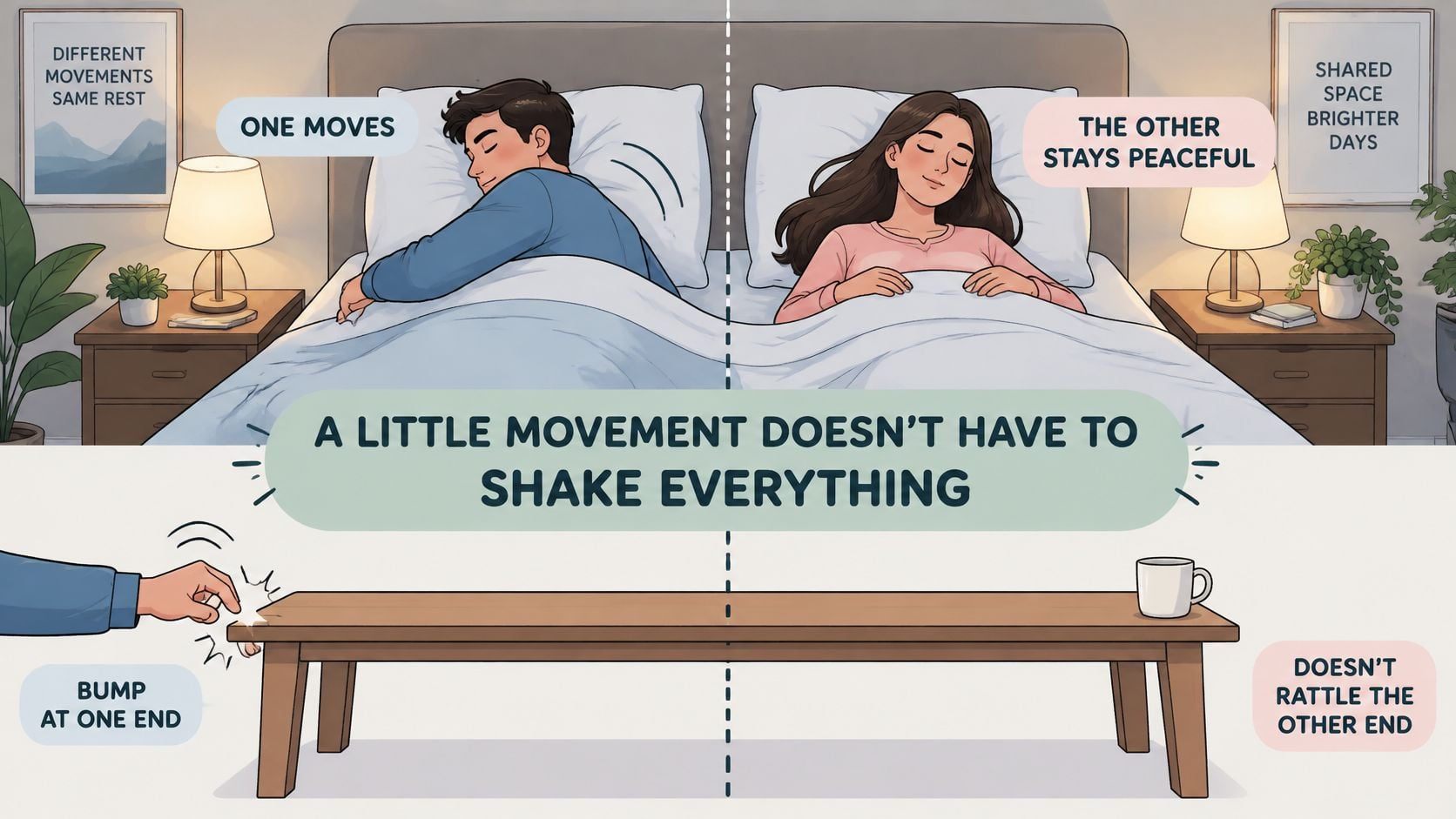
A bump at one end of a shared table shouldn't rattle the glasses at the other. Motion isolation describes how well a mattress keeps movement under one sleeper from reaching the other.
In a 1999 laboratory study indexed by PubMed, researchers simulated a bed partner with a 240-pound, eight-sided cylindrical roller that rocked intermittently during experimental nights, and those movement episodes collectively represented approximately 13% of total sleep time.
Disturbance doesn't always mean waking up
Transferred movement significantly increased Stage 1 sleep, the lightest stage, and significantly reduced Stage 3/4 sleep, associated with deep slow-wave sleep. Overall sleep efficiency, the number of awakenings, and wakefulness after sleep onset stayed statistically unchanged.
The shift toward shallower sleep was more pronounced on mattresses that transferred more motion. The researchers proposed that movement could thin sleep and lower the threshold for arousal from other disturbances, including noise. A partner's turn may never wake you outright. It can still pull you toward lighter sleep.
That distinction matters for a couple whose complaint isn't a clear nightly awakening. One partner can register a shifting surface without remembering any single interruption, then wonder why mornings feel flat. A mattress that localizes movement reduces the impact of turning, climbing into bed, or changing position. Noise and the other arousals the study mentions still travel their own routes.
There's a real trade-off worth knowing before you shop. The conforming, damping layers that localize movement tend to respond more slowly when you change position, and a surface that hugs closely can hold more warmth next to the skin. You can feel the difference in a showroom: have one partner roll or sit on their side while the other lies still and notes what arrives, then have the resting partner try repositioning on that same surface.
For households also working on the restless sleeper's own habits, SleepHabits offers a complementary guide on how to reduce tossing and turning. Moving less and limiting how far movement travels are two different levers, and both can be worth pulling.
Motion isolation shows up in sleep depth and architecture, even when a sleeper never fully wakes.
How Labs Test Motion Transfer
Laboratory testing replaces a vague impression of bounce with a controlled disturbance and an observation point. An accelerometer placed away from the impact records the movement that reaches the other side of the mattress.
The Tom's Guide mattress-testing methodology describes a 5 kg slam-ball setup and distinguishes Initial Impact Absorption, the peak acceleration after impact, from Motion Dampening Speed, the time residual movement takes to return near zero. Lower initial acceleration means a smaller first disturbance; a shorter settling time means less lingering rebound.
Motion transfer test set-ups compared
The protocols below use different impacts and observation methods. Their results aren't interchangeable scores.
| Test | Impact used | What is measured | What it reveals |
|---|---|---|---|
| Accelerometer with slam ball | Standardized slam ball dropped on the opposite side | Initial Impact Absorption and Motion Dampening Speed | Peak disturbance and decay time |
| GoodBed bowling-ball test | 16-pound bowling ball with a bowling pin on glass elsewhere; 200-pound tester body drop | Whether the pin stays still, wiggles, or falls, rated 1 to 10 | Surface disturbance and larger entry-and-exit impacts |
| Sleep Foundation topper testing | Kettlebell dropped from 3 and 5 feet beside a sleeper | Water-container stability and ripples recorded with SensorTag equipment | Movement across the surface and the topper's contribution |
| Published accelerometer protocol | 12-pound medicine ball dropped opposite the sensor | Acceleration range in m/s², plus time to return near zero | Strength and duration of transmitted movement |
A visible indicator makes the outcome easier to understand, but a pin staying upright doesn't reveal every small vibration. Sensor readings can distinguish a sharp initial jolt from a lower-amplitude disturbance that continues afterward.
The larger body-drop test addresses another practical issue. A partner rolling over isn't the same event as a partner sitting down at the edge before standing. A mattress can handle gentle position changes reasonably well yet react noticeably to an abrupt entry or exit.
What shoppers should ask
A useful retailer question is whether movement comparisons can be repeated under the same conditions. The same sleeper, position, action, and observation point make a demonstration more informative than an impressive but inconsistent bounce test.
- Ask about the first impact: Does the still partner feel a distinct jolt?
- Ask about the rebound: Does the surface settle promptly, or continue oscillating?
- Ask about the complete bed: Is the result being attributed to the mattress, a topper, or the support beneath it?
A topper shouldn't be assumed to cure an exceptionally bouncy mattress. The underlying construction remains central to the result. For spring terminology, the showroom's pocket-coil mattress guide helps shoppers ask more precise questions.
Firmness alone isn't a motion-transfer test. A mattress can feel steady under slow pressure and still transmit a sudden sitting impact.
Who Gains Most From Motion Isolation
Couples with different bedtimes, shift workers, light sleepers, and households with pets that jump onto the bed have a clear reason to prioritize movement control. Their shared problem is an incoming disturbance while someone else is trying to remain asleep.
The feature also influences purchasing decisions. According to Gitnux, in 2023, 61% of consumers cited motion isolation as a key reason for choosing foam mattresses. That preference doesn't establish that foam is the right choice for every body or bedroom.
The strongest isolator isn't automatically the right bed
Laboratory evidence discussed in a technical report on viscoelastic surfaces supports their ability to reduce transmitted shock and vibration. It doesn't establish that every sleeper will prefer their feel or receive adequate edge support and ease of repositioning.
A heavier sleeper may compress the mattress differently from a lighter partner. Someone sitting on the perimeter also creates a different loading situation from someone lying near the center. Both partners need to test the mattress, rather than letting the lighter or less movement-sensitive sleeper make the decision alone.
The useful priorities are distinct:
- Prioritize isolation when movement disturbs sleep: Judge the bed from the still partner's position, not only from the moving partner's experience.
- Prioritize responsiveness when turning is difficult: A quiet surface is not helpful if changing position requires repeated pushing and bracing.
- Check perimeter support when sitting matters: Dressing, transferring into bed, and sleeping near the edge deserve their own assessment.
- Keep pressure relief separate: Shoulder or hip discomfort should not be accepted just because the other side feels still.
Temperature regulation belongs on that list, too. A surface that feels pleasant during a quick hand press may feel different after the sleeper settles into it.
For couples balancing several competing needs, the guide to choosing a mattress for couples provides a useful starting point for discussing preferences before a showroom visit. Each partner should name the current bed's most troublesome characteristic.
Comfort boundary: Better movement control isn't a worthwhile trade if the sleeper becomes uncomfortable, overheated, or unable to reposition easily.
A hot sleeper should check temperature regulation before committing to dense foam. Neither a cooling label nor a strong isolation score settles that personal comfort question.
Reading Motion Transfer Numbers Without Guesswork
A foam mattress posts a motion-transfer acceleration range of 10.86 m/s² and a motion duration of 0.75 seconds. Is that good? There is no honest answer until you know what the test did to produce those figures, because the same numbers could describe a gentle drop on soft foam or a heavy impact the mattress absorbed well. Treat them as reference points from a single protocol; no shared pass-or-fail scale exists for them.
How to read motion transfer metrics
| Metric | Unit | What a stronger reading shows | What the number alone misses |
|---|---|---|---|
| Total motion-transfer acceleration range | m/s² | A narrower spread, so less movement reached the sensor | Whether the impact or the rebound produced the extremes |
| Motion duration | Seconds | A disturbance that ends sooner | How sharp the first jolt felt |
| Initial Impact Absorption | Peak acceleration | A smaller spike at the moment of impact | How long the after-bounces continue |
| Motion Dampening Speed | Seconds to return near zero | A quicker return toward stillness | How large that first spike was |
The labels matter as much as the digits. A range captures the extremes of the whole signal, while a peak metric isolates one feature of it, so a published range should never be relabeled as Initial Impact Absorption. Duration works the same way: it only equals dampening speed when the lab defines the settling threshold identically. Similar wording can hide different measurement rules.
Make a fair comparison
Return to that foam mattress at 10.86 m/s² and 0.75 seconds. Suppose a hybrid goes through the same ball, drop height, sensor placement, and repeat procedure, and comes back with a lower range and a shorter duration. On both measures, the hybrid performs better.
Real comparisons are rarely that clean. If the hybrid shows a smaller initial spike but takes longer to settle, the better pick depends on the sleeper. A partner woken by a sudden jolt should weigh the peak; a partner bothered by rippling after-bounces should weigh the duration. A surface that suppresses rebound aggressively also tends to contour more, which can make rolling over feel like climbing out of a dip. The lab numbers describe what reached the sensor, and that recovery effort is one thing they leave out.
A comparison falls apart entirely when two labs use different ball weights, impact locations, or drop heights. A lower number produced by a gentler test says nothing about construction.
Before treating any score as decisive, establish four things:
- The protocol: What created the impact, and where was it applied?
- The observation point: How far did the sensor or still sleeper sit from the impact?
- The metric definition: Is the number a peak, a range, a duration, or a reviewer's own rating?
- The repeat procedure: Were repeated drops used to catch unusual readings, or is one dramatic impact doing all the work?
The personal feel test still decides comfort. When a retailer quotes a motion-transfer figure, I ask one question before anything else: which protocol produced it? A number without a protocol is a rating, and ratings travel poorly between test rigs.
Testing Motion Isolation at the Norwich Showroom
A quick sit on the corner won't reveal how a shared mattress behaves. At the Norwich showroom, a couple can borrow the logic of laboratory testing without bringing weights, glassware, or sensors.
Use the same routine on every candidate
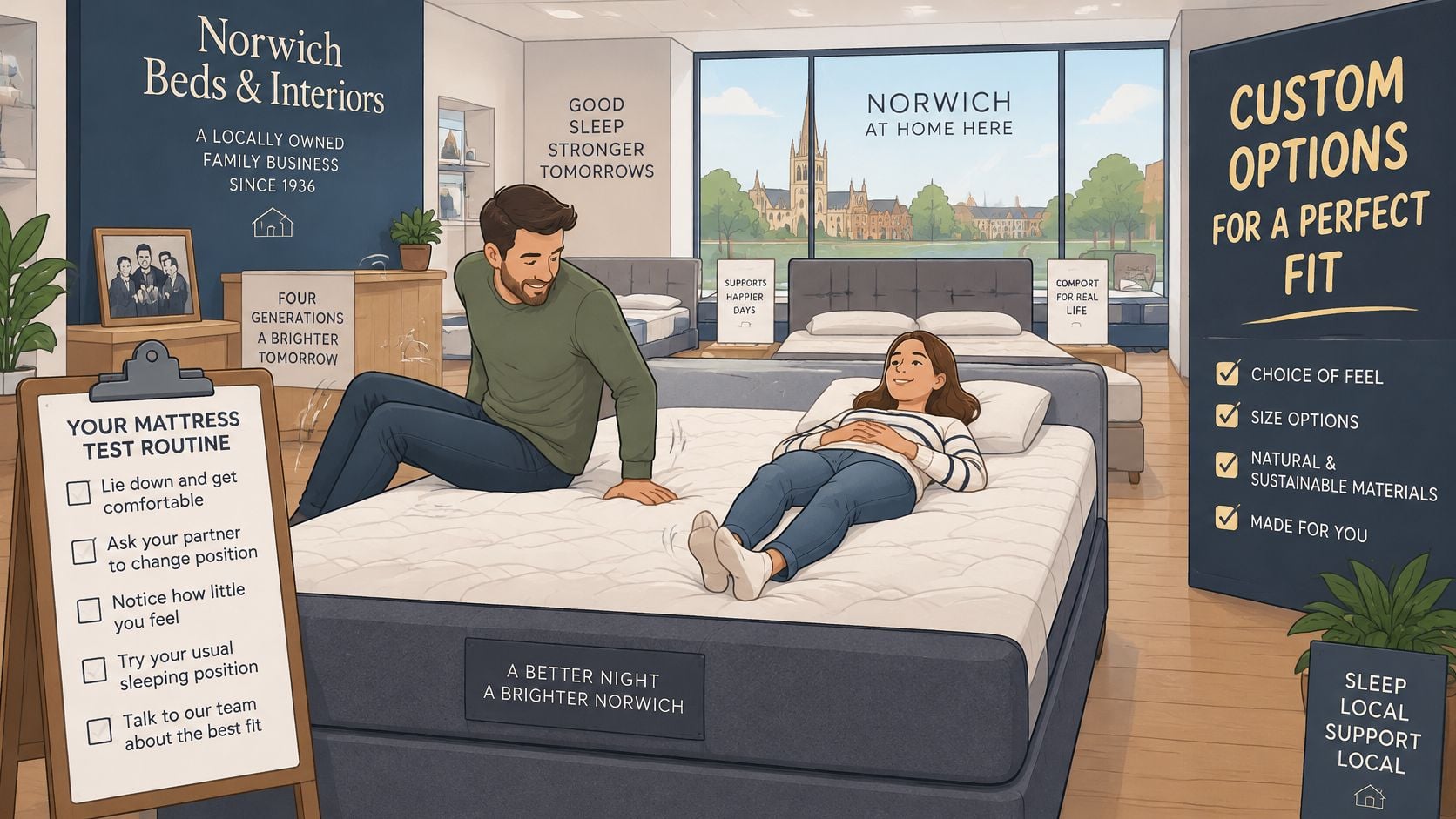
The still sleeper should begin in a normal sleeping position, with an appropriate pillow. The moving partner should repeat ordinary bedtime actions rather than deliberately bouncing, then switch roles.
- Start with an edge sit: One partner sits normally on the edge while the other stays near the center. The still partner notes any sideways tilt, pulling sensation, or dip.
- Repeat a normal rollover: The moving partner turns between usual sleeping positions. The other watches and feels for a ripple, while the moving sleeper checks whether the surface recovers comfortably.
- Practice entry and exit: Use a deliberate, ordinary sit before lying down or standing. Note whether the mattress produces a sharp rebound.
- Check independent movement: Each sleeper rolls, brings the legs toward the edge, and stands. Good isolation shouldn't leave either person struggling in a deep impression.
- Allow a temperature check: Remain still long enough to notice developing warmth. This is an early comfort screen, not proof of overnight cooling.
- Compare constructions fairly: Repeat the same actions on foam, hybrid, and innerspring candidates with similar pillow and sleeping positions.
A simple note on each candidate helps: barely noticeable, noticeable but acceptable, or distracting. Those descriptions are more useful than assigning a precise score without measuring equipment.
Match the test to everyday comfort
The Sleep Gallery includes Tempur-Pedic, Serta, Beautyrest, Stearns & Foster, Sealy, and King Koil, allowing shoppers to compare comfort by feel rather than choosing by brand name alone. The aim is a setup that supports healthier sleep, not a promise that any particular mattress will resolve every sleep complaint.
The mattress firmness guide helps separate the preferred surface feel from the motion test. Both sleepers should remain comfortable in their usual positions, even when their firmness preferences differ.
For neighbors in Norwich, New London, Plainfield, Waterford, and surrounding Eastern CT/Rhode Island communities, bringing a partner makes the showroom visit more informative. After purchase, the 5-Star Delivery team handles the mattress with care, while shoppers should confirm the selected foundation and delivery arrangements before completing the order.
Choose Your Motion Isolation Mattress in Norwich
The decision should begin with the problem that most needs solving. Movement-sensitive sleepers should prioritize isolation; frequent position changers should protect ease of movement; hot sleepers should avoid accepting uncertain temperature comfort just for a quieter surface.
Those priorities rarely point to the same mattress. Deeper foam constructions tend to absorb more movement but can slow repositioning and hold warmth closer to the body, while hybrids with individually wrapped coils often split the difference. The mattress selection guide can help organize those priorities before comparing showroom candidates. A mattress earns its price through suitable construction and comfortable daily use, not through a single feature purchased in isolation.
Make the choice that fits the household
A couple on mismatched schedules gains more from strong damping than two deep sleepers who rarely stir, and a restless combination sleeper needs a surface that gives movement back easily. Weigh the showroom notes against who sleeps on the mattress each night.
Promotional Financing with equal monthly payments, subject to credit approval, can help make a larger purchase manageable. Shoppers should review the applicable terms before choosing a payment program.
- Visit the Norwich showroom: Bring a partner and repeat the movement routine side by side.
- Take the online Style Quiz: Narrow preferences for the wider home while planning the visit.
- Browse the Clearance section: Explore value-driven savings.
Family-owned in Norwich since 1936, Gorins keeps its showroom low-pressure, so couples can take the time the movement test requires. Visit Gorins Furniture & Mattress with a partner, run the same routine across foam, hybrid, and innerspring candidates, and choose the mattress that keeps both sleepers comfortable.