Best Mattress Under 300: A Norwich Buyer’s Guide


A Saturday search for a mattress can start with a simple limit: less than $300. In Norwich, a shopper may find a twin marked at $199, another at $249, and a third at $289, then wonder why the choices feel so different when the prices sit so close together. The answer usually sits in the details, not the sticker.
A budget mattress can offer sound value for a guest room, child's room, rental, or smaller sleeping space. It can also become an expensive mistake if delivery, a required foundation, difficult returns, weak defect coverage, or early loss of support changes the true cost. The best mattress under 300 is therefore the one that delivers suitable support and predictable ownership, not just the lowest advertised number.
A Norwich Neighbor's First Search for a Sub-$300 Mattress
A Norwich homeowner checking listings on a Saturday morning may begin with a twin mattress for a guest room. The first option costs $199, the second $249, and the third $289. All three look affordable until the fine print raises different questions: Does the price include delivery? Is the mattress compressed in a box or delivered flat? Does the bed require a specific foundation? Is the box spring included, or does it cost extra?
Those questions matter because a mattress purchase rarely ends at checkout. A low-priced bed with a paid return shipment can create more financial risk than a slightly higher-priced model with clearer terms. A mattress that requires a new platform or foundation may also move beyond the intended budget before anyone has slept on it.
The questions that belong before checkout
A practical Norwich shopper should ask:
- What arrives at the door: Confirm whether the advertised amount covers delivery, room placement, setup, and removal of the old mattress.
- What happens after a poor fit: Read the return window, pickup process, inspection requirements, and any return-shipping responsibility.
- What supports the mattress: Check whether the manufacturer requires slats, a platform, a box spring, or a particular spacing between supports.
- What the warranty covers: Look for defect definitions, exclusions, transportation charges, and whether the coverage becomes prorated.
- What size the price represents: A bargain twin may not translate into a comparable full, queen, or king price.
A mattress should also be judged against the expected use. A guest-room bed may face occasional use, while a primary bed carries nightly pressure from one or two sleepers. Construction, body size, sleep position, and foundation quality all affect how long the mattress remains comfortable.
Practical rule: The price at checkout is only the opening figure. The useful comparison is the total delivered cost divided by the years of comfortable service.
That is why the search for a sub-$300 mattress quickly becomes a value investigation. Norwich buyers aren't only comparing prices. They're comparing support, materials, delivery, returns, warranty exposure, and the likelihood of replacing the bed sooner than planned.
Where the Under-$300 Mattress Category Actually Sits
The under-$300 category is a meaningful budget segment, but it sits at the lower edge of the wider mattress market. One market summary reports that mattresses priced below $300 represented approximately 15% of purchases, while the most common price band for king-size mattresses, $1,000 to $1,999, represented 28% of purchases. The same market reference places the average U.S. mattress purchase at roughly $763 and a queen-size traditional synthetic innerspring mattress at about $1,050. These figures are reported in the mattress market pricing overview.
That gap changes what “best” can reasonably mean. Under-$300 shoppers are usually prioritizing essential support, an appropriate firmness, manageable delivery, usable warranty terms, and a size that fits the household. Advanced cooling systems, thick comfort packages, elaborate customization, and premium materials may not survive the price ceiling.
A useful price map
| Price Band | Typical Size | Common Construction | Avg. Queen Market Price |
|---|---|---|---|
| Under $200 | Twin or compact formats | Basic foam or simple innerspring | About $1,050 for a queen traditional synthetic innerspring mattress |
| $200 to $300 | Twin and full, with selected queen offers | Entry foam, innerspring, or promotional inventory | About $1,050 for a queen traditional synthetic innerspring mattress |
| Near $300 | Twin or full, with occasional closeout opportunities | More substantial foam, entry hybrid, or floor-model inventory | About $1,050 for a queen traditional synthetic innerspring mattress |
The table shows why size must be checked before construction. A quoted price may reflect a twin rather than a queen, a compact profile rather than a full-height mattress, or a clearance item rather than current production. Promotional pricing can also make a product appear to belong to a better construction tier than its regular specifications justify.
A budget shopper should treat a queen under $300 as a product requiring especially close inspection. The price may be legitimate value, but it may also involve fewer comfort layers, a shorter profile, a discontinued cover, limited availability, or delivery terms that make the final purchase less attractive.
The most useful benchmark isn't whether a mattress resembles a premium bed. It is whether the candidate provides the basics reliably for the intended sleeper. A guest-room twin can be a sensible investment at this level. A primary queen for two larger adults demands more scrutiny because the support system, edge structure, and material specifications carry greater responsibility.
For broader guidance on firmness, construction, and fit, Norwich shoppers can consult this mattress selection guide. The central lesson remains simple: a small price tag doesn't automatically identify a small value.
Foam, Innerspring, and Hybrid Compared Under $300
Construction determines where an affordable mattress feels competent and where it starts making compromises. Foam commonly offers the quietest surface and the easiest boxed delivery. Innerspring models can feel cooler and more supportive at the edge. Hybrids promise a blend of both, but a low price often means thinner comfort layers or a less substantial support package.
The trade-offs by construction
| Type | Support | Motion Isolation | Cooling | Typical Lifespan |
|---|---|---|---|---|
| Foam | Contouring support, dependent on core quality | Usually strong | Can retain heat | About 6 to 7 years on average, according to consumer guidance |
| Innerspring | Responsive support and useful edge feel | Often weaker than foam | Usually more breathable | About 5.5 to 6.5 years on average |
| Hybrid | Balance of coils and foam when layers are substantial | Moderate, depending on the coil system | Often better airflow than all-foam | About 6.5 to 7.5 years on average |
The lifespan estimates above are averages, not promises, and come from consumer guidance on how often a mattress should be replaced. Body weight, sleep position, rotation, foundation quality, moisture, and daily use can shorten or extend the useful period.
Where the budget usually gets trimmed
An under-$300 foam mattress may isolate movement well, which helps a couple or a sleeper sharing space with a restless pet. The trade-off can be heat retention, limited edge support, or a comfort layer that loses its original feel sooner than expected. Buyers should request the layer breakdown rather than relying on broad phrases such as “premium foam.”
Traditional innerspring construction can provide a cooler, more buoyant feel. It may suit a back or stomach sleeper who dislikes sinking, but coil quality, edge reinforcement, padding thickness, and noise control deserve attention. A low price can hide a thinner upholstery package that feels acceptable at first and less comfortable after sustained use.
Hybrids are appealing because they combine coils with foam. Under this budget, however, the word hybrid doesn't guarantee a generous comfort system. A shopper should inspect the total mattress height, foam layers above the coils, edge treatment, and the precise support design.
A candidate should also be compared with the practical needs of the room. Foam may be the better choice for a compact delivery route or a couple prioritizing motion isolation. Innerspring may serve a guest room where easy movement and airflow matter more. Hybrid inventory can be worthwhile when a closeout offers transparent specifications and a sound return policy. More detail on the construction decision appears in this hybrid and innerspring comparison.
How Budget Durability Tested Plus Motion Isolation Really Get Measured
A quick showroom impression can't reveal how a mattress will respond to years of repeated loading. It can, however, help a shopper understand the difference between initial comfort and structural confidence. Independent testing adds another layer by applying repeatable pressure and measuring what happens afterward.
What repeated loading reveals
Consumer Reports uses a durability protocol that rolls a 300-plus-pound wooden cylinder 30,000 times across a mattress, a process intended to simulate roughly 8 to 10 years of use. Its stabilization test drops a 38.5-pound weight and measures vibration at the impact point and across the surface. Those methods are described in its budget mattress testing guidance.
The roller test is useful because low-cost materials can feel comfortable when new yet lose height or shape under repeated pressure. A published result showing resistance to deformation carries more weight than a showroom impression alone. The test doesn't predict the exact experience of every household, but it gives buyers a consistent way to compare products.
The stabilization test addresses motion isolation. If one sleeper turns or rises, the important question is how much movement reaches the other side. Lower transmitted vibration generally means less disturbance, while a more responsive coil system may pass more energy across the surface.
What a Norwich shopper can check directly
In a showroom, a shopper can lie in the usual sleeping position, roll from side to back, and notice whether the surface bottoms out or pushes sharply against the shoulders and hips. Sitting near the edge reveals whether the border holds a person securely or collapses under concentrated weight.
For couples, one person can change position while the other remains still. That simple demonstration won't replace laboratory measurement, but it exposes obvious disturbance and edge weakness. A candidate that feels comfortable for one sleeper may behave differently when two people share it.
Published durability and stabilization results should be read alongside firmness and support information for different body sizes. A mattress shouldn't be judged by one tester's preference alone. More practical advice on reducing disturbance appears in this motion-transfer guide.
Reading Foam Density Numbers Without Getting Misled
Foam buyers often hear two technical terms and treat them as interchangeable. They aren't. ILD or IFD describes firmness, while density describes the amount of material in a given volume and is more closely associated with durability.
Under ASTM D3574-style testing, ILD or IFD measures the force required to compress a standardized foam sample by 25% of its original thickness, as explained in this technical guide to foam density. A higher ILD generally indicates a firmer initial feel. It doesn't prove that the foam will resist permanent deformation.
Density is calculated from mass per unit volume. More polymer generally indicates a heavier, more substantial foam, although density alone doesn't determine comfort, firmness, or the performance of the complete mattress.
A practical specification checklist
| Foam Layer | Minimum Acceptable Density | Typical Budget Density | Target ILD Range |
|---|---|---|---|
| Comfort layer | Request a documented figure, especially for nightly use | Varies by product and construction | Match the sleeper's preferred firmness rather than chasing a universal number |
| Transition layer | Confirm whether a distinct layer exists | Often not disclosed on low-cost listings | Ask how the layer changes pressure relief and support |
| Support core | Look for transparent specifications | May be described only with broad marketing terms | Judge firmness alongside the core design and foundation |
| Any foam layer | Treat missing data as a durability unknown | “High density” alone is not a measurable specification | Compare documented values between similar candidates |
One independent technical reference notes that foam below approximately 30 kg/m³ isn't recommended for mattresses exposed to demanding conditions because lighter grades have poorer fatigue resistance. That benchmark should prompt questions, not a simplistic pass-or-fail decision, because the layer's role and the complete construction also matter.
Questions that expose vague marketing
“High density,” “HD foam,” and “luxury base” don't tell a shopper enough on their own. The buyer should ask for the density of the comfort layer and core, the ILD or IFD where available, the thickness of each layer, and the recommended foundation.
A surface press can reveal immediate firmness, but it can't reveal density. A specification sheet is more useful than a sales label, especially when comparing two mattresses with similar prices. A less expensive mattress with undisclosed foam may be a greater durability gamble than a slightly higher-priced model with clear construction.
For readers who want a plain-language explanation of the material itself, this memory foam mattress guide provides helpful background. The shopping decision should remain focused on documented composition, suitable firmness, and realistic service expectations.
Why a Long Warranty on a Budget Mattress Is Not the Same as Strong Coverage
A long warranty can look reassuring on a product priced below $300. It can also distract from the terms that determine whether a buyer receives meaningful help. Warranty length is only one line in the agreement.
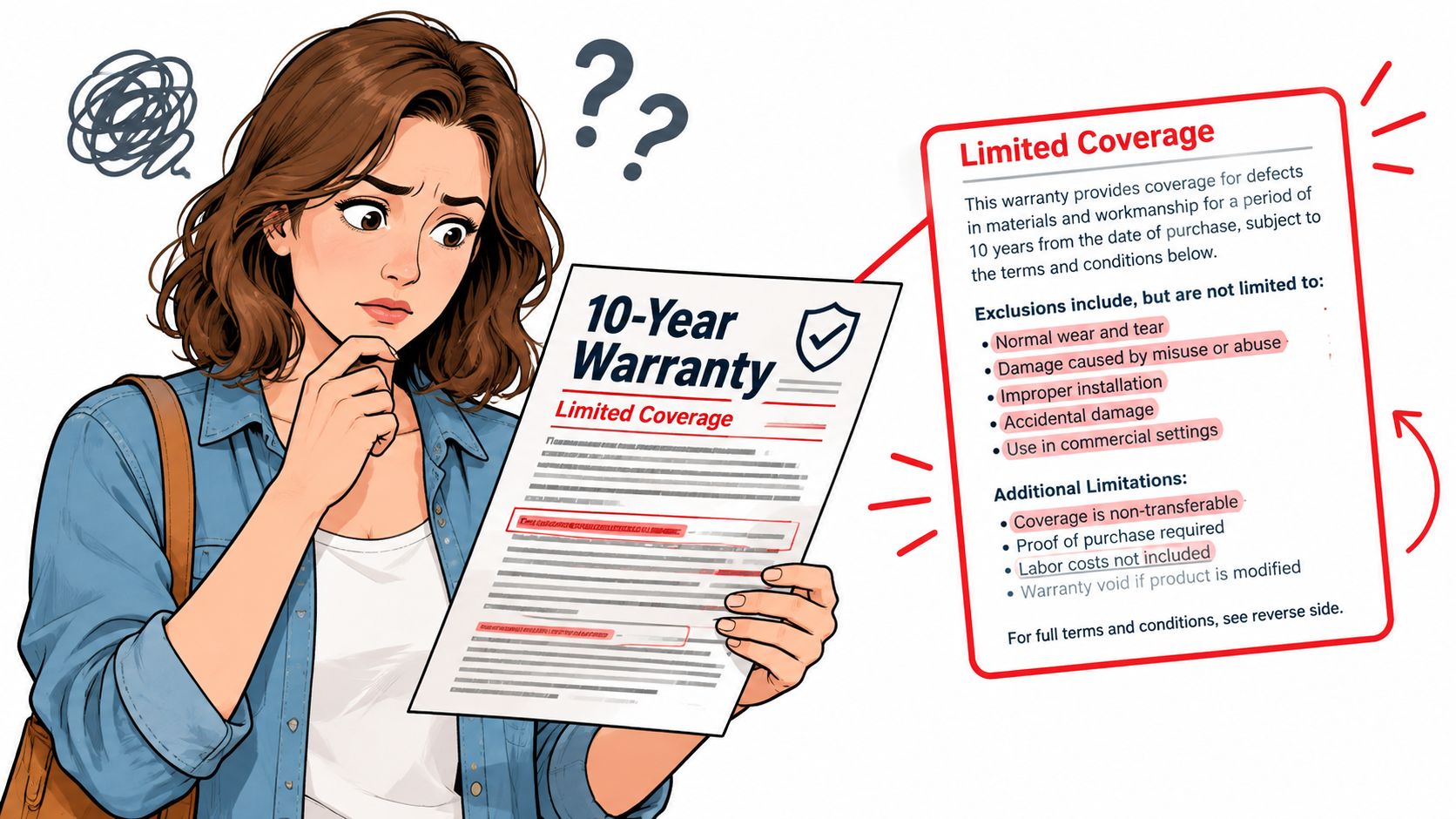
The federal Magnuson-Moss Warranty Act requires consumer-product warranties to be available for review before purchase and written in language consumers can understand. That framework doesn't force every mattress warranty to provide identical protection. Manufacturers can define covered defects, set exclusions, require a suitable foundation, and establish whether replacement becomes prorated.
The coverage structures
- Full, non-prorated coverage: The manufacturer covers an eligible repair or replacement during the stated period, subject to the written exclusions and possible transportation requirements.
- Prorated coverage: The owner pays an increasing share of the replacement cost as the mattress ages.
- Limited coverage: The warranty applies only to specified manufacturing defects, not every change in comfort or appearance.
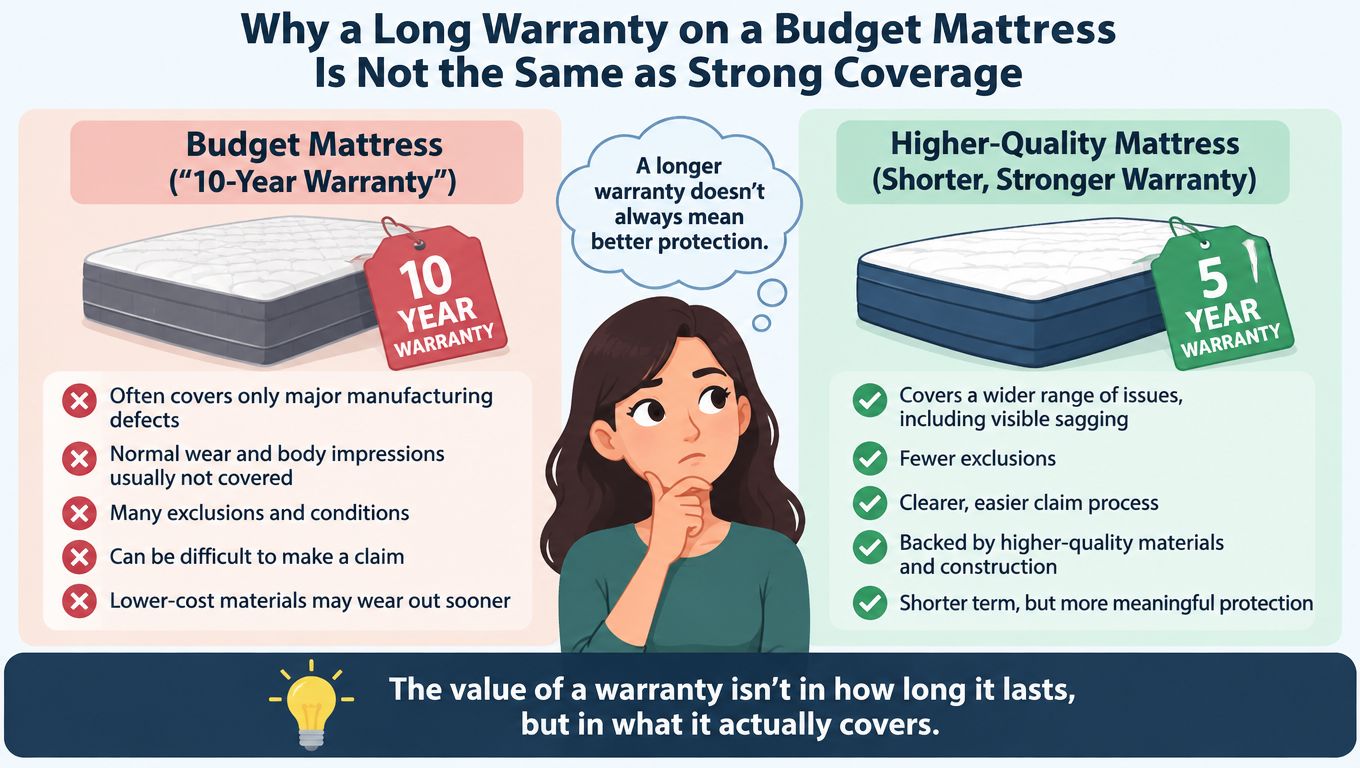
Consumer guidance notes that some mattress warranties last only 90 days, while collected warranty data for many tested products shows terms of roughly 10 years, with some extending from 12 to 25 years. The same guidance stresses that a long term generally covers specified manufacturing defects rather than normal softening, comfort preference, or ordinary wear. Those details appear in this mattress warranty explanation.
The terms worth reading line by line
A Norwich buyer should look for:
- Defect thresholds: The document should state what degree of sagging, separation, or structural failure qualifies.
- Foundation rules: An unsuitable frame can void coverage even when the mattress itself has a manufacturing problem.
- Transport responsibility: The owner may need to pay for inspection, shipping, or return transportation.
- Proration schedule: A replacement promise can become much less valuable if the owner must contribute a rising share of the cost.
- Original purchaser rules: Some warranties don't transfer to a later owner.
A warranty should support the purchase decision, not rescue a poorly specified mattress. The strongest budget choice combines transparent construction, a sensible return policy, and coverage that addresses realistic defects. A headline term without usable protection is just a longer piece of marketing.
Matching an Under-$300 Mattress to Your Sleep Profile
There isn't one universal winner in the budget category. The right choice depends on who sleeps on the mattress, how often the bed is used, and which compromise creates the least trouble.
| Sleep Profile | Best Budget Construction | Why It Works | Typical Price Band |
|---|---|---|---|
| Guest room | Basic foam or simple innerspring | Supports occasional use without demanding premium materials | Lower end of the sub-$300 category |
| Child's room | Twin foam with a practical washable cover | Fits a smaller frame and simplifies routine cleaning | Twin-focused budget pricing |
| Couple | Foam or a motion-conscious coil design | Helps limit disturbance while preserving usable support | Mid to upper end of the category |
| Side sleeper | More cushioning foam or a plush-topped construction | Gives shoulders and hips room to settle | Often requires the stronger end of budget inventory |
| Larger sleeper | Denser foam with reinforced edges | Reduces edge collapse and premature loss of support | May narrow the available size and construction choices |
The room changes the recommendation
A guest-room mattress doesn't need to meet the same demands as a primary bed. A straightforward twin or full can be a sensible value when the room sees occasional use and the foundation is compatible. The buyer should still verify the return and warranty terms, but the expected load is different.
Children create another practical scenario. A twin with a removable or washable cover can matter more than a complex comfort package. The mattress should feel supportive without becoming so firm that it disrupts sleep, and the surrounding bed frame should remain stable.
Couples need to focus on motion and edge behavior. One partner's movement can disturb the other, particularly on a responsive innerspring. Foam often limits that transfer, while a pocket-coil design may offer a compromise between movement control and airflow. The surface should also let each sleeper settle without forcing the heavier person toward the center.
Position and body size deserve equal weight
Side sleepers generally need more pressure relief around the shoulders and hips. At this price point, that may mean choosing a thicker foam surface or accepting a full rather than stretching for a queen with thinner materials. Stomach sleepers usually need a more stable surface, while back and combination sleepers often prefer a middle firmness that balances support and cushioning.
Larger sleepers should examine the edge and core rather than trusting the showroom feel. A mattress that compresses easily under concentrated pressure may lose useful support sooner. Buyers can use this mattress firmness guide to frame the conversation around sleep position and body type.
Sleep quality has a practical health context. The Centers for Disease Control and Prevention recommends at least 7 hours of sleep for adults ages 18 to 60, with different ranges for older adults, as stated in its adult sleep recommendations. A budget mattress earns its place when it supports consistent, comfortable rest, not when it merely fits a shopping filter.
Shopping Smart at Gorins and Around Norwich
A local mattress visit should be treated as a test, not a performance. A shopper needs enough time on each candidate to notice pressure, support, heat, movement, and edge stability. Sitting down for a moment rarely reveals how the surface behaves during a full night.
A showroom inspection that earns its time
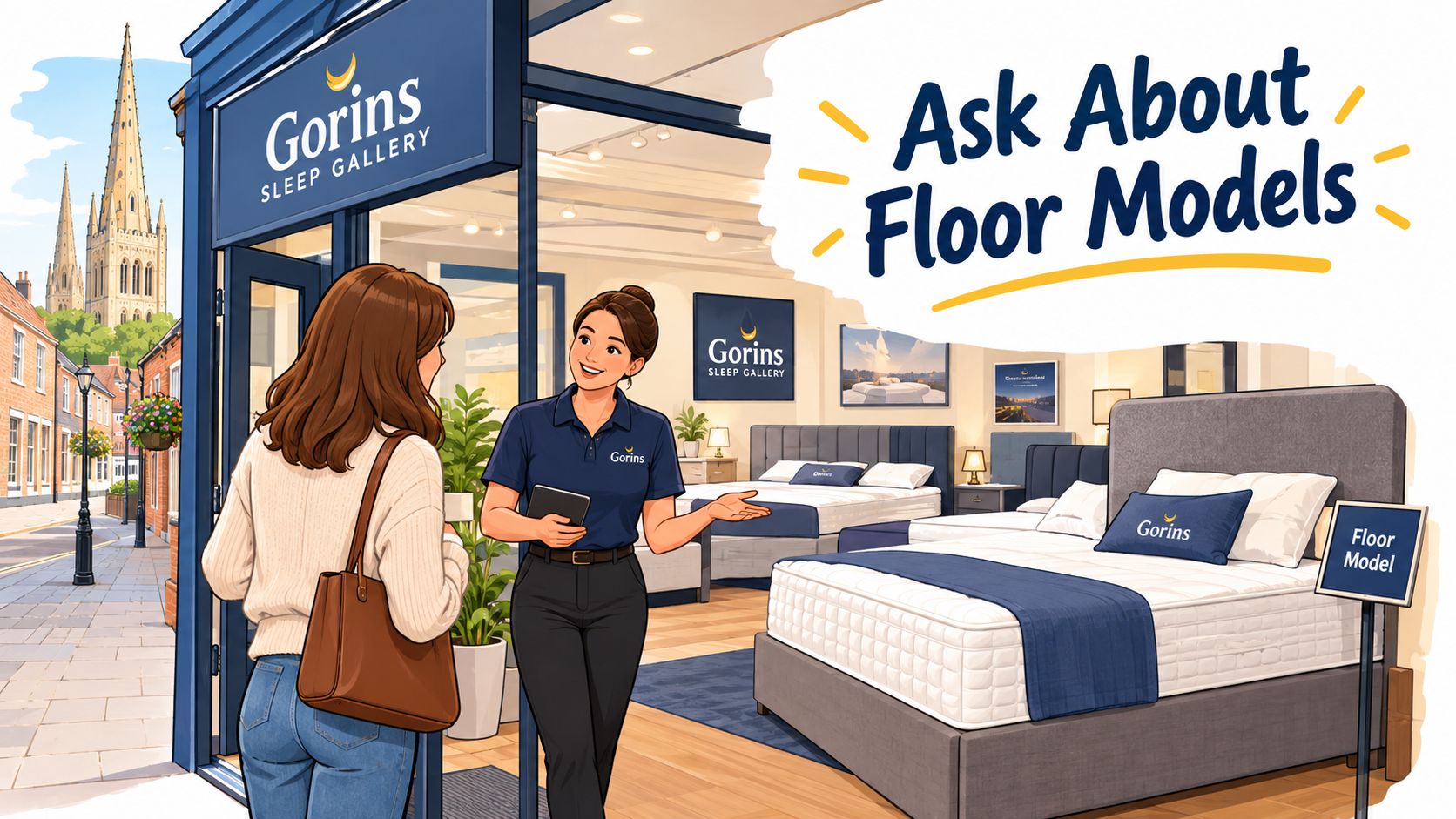
At the Gorins Sleep Gallery, a Norwich shopper can ask about clearance twins, floor models, last-season inventory, and returned products. End-of-line stock can offer genuine value, but the buyer should request the exact condition, warranty status, return terms, and delivery arrangement before treating a reduced price as a bargain.
The physical test should include:
- Lie in the normal position: Side sleepers should check shoulder and hip pressure. Back sleepers should notice whether the lower back feels unsupported or overly arched.
- Change position: A surface that traps the body can become frustrating for combination sleepers.
- Sit on the border: Edge compression matters for getting in and out of bed and for preserving usable sleep space.
- Test shared movement: One person can turn while the other observes disturbance.
- Inspect the paperwork: The law tag and specification sheet may reveal the construction, materials, and care requirements more clearly than the display sign.
Shoppers furnishing temporary housing or worker accommodations may also find this resource on beds for builders working in Norwich Norfolk useful when planning practical sleeping arrangements. The same principle applies at home: the mattress must fit the room, the sleeper, and the delivery plan.

Price timing and financing need discipline
Holiday promotions can change the available value, especially around Presidents' Day, Memorial Day, and Labor Day. A shopper should compare the actual model, size, construction, delivery, and warranty rather than assuming every sale represents the same saving.
Promotional financing can lower the immediate barrier to a better mattress, but a budget purchase shouldn't become an open-ended credit obligation. Equal monthly payments can make sense when the repayment schedule is clear, the buyer can meet every payment, and the final cost is understood. The advertised price should still be compared with the delivered total.
Delivery and old-mattress removal can change the result. Before purchase, the buyer should request a written total that includes the mattress, foundation if required, delivery, setup, removal, taxes, and any return-related responsibility. That final figure determines whether the candidate is the best mattress under 300 or the cheapest listing before the practical costs arrive.
Since 1936, Gorins Furniture & Mattress has helped Norwich and Eastern CT families create homes they love, with a locally owned, family-operated showroom, expert Sleep Gallery guidance, trusted names such as Tempur-Pedic, Serta, and Beautyrest, custom options with thousands of combinations, promotional financing with equal monthly payments, and value-focused clearance choices. Norwich shoppers can visit the showroom to test mattresses by feel, ask about delivery and warranty terms, and find an affordable sleep solution suited to their lifestyle.