Multifunctional Living Room Furniture: A Norwich Guide

A lot of living rooms in Eastern Connecticut are doing too many jobs at once. One room might need to handle movie night, homework, remote work, overnight guests, and the daily shuffle of bags, blankets, and chargers. That's when a space starts feeling crowded even if it isn't especially small.
Multifunctional living room furniture helps solve that problem without making a room feel temporary or overdesigned. The goal isn't to cram in more features. It's to choose pieces that earn their place, support daily routines, and still look right in a real home. For anyone refining a room in Norwich, New London, Plainfield, Waterford, or nearby communities, that usually means shopping with layout, comfort, and durability in mind at the same time.
Table of Contents
- Making Your Living Room Work Harder Not Look Harder
- The Smart Furniture Toolkit Key Multifunctional Pieces
- Choosing Furniture Tailored to Your Lifestyle
- Solving Awkward Layouts With Smart Furniture
- Your Practical Guide to Buying and Measuring
- Your Partner in Home Furnishing Since 1936
Making Your Living Room Work Harder Not Look Harder
A common local scenario goes like this. The sofa is comfortable, but there's nowhere to put extra throws. The coffee table looks good, but it becomes cluttered by the end of every day. Guests visit, and suddenly the room needs to become sleeping space, storage space, and gathering space all at once.
That pressure on one room isn't unusual anymore. The global multifunctional furniture market was valued at USD 7.21 billion in 2023 and is projected to reach USD 11.21 billion by 2030, with growth tied directly to smaller living spaces and strong residential demand, according to Grand View Research's multifunctional furniture market report.
For homeowners and renters, that trend shows up in practical choices. A sectional with a chaise that hides blankets can reduce visual clutter. A sleeper can make hosting easier without turning a living room into a permanent guest room. A compact console can hold media, games, and baskets instead of letting them spread across the room.
Multifunctional furniture works best when it disappears into daily life. The room should feel calmer, not more complicated.
A room like this also benefits from editing the walls, not just the floor. When a living room needs to feel more organized, carefully planned art can help define the space without adding bulk. For anyone sorting out visual balance, these living room gallery wall designs offer useful inspiration for arranging art around seating and storage pieces.
Since 1936, Norwich-area families have looked for furniture that can last through changing homes, changing routines, and changing room needs. That's why multifunctional living room furniture matters. It isn't a passing trick. It's a practical design strategy for people who want one room to do more while still feeling settled, comfortable, and designed for daily life.
The Smart Furniture Toolkit Key Multifunctional Pieces
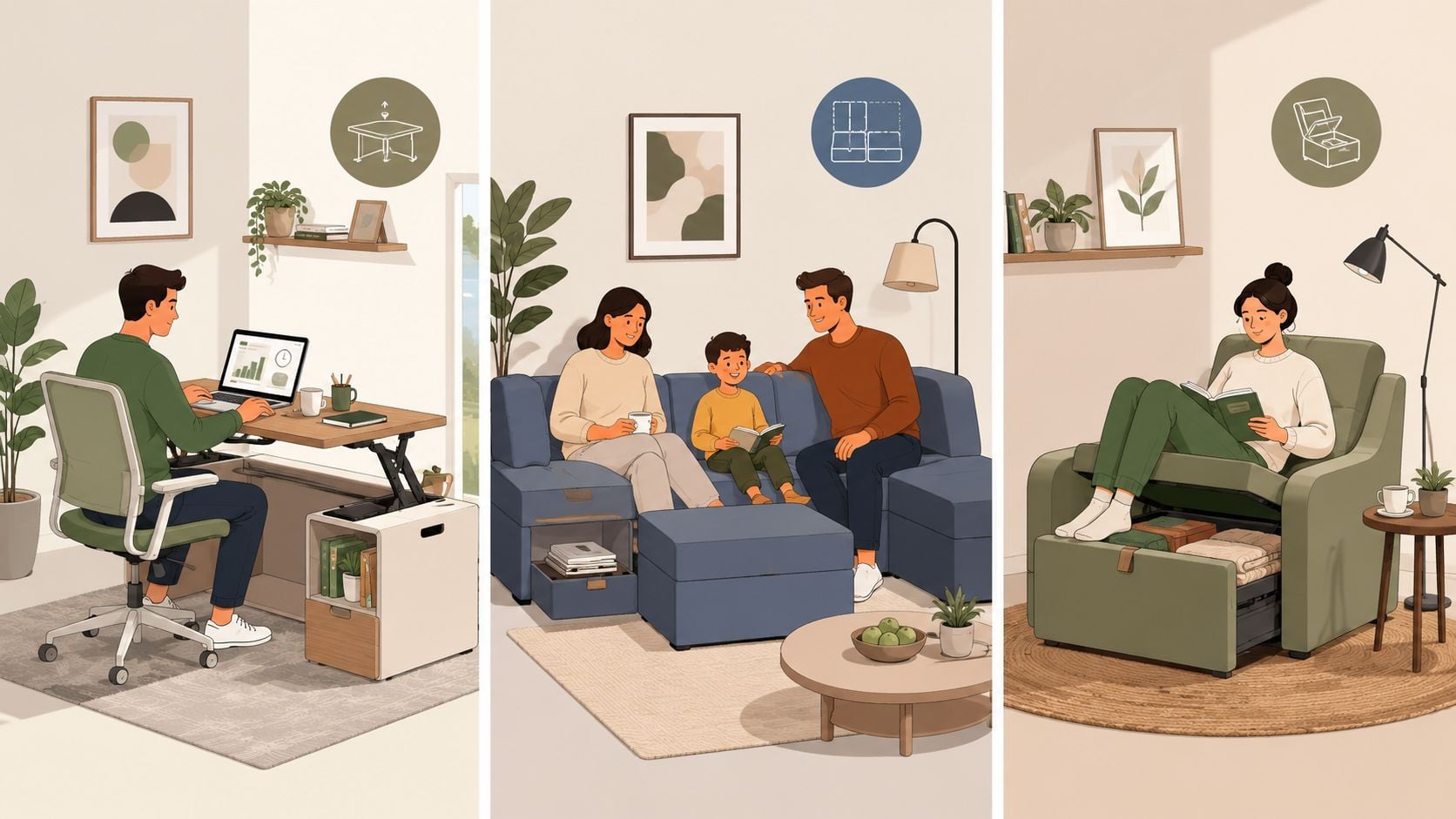
Some furniture saves space. Better furniture saves space and stays pleasant to use. That distinction matters because a piece that looks clever on the sales floor can become frustrating at home if it's hard to open, awkward to move, or uncomfortable in its second role.
What makes a piece genuinely useful
The strongest multifunctional pieces are judged by transformation speed, latch or hinge reliability, and whether the secondary function preserves primary comfort, as noted in this multipurpose furniture guidance from Living Spaces. A sleeper that opens stiffly or sleeps poorly isn't a smart buy just because it folds out.
That's why shoppers should think in terms of repeated use. If a storage ottoman opens every day, the lid should feel secure and easy to handle. If a modular sectional gets rearranged for guests or family gatherings, the connections should stay stable. If a recliner supports mobility needs, the controls should feel simple and dependable.
For readers planning a room that also supports work, Gorins has a related resource on multifunctional home office furniture ideas that helps connect living room flexibility with day-to-day productivity.
Multifunctional furniture at a glance
| Furniture Type | Primary Function | Secondary Function(s) | Best For |
|---|---|---|---|
| Sleeper sofa | Everyday seating | Guest sleeping space | Homes that host overnight visitors |
| Storage ottoman | Footrest or casual table | Hidden storage | Rooms that collect blankets, toys, or remotes |
| Modular sectional | Main seating | Reconfigurable layout | Multi-use rooms and changing routines |
| Lift chair | Supportive seated comfort | Easier standing and reclining support | Users prioritizing comfort and mobility |
| Nesting tables | Surface space | Flexible expansion | Small rooms that need occasional extra table area |
| Media console with storage | TV support | Concealed organization | Family rooms with electronics and accessories |
How each category solves a different problem
Sleeper sofas work well when a living room occasionally becomes a guest room. The practical test is simple. It should seat comfortably in normal use, open without a struggle, and provide a sleep surface that doesn't feel like an afterthought. In a showroom, that means testing the sit first and the sleep second, not the other way around. Selections from Flexsteel and Craftmaster often appeal to shoppers who want that balance of everyday comfort and occasional hospitality.
Storage ottomans are one of the easiest upgrades because they don't demand a full room redesign. They can hold throws, toys, chargers, magazines, or seasonal decor while still serving as a footrest or soft tabletop with a tray. In rooms that need a little greenery but can't spare floor clutter, a vertical accent like a metal plant stand 3 tier can pair nicely with hidden-storage pieces and keep the floor plan cleaner.
Practical rule: If a piece has a second function, that second function should be easy enough to use on an ordinary Tuesday, not just in theory.
Modular sectionals help when the room has to change shape for different moments. One arrangement can support lounging. Another can open up conversation space. Another can make room for a game night or holiday crowd. Investment-grade design matters. The sections should connect cleanly, the scale should fit the room, and the fabric should suit the household.
Lift chairs, especially from UltraComfort, belong in this conversation because they do more than recline. They support comfort, easier transitions in and out of the seat, and longer stretches of daily use. For households where one chair needs to deliver both relaxation and function, that's real multifunctional value.
Nesting tables and storage-forward media consoles solve a quieter kind of problem. They reduce permanent bulk. A nesting table set spreads out when people need drinks and snacks, then tucks back in. A well-designed console hides devices and accessories so the room looks calmer when the day is done.
Choosing Furniture Tailored to Your Lifestyle
The right multifunctional living room furniture depends less on square footage than on daily habits. Two homes with similar room sizes can need completely different furniture if one hosts guests every month and the other handles pets, kids, and constant activity.
The guest-ready home
Some households want the living room to stay polished most of the time but convert gracefully when friends or family stay over. In that setting, a sleeper sofa often makes more sense than adding a dedicated guest bed elsewhere. A storage ottoman can hold extra bedding, and a slim side table can act as a temporary nightstand when needed.
This setup works because it keeps hospitality available without making it permanent. The room still reads as a living room first.
The compact and clever setup
Apartments, condos, and smaller homes often need each piece to pull more weight. A modular sectional can offer seating flexibility without forcing the owner into one layout forever. Nesting tables reduce clutter because they expand only when needed. A console with drawers or doors keeps work supplies, cords, and entertainment gear from taking over visible surfaces.
For shoppers living with pets as well as limited space, material choice matters as much as function. Households that deal with fur every day may also appreciate these expert pet hair solutions when comparing upholstery options and planning maintenance routines. Gorins also offers a helpful guide to kid-friendly and pet-friendly furniture, which can narrow choices by fabric feel, cleanability, and real-life use.
The busy family hub
Family rooms usually need furniture that can absorb daily traffic without becoming a mess magnet. Hidden storage matters here because visible clutter multiplies fast. Modular seating also helps because the room may need to support cartoons in the morning, homework in the afternoon, and company at night.
A useful decision filter looks like this:
- Choose easy maintenance: Fabrics and finishes should tolerate frequent touch, quick cleanup, and repeated use.
- Prioritize flexible surfaces: Soft ottomans, nesting tables, and compact side tables support changing activities better than one oversized fixed table.
- Protect open floor area: Pieces should support movement, especially when children, pets, or multiple adults use the room at once.
The best piece for one household can be the wrong piece for another. A feature only matters if it matches the way the room is actually used.
That's why lifestyle-first shopping usually leads to smarter long-term choices. Instead of asking what's most impressive, shoppers do better asking what will get used comfortably, consistently, and without extra hassle.
Solving Awkward Layouts With Smart Furniture
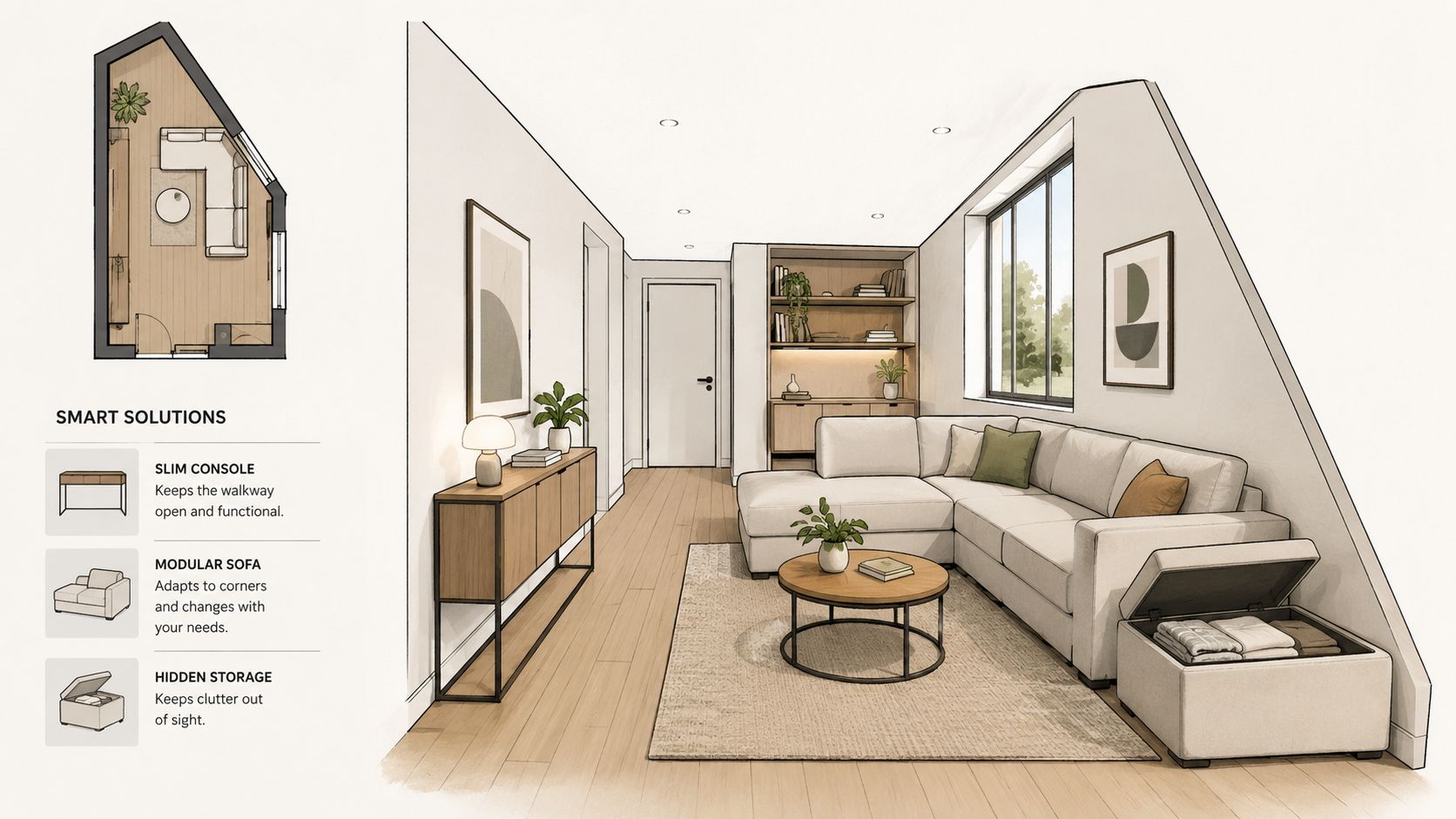
Not every hard living room is small. Plenty of homes around Eastern Connecticut and nearby Rhode Island have rooms with long narrow footprints, angled walls, deep windows, off-center fireplaces, or a television competing with another focal point. Those rooms frustrate shoppers because standard advice about “small-space furniture” doesn't really solve the geometry.
Why small-space advice often misses the point
For awkward layouts, the best multifunctional choice is often not the most feature-packed item. It's the piece that solves the room's shape. Rooms with unusual geometry need furniture that defines zones, preserves circulation, and avoids blocking sightlines, as explained in this awkward living room layout guide.
A long room, for example, may work better with a modular sectional that creates a conversation area in one end and leaves the other end open for reading, work, or traffic. A room with windows on multiple walls may need low-profile storage so natural light and views stay open. A room with a fireplace and television may need movable tables instead of one large center table that locks the layout in place.
Furniture that helps a difficult room behave better
A few layout-based matches tend to work well:
- For long narrow rooms: Modular seating, narrow consoles, and nesting tables help maintain flow without making the room feel like a hallway.
- For angled or irregular walls: Scaled chairs, movable ottomans, and flexible side tables adapt better than one large rectangular arrangement.
- For rooms with competing focal points: Low-profile pieces and lighter visual weight keep the eye from getting stuck on furniture instead of the architecture.
One useful next step is to compare furniture shape to traffic patterns, not just to wall length. A room can technically fit a large piece and still function poorly once people start moving through it.
For homeowners working through that challenge, Gorins shares additional living room layout ideas that can help translate room quirks into workable furniture plans.
A difficult room usually doesn't need more furniture. It needs furniture that leaves the right spaces open.
That's where multifunctional design becomes especially helpful. A nesting table can disappear when the room needs breathing room. A storage bench can define an edge without feeling heavy. A sectional with rearrangeable pieces can respond to the architecture instead of fighting it.
Your Practical Guide to Buying and Measuring

Buying multifunctional living room furniture gets easier when the process starts with the room, not the catalog. A piece can be attractive, well made, and still be wrong if it blocks movement or can't fully open once it's inside the home.
Measure the room and the motion
Proper layout planning should preserve 32 to 40 inches for main walkways and 16 to 20 inches between a sofa and coffee table, according to Snaidero America's living room size guide. That same guidance stresses the importance of the piece's deployment envelope, meaning the full space it needs when opened or actively in use.
That point trips up a lot of shoppers. A sleeper sofa may fit the wall perfectly in closed form and still fail once extended. A storage ottoman might clear the rug but clash with nearby seating when the lid opens. A recliner may fit on paper but need more space behind or in front to operate comfortably.
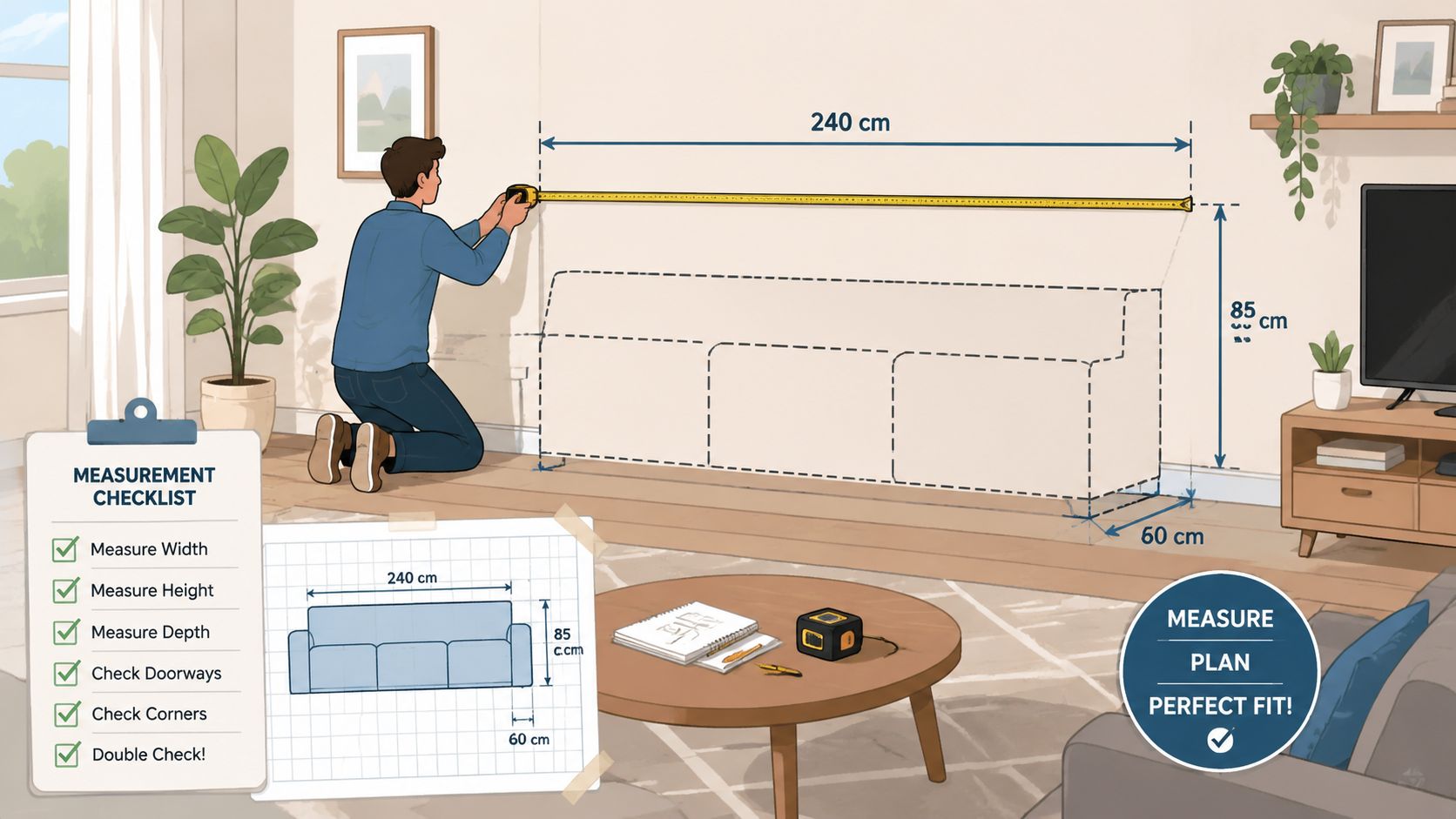
A reliable measuring process looks like this:
- Measure the room footprint: Note wall lengths, window positions, outlets, vents, and door swings.
- Mark traffic paths: Identify where people naturally walk from one doorway or zone to another.
- Measure open-state use: Account for pull-outs, recline positions, lift functions, and lid clearance.
- Check the delivery path: Hallways, stairs, corners, and entry doors matter just as much as the room itself.
For a more detailed checklist, Gorins provides a practical guide on how to measure furniture.
How to judge quality before buying
Once the size works, the construction has to justify the investment. Multifunctional pieces do more moving than static furniture, so weak hardware or flimsy frames show up faster.
Look for these signs:
- Stable operation: The mechanism should move smoothly, without jerking, scraping, or obvious strain.
- Comfort in both roles: The seat shouldn't feel great only when closed or only when opened.
- Materials that suit routine use: Cushions should recover well, upholstery should match the household, and exposed surfaces should be easy to maintain.
When customization makes more sense than compromise
Some rooms don't fit standard furniture well, and some families don't live in standard ways. That's where custom programs become useful. The F9 Custom Sofa series allows shoppers to choose details such as arm style, back style, and cushion feel so the final piece suits the room and the routine instead of forcing a compromise.
The Norwich showroom also gives shoppers a chance to test seat depth, firmness, mechanism feel, and fabric options in person. That matters because multifunctional furniture can't be judged by looks alone. It needs to work in motion.
For households balancing long-term value with budget, promotional financing with equal monthly payment options can also make a better-grade purchase more manageable. That makes it easier to choose for durability and fit, not just for the quickest short-term fix.
Your Partner in Home Furnishing Since 1936
Furniture decisions tend to last for years. That's why the smartest approach isn't chasing the piece with the longest feature list. It's choosing furniture that fits the room, supports the household's routines, and stays comfortable through daily use.
Since 1936, families across Norwich and surrounding Eastern CT communities have looked for that mix of quality, value, and helpful service. Multifunctional living room furniture fits that mindset well because it asks more from every piece. The room should store better, host better, flow better, and still feel like home.
Customization also matters in that process. A room may need a specific sofa scale, a particular cushion feel, or a layout that coordinates with dining and bedroom choices elsewhere in the house. That's where thousands of combinations through Canadel Custom Dining and custom seating options can help create a more customized home instead of a pieced-together one. Readers interested in the store's background can learn more about this family-owned furniture store in Norwich.
A good showroom experience should reduce guesswork. It should help shoppers compare proportions, test comfort by feel, and choose lasting materials without pressure. The same idea carries into sleep products too, where brands like Tempur-Pedic, Serta, and Beautyrest support healthier sleep through in-person comfort testing in The Sleep Gallery.
Since 1936, Gorins Furniture & Mattress has helped Norwich and Eastern CT families create homes they love. Neighbors looking for multifunctional living room furniture can visit the Norwich showroom to test comfort and scale in person, take the online Style Quiz for guidance suited to their lifestyle, or browse the Clearance section for value-driven savings backed by local, family-owned service and 5-Star Delivery.