Recliner Chair with Footrest: How to Choose


The old chair still looks fine, but getting comfortable has become a negotiation. The ottoman drifts across the rug, the cushion swallows the sitter, and standing up takes more effort than it should. A replacement recliner looks like the answer, until the footrest opens straight into the coffee table.
A recliner chair with footrest should solve those everyday problems, not introduce different ones. For Norwich-area households, the useful starting points are the mechanism, the fit of the leg support, the room with the chair fully open, and the effort required to stand. Fabric comes after those decisions.
Pick the Mechanism Before the Fabric
Which recliner mechanism fits the daily job
| Mechanism | How the footrest moves | Choose it when | Limit |
|---|---|---|---|
| Manual lever or push-back | Handle or body weight opens the footrest | Everyday sitting with no cord or motor | Harder if leg strength is low |
| Power remote | A motor opens the footrest and reclines the back | Several positions, lumbar, headrest, heat, massage, or USB are priorities | Needs an outlet and a working remote |
| Lift chair | Power recline plus a forward seat tilt to help standing | Standing is the hardest part of using the chair | Footrest must fully close first, and a lift isn't safer for every user |
| Wall-hugger linkage | Seat glides forward as the footrest opens | The chair must sit close to a wall | The open footrest still needs room in front |
The shopper should choose the appropriate row before judging color or cushion feel. A chair that feels inviting while stationary can still be difficult to operate at the end of an evening.
A manual recliner uses a side lever, pull handle, or push-back action. The sitter supplies the force, and there's no electrical cord to route across the floor. It's the straightforward choice for someone who wants no electronics and can comfortably operate both the opening and closing movement.
A power recliner uses a remote or mounted control to move the footrest and backrest. Some models adjust those parts independently, while others move them together. Optional power lumbar, power headrest, heat, massage, and USB features should be treated as individual specifications, not assumed features of every powered chair.
Choose movement that matches the person
A lift chair adds a powered movement that raises and tilts the seat forward. That can make it a candidate for someone with limited leg strength, but lift assistance is a function to test, not an automatic upgrade. The user still needs a controlled transition from sitting to standing.
A wall-hugger belongs in the comparison even though it isn't a separate type of motor. Its linkage changes the chair's path through the room, and that linkage can be manual or powered. It suits a location near a wall, provided the room can accommodate the chair's forward movement.
- No electronics wanted: A manual mechanism is the starting point, provided closing it doesn't require a struggle.
- Several comfortable positions needed: Power adjustment deserves a trial, especially when back and leg positions need separate control.
- Standing is difficult: A lift-chair assessment should focus on the actual user's exit, not a demonstration by someone else.
- The wall is close: A wall-hugger can help behind the chair, but it doesn't excuse measuring the front.
The power recliner versus manual guide provides additional context for that operating decision. During a showroom visit, the person who'll use the chair should operate the controls from a normal seated position, rather than leaning forward to reach them.
The next buying decisions are body fit and fully open dimensions. A favorite fabric can't correct a handle that's out of reach or a footrest the sitter can't close.
Match Footrest Style Size and Cover
Footrests aren't interchangeable padded shelves. Their shape determines where the legs meet the chair, how much calf support is available, and whether a separate piece of furniture is needed.
A built-in pop-up footrest folds out from beneath the seat. Its practical advantage is that the chair doesn't need a separate ottoman. A chaise or extended footrest provides a longer upholstered support surface, rather than concentrating contact on a short pad near the heels.
Sort the support before the swatch
A higher adjustable leg rest, including configurations offered on some zero-gravity models, provides another position to assess. The label alone doesn't establish a comfortable fit. The useful question is whether the actual chair supports the sitter's lower legs without pulling the body away from the backrest.
- Pop-up support: Check where the pad meets the legs, not just how neatly it disappears beneath the seat.
- Chaise or extended support: Check whether the longer surface suits the user's leg length without creating an uncomfortable ridge.
- Higher leg-rest position: Check it together with the backrest, rather than treating elevation as a benefit by itself.
The shopper should sit fully back before assessing size. Hips need room without the armrests squeezing, and the front seat edge shouldn't press into the area behind the knee. A shorter adult shouldn't have to perch at the front to reach the floor.
A cushion also needs more than a quick hand press. After the sitter settles, the showroom assessment should include whether the pelvis sinks far, whether the torso stays supported, and whether the surface makes moving toward the front difficult.
Match the cover to friction and everyday use
Performance fabric is worth considering where pets, frequent television use, and repeated contact will wear the arms and seat. “Performance” still needs a specific explanation of cleaning and care. The upholstery fabric guide can help organize those choices.
Leather or another smoother cover may suit someone who needs less resistance while repositioning to stand. However, easier sliding isn't always better, particularly if the sitter feels insecure on a slick surface. Heat buildup and grip should be assessed during the same seated trial.
For households considering a removable cover, The Sofa Cover Crafter's armchair guide offers useful context for cover selection. A recliner cover must leave controls accessible and moving parts unobstructed. A loose throw tucked into the mechanism isn't a substitute for a correctly fitted cover.
How the Footrest Changes Body Pressure
A useful benchmark comes from a functional-recliner experiment published in BioResources: 20 young adults tested footrest angles from 0° to 90° and backrest angles from 110° to 130°, with approximately 60° at the footrest and 125° at the backrest identified as the most favorable tested combination. The favorable footrest setting was associated with the highest alpha-band power and strong comfort ratings.
Those findings describe a tested configuration, not a universal prescription. Angle measurements also need context: a backrest angle measured relative to a seat isn't interchangeable with a recline angle measured from upright.
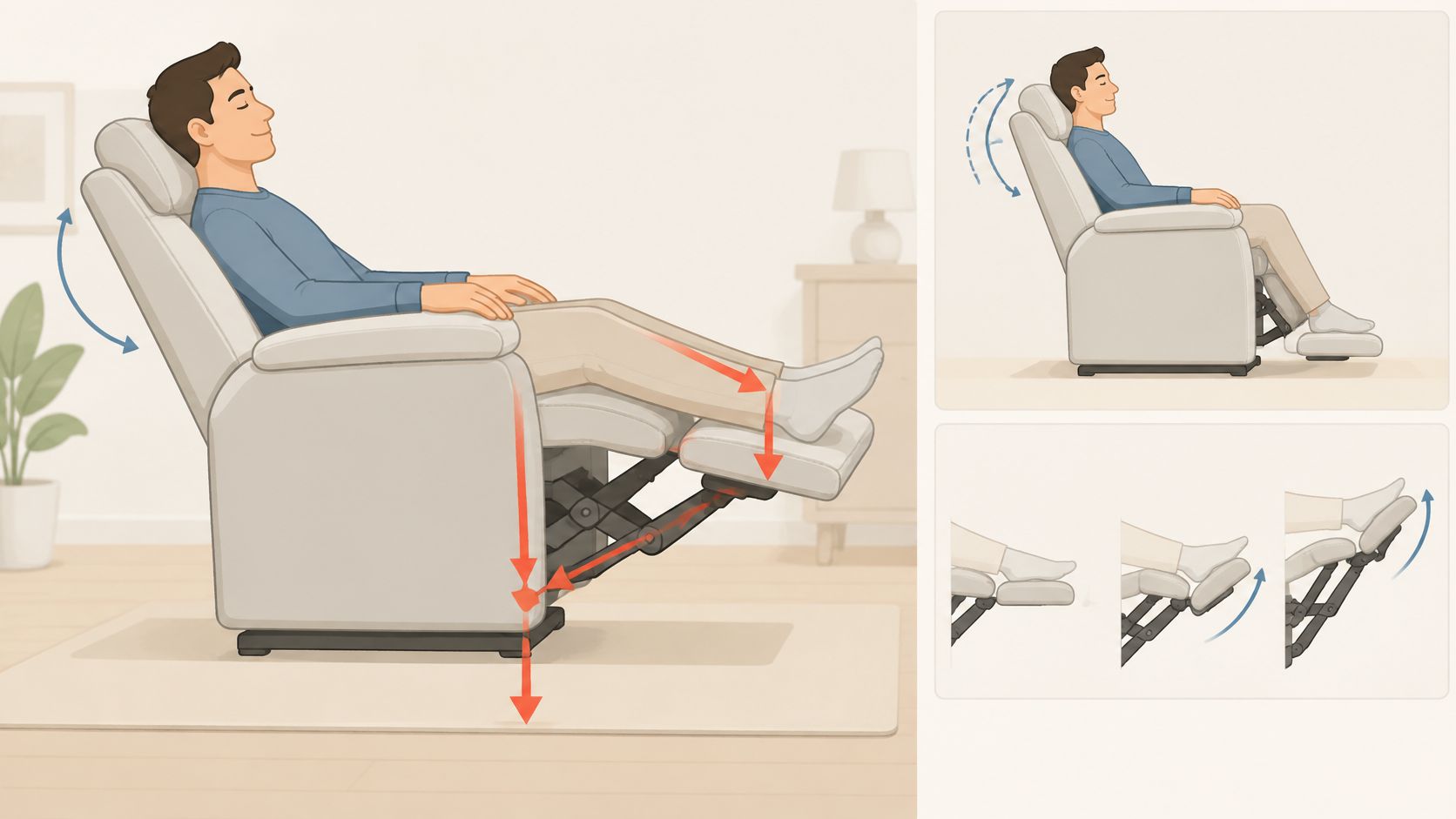
The footrest acts as part of a load-sharing system. Raising the legs changes how the sitter meets the seat and back, so a comfortable lower-leg position can still leave an uncomfortable concentration of pressure elsewhere.
In a wheelchair-seating study published in the Journal of Physical Therapy Science, leg-rest angles of 20°, 40°, and 60° had little effect on measured foot pressure but changed pressure distribution between the back and buttocks across backrest reclines of 10°, 30°, and 50°. That wheelchair-based experiment supports evaluating the back and leg rest together, but its settings shouldn't be transferred directly to a household recliner.
A body test that matters more than the deepest recline
- Support the heel and calf. The legs should rest on the upholstery rather than being held in position by muscular effort.
- Free the knee crease. The seat edge shouldn't dig into the area behind the knee.
- Avoid a forced bend. The mechanism shouldn't push the knees into an uncomfortably tight position.
- Keep lower-back contact. The sitter shouldn't have to brace the torso upright after the backrest moves.
- Adjust in small changes. The user should compare nearby combinations rather than repeatedly running the chair to its limits.
A recliner-design study on adjustment efficiency describes repeated trial and error as a comfort-setting problem and suggests presets near suitable ranges may improve adjustment efficiency for young adults. A preset is therefore a useful starting position, not proof that the chair fits every occupant.
Older adults, shorter occupants, and people with edema or hip, knee, or vascular conditions may need a different configuration and individual fitting advice. The deepest recline isn't the goal.
The arrangement works like a seesaw: raising the legs only helps when the back and seat take their share of the weight.
Measure the Chair with the Footrest Out
Clearance to check with the footrest open
| Check | Conventional recliner | Wall-hugger |
|---|---|---|
| Rear clearance | About 12 to 18 inches | About 3 to 6 inches |
| How the chair moves | Back travels backward | Seat glides forward into the room |
| Open front-to-back depth | Measure with the footrest fully out | Measure with the footrest fully out; rear savings don't shrink the front |
| Walkway, table, and door | Footrest can block each one | Same front risk remains |
| Seat-to-footrest opening | Assess the moving gap against the cited guideline | Same moving-footrest check applies |
The rear-clearance ranges in the table come from Indian River Furniture's wall-hugger guidance, which describes approximately 50%–75% less rear clearance through forward-gliding movement. These are planning ranges, not substitutes for the selected model's installation requirements.
For the moving opening, reclining-furniture safety guidance cites an industry guideline limiting the seat-to-footrest gap to no more than 5 inches. That is a buying check, not a claim that every opening below that size is harmless.
Measure in the order the chair will move
- Mark the rear location. Painter's tape can identify the wall line or intended position behind the chair. A freestanding arrangement needs a clear reference point too.
- Check the rear gap upright and reclined. The backrest's travel matters, along with any nearby curtain, windowsill, or radiator.
- Measure fully open depth. The measurement should run from the furthest rear point to the end of the extended footrest, not merely across the seat.
- Operate nearby furniture and doors. The nearest door should open normally. Any chair normally pulled out near the coffee table should still have room, and the table shouldn't require moving every time the recliner opens.
- Walk the usual route. The daily cane or walker belongs in this test. A person should be able to follow the actual path through the room without turning sideways around the footrest.
A sketch becomes more useful when it includes the coffee table, doorway swing, end table, and outlet. The reclining-sofa dimensions guide offers related planning context for rooms that combine a recliner with other motion seating.
The space beneath a lift mechanism also deserves attention. Children and pets should stay away during operation, and blankets, fingers, paws, and electrical cords must remain clear of closing components. Manual mechanisms need the same respect as powered ones.
Room-planning rule: A chair that fits against the wall but fails the front walking path is still the wrong size.
A showroom measurement should describe the exact chair being considered. A similar-looking model can have a different motion path, so a photograph of the closed chair isn't enough to approve the layout.
Check Standing Safety Before You Buy
A power lift is not automatically safer than a manual recliner. It can assist a movement, but safe standing also depends on the person's balance, understanding of the controls, and ability to complete the transfer.
The U.S. Consumer Product Safety Commission's older-adult hazards report estimated 717,700 emergency-department-treated fall injuries associated with chairs among adults aged 65 and older, and reported recliner-chair injury rates 12.5 times higher for older adults than younger adults. These figures aren't limited to lift chairs and don't establish that a motor causes falls.
The report also discusses coroner-reviewed cases involving people with cognitive decline who used power-lift recliners to stand, fell unwitnessed, and later died from injuries or complications. That makes control comprehension and supervision part of chair selection, not an afterthought.
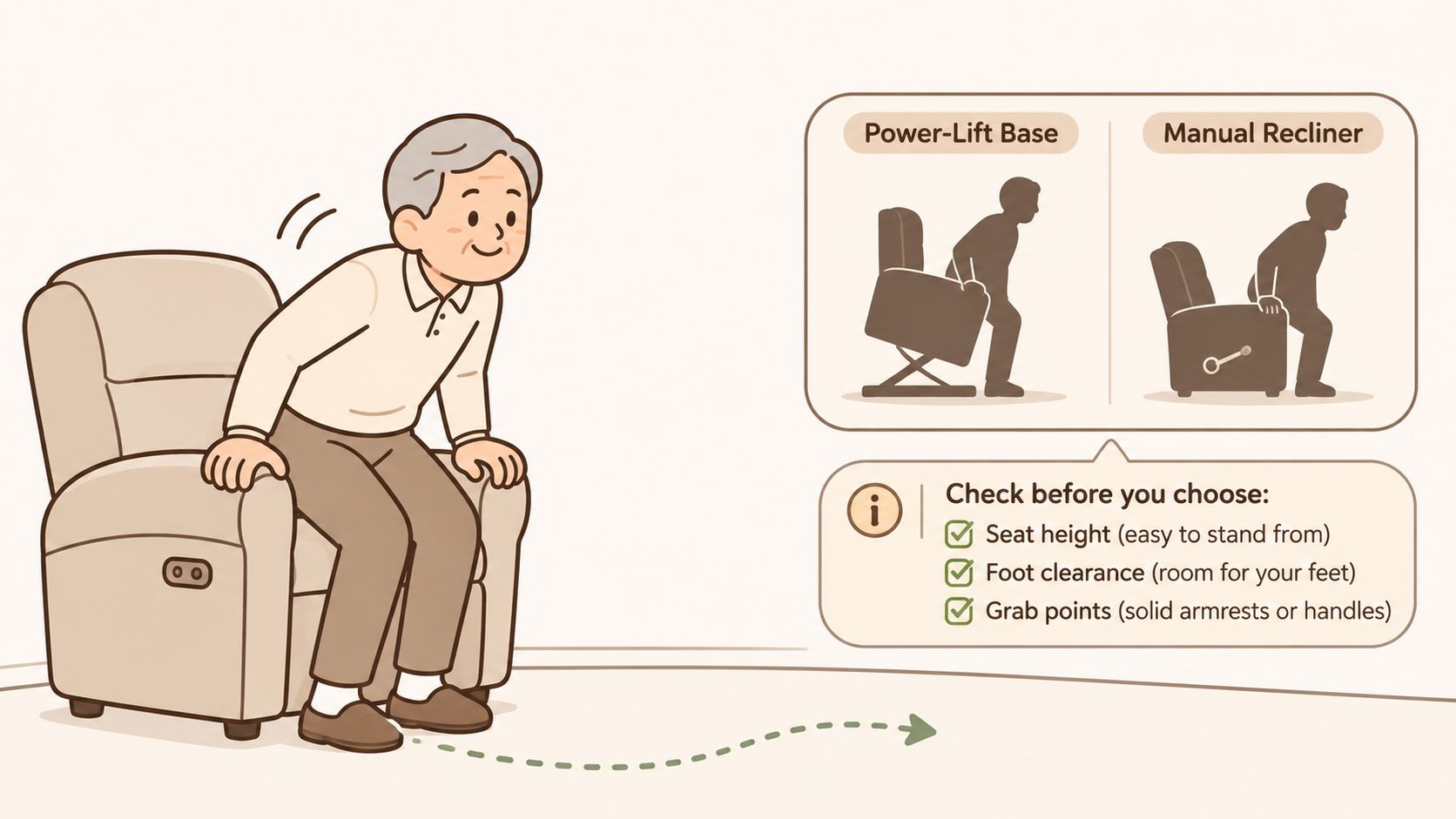
Test the exit with the actual user
The Home Modification Information Clearinghouse summary of chair-egress findings identifies lower seat height, greater backward seat tilt, a more reclined backrest, and more compressible cushioning as factors that can interfere with rising. A softer chair can therefore be the wrong chair, even when it feels pleasant during the first sit.
- Both feet reach the floor securely. The user shouldn't have to search for the floor with the toes or slide unpredictably toward the edge.
- The armrests provide support. Their position and firmness should allow a controlled push, rather than forcing an awkward reach.
- The footrest fully retracts before standing. The user needs a clear place for the feet. Stepping over an extended support isn't an acceptable exit strategy.
- The user operates the remote without confusion. The relevant test is recognizing and using the controls, not merely being able to hold the handset.
- The chair remains stable during exit. Standing should look controlled, without a sudden forward lurch or an uncertain pause.
- The home supports the transfer. Lighting, walking routes, and caregiver availability should match the user's needs throughout the day and evening.
For someone with repeated falls or changing mobility, a clinician can assess more than the furniture alone. Rx360's overview of evidence-based screening for clinicians provides context for that professional conversation.
The recliner guide for seniors can help organize shopping questions, but an in-home assessment may be the more useful next step when transfers are uncertain. The choice should follow cognition, transfer strength, supervision, and control usability, rather than treating lift assistance as the safer default.
Match the Chair to Real Evenings at Home
A recliner's most useful setting is often less dramatic than its showroom demonstration. Ordinary routines reveal whether the controls, support, lighting, and nearby surfaces work together.
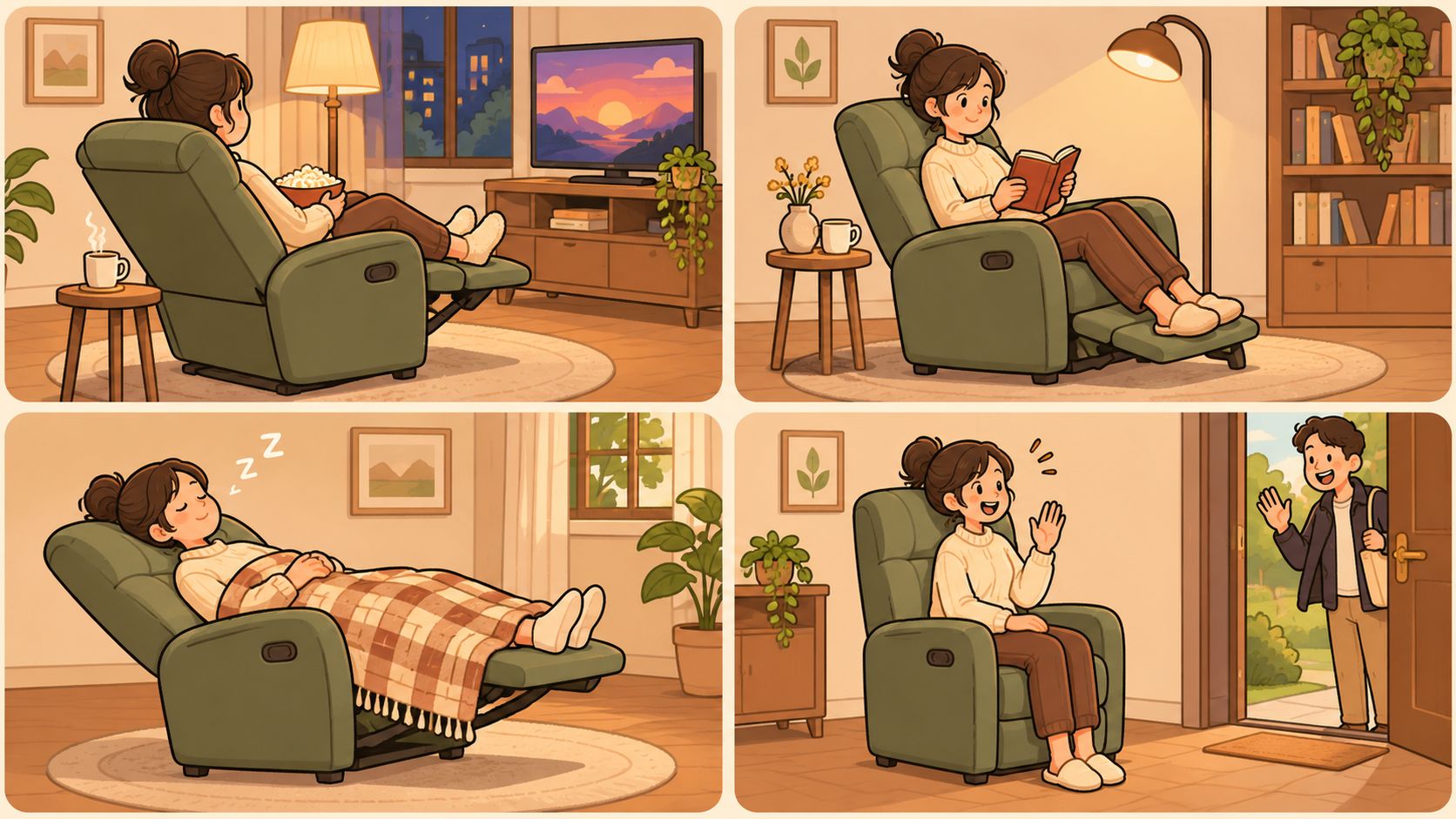
Television and reading need different arrangements
A long television evening might begin with the footrest raised and the back only moderately reclined. The viewer should still face the screen without lifting the head away from its support. The deciding setting is a moderate back angle that allows relaxed viewing rather than the chair's maximum extension.
For a reading corner, a floor or table lamp should illuminate the page without forcing the reader to twist toward the light. A small surface can hold a cup and glasses without requiring a reach across the moving footrest. The deciding setting is a supported leg position with the page slightly below eye level.
These scenes also expose control placement. A handset that disappears between cushions or requires a long sideways reach can interrupt an otherwise comfortable arrangement. The ordinary resting place for the remote deserves a trial alongside the chair.
A pause is different from a day chair
An afternoon rest between activities calls for a comfortable pause, not an assumption that the recliner should replace a bed. The occupant can settle briefly and then return the chair upright when the rest ends. The deciding setting is one that can be left deliberately and comfortably.
A mobility-focused day chair in a tighter Eastern Connecticut home has a different job. In Norwich, New London, Plainfield, or Waterford, a familiar room may need to accommodate both established furniture and a walking aid. That arrangement only works after the stand-up test passes and the walker still clears the coffee table and doorway.
The deciding setting for that household is the chair's usable exit position within the room. A layout that requires someone else to move a table every time the occupant stands isn't suited to daily life.
Comfort is a chair someone can leave as easily as they enter.
Plan Repairs Before the Warranty Ends
In a European consumer repair study presented through PLATE, 77% of surveyed consumers wanted to repair products before replacing them, while 64% had repaired products. Price, perceived repairability, and ease of replacing parts were barriers. Furniture-focused findings also identify durability, safety, repairability, and easy assembly or disassembly as valued sustainability characteristics.
For a recliner buyer, that makes serviceability part of the purchase decision. The lowest purchase price may not produce the lowest lifetime cost, and a premium chair isn't necessarily durable unless parts and service remain available.
Identify the parts that can be renewed
- Mechanical components: Can the reclining mechanism or linkage be replaced without replacing the entire chair?
- Electrical components: Can the motor, transformer, remote, and cord be replaced individually?
- Comfort components: Can the cushion or upholstery be renewed, and how is the relevant fabric identified?
- Service access: Is local service available, and does a typical visit involve diagnosis, parts ordering, or workshop transport?
Manual chairs mainly present linkage, upholstery, and cushion-wear questions. Power and lift chairs add electrical components that need identification before a replacement can be matched. Gorins Furniture & Mattress provides local post-purchase service, making service access a practical conversation rather than an abstract buying criterion.
Keep a delivery-day record
The owner should retain the model name, finish or fabric, purchase date, and accessible remote or motor labels. Photographs of the fully open and fully closed chair can help describe a later operating problem without requiring someone to guess which mechanism is fitted.
Coverage deserves the same precision. Ecuadane's warranty terms for woven blankets provide an example of why a named warranty needs its own written terms; blanket coverage doesn't establish recliner coverage. The Platinum Protection Plan information is a separate document to review alongside the chair's manufacturer warranty, with attention to covered events, exclusions, and the claim process.
Test the Fit at Gorins in Norwich
Gorins Furniture & Mattress is a locally owned, family-operated Norwich showroom founded in 1936, serving Norwich, New London, Plainfield, Waterford, and nearby Eastern Connecticut and Rhode Island communities. Its personalized guidance can turn a photograph-based decision into a seated trial.
Bring the room measurements and the daily user
The recliner selection includes power recliners, manual recliners, lift chairs, and comfort models with heat and massage. Feature filters include Power Recline, Manual Recline, Zero Gravity, Power Lumbar, Power Headrest, USB Port, and Wall Hugger. Specialty seating from BarcaLounger and UltraComfort, alongside living-room makers such as Flexsteel and Best Home Furnishings, gives shoppers pieces to assess through sitting and movement rather than appearance alone.
For a whole-room plan, Canadel Custom Dining and the F9 Custom Sofa series offer thousands of combinations. The Sleep Gallery, including Tempur-Pedic, Serta, and Beautyrest, extends the discussion to comfort by feel and choices supporting healthier sleep.
- Visit the Norwich showroom: Bring measurements and complete the standing and open-footrest tests.
- Take the online Style Quiz: Use it when the chair needs to fit a broader room plan.
- Browse Clearance: Consider value-minded finds without abandoning fit and serviceability.
Promotional Financing through the Nest Credit Card and TD Bank includes equal monthly payment programs and no-interest-if-paid-in-full plans, subject to credit approval. Home delivery is $89.00, with 5-Star Delivery and local post-purchase service supporting the investment.
Since 1936, Gorins Furniture & Mattress has helped Norwich and Eastern CT families create homes they love, combining custom-designed Canadel dining sets, Tempur-Pedic sleep technology, selection, quality, and value with the personalized care of a local, family-owned business.
Gorins Furniture & Mattress offers recliner choices and personalized guidance for matching the mechanism, footrest, and room to everyday life. Visit Gorins Furniture & Mattress in Norwich with room measurements and the intended user so the decision can include a real standing test, a fully extended footrest, and a clear plan for getting the chair home.