Modern Ottoman Coffee Table Sizes and Styles


The living room is already doing too many jobs. Guests need a spot for glasses, someone wants feet up after dinner, and a hard coffee table keeps catching shins on the way to the kitchen. A modern ottoman coffee table is the low, upholstered piece people reach for in that moment. It only earns the center of the room if the height, the covering, and the hardware match how the household moves.
Neighbors in Norwich, New London, and Waterford hit the same snag. The photo looks soft and tidy. At home the top tips a mug, the lid pinches, or the base slides when someone leans on it. The checks below move from what the piece is, to size, surface, real jobs, safety, and how long it should stay in the house.
What a Modern Ottoman Coffee Table Is
Picture a Saturday with four people on the sectional, a board game on the floor, and nowhere steady for the wine glasses. The wood table is too sharp for bare feet and too fixed for the person who wants to stretch out. That is the job a modern ottoman coffee table is built to cover: a low upholstered platform that becomes a table once it has a firm enough top, a tray, or a lid.

The form is old, even when the silhouette looks new. Historical design research traces the ottoman to the late 18th-century Ottoman Empire, where it began as a low wooden platform covered with cushions for floor-based seating. In the 19th century, European makers shrank that idea into footrests, stools, and extra seats. Western words such as "ottoman," "sofa," and "divan" come from that Turkish-influenced furniture, which Europe had already started adopting in the 18th century.
From floor cushions to a freestanding room
Two palace projects mark the shift toward freestanding furniture in elite Turkish rooms. Dolmabahçe Palace was constructed and furnished from 1842 to 1856. Beylerbeyi Palace followed from 1861 to 1865. Those years are milestones, not a lecture. Rooms that had been organized around the floor began to hold chairs, sofas, and small pieces you could move. Today's hybrid keeps both habits. It stays low and padded, and it can still act as a table, a footrest, a casual seat, or a centerpiece.
What makes the current version modern is simpler geometry, performance fabric or leather, and a body light enough to slide between the sofa, the television, and the conversation. It is not a pouf with a tray dropped on top, and it is not a wood coffee table with a loose cushion. A pouf is mostly a soft seat. A cushion on wood is still a hard table. The hybrid has a built top you can trust with a tray, plus upholstery you can sit against.
If you want a harder, all-wood cousin for comparison, it helps to compare solid teak stool designs and notice what a rigid seat does well, and what it refuses to soften.
Before color, judge four jobs:
- Surface: Will a tray or lid hold glasses without tipping?
- Footrest: Is the top near sofa-seat height, and soft enough for a long show?
- Casual seat: Can a guest perch, without anyone treating it as a step stool?
- Storage: Does a lid open safely, and is the inside worth the extra weight?
Sizes That Sit Level With Your Sofa
A tray should sit within easy reach, and your knees should have room to move. Start by measuring the sofa's seat height, then choose an ottoman top at about the same height or an inch lower. Many sofa-height setups fall near 16–18 inches, but your sofa is the better guide. A top that sits much higher can interrupt sightlines; one that sits much lower may make reaching for a drink awkward.
| Situation | Footprint | Height | Clearance | Fit note |
|---|---|---|---|---|
| Standard sofa group | 36–48 in long, 20–30 in deep | 16–18 in | 24–30 in | Keep the top near sofa seat height |
| Round living-room piece | 30–36 in diameter | 16–18 in | 24–30 in | Check that the circle leaves a clear walking route |
| Low pouf used as a table | 24–30 in across | 15–17 in | About 24 in | A tray gives cups and small items a stable surface |
| Oval in a tight path | 40–48 in long | 16–18 in | 24–30 in | Rounded ends can make passing feel less cramped |
| Storage or lift-top | 36–42 in long | 17–19 in | 24–30 in plus lid swing | Check that the open lid clears the sofa |
How to read each row
Standard sofa group. A table around two-thirds of the sofa's length often gives you useful surface area without taking over the floor. The listed dimensions are typical ranges; measure your sofa and rug before settling on a footprint.
Round living-room piece. A 30–36-inch circle can soften a room with lots of straight edges. Allow enough clearance around its widest point, since a round shape still occupies floor space.
Low pouf used as a table. A 15–17-inch height can suit a lower sofa. A tray helps create a steadier place for drinks, while the upholstered top remains comfortable for feet.
Oval in a tight path. In a smaller room, an oval's rounded ends may be easier to pass than sharp corners. Check the route between the doorway and sofa, not just the space directly in front of the seat.
Storage or lift-top. Measure the lid's full opening arc with the piece in its intended position. The closed footprint can fit neatly while the raised lid still hits the sofa.
Practical rule: Let the sofa seat set the starting height. If it is unusually low, consider the 15–17-inch range; if it is higher, compare the table top directly with the cushion.
Use this coffee table size guide to compare proportions, then mark the proposed footprint on the rug with tape. Walk past it as you normally would, carrying something in both hands. If the route feels cramped, reduce the depth or choose a different shape.
Fabrics Finishes and Surface Choices
After a busy evening, an ottoman top may show shoe marks, a tipped drink, and pressure from a serving tray. Choose its fabric and finish for the wear it will face, then check how the material can be cleaned or repaired.
A test rating gives one useful clue about abrasion, not a complete measure of durability. The Association for Contract Textiles performance guidelines describe 15,000 Wyzenbeek double rubs or 20,000 Martindale cycles as a general contract-upholstery benchmark. For heavy-duty use, the guideline gives 30,000 Wyzenbeek double rubs or 40,000 Martindale cycles. A double rub is one complete back-and-forth pass; the test tracks yarn breaks or a noticeable change in appearance.
For a top that regularly takes feet and trays, ask for at least 30,000 double rubs and confirm which test method the quote uses. Wyzenbeek and Martindale figures cannot be compared directly, so ask for the method by name. Neither abrasion rating predicts stains, pilling, fading, seam strength, or pet-claw damage. Check those factors separately on the fabric specification. The upholstery fabric overview can help you understand weave types.
| Surface | Spec to request | What the spec misses | Best household job |
|---|---|---|---|
| Performance fabric | 30,000 Wyzenbeek double rubs or 40,000 Martindale cycles | Stains, fading, pilling, pet claws | Daily feet and casual seating |
| Light-use contract fabric | 15,000 Wyzenbeek or 20,000 Martindale | Wear from frequent foot traffic | Guest rooms and low-use seating |
| Leather or faux leather | Wipe-clean finish and stated scratch resistance | Heat marks and creasing | Spills in a more formal room |
| Wood or stone-look top | Stable, sealed surface | Harder corners and less give | Glasses, remotes, and laptops |
| Woven rattan or rope | Frame weight and joint construction | Little cushion; check wobble | Airy, coastal-style rooms |
Which habit breaks which surface
Performance fabric suits a family room where feet often rest on the ottoman. It may handle abrasion well, but spills still need a cleaning plan.
Light-use contract fabric may look similar to a heavier-use option while wearing differently under repeated contact. Keep it for a guest room or another area with less frequent use.
Leather or faux leather wipes clean after many spills, but heat can mark it and repeated pressure can crease the front edge. Pale upholstery also makes food marks more noticeable.
A wood or stone-look cap gives trays and glasses a firm surface, though its corners offer less cushioning than upholstery. A guide to polished, matte and textured stone finishes explains how sheen affects appearance and how marks show.
Woven rattan or rope has less padding than upholstered surfaces. Check the joints and frame for movement; a loose connection can make the top feel unstable.
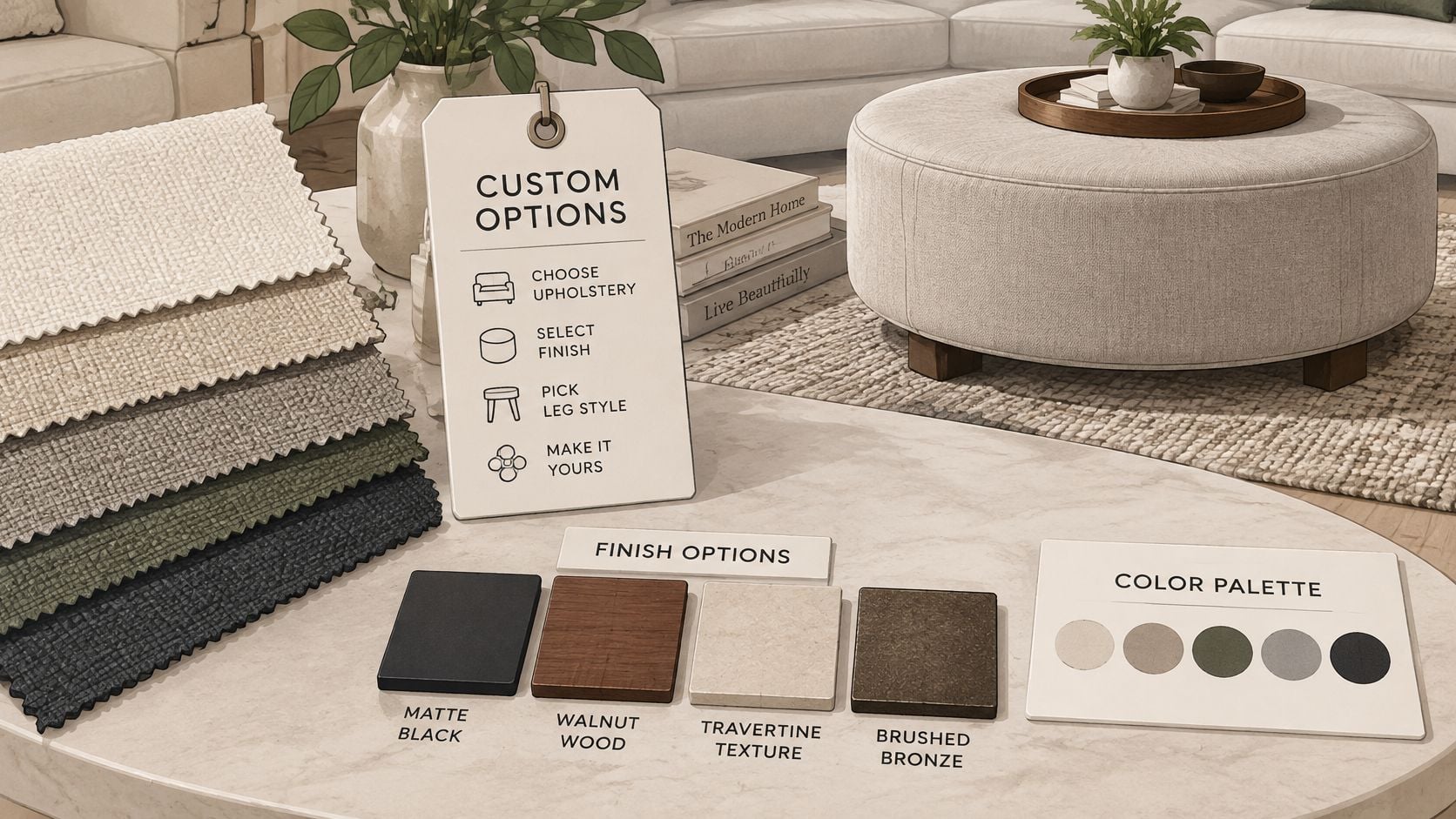
Name the finish you want, such as matte fabric, low-sheen leather, or wire-brushed wood. A removable tray can protect fabric from cups and serving dishes, while the upholstered surface remains available for resting feet. Choose according to the wear your household creates, and ask how the material can be cleaned or repaired before ordering.
Jobs This Piece Can and Cannot Do
An ottoman coffee table combines several functions, but each one asks something different of its construction. A cushion suits feet and occasional sitting; a firm surface and stable base work better for drinks or a laptop. Choosing the main job first helps you spot where a hybrid piece may need support from another table or seat.
For reading or remote work, set a firm tray on the upholstered top. It gives a mug or laptop a level surface, while the padding beneath can still shift if someone leans on it. Keep the tray clear of the edge, and avoid treating the cushion itself as a stable work surface.
As a footrest, the ottoman is most comfortable when its top sits close to sofa-seat height. A lower piece may leave legs angled down; a higher one can raise the knees. For sitting, check the maker's stated use and load limit, then follow both. Do not stand on it or use it to support your weight while rising unless its instructions specifically allow that use.
A storage lid saves floor space compared with a separate blanket chest, but it adds a hinge and a lifting task. Consider who will open it and how often. A lid that feels heavy or awkward can make everyday storage less useful.
Compared with a conventional coffee table, an upholstered ottoman has more give at its edges and can serve as a flexible extra seat. It may also shift when pushed, and soft padding makes drinks less steady. A tray can provide a firmer landing spot, though it does not turn the whole top into a hard table.
For a room that needs a dependable surface for dining or laptop work, pair the ottoman with a small hard-top table. If feet, occasional seating, or storage matter more, one hybrid piece may reduce the need for separate furniture. Explore multifunctional living room furniture to see how different pieces can serve more than one purpose.
Safety Checks for Real Households
A fully upholstered ottoman is not automatically the safest coffee table. Soft sides cushion a shin. A light or narrow base can still slide when an older adult uses it to stand, and a mushy top makes a mug less stable than wood.
A recent design guide recommends about 24–30 inches of clearance around the piece and notes that oval forms can reduce tripping hazards in smaller rooms. It also points to soft-close hardware and a finger gap or vent on storage lids. The same guide is clear that shoppers should separate a footrest, a seat, and a load-bearing support surface. Those labels get blurred on tags, and they are not interchangeable.
A showroom inspection
Do this before you talk about color.
- Press a corner. See whether the piece rocks. A rock means the base will shift under a hand.
- Read the edges. Rounded corners beat a sharp plinth where children cut across the room.
- Work the lid. Look for a soft-close hinge and a finger gap or vent so a hand is not pinched.
- Try the pull. It should be easy to grip without leaning or twisting.
For a wheelchair user or someone with limited reach, the approach matters more than the silhouette. The front should be open enough to roll or step close. The top should not force a long reach across a deep cushion.
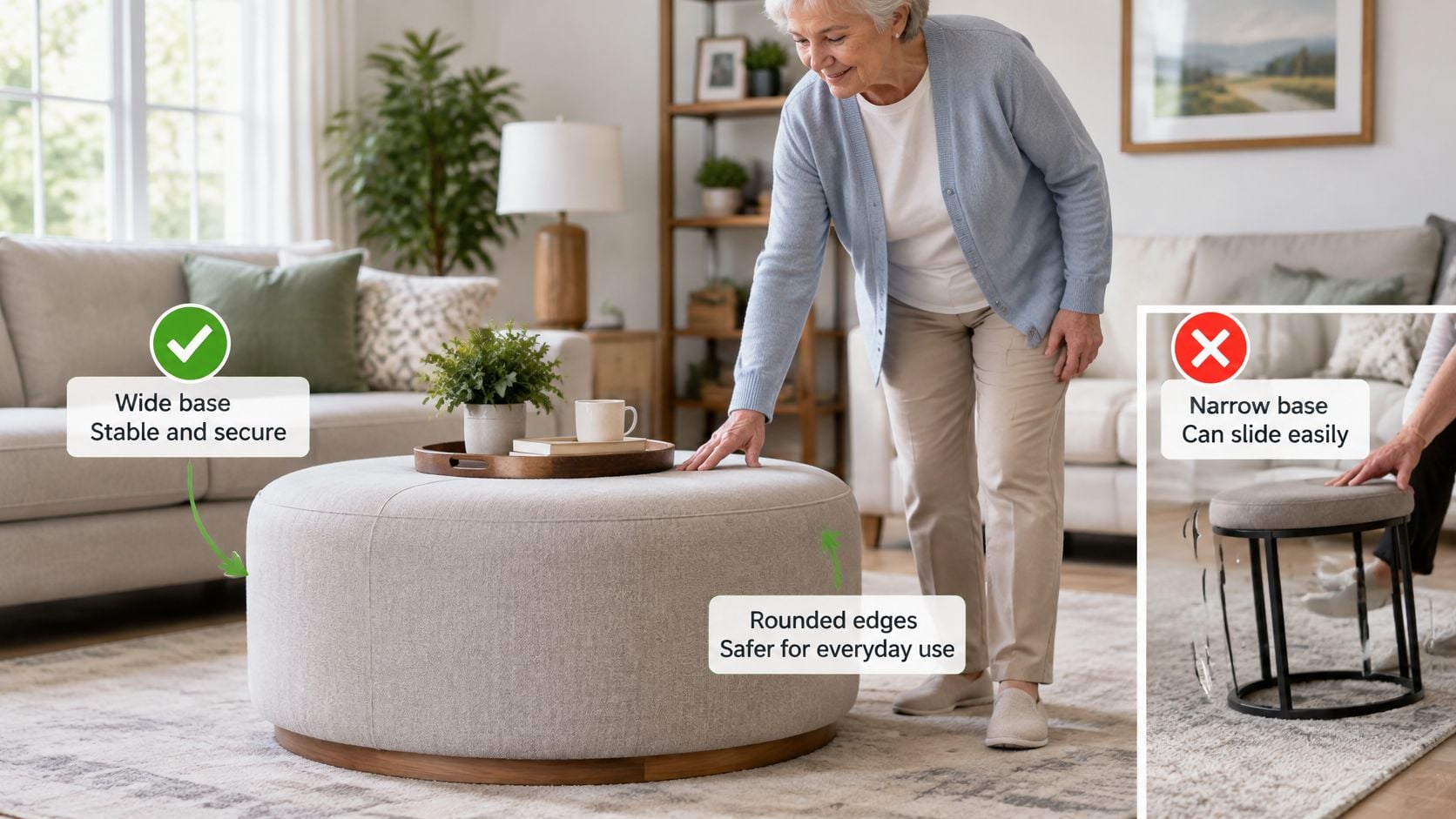
Three labels to keep apart:
- Footrest: Padding and a height near the sofa seat. Not a step.
- Occasional seat: A top rated for sitting, not for climbing.
- Support while standing: Only this job needs a stable, heavier base that does not creep.
Would you trust this piece if someone grabbed it on the way up from the sofa?
Answer that yes or no before fabric talk starts. Households with kids and pets can use the same inspection alongside this guide to kid-friendly and pet-friendly furniture. A pretty silhouette that slides under a hand is the wrong piece for a multigenerational room, no matter how soft the sides feel.
Durability Versus a Short-Lived Bargain
An ottoman coffee table earns its place through repeated use: feet rest on it, hands reach across it, and its top may take daily wear. Furniture-market research reports that durability matters to 95.5% of surveyed consumers, while 65.3% consider sustainability important or very important. The same furniture-market research found that only about 19% are willing to pay more for sustainable furniture. For a household weighing price against longevity, the useful question is whether the piece can be cleaned, maintained, and repaired.
A repairable ottoman kept for years may offer better value than a cheaper table that must be discarded. Storage models made from textile, foam, plywood, metal, and adhesive can be difficult to take apart. A label such as “eco-friendly” does not tell you whether worn parts can be replaced.
Questions before you order
- Cover: Can it be removed or replaced when the top wears?
- Frame: Can you access the joints, or is the body sealed?
- Parts: Can you replace the hinges or tray separately?
- Cleaning code: Does the fabric's cleaning code suit the spills and wear expected in your home?
- Material claim: Does any certified or recycled-content claim affect how the piece can be repaired?
For a value-conscious household in Eastern Connecticut, affordable luxury means a top you can clean and a base you can keep. A fabric that wears through early can erase the savings from a lower price. The Lewis and Sheron Textiles abrasion guide explains how abrasion resistance relates to fabric wear, a useful detail when a product description calls the cloth durable.
Write down three answers before choosing:
- Expected years of use in the room where the ottoman will live.
- The likely cost of replacing a cover or hinge compared with replacing the whole piece.
- Whether one failed part would make the entire ottoman unusable.
Those answers show what the purchase may cost over time. A frame with accessible joints and a replaceable top gives you more options when one part wears out.
Style It Then Order It in Norwich
The right styling leaves the ottoman usable. Center it on a rug, add a low tray, and keep books in one stack so the top can still serve as a footrest. Choose a tray you can lift off easily when you need the full surface.
In a small apartment, a round or oval shape can help keep the walkway clear. A family room may call for a more wear-tolerant fabric and a washable throw where snacks are likely to land. Check that the throw stays in place and does not cover hinges or pinch points on a storage ottoman.
For more ideas on arranging the surface, see this guide to styling a coffee table.
Ordering with a local showroom
At Gorins Furniture & Mattress, customers can get complimentary design help with furniture, fabrics, finishes, and room layouts. The store also offers design quizzes for living room, bedroom, dining room, and home office styles. A showroom visit lets you compare materials and discuss how a piece may work with your sofa and available floor space.
Customization extends beyond ottomans. Many living room collections offer choices such as fabric, color, and configuration, and special orders can include custom upholstery, Amish-crafted furniture, and special finishes. Gorins also offers dining furniture, including Canadel custom dining options.
Promotional financing options are available through the Nest Credit Card, issued by Comenity Capital Bank, and TD Bank. Equal monthly payment and no-interest-if-paid-in-full plans are subject to credit approval and the terms of the offer.
To get started, visit the Norwich showroom or take the online Style Quiz. Gorins Furniture & Mattress helps customers consider an ottoman's height, fabric, and function as part of a room, with design services and professional advice available.
Visit Gorins Furniture & Mattress to explore furniture options and get design guidance.