What Is a Wall Hugger Recliner? a Norwich Guide


A wall hugger recliner is a space-saving chair that reclines by sliding its seat forward, usually needing only 3 to 6 inches of wall clearance. That lets it deliver near-full reclining comfort without consuming the rear space required by a conventional recliner.
A Norwich homeowner may know the feeling well. A living room has room for one comfortable chair, but placing a traditional recliner beside the sofa leaves too little passage space, blocks a walkway, or forces the chair too far into the room. Renters, apartment residents, RV owners, and families in compact homes face the same design puzzle.
The answer isn't giving up on reclining comfort. A wall hugger uses a different movement pattern, keeping the back of the chair close to the wall while the seat travels forward. For households planning a smaller home, it can also work alongside practical resources such as secure storage solutions for downsizing, especially when every remaining piece of furniture must earn its floor space.
The Recliner Dilemma in Small Spaces
A traditional recliner may fit neatly beside a sofa while upright, then create a problem once opened. Its backrest travels toward the wall as the footrest rises, potentially colliding with window treatments or shelving and narrowing the route beside the chair. For Norwich homeowners, the key question is not just whether the chair fits. It is whether the whole room still works when someone reclines.
That decision affects homes in Norwich, Plainfield, New London, and Waterford. Set a conventional recliner too far forward and the walking area shrinks. Choose a smaller model and the household may lose the support or legroom it wanted. In a compact Eastern CT living room, a few inches can influence the sofa position, side-table access, and path to another room.
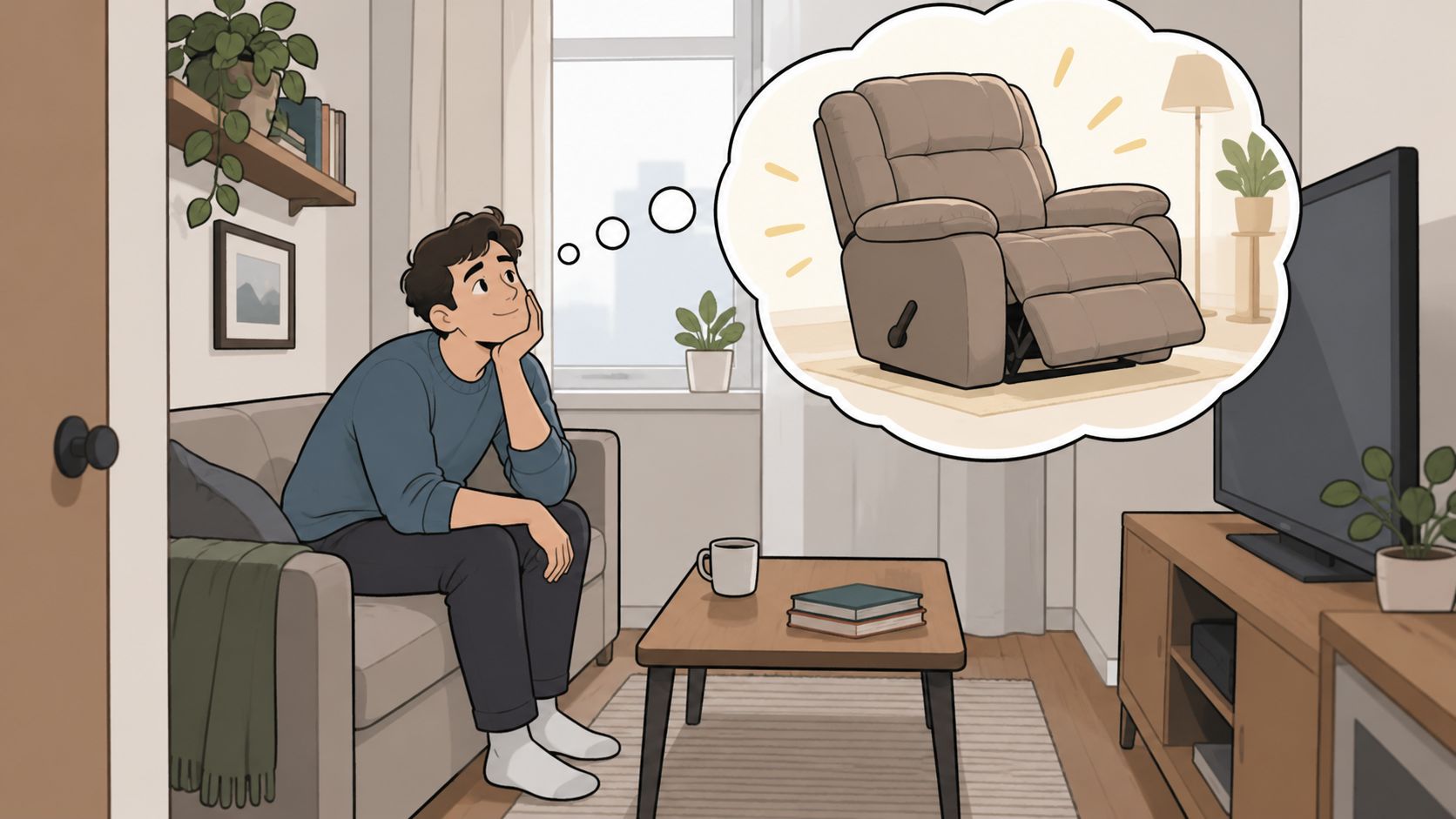
A practical answer for close-to-the-wall seating
A wall hugger recliner is designed for placement close to the wall, commonly leaving about 3 to 6 inches between the chair and the wall while fully reclined. Check the exact clearance for the model, since mechanisms and upholstery vary. That rear measurement is the main distinction from a standard recliner.
The floor plan still needs open space in front of the chair. As the seat moves into the room, the footrest needs somewhere to extend, so measure the clearance from the wall to the front edge of the chair in its open position. This approach can preserve a clearer walkway and keep a side table within reach, while giving the seating arrangement more flexibility. Homeowners comparing options can also review guidance on the best furniture for small spaces before planning the room.
Gorins Furniture & Mattress has served Eastern CT families as a locally owned, family-operated business since 1936. For households reducing possessions, secure storage solutions for downsizing can help manage furniture during a move or room change.
How a Wall Hugger Recliner Actually Works
For a Norwich living room where every inch affects the walkway, the mechanism matters as much as the chair's width. A kitchen drawer offers a useful comparison. It glides along its tracks instead of swinging into the cabinet behind it. A wall hugger recliner uses a related movement, combining a forward-shifting seat with a tilting backrest and rising footrest.
As you begin to recline, the seat base moves forward into the room. The backrest can then angle backward while the upper chair stays closer to the wall. The chair still needs open floor space in front, so measure both directions before choosing a position.
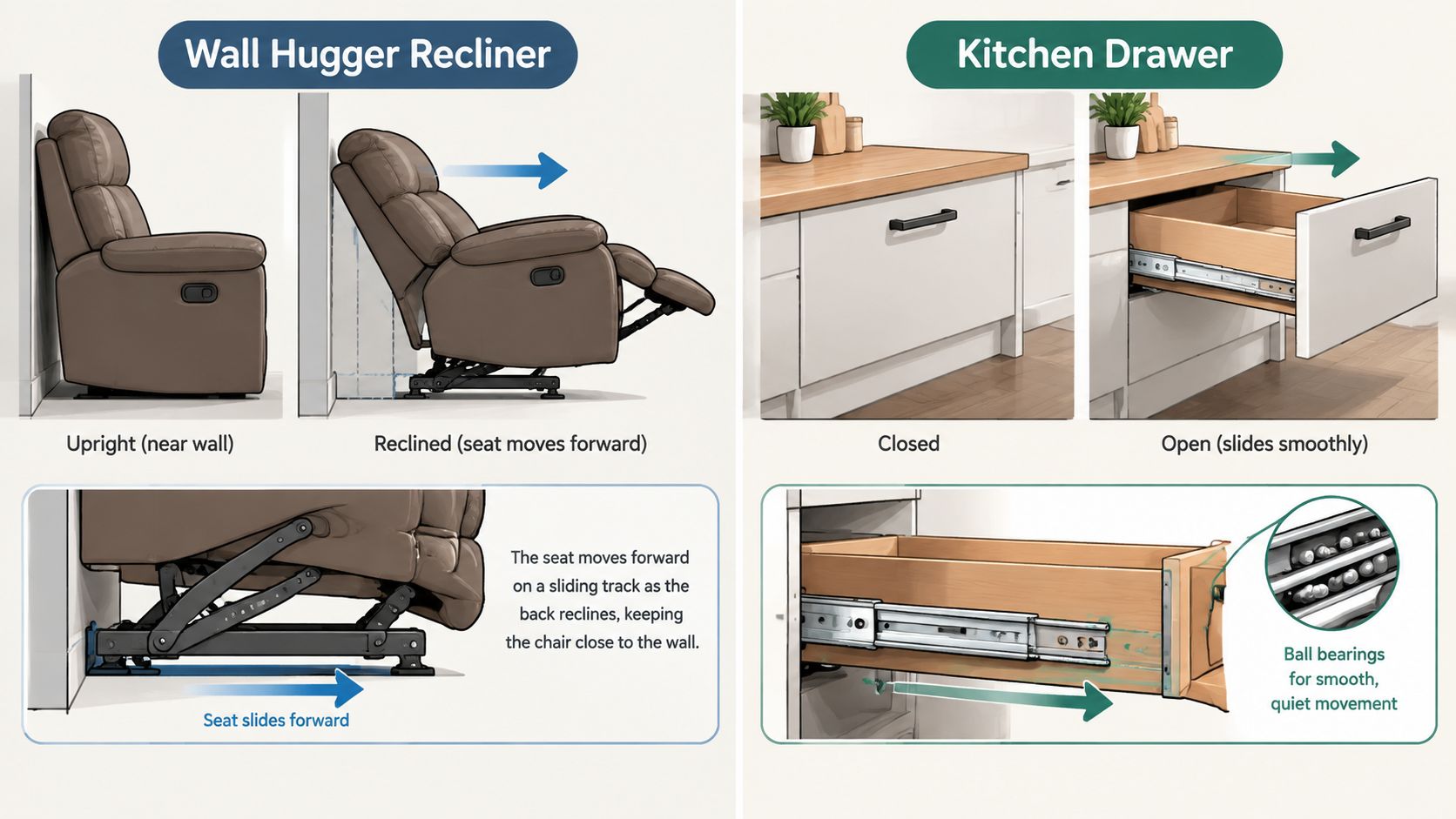
The movement in plain language
A wall hugger usually follows four stages:
- The user activates the chair. A manual lever or powered control starts the reclining cycle.
- The seat glides forward. Tracks or pivots shift the seating position into the room.
- The backrest tilts. The chair creates a relaxed posture without driving the back directly into the wall.
- The footrest extends. The legs receive support, allowing the chair to function as a full recliner.
This forward movement distinguishes it from a standard recliner, whose back and frame generally travel farther rearward. Common planning guidance allows 12 to 18 inches of wall clearance for a standard model, compared with 3 to 6 inches for a wall hugger. Treat those as starting points, not guarantees. Check the product dimensions and test the open position, since track layouts, cushions, and upholstery can change the required space. A recliner clearance guide can also support early room measurements.
The footrest may still reach into a walkway or toward a coffee table. For powered seating, compare types of power reclining seating and consider whether the control location suits the intended side of the room.
Wall Hugger vs Standard Recliner A Quick Comparison
For a Norwich living room, the best choice depends on where the chair must sit and how much open floor the room offers. A wall hugger keeps its back close to the wall while reclining, whereas a standard recliner usually needs more room behind its frame. That difference can affect a walkway, radiator access, or the space between the chair and coffee table.
The figures below are general planning ranges, not promises for every model. Use them to compare layouts, then check the product sheet for the exact chair dimensions and movement path.
Recliner Comparison At a Glance
| Feature | Wall Hugger Recliner | Standard Recliner |
|---|---|---|
| Rear wall clearance | Typically 3 to 6 inches | Commonly 12 to 18 inches |
| Typical recline angle | About 130 to 145 degrees | Roughly 140 to 160 degrees |
| Total reclined depth | About 48 to 56 inches in many models | Roughly 60 to 70 inches |
| Movement | Seat glides forward as the back reclines | Frame and back move farther rearward |
| Best placement | Against or near a wall, in compact rooms, apartments, and RVs | Open layouts with more space behind the chair |
| Main priority | Efficient use of floor space | Maximum traditional recline range |
The table highlights the main trade-off. A wall hugger saves space behind the chair by using forward movement. A standard recliner may offer a deeper, more traditional reclining position, but its extended frame can occupy more of the room.
Which one fits a Norwich home?
Choose a wall hugger when the chair needs to sit beside a wall, near a doorway, or within a tighter seating arrangement. It can leave more usable floor behind the chair, but the footrest still moves forward, so mark the open position before deciding where it will go.
A standard recliner suits a room with generous depth behind the seat and enough clearance around its fully reclined frame. It may be the better match for households that value a wider reclining range over compact placement.
Control choice matters too. For a clear comparison of power recliner vs manual seating, consider whether you prefer a powered control or a manual lever, as well as where that control will sit.
The practical question is which space the room can spare: rear clearance, forward space, recline depth, or control convenience.
Measuring Your Space for the Perfect Fit
A wall hugger can sit close to a wall, but that does not mean it fits every Norwich living room. The rear gap is only one part of the calculation. You also need room for the seat and footrest to travel forward, especially beside a coffee table, doorway, or main walkway. Practical room-planning guidance on wall hugger recliners treats the chair as a moving footprint, not a fixed rectangle.
Check both the upright and fully open positions. Many models measure around 34 to 39 inches wide and 36 to 41 inches deep, while some fully reclined products extend to about 64 to 67 inches. Use the exact specification for the model you are considering, because arm width, footrest design, and recline mechanism can change the result. General wall hugger recliner dimensions provide a useful starting point, not a substitute for the product sheet.
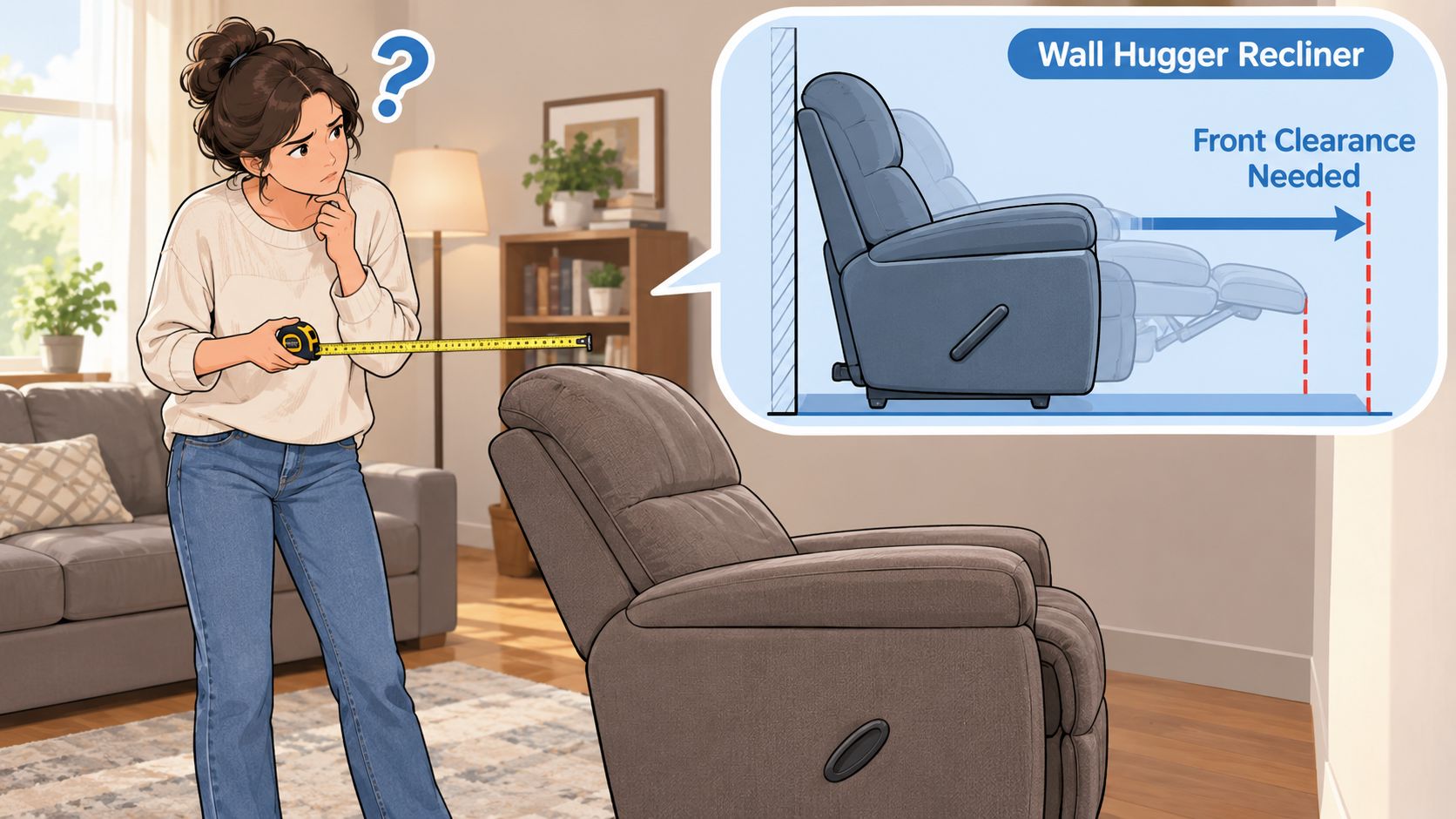
A room-planning method that works
- Mark the back wall. Include skirting boards, trim, sockets, and nearby furniture in the proposed position.
- Measure the full chair width. Measure from outside arm to outside arm, then mark that width with painter's tape.
- Allow the specified rear clearance. Use the model's measurement rather than judging the gap by eye.
- Mark the open footprint. Measure from the wall-side position to the furthest point reached by the footrest.
- Check circulation. Walkways, door swings, the coffee table, and access routes should remain usable when the chair is open.
- Confirm delivery access. Measure the entrance, turns, stairs, and room doorway before ordering.
Practical rule: Mark the chair's complete open footprint, not only the space behind its back.
Cardboard or painter's tape makes the proposed position easy to read from different angles. Before choosing a model, use this guide to measure furniture correctly and compare the measurements with your room plan.
Pros and Cons Is a Wall Hugger Right for You
A Norwich living room can feel crowded quickly. The sofa, television, side tables, windows, and main walkway all need space, so a recliner that sits close to the wall may keep the layout more usable.
The main advantage is efficient placement. Its forward-gliding mechanism reduces the gap needed behind the chair, allowing the seating group to stay nearer the wall instead of moving into the centre of the room. That can make an apartment, bedroom, or downsized home easier to move through.
The advantages
- Efficient rear placement: The mechanism needs less space behind the chair than a conventional rear-reclining design.
- Better use of compact rooms: More floor area remains available for circulation and neighbouring furniture.
- Comfort within a smaller footprint: The chair can still provide a substantial reclining position while using a compact movement pattern.
- Flexible seating: Wall hugger models suit living rooms, bedrooms, media areas, and arrangements planned around mobility needs.
The compromise is the reclining geometry. Since the seat travels forward instead of following a long rearward arc, some models offer a slightly less open recline than standard recliners. Industry benchmarks commonly place wall huggers at about 130 to 145 degrees, compared with roughly 140 to 160 degrees for standard recliners. Treat those figures as a starting point, because individual mechanisms and user comfort vary.
The possible limitations
A shopper who prefers a deep, nearly flat lounging position should test the chair in person. Someone else may value wall clearance more, especially if the room must also provide space for a walker, another seat, or a clear passage. The practical choice depends on which part of the room needs priority.
For households managing mobility needs or long-term health concerns, furniture planning can sit alongside reliable strategies for managing chronic conditions and guidance from an appropriate healthcare professional. Consider the user's daily routine, posture preferences, reach to the controls, and ability to sit down and stand safely. A compact mechanism helps with room planning, but the label alone does not confirm that a chair suits the person using it.
Before visiting a showroom, use this ultimate recliner buying guide to organise priorities such as available floor space, reclining depth, support, controls, and upholstery. Bring your measurements, then judge the chair both upright and fully open.
Find Your Investment-Grade Recliner in Norwich
A wall hugger recliner should be judged by more than its clearance figure. The chair needs to feel supportive in the upright position, move smoothly, suit the room's proportions, and match the user's preferred way to relax. That's why an in-person test remains valuable, especially for households deciding between manual and powered seating.
At Gorins Furniture & Mattress, the Norwich showroom includes reclining furniture from established names such as Flexsteel and Best Home Furnishings. The selection can help shoppers compare construction, upholstery, control options, and the feel of different cushions without reducing the decision to a single measurement.

Comfort that fits the broader home
Gorins also offers customization through the Canadel Custom Dining partnership and the F9 Custom Sofa series. Across these programs, thousands of combinations of finishes, fabrics, layouts, and details can help a household create a coordinated room rather than add a recliner that feels disconnected from the rest of the home.
The showroom's Sleep Gallery includes brands such as Tempur-Pedic, Serta, and Beautyrest, with guidance focused on comfort by feel and healthier sleep. Promotional Financing, including equal monthly payments subject to approval, can help lower the barrier to an investment-grade furniture purchase.
For local details, shoppers can review the Norwich furniture and mattress showroom information before planning a visit. Gorins serves Norwich, New London, Plainfield, Waterford, and surrounding Eastern CT and Rhode Island communities.
Since 1936, Gorins Furniture & Mattress has helped Norwich and Eastern CT families create homes they love. From custom-designed Canadel dining sets to the latest in Tempur-Pedic sleep technology, the family-owned business combines a broad selection with personalized local care and 5-Star Delivery service.
Visit Gorins Furniture & Mattress in Norwich to test wall hugger recliners, compare comfort by feel, and discuss a layout designed for the household's space. Shoppers can also take the online Style Quiz or browse the Clearance section for value-driven savings before choosing the seating that fits both their room and lifestyle.