Coffee Tables and End Tables Set: The Complete Buyer’s Guide

You're probably standing in the middle of a living room that's almost finished, except the table situation still feels wrong. The sectional is in place, the rug looks good, and the lamps are ready, but the coffee table and end tables either feel too small, too bulky, or too identical. That's the moment to slow down and choose a coffee tables and end tables set as a proportion decision first, a style decision second.
A strong set should do three things at once. It should fit the room, support daily use, and look like it belongs to the rest of the home instead of arriving as an afterthought. In a place like Norwich, where rooms often have to work harder than the picture-perfect layouts in magazines, that means measuring carefully and buying with intent.
Understanding the Role of Each Table in Your Set
A lot of people start with the wrong question, they ask what looks nice together before they decide what each table is supposed to do. That's how a room ends up with a coffee table that fights for space with the sectional, or end tables that are so tiny they disappear next to the arms of the sofa. The cleaner approach is to define the job of each piece first, then let the style follow.
A coffee table is the shared surface in the middle of the seating area, while an end table sits beside a sofa or chair for individual use. That distinction matters because each piece carries a different visual weight and serves a different person in the room. A coordinated set often works best as 2 to 4 tables with matching finish, hardware, and edge style, because that creates a calmer room than mixing unrelated pieces that all demand attention at once. A useful planning guide also recommends 14–18 inches between sofa and coffee table, 24–30 inches behind the coffee table for the main walkway, and 36 inches of continuous clear path through the room. Those spacing rules help the room breathe instead of feeling packed.
One practical way to think about it is simple, the coffee table serves the room, the end table serves the seat next to it. If both pieces try to do the same visual job, the layout gets noisy.
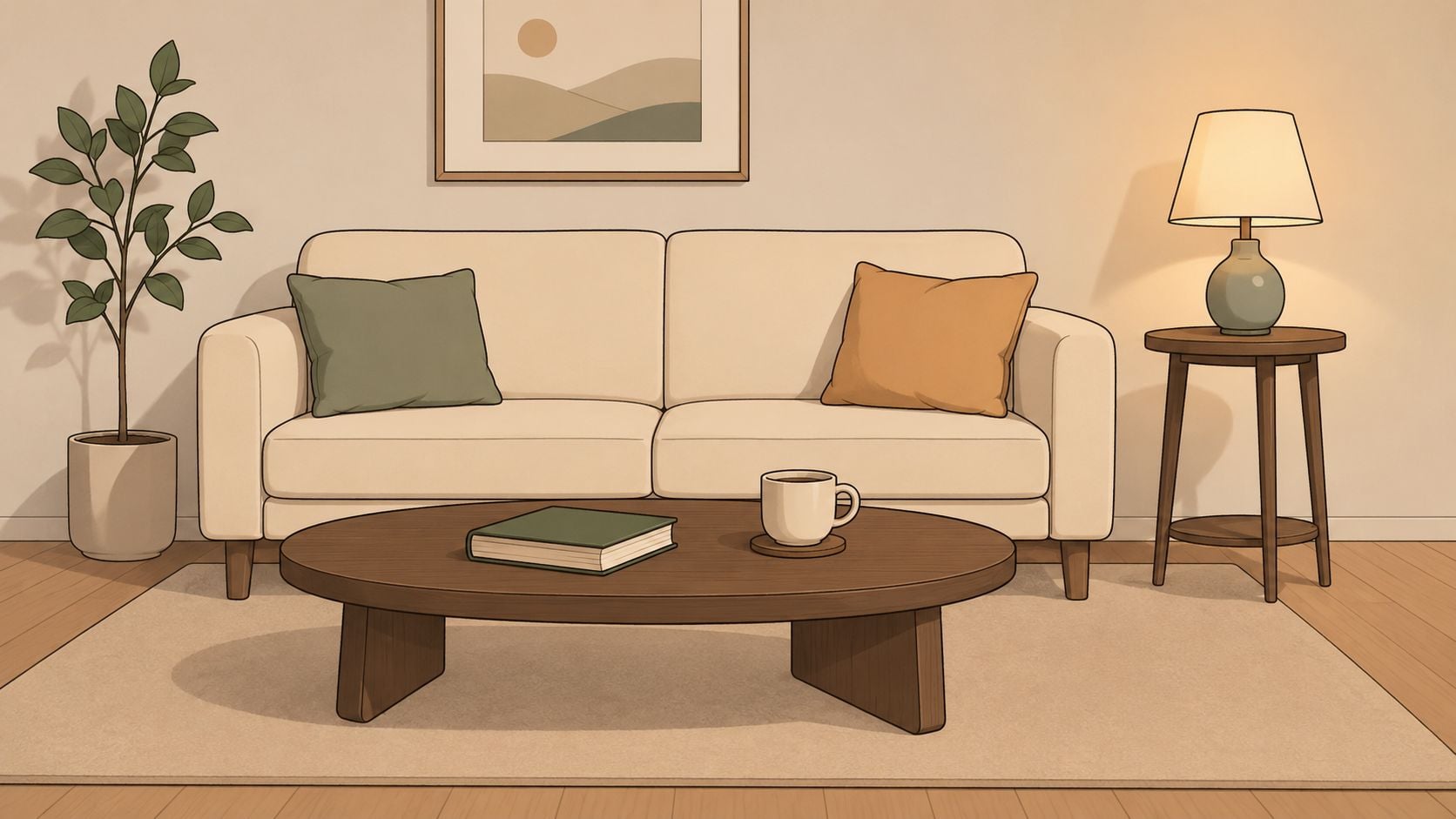
Match the function before the finish
The most useful set is the one that fits how the room is used. If the family piles in for game night, the coffee table needs enough presence to hold trays and drinks. If the sofa seat is mostly for reading and charging devices, the end tables need to land at a comfortable arm height and keep essentials close.
Practical rule: A room feels more polished when every table has a clear job and nothing is pretending to be the centerpiece.
That's why matched-looking pieces can still fail if their roles are muddled. A lower, broader center table and taller side tables usually create a stronger rhythm than three pieces that all repeat the same profile. For a quick reference on proportions, the broader furniture relationship guide on how to measure furniture is worth using before any purchase.
Sizing Your Set for Non-Standard Layouts
Sectionals change everything. So do chaises, apartment-scale rooms, and mixed-height seating, because the old sofa-and-two-chairs formula stops being useful the minute the furniture footprint gets irregular. The solution isn't guesswork, it's a tape measure, a notepad, and a willingness to size to the actual room instead of the idealized version in your head.
Measure the center surface first
Start with the coffee table. A solid buying guide says to measure both the seat height and the length of the sofa or sectional before choosing the table, and a technical furniture guide says the coffee table should generally be about the same height as the sofa seat and no more than about two-thirds the sofa's length, with 12–18 inches of clearance between the table and sofa. That combination keeps reach distance reasonable and protects the main circulation lane. It also keeps the table from looking stranded in front of a large sectional or oversized next to a compact one. Ethan Allen's coffee table buying guide and the coffee table buying guide PDF both emphasize those measurement basics.
For a sectional with a chaise, don't center the table on the whole footprint if that leaves one seat awkwardly far away. Place the table where the most-used seats can reach it without twisting, then confirm that no corner of the table pushes into the walkway. If the room is narrow, prioritize clearance over scale.
Don't buy the size you wish the room had. Buy the size the room can actually carry without crowding the path.
Size the side tables to the seat
End tables need to relate to the arm of the seating, not just the floor plan. Standard dimension guidance places end tables around 22–28 inches high and 12–20 inches wide, which is why they can sit beside armrests without feeling too tall or too squat. The same guide notes that coffee tables are commonly 36–48 inches long and 16–18 inches high, which explains the visual separation between a central shared piece and a side support piece. Those ranges are a starting point, not a law, but they're useful when the room has a recliner, a high-arm chair, or a chaise that changes the usual sightline.
For apartment rooms, keep the path clean. If a table blocks the line from doorway to seating, it's too big. If the end table can't hold a lamp and still leave room for a drink, it's too small. In a mixed-height layout, the best move is to align the table top with the chair arm or sit just below it, then let the coffee table stay lower and more centralized. That's what makes the arrangement feel intentional rather than improvised.
Material and Style Trends for 2025 and Beyond
The category is moving toward shapes and finishes that work harder in smaller homes. In 2025, neutral market commentary on end tables points to round shapes, multi-functional designs, storage-centric features, sustainability, and natural materials as the defining priorities. The coffee table market also shows long-run growth, with the global category recorded at $2,427.61 million in 2021, projected to reach $3,289.3 million by the end of 2025, and forecast at $6,038.83 million by 2033, according to one market report. That projected path reflects a category that has become a recurring replacement and style-upgrade purchase rather than a one-time buy. Coffee table market report
Wood, glass, and metal each solve a different problem
Wood is still the most dependable choice for buyers who want weight, warmth, and a piece that settles visually into the room. It usually handles everyday living better than delicate-looking alternatives, and it tends to make sense in family rooms where the table will take regular use. Glass lightens the room visually, which can help in compact spaces, but it asks for more cleaning and more discipline from the people using it. Metal reads crisp and modern, and it can be the right answer when the room already has strong lines and minimal ornament.
The trend direction favors tables that do more than sit there. Storage lids, nested forms, lift-friendly designs, and round edges all make sense in Eastern CT homes where one room may need to handle lounging, laptop work, and visiting guests all in the same week. That's why round coffee tables and end tables are showing up more often, they soften traffic flow and reduce the visual block in tighter layouts.
For a wider design context, the living-room trend roundup at 4 living room trends 2025 is a practical companion piece. It helps connect table choice to the rest of the room instead of treating the set as an isolated purchase.
Choose materials that age well, not just materials that look fresh
A good table set should still look grounded after daily use, not just on delivery day. Natural materials and restrained shapes usually age more gracefully than pieces built around a novelty form. If a finish already works with the flooring, the upholstery, and the wall color, the table is less likely to feel dated when the room gets refreshed later.
For homeowners thinking ahead to a full room update, it also helps to notice how finishes coordinate with adjacent spaces. A useful example is the way cabinet and surface trends are handled in Orlando kitchen color trends for 2026, because the same logic applies here, choose finishes that won't fight the home's broader material palette.
Coordinating Your Tables with Existing Furniture
A table set shouldn't look dropped into the room by a moving crew. It should feel related to the sofa, the chair, the rug, and the hardware already in the space. That's especially important when the main seating is a structured sofa or recliner with a strong silhouette, because the tables have to support the room rather than compete with it.
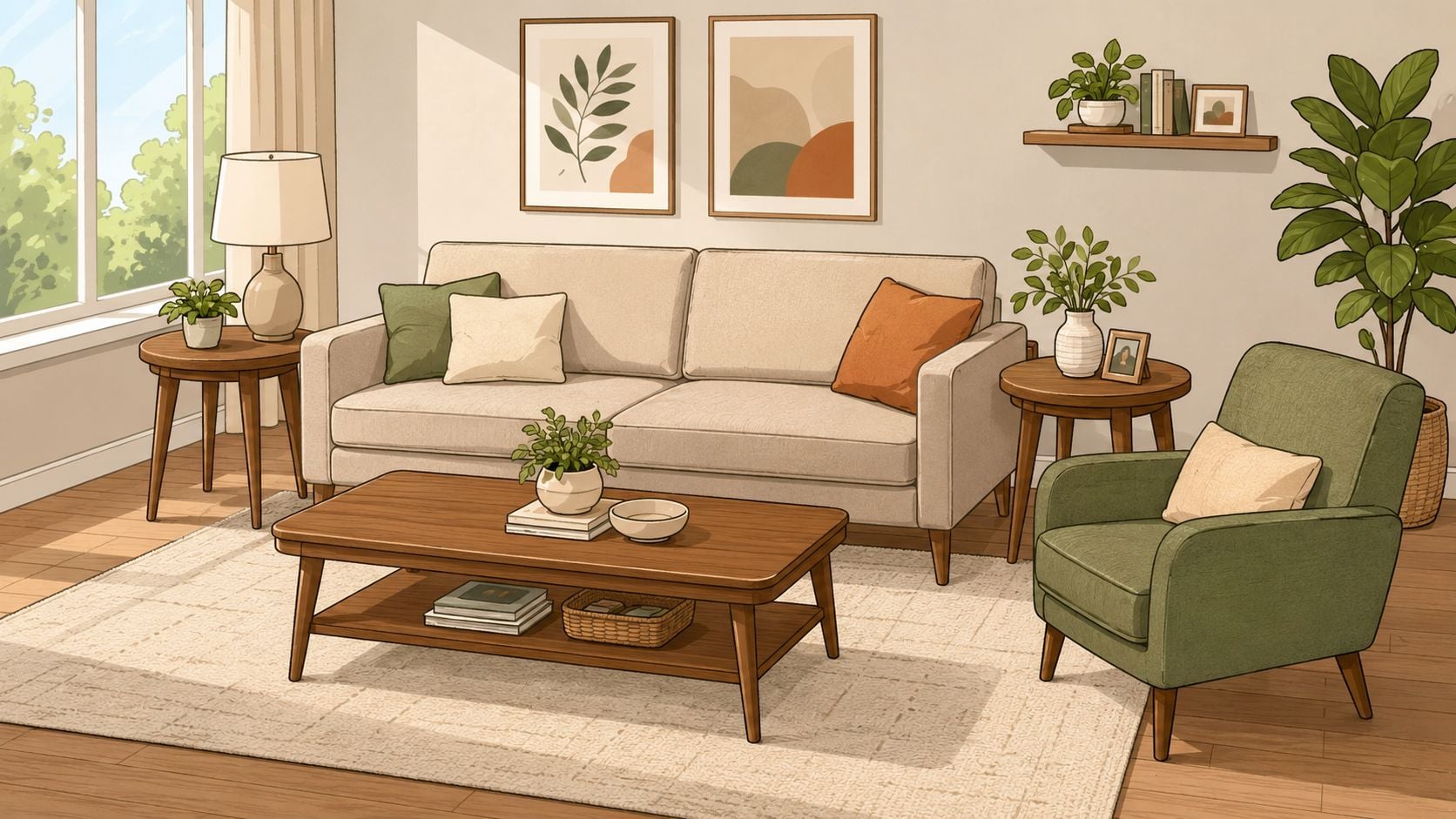
Let the upholstery and wood tone do the talking
If the sofa has a clean, defined profile, choose tables with a little visual substance so the room doesn't flatten out. If the seating already feels heavy, bring in a table with lighter legs, an open apron, or a round top to restore balance. The point is not to match every line, it's to keep the room from leaning too hard in one direction.
A useful habit is to compare undertones instead of chasing an exact finish match. Warm wood tones pair better with warm upholstery and brass-like accents, while cooler finishes sit more comfortably beside gray, blue, or black details. A coordinated look starts to feel designed rather than assembled.
For shoppers who like a tighter ratio between seating and table size, the room-planning note on sofa to coffee table ratio gives a practical frame without pushing the room toward a one-size-fits-all formula.
Build around the room, not around the catalog photo
That advice matters most when the room already has a strong anchor piece. A Flexsteel sofa, for example, usually asks for tables with enough substance to hold their own. A Best Home Furnishings recliner often benefits from a side table with a stable top and a shape that leaves enough elbow room beside the chair. The tables should respond to the furniture you already own, not erase it.
One straightforward way to avoid a mismatched result is to narrow the room's palette before shopping. Pick the dominant wood tone, the primary upholstery tone, and one accent finish, then refuse anything that breaks the pattern without a good reason. That keeps the set cohesive, even when the shapes are different.
The Value of Custom Orders and Local Expertise
Generic sets are convenient until the room proves they don't fit. That's why custom-order programs matter, especially for homeowners who need specific dimensions, a particular finish, or a shape that suits a sectional or compact footprint. Since 1936, Gorins Furniture & Mattress has operated as a locally owned, family-run business in Norwich, and that kind of long memory shows up in how a showroom handles fit, finish, and delivery.
Why customization solves more problems than standard stock
A custom program gives the buyer control over proportions and coordination. The brand's thousands of combinations approach lets a shopper dial in the size, shape, finish, and fabric details needed for a room that doesn't follow a standard template. That matters in Eastern CT homes where the layout may be unusual, the seating may be mixed-height, or the room may need a table that works with a sectional instead of a straight sofa.
Local expertise helps after the order is placed, too. A showroom team can look at the room plan, point out where a table will crowd a walkway, and steer the purchase toward a shape that makes sense in the actual space. That kind of guidance is especially useful when a furniture investment needs to last beyond one decorating cycle.
The custom-order process can also be the right fit when a buyer wants living-room pieces that work with a broader home plan. The same design discipline that shapes Custom Dining Norwich projects applies here, the furniture should solve a real spatial problem and still look like it belongs in the home.
Service matters after delivery day
A table is only a good purchase if it arrives intact and gets placed correctly. That's where local 5-Star Delivery has real value, because careful handling matters on finished wood, glass, and mixed-material tables. Gorins Furniture & Mattress also pairs that delivery approach with local service support, which gives the buyer a real contact point if anything needs attention after the sale.
The practical advantage is simple. A local team can coordinate the order, delivery, and service follow-up without turning the whole process into a customer-service maze. For people who want furniture to feel like a long-term investment, that support structure is worth more than a flashy display floor.
For shoppers ready to start the customization conversation, the process guide at getting started with custom order is the right place to begin.
Maintenance and Financial Flexibility
A good table set should stay looking good, and that depends on basic care that doesn't get ignored after the first week. Wood needs occasional dusting and gentle polishing. Glass needs regular cleaning to stay clear instead of cloudy. Metal tops and legs need quick attention before fingerprints and moisture marks settle in.
Keep the finish in fighting shape
The rule is simple, clean the surface based on what the surface is made of. Wood should be wiped with a soft cloth and protected from harsh cleaners that strip the finish. Glass is easiest when cleaned often, because waiting too long turns every smear into a bigger job. Metal needs attention around joints and edges, especially in rooms where drinks, lamps, and remotes end up collecting around the table.
Protect the top before the wear starts. Use trays, coasters, and felt pads, because the point isn't to baby the furniture, it's to preserve the finish so the set still looks investment-grade in a few years. A table that ages gracefully saves money and keeps the room from feeling tired too soon.
Keep the care routine boring. That's usually what keeps a table beautiful.
Use financing to buy the right set once
A strong table set can be a meaningful purchase, which is exactly why financing can help. Promotional financing with equal monthly payments lowers the barrier to entry for big-ticket furniture, and the financing options tied to the Nest Credit Card and TD Bank partnerships give buyers a way to manage the investment with more predictability. For a closer look at the structure, the details on no-interest furniture financing are the right place to review.
The better strategy is to buy the size and quality the room really needs, then use financing to spread the cost instead of compromising on fit. That keeps the furniture decision focused on the home, not the monthly pressure.
A CTA for Gorins Furniture & Mattress. Visit the Norwich showroom, take the online Style Quiz, or browse the Clearance section to find a coffee tables and end tables set that fits your room, your layout, and your budget without guesswork.