How to Loft a Bed: A Safe and Secure Guide


A small bedroom starts to feel crowded fast. In Norwich, New London, and plenty of older homes across Eastern Connecticut, that usually shows up the same way. The bed takes the best wall, the desk gets squeezed into a corner, and the floor space disappears under storage bins, baskets, and whatever didn't fit anywhere else.
Lofting the bed is one of the cleanest ways to get that room back. It's not just a college-dorm trick anymore. In many university residence halls, lofting is already part of the furniture system, and some setups create about 52 inches of clearance underneath according to Stetson University's bed lofting guidance. That's enough room to turn dead space into practical space.
For homeowners and renters, that same logic works beautifully in a guest room, teen room, studio, or compact apartment bedroom. The difference is that a safe lofted setup depends on planning, the right hardware, and a realistic look at what the bed frame can handle. A rushed job usually ends with a crooked frame, bruised knuckles, or a bed that never quite feels solid.
Table of Contents
- Reclaiming Your Space One Bed at a Time
- Choosing Your Lofting Method
- The Step-by-Step Lofting Process
- Essential Safety Checks and Troubleshooting
- Design Your Perfect Space with Gorins
Reclaiming Your Space One Bed at a Time
A lofted bed changes how a room works. Instead of letting the mattress dominate the floor plan, the bed moves upward and frees the footprint below for storage, reading, homework, or just easier movement around the room. That's why lofting has lasted. It solves a very ordinary problem without asking for a bigger house.
College housing made the idea feel normal. Many dorm systems now use modular metal frames with adjustable positions instead of one-off carpentry, and that matters because it shows lofting can be a repeatable furniture setup, not just an improvised workaround. For anyone trying to learn how to loft a bed at home, that's useful context. The method has already been stress-tested in tight spaces for years.
Practical rule: Lofting works best when the room is short on floor space but still has enough vertical room to keep the sleeping area comfortable.
The biggest win is flexibility. The space underneath can hold a dresser, low bookcase, soft chair, compact workstation, or closed storage that keeps the room looking less cluttered. In a narrow bedroom, even a simple open zone under the bed can make the room feel easier to use day to day.
For readers planning a larger refresh, it helps to pair lofting with other small-room ideas instead of treating the bed as the only answer. Gorins has a helpful look at bed ideas for small rooms that fits nicely into that bigger layout conversation. Anyone gathering materials or project basics can also browse practical DIY home renovation supplies before getting started.
Measure the room before touching the frame
Preparation saves more trouble than any tool does. Before lifting anything, measure the room from floor to ceiling, then measure the mattress thickness and the height of anything that will sit under the lofted bed. That gives a realistic sense of whether the finished setup will feel usable, not just technically assembled.
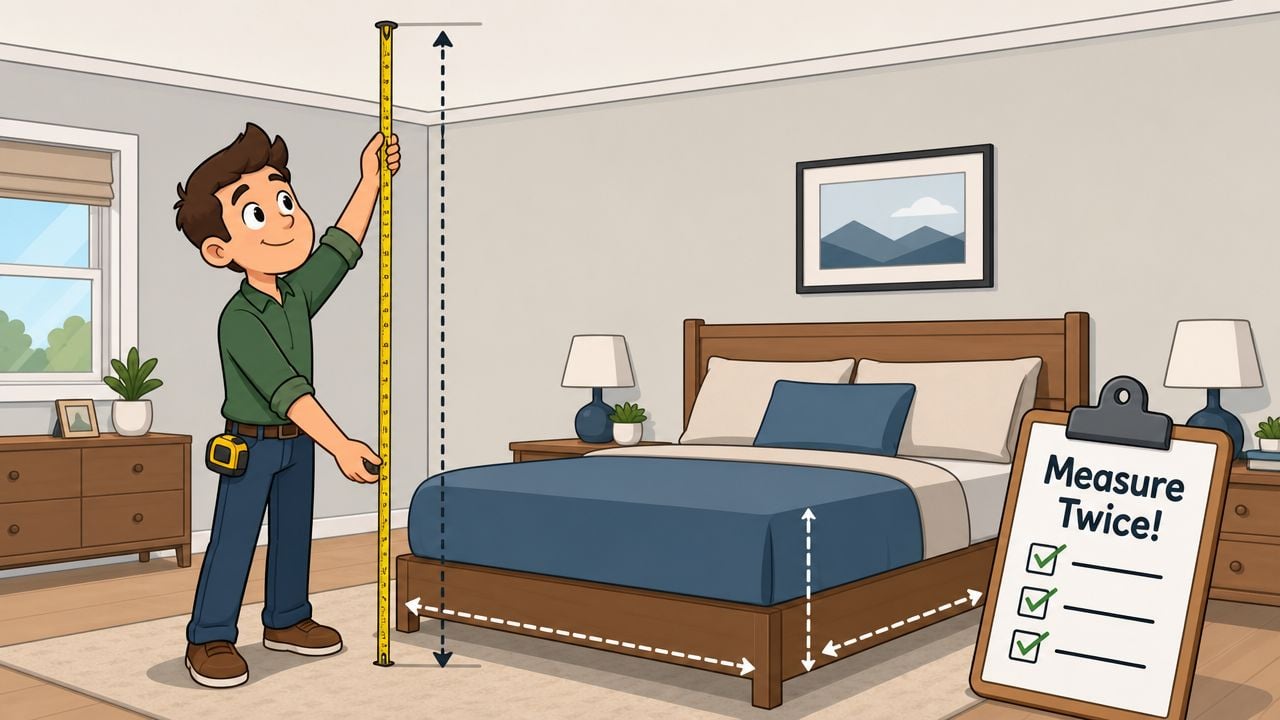
A good planning check includes these points:
- Ceiling clearance: There should be enough room above the mattress so the sleeper can get in and out without constantly ducking awkwardly.
- Mattress profile: A thicker mattress changes the final sleeping height more than people expect.
- Under-bed goal: Decide what belongs below the bed before choosing the loft height.
- Path around the bed: Make sure doors, windows, dressers, and closet access still work after the bed goes up.
A lot of misfires happen because someone measures only the frame and forgets the mattress. That's especially important when shopping for sleep products. A lower-profile mattress can make a lofted setup far more comfortable in a room with limited height, and anyone replacing old sleep surfaces should compare dimensions carefully with a room-planning guide like how to measure furniture for your space.
Gather the right setup items
The tools depend on the frame style, but the prep list is usually simple. Clear the floor, strip the bed fully, and set aside all pins, connectors, and hardware in one container so nothing disappears mid-project.
A practical setup usually includes:
- A helper: This isn't optional for safe lifting and alignment.
- A rubber mallet: Useful for final seating, not for forcing misfit parts.
- Work gloves: Helpful when dealing with metal edges or stubborn joints.
- Open floor space: Enough room to move the frame away from the wall and work around each corner.
Beds are easier to loft when the room is organized before the first corner moves. Tight spaces punish rushed setup.
Choosing Your Lofting Method
Not every bed should be lofted the same way. The right method depends on the frame's construction, the amount of lift needed, and how permanent the result should be. Some rooms only need a little extra storage clearance. Others need a full sleeping platform high enough to open up the whole lower half of the room.
Bed risers work for light changes
Bed risers are the simplest option. They're best for modest height gains when the goal is basic storage underneath, not a full desk or seating zone. They're quick, but they also have limits. If the frame is heavy, oddly shaped, or already a little wobbly, risers can amplify that instability instead of fixing it.
This route makes sense when someone wants extra under-bed bins and the original frame is already sturdy. It's not the right answer for a full loft effect.
Loft kits fit adjustable bed systems
A loft kit is the middle-ground choice. It works well when the existing bed is designed with compatible connections, adjustable levels, or a hardware system that supports elevation. That's often the most realistic way to learn how to loft a bed without building one from scratch.
This approach also depends heavily on the frame quality. Strong, well-built bedroom frames tend to respond better to kits and height adjustments than lighter construction does. For shoppers comparing styles, a product page such as this half loft bed overview gives a good sense of the kinds of configurations that are made with elevation and access in mind.
Custom-built lofts need real carpentry discipline
A custom wood loft is the most flexible option, but it's also the one that leaves the least room for guesswork. For a secure DIY loft bed, construction should involve anchoring the frame to wall studs using at least two 5-inch lag screws per stud and verifying the frame is square by measuring the diagonals before final tightening, as described in this DIY loft bed build guide.
That advice matters because a loft bed doesn't fail only from weak parts. It also fails when the frame racks out of square during assembly and the twist gets locked in. The bed may look finished and still feel wrong every time someone climbs in.
A custom loft should be dry-fit, squared, adjusted, and only then tightened fully. Tightening first is how a small alignment error becomes a permanent wobble.
Comparing Bed Lofting Methods
| Method | Average Cost | Skill Level | Space Gained |
|---|---|---|---|
| Bed risers | Varies by product and frame style | Low | Limited extra storage space |
| Loft kit | Varies by hardware compatibility | Moderate | Moderate to substantial usable space |
| Custom DIY frame | Varies by lumber, fasteners, and design | High | Most flexible and substantial space gain |
The table stays qualitative for a reason. Real cost depends on the frame, hardware, tools already on hand, and whether wall anchoring or custom carpentry is involved. In practice, the better choice usually comes down to one question: is the goal a little more storage, or a true room-within-a-room effect?
The Step-by-Step Lofting Process
Individuals asking how to loft a bed typically work with an adjustable frame or a compatible lofting kit, not building a platform from bare lumber. In that situation, the process should stay methodical and calm. Fast usually means crooked.
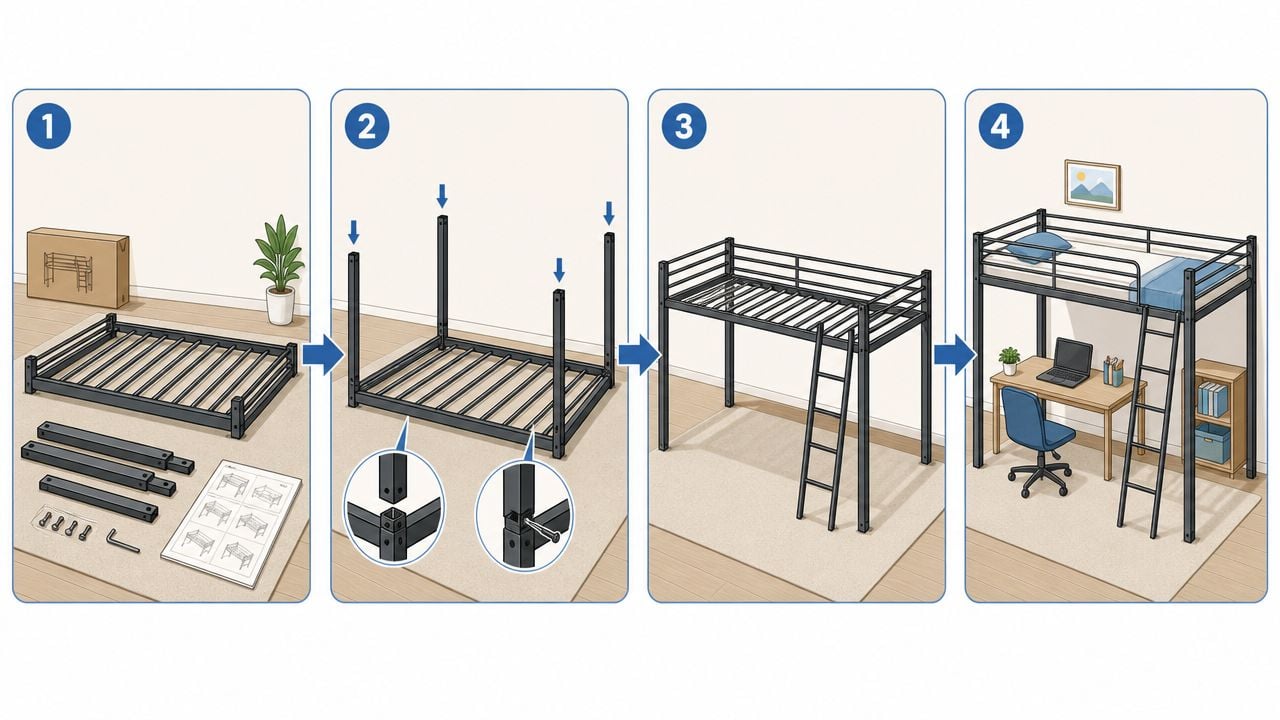
Clear the bed and the floor first
Start by removing the mattress, bedding, and anything stored underneath. Then pull the frame away from the wall so both people can access all corners safely. That extra floor space makes alignment much easier and reduces the temptation to twist the frame in place.
Official university housing instructions say this is a two-person job. UConn and UVA guidance specifically call for removing the mattress, having a helper stabilize the frame, and raising each corner evenly before using a rubber mallet for final seating, as outlined in UConn's lofting and bunking instructions.
Raise the frame evenly with a helper
One person should steady the frame while the other lifts and repositions each corner. The important part is even movement. If one side goes too far ahead, the opposite corner can bind or drop out of alignment.
A clean sequence looks like this:
- Stabilize first: One person holds the frame level while the other works the connection points.
- Lift in small increments: Move corner by corner, keeping the frame as even as possible.
- Watch the hardware: Pegs, hooks, pins, or slots should line up naturally. If they don't, lower slightly and reset.
- Avoid twisting pressure: Don't yank one rail upward while the rest of the frame lags behind.
Seat the connections gently and recheck alignment
Once the frame is set at the intended height, use a rubber mallet only for light seating. It should help snug the connection into place, not force a bad fit. If the hardware doesn't settle under light tapping, the frame needs repositioning.
After that, test each corner by hand before the mattress goes back on. Look for any corner that sits visibly higher, lower, or looser than the others. If the bed feels awkward to manage or the hardware seems unfamiliar, some homeowners choose outside help through a local furniture assembly service rather than wrestling with a stubborn frame alone.
If a corner resists, stop. Realign the frame. A mallet should seat a connection, not convince it.
Essential Safety Checks and Troubleshooting
A lofted bed isn't finished when the mattress goes back on. It's finished when the frame feels stable under normal movement and every connection stays seated after testing. That last part matters most on older frames, where wear and small bends can make alignment less predictable.
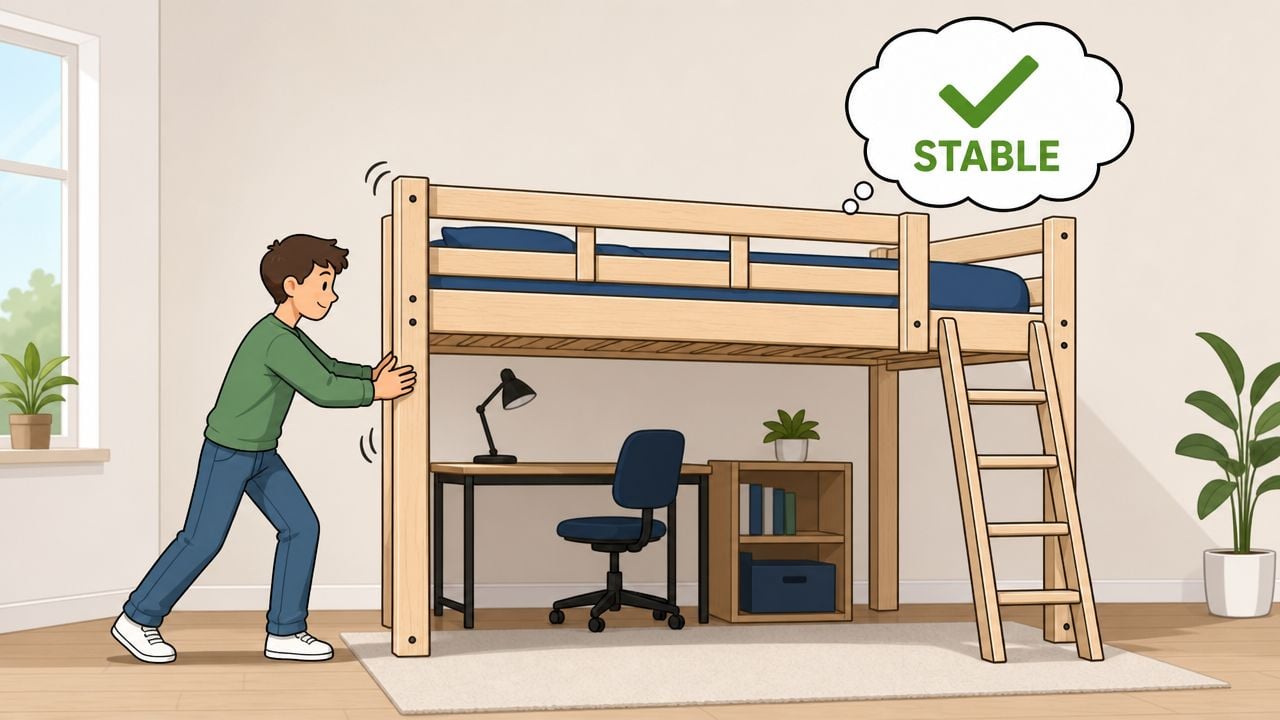
Test the frame before daily use
Do a simple stability check before anyone sleeps on the bed:
- Push from more than one side: The frame should feel firm, not loose or springy.
- Inspect all corners: Each joint should look fully seated and even.
- Check access points: Ladder, steps, or side entry should feel controlled and comfortable.
- Confirm rail security: If the sleeping surface sits high, guardrail protection matters.
A quick visual check catches a lot, but a light hands-on shake test usually reveals the truth. If the frame shifts noticeably, the problem is almost always in the joints, not the mattress.
What to do when the bed won't line up
Stubborn frames are common, especially with older furniture. Success often depends on keeping the bed level, using two people so the frame doesn't bind, and knowing when to stop instead of forcing a connection. Minor adjustment with a rubber mallet can help, but brute force shouldn't be part of the job, as explained in this troubleshooting video on stubborn bed lofting.
The most common problems are familiar:
- Pins won't line up: Lower the frame slightly and level it again.
- One corner keeps slipping out: Another corner is probably carrying too much weight or sitting too high.
- The frame looks square but feels wrong: Recheck every connector, then inspect the bed itself for wear or distortion.
- The setup still seems questionable: Stop and reconsider whether the bed was meant to be lofted at all.
For anyone comparing purpose-built options instead of modifying an older frame, a full wood loft bed can be a better fit than trying to force a standard bed into a job it wasn't designed to do.
Design Your Perfect Space with Gorins
Once the bed is off the floor, the room opens up in a useful way. That's when layout starts to matter just as much as the lift itself. The space underneath can become a reading nook, a clean storage zone, or a compact work area that makes the whole room feel calmer.
That's also where product choices have to match the room, not just the catalog. A lower-profile mattress can help preserve headroom in a lofted setup, and a sturdier bed frame gives the whole arrangement a better starting point than a lightweight frame ever will. For sleep-focused shoppers, mattress lines such as Tempur-Pedic, Serta, and Beautyrest are often worth testing in person because comfort by feel matters more than specs on a screen.
Good lofting also pairs well with better bedroom planning overall. Readers refining the room after the lift can pick up a few practical ideas from this restorative sleep environment guide, especially when the goal is to make a smaller bedroom feel both functional and restful.
Since 1936, Gorins Furniture & Mattress has helped Norwich and Eastern CT families furnish around real life, not ideal floor plans. That includes custom options like Canadel dining with thousands of combinations, the F9 Custom Sofa series for living spaces suited to your home, and promotional financing with equal monthly payments for bigger purchases when timing matters.
Visit Gorins Furniture & Mattress in Norwich to explore bedroom furniture, try mattresses in person, and talk through space-saving options suited to your lifestyle. Readers can also take the online Style Quiz or browse the Clearance section for value-driven savings. Since 1936, Gorins Furniture & Mattress has helped Norwich and Eastern CT families create homes they love. From custom-designed Canadel dining sets to the latest in Tempur-Pedic sleep technology, they combine a massive selection with the personalized care only a local, family-owned business can provide. Visit today to experience quality, value, and 5-Star Delivery service.