Size of Rug Under Dining Room Table

The rug should extend at least 24 inches beyond the table on all sides. That's the right starting point for the size of rug under dining room table decisions, but it isn't always the final answer if the chairs are deep or the room layout is tricky.
A lot of dining rooms look finished until someone pulls out a chair. Then the problem shows up fast. The back legs catch the rug edge, the chair tilts, and the whole space feels less comfortable than it looks.
That's why rug sizing is more than a decorating choice. It's a function choice first. In homes across Eastern CT, the best dining rugs are the ones that let people sit, slide back, and get up without thinking about the floor at all.
Finding the Perfect Fit for Your Dining Room
A common dining room mistake is easy to spot once it happens. The table looks centered, the rug color works, the chairs look proportional, but every meal comes with that little scrape when a guest pushes back from the table. The rug is too small for the way the room gets used.
The baseline rule is straightforward. Rugs under dining tables should extend at least 24 inches beyond the table edge on all sides so chairs can be pulled out comfortably while still staying on the rug, as noted in this dining rug guidance.
That rule matters because dining chairs move more than almost any other seat in the house. A rug under a coffee table mostly stays put visually. A rug under a dining table has to perform every single day.
Practical rule: If the chair leaves the rug when someone sits down or stands up, the rug is undersized, even if it looks good from across the room.
Homes in Norwich, New London, Plainfield, Waterford, and the surrounding Eastern CT communities often have one of two challenges. Some have formal dining rooms with enough floor area but bulky chairs. Others have compact eat-in spaces where every inch counts.
A good fit starts with the table, but it never ends there. Chair style, room width, nearby case goods, and traffic paths all affect what works and what doesn't.
For homeowners starting from scratch, it helps to think through the entire room first, not just the rug. A useful place to begin is this guide on designing a dining room from the ground up, because the rug should support the furniture plan rather than fight it.
The 24-Inch Rule And When to Break It
The 24-inch rule is a good starting point, not a guarantee. In real dining rooms, the chair usually decides whether the rug works.
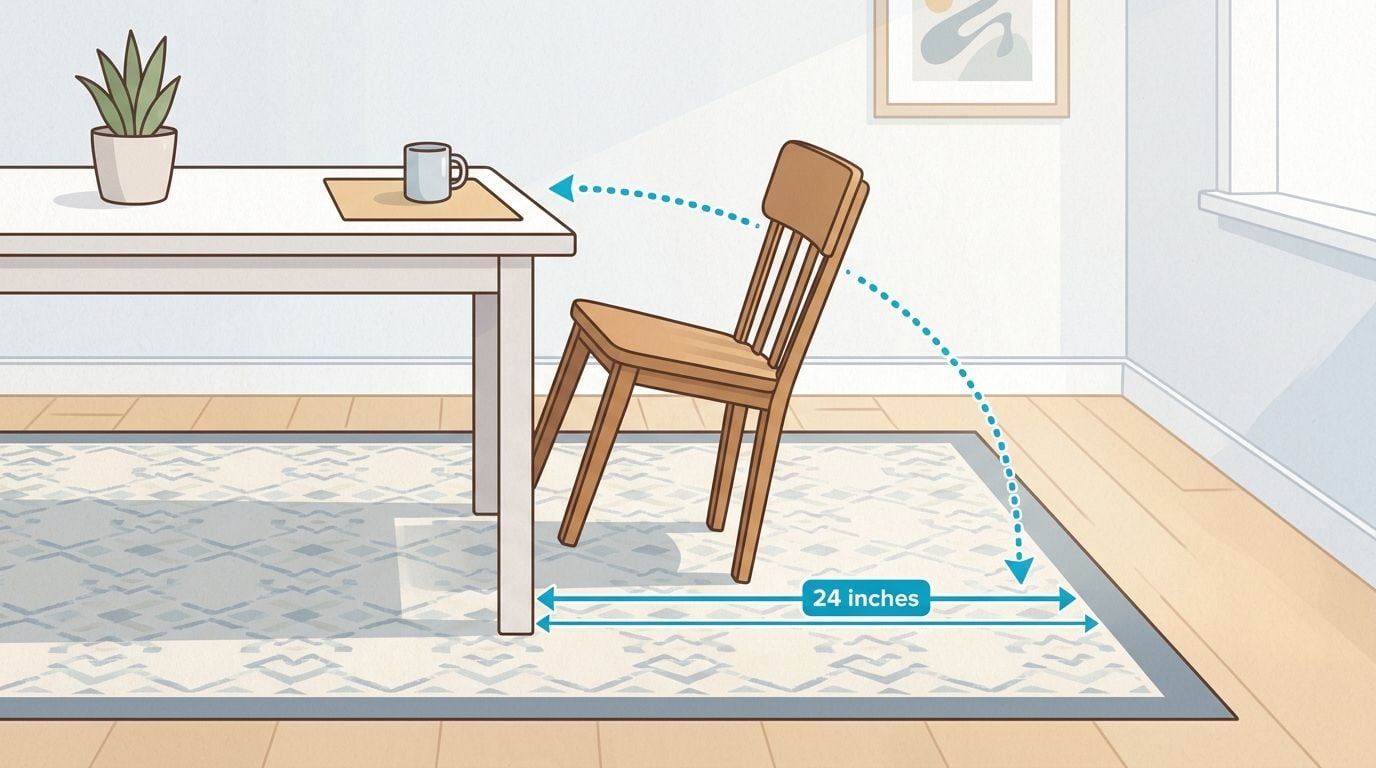
For a standard dining setup, the math is still simple. Measure the table length and width, then add 48 inches to each dimension to allow 24 inches of rug beyond every side. If your table is 72 inches by 42 inches, the target rug footprint comes out to about 120 inches by 90 inches. Since rugs are sold in standard sizes, that usually means choosing the next size that gives the chairs enough support once they slide back.
That baseline works well with lighter side chairs and compact seats.
It starts to fall short once the chairs get deeper, heavier, or more upholstered. I see this often with custom dining sets, especially with fuller Canadel chairs that have a generous seat and a curved back. The table may fit the formula perfectly, but the chair can still catch the rug edge when someone pushes back from dinner. That is the mistake people notice after the rug is delivered.
A better test is to measure the chair itself. Start at the front leg and measure to the farthest back point of the chair. Then allow for the position the chair reaches when someone gets up from the table, not just when it is neatly tucked in. If that pull-back position leaves the back legs near the rug edge, the minimum size is too tight.
In those cases, I usually recommend treating 24 inches as the floor, not the goal. Deep dining chairs often need closer to 30 inches or even 36 inches of extension for a comfortable fit, as discussed in this chair-depth and placement guide. The difference sounds small on paper, but it can be the difference between a chair that glides cleanly and one that drops a leg off the rug every night.
Room layout matters too. In many Eastern CT homes, the dining room is not a perfect box. A radiator, china cabinet, doorway, or tight passage to the kitchen can limit how far you can scale up. In that situation, the right answer is not always the biggest rug the room can hold. Sometimes the better move is choosing a slightly narrower chair, a round pedestal table, or a custom table size that keeps the whole layout balanced. Our guide to dining table sizes for Connecticut homes is helpful if you are sorting out those trade-offs before you buy.
Use the 24-inch rule to get into the right range. Use your actual chairs and room obstacles to make the final call. That is how you avoid a rug that looks right in the photo but feels wrong every day.
Rug Size Chart for Every Table Shape
Different table shapes ask for different rug decisions. Shape affects not only the footprint but also how people move around the table and where the chairs land when they're pulled out.
Rectangular tables
Rectangular tables are the most common setup, and the sizing method is the most straightforward. Add the clearance to the length and width, then choose the next workable rug size.
For a standard 6-foot (72-inch) rectangular dining table, the minimum recommended rug size is 12 feet by 8 feet (144 inches by 96 inches), based on adding 24 inches of clearance on each side, as shown in this rectangular table example.
That example also explains why many buyers get tripped up by orientation. An 8' x 12' rug and a 12' x 8' rug are the same dimensions stated in a different order. What matters is that the longer side follows the table's longer side.
Round tables
Round tables need a different measuring habit. Instead of length and width, start with the diameter.
Round dining tables require rugs with a diameter at least 36 inches larger than the table's diameter. For example, a 48-inch round table needs a minimum 84-inch (7-foot) round rug, according to this round table sizing note.
In practice, some homeowners still choose a rectangular rug under a round table when the room itself is long or open on one side. That can make the dining zone feel more anchored in the room, even though the table is curved.
Square tables
Square tables can be the easiest visually and the hardest spatially. They look balanced on square rugs, but they often sit in rooms that aren't square at all.
Industry recommendations for square dining tables that seat 6 to 8 people often land at 9' x 9' or 10' x 10', while a smaller 4-person setup usually starts at 8' x 10' if the room is rectangular, as outlined in this standard dining rug size guide.
A square table can also sit well on a rectangular rug if the room is narrow and the rug needs to relate to the architecture rather than just the tabletop.
Recommended Rug Size by Table Shape and Size
| Table Shape | Table Dimensions | Seats | Recommended Rug Size |
|---|---|---|---|
| Rectangular | 72-inch rectangular table | 6 | 12' x 8' |
| Round | 48-inch round table | 4 | 7-foot round rug |
| Square | Square table for a compact setup | 4 | 8' x 10' |
| Square | Square table for a larger setup | 6 to 8 | 9' x 9' or 10' x 10' |
| Oval | Oval table for a larger setup | 6 to 8 | 9' x 12' |
| Rectangular | Standard larger dining setup | 6 to 8 | 9' x 12' |
| Rectangular | Large dining setup | 10 | 10' x 14' |
A helpful next step is comparing table shapes before the rug is selected. This overview of table shapes and seating arrangements makes that decision easier because the rug should support the table's real use, not just its silhouette.
Designer Tips for Style and Material
A dining rug works hard. It has to handle chair movement, dropped food, and regular cleanup without turning every meal into a small annoyance. In practice, the best-looking option is not always the one that performs best under daily use.
For most dining rooms, a low-pile or flatweave rug gives the smoothest chair movement and the easiest cleanup. Thick, plush rugs can feel great underfoot, but they tend to catch crumbs, slow chair legs, and wear unevenly where people sit down and push back from the table.
What works best under chairs
Chair design matters just as much as rug material. A slim side chair behaves very differently from a deeper upholstered dining chair with a wider footprint. That comes up often with custom dining sets, especially Canadel, where seat depth, leg placement, and arm style can all change how the chair travels on the rug.
A rug that seems large enough by the usual rule can still feel cramped if the chairs are deep or heavily framed. I always tell shoppers to measure the chair in its fully pulled-out position, not just the table. That extra few inches is often the difference between a dining room that feels easy to use and one that nags at you every day.
Low-profile constructions usually perform best because they solve several problems at once.
- Better glide: Chairs pull out with less resistance.
- More stability: Chair legs stay planted instead of wobbling on a thick surface.
- Easier cleaning: Crumbs and spills stay closer to the surface where they are easier to spot and clean up.
A dining room rug should feel firm and dependable under a chair.
Shape, pattern, and room flow
The cleanest look usually comes from repeating the table shape in the rug, but real rooms are rarely that simple. In many Eastern CT homes, the dining room opens to a living area, sits near a hutch wall, or shares space with a walkway to the kitchen. In those cases, the rug has to relate to the room as a whole, not just the table centered on it.
Pattern plays a big role here. If the chairs have a busy fabric or the wood grain has strong character, keep the rug quieter. If the dining set is simple, the rug can carry more visual interest. This guide on mixing and matching patterns with balance is a helpful reference for combining those elements without making the room feel crowded.
Custom dining furniture gives you more freedom, but it also asks for better coordination. With Canadel, for example, you can adjust size, finish, and upholstery in ways that make the rug choice more specific. Warm wood tones tend to sit well on softer, muted patterns. Painted finishes and lighter fabrics can handle stronger contrast. The goal is a room that feels considered, not overdone.
Lighting changes the result more than shoppers expect. A rug that looks flat at midday can feel much richer at dinner under layered lamps and warmer bulbs. For readers exploring that atmosphere, this piece on styling with soft lighting offers useful ideas for building a softer evening mood around the table.
How to Handle Small Spaces and Unique Layouts
Not every dining area has the luxury of generous clearance. In smaller homes, breakfast nooks, or open-concept layouts, the rug has to solve both a furniture problem and a room-definition problem.
When space is tight
If a full 24-inch extension won't fit, interior design standards allow 18 inches beyond the table edge as an acceptable minimum, though chair mobility is reduced and front legs may slip off when chairs are fully extended, according to this small-space guideline.
That means the compromise is usable, but not ideal.
- Best use case: Compact dining nooks where wall clearance is already limited
- Main trade-off: Chairs won't stay as fully supported when pulled back
- Smart adjustment: Keep chair profiles lighter and less bulky in tighter rooms
Open-concept rooms and mismatched shapes
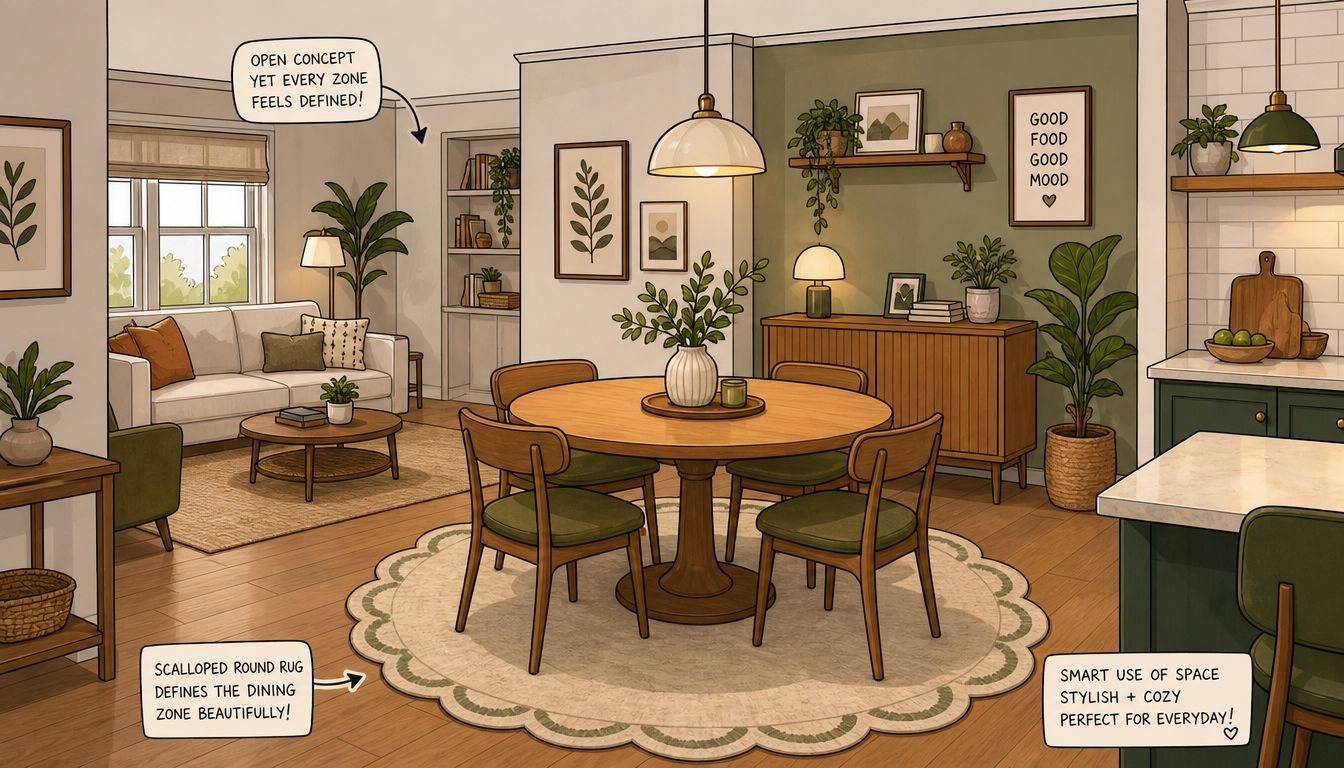
A useful designer move in open layouts is to let the rug follow the room rather than the table. Current coverage often ignores the projected 2025–2026 trend of asymmetrical dining zones in open-concept Connecticut homes, where the rug shape is deliberately mismatched to the table to align with room flow, as noted in this discussion of asymmetrical placement.
That can look especially strong in a long dining nook or a combined kitchen-dining area. A round table may sit better on a rectangular rug if the goal is to define the whole dining zone within a larger footprint.
The room doesn't always want the same shape the table does. In tighter layouts, the rug should answer to circulation first and symmetry second.
One more practical note. A buffet, cabinet, or sideboard usually shouldn't sit half on and half off the dining rug. The cleaner look is to let the rug define the table-and-chair zone only. In small homes, that separation keeps the room from feeling crowded.
For more ideas suited for compact rooms, this guide to dining furniture for small spaces is worth a look.
Your Dining Room Rug Questions Answered
Does a dining room rug need a rug pad
Yes, in most homes a pad helps keep the rug in place and reduces shifting as chairs move in and out. The pad should fit under the rug cleanly so edges stay flat.
Should the rug touch the walls
Usually no. A dining rug looks better when it reads as a defined zone beneath the table instead of wall-to-wall coverage. The room generally feels more intentional when the rug floats within the space.
Is it better to go slightly bigger or slightly smaller
Slightly bigger usually works better. An undersized dining rug creates more daily frustration than an oversized one, especially once chairs are in use.
What's the safest way to choose the size of rug under dining room table
Measure the table, then measure the chairs in the pulled-back position. That second measurement catches the mistake most buyers miss.
What should buyers remember most
Start with the minimum extension standard, then check the chair depth and the room layout before buying. That's the combination that leads to a fit that looks right and functions well.
For neighbors shopping for a dining room that suits their lifestyle, Gorins Furniture & Mattress is a strong local resource. Since 1936, this locally owned, family-operated Norwich showroom has helped families across Norwich, New London, Plainfield, Waterford, and surrounding Eastern CT and Rhode Island communities make confident home decisions with helpful guidance, investment-grade quality, and a low-pressure experience. Shoppers can explore Canadel Custom Dining with thousands of combinations, look into the F9 Custom Sofa series for connected open-plan style, and ask about Promotional Financing with equal monthly payments to make larger purchases more manageable. Visit the Norwich showroom, take the online Style Quiz, or browse the Clearance section for value-driven savings. Since 1936, Gorins Furniture & Mattress has helped Norwich and Eastern CT families create homes they love. From custom-designed Canadel dining sets to the latest in Tempur-Pedic, Serta, and Beautyrest sleep technology in The Sleep Gallery, they combine a massive selection with the personalized care only a local, family-owned business can provide. Visit today to experience quality, value, and their 5-Star Delivery service.