Dining Furniture for Small Spaces: Expert Solutions


A lot of homes in Norwich and across Eastern CT have the same awkward corner. It's too small for a full dining room set, too visible to ignore, and too important to waste. That's where many people get stuck. They buy a table that looks compact in a showroom or online, bring it home, and discover the chairs hit the wall, the walkway disappears, or the whole room starts feeling tight.
Small-space dining problems usually aren't style problems. They're planning problems. A dining area can sit in a kitchen pass-through, an apartment nook, a condo great room, or the edge of a living space and still work beautifully, but only when the furniture matches the room's real movement patterns.
Since 1936, a local family-run showroom has helped Eastern CT households solve exactly these kinds of furnishing puzzles with practical guidance and investment-grade choices that fit how people live. Neighbors who are weighing a two-seat setup, a compact dinette, or a more flexible solution often start with ideas like small kitchen table inspiration for compact homes and then narrow the options based on layout, not guesswork.
Table of Contents
- Your Small Space Dining Dilemma Solved
- Start with a Plan Measuring for Success
- Smart Table Solutions for Every Layout
- Maximize Seating in Minimal Space
- The Ultimate in Customization The Canadel Experience
- Beyond Dining Multifunctional Furniture and Styling
- Bring Your Vision Home with Gorins
Your Small Space Dining Dilemma Solved
The usual problem goes like this. A household wants a place to eat, work, host a friend, sort the mail, or help with homework, but the room only offers one narrow zone to do all of it. A standard four-chair set often looks right in a photo and feels wrong in real life.
That mismatch shows up in a few common ways:
- The table fits, but the room doesn't. The tabletop clears the walls, yet no one can pull a chair out comfortably.
- The chairs become clutter. Even a modest set can dominate a compact apartment or condo when the seats stay parked in circulation paths.
- The layout fights daily routines. Entry doors, kitchen routes, and living room traffic all compete with the dining area.
Small rooms don't need less intention. They need better decisions.
A compact dining area works when every piece answers a practical question. Can people move past it without sidestepping? Can the seats tuck in cleanly? Can the table support dinner one hour and laptop work the next? The strongest dining furniture for small spaces solves those issues first and style second.
That's also why “small” isn't one category. A square breakfast nook behaves differently from a skinny apartment wall, and both behave differently from an open-plan living room edge. The right answer depends on shape, clearance, and how often the space shifts jobs during the day.
Start with a Plan Measuring for Success
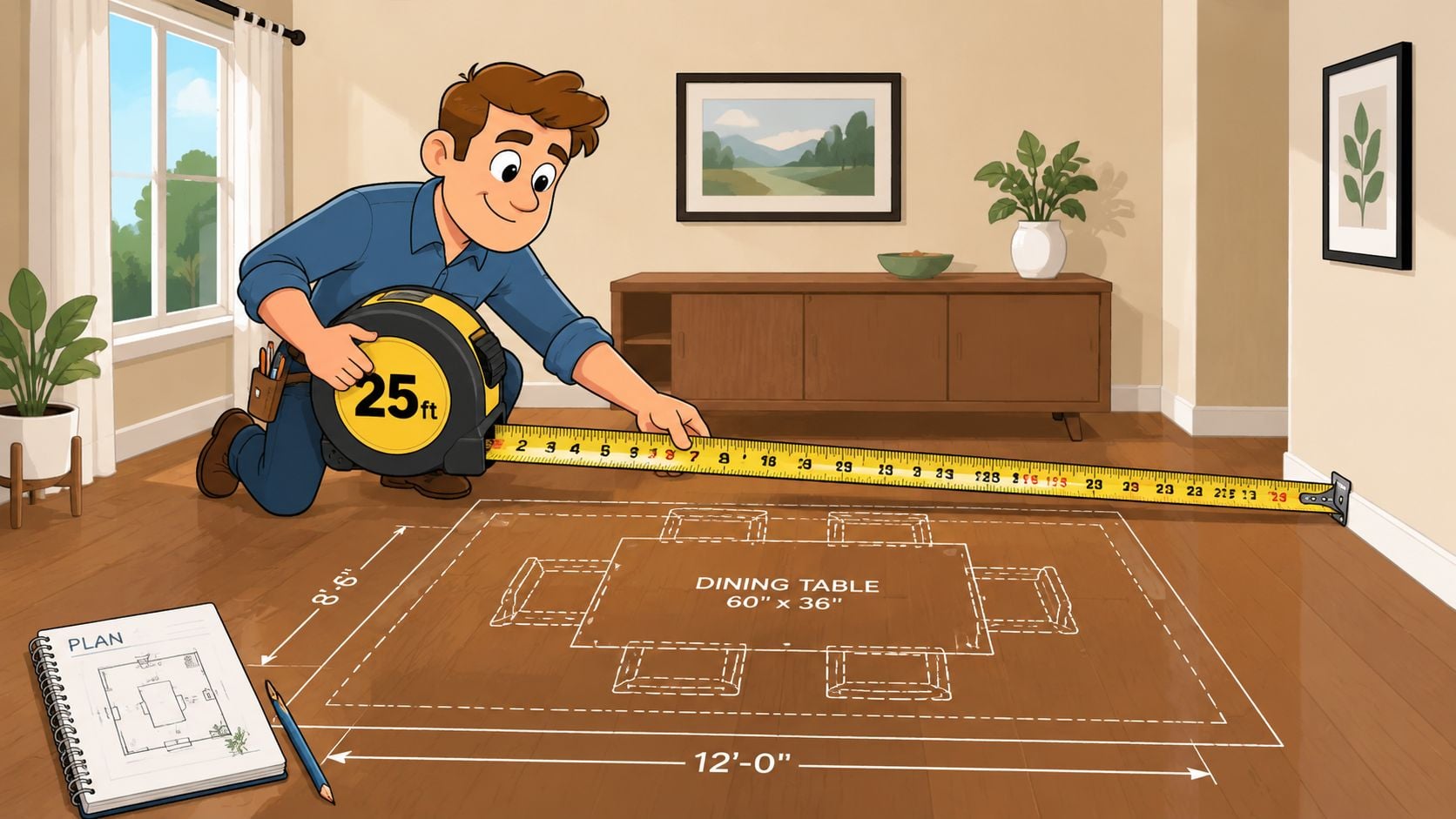
A small dining area should be measured from the outside in. A common approach is to start with the table size one wants, then try to force the room to accept it. The smarter move is to measure the usable area first, then choose furniture that respects it.
Measure the room people actually use
The first dimension to care about isn't the wall-to-wall room size. It's the zone available after accounting for doors, radiators, nearby cabinetry, and the walking path everyone already uses.
A practical guideline for compact dining is a table footprint of about 24 to 36 inches wide and 30 to 48 inches long, with at least 36 inches of clearance to walls or nearby furniture so chairs can slide out and people can pass comfortably. In tighter, lower-traffic corners, 30 inches can sometimes work, but 36 inches is the more comfortable target for circulation, as outlined in this small dining area sizing guide.
That clearance is what many buyers miss. The table itself isn't the whole purchase. The working footprint includes chair movement, body space, and travel paths through the room.
Use a taped layout before buying
The most useful low-tech tool is painter's tape. Mark the table shape on the floor, then walk around it as if the chairs were occupied. Open the nearby door. Pass through with a laundry basket. Pretend someone is seated while another person walks by.
Practical rule: If a layout only works when no one is using it, it doesn't work.
This simple floor test turns guesswork into a decision. It also helps narrow choices before a shopping trip, especially when reviewing a more detailed dining table size guide for Connecticut homes.
For households that entertain, the planning step should also include soft goods. Once the table size is settled, it becomes much easier to choose pieces like runners or perfect tablecloths for home entertainers without buying linens that overwhelm a compact setup.
A measured plan changes the whole shopping experience. Instead of asking, “Will this look okay?” the better question becomes, “Will this function every day?” That's the question that protects both budget and square footage.
Smart Table Solutions for Every Layout
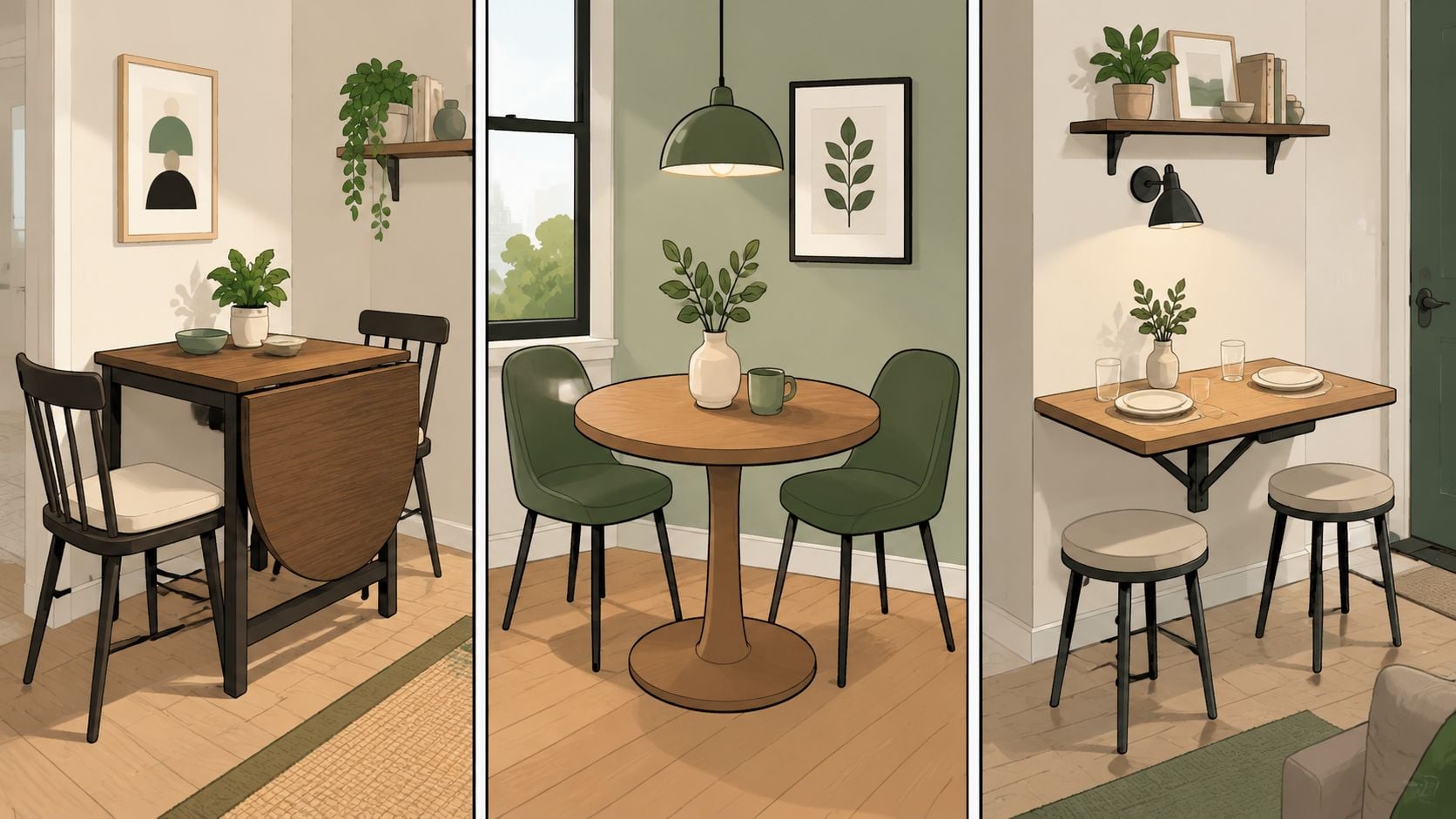
Table shape changes how a room moves. In tight homes, that matters as much as the finish or color.
When round and oval tables make life easier
In compact rooms, round or oval tables usually outperform rectangular ones because they remove corner conflicts and improve movement flow. A pedestal base can also increase usable legroom, and armless chairs around 18 to 20 inches wide reduce chair bulk and make pull-out motion easier in constrained layouts, according to this expert guide to selecting dining sets for small spaces.
That combination works especially well in these layouts:
| Layout type | Table style that often works | Why it helps |
|---|---|---|
| Tight square nook | Round pedestal | Softer circulation and fewer corner collisions |
| Open corner of a living room | Oval | Keeps flow moving without looking too rigid |
| Shared kitchen-dining edge | Small round with slim chairs | Easier to navigate during daily traffic |
A round top often feels calmer in a room with several pathways. There's no sharp corner projecting into the walkway, and the table reads as lighter even when it's substantial enough for daily use.
A pedestal base also solves a common annoyance. Four-legged tables can place a leg exactly where someone wants to sit, especially in a compact setup where every chair position matters.
Where rectangular and extendable tables still work
Rectangular tables aren't wrong for small homes. They just need the right room. A narrow wall zone, galley-style dining area, or kitchen banquette often handles a rectangle better than a round table.
The deciding question is how the room is shaped.
- Choose rectangular when the dining area is long and narrow and the table needs to align with that shape.
- Choose extendable when daily life stays compact but occasional guests need extra surface.
- Choose drop-leaf when the table must shrink visually and physically between meals.
The best small-space table is usually the one that disappears into the room when it isn't being used.
Some households also like to think beyond indoor use and compare how foldable or adaptable tables behave in other settings. For a different perspective on portability and compact design, this look at portable dining solutions for adventure highlights the same core principle: furniture earns its keep when it stores well, moves easily, and opens only when needed.
For style-minded shoppers, brands such as Aspen Home often appeal because they balance practical scale with cleaner silhouettes. But the key isn't the label. It's choosing a top shape and base style that make the room easier to live in every day.
Maximize Seating in Minimal Space

Most small dining areas fail at the seating, not the table. The tabletop may be modest, but oversized chair backs, bulky arms, and awkward pull-out space quickly make the room feel blocked.
A widely used planning standard is to leave 36 inches of open clearance around the table for comfortable circulation, with 30 inches sometimes acceptable in lower-traffic corners. Designers also recommend mapping a table footprint before buying. One practical method is to tape out a 48" x 30" rectangle and add 20 to 24 inches beyond each edge to simulate chair pullout and seating clearance, as described in this small-space dining planning reference.
Chairs that earn their footprint
Not every dining chair deserves a place in a compact room. The strongest choices tend to be the least fussy.
- Armless chairs keep the outer edge slimmer and usually make it easier to move in and out.
- Open-back designs feel less visually heavy than solid, upholstered bulk.
- Fully tuckable chairs preserve floor space when the table isn't in use.
That's one reason some homeowners also look at bar-height dining ideas for compact layouts. In the right room, a higher profile can create a casual zone that feels more like a perch than a formal dining setup.
When benches and stools make more sense
Benches solve a different problem. They reduce the number of moving parts. Instead of pulling out multiple chairs, one bench can slide under the table and clear the walkway faster.
They tend to work well when:
- One side sits against a wall. A bench keeps that edge cleaner than two separate chairs.
- The room does double duty. Tucking a bench under the table can open floor space for work, play, or easier movement.
- The priority is flexibility. Extra guests can often share a bench more easily than a fixed set of chairs allows.
Stools can also be useful, though they're best when the dining setup is informal. Backless seating stores neatly, but it usually isn't the first choice for long meals or lingering conversations.
A compact dining area should support real life, not just a staged photo. If the seats are hard to move, hard to store, or hard to live with, they're too much for the room.
The right seating mix often ends up asymmetrical. Two chairs and a bench. A pair of slim seats on one side and tucked stools nearby. That kind of solution tends to outperform the default four-chair package because it respects how compact homes function.
The Ultimate in Customization The Canadel Experience

Off-the-shelf dining furniture often comes close. It's almost narrow enough, almost the right shape, almost the right finish, almost the right seating mix. In a generous room, “almost” can be acceptable. In a small one, it usually creates daily frustration.
Why off-the-shelf sizes often fall short
A major gap in small-space shopping is the lack of clear decision rules around room shape, chair overhang, and aisle clearance. Generic advice often recommends compact or extendable tables but doesn't translate that into practical choices for narrow versus square rooms, or for deciding between round, square, pedestal, or bench seating, as discussed in this analysis of the small-space sizing problem.
That gap explains why shoppers so often feel stuck between two imperfect options:
| Common situation | What usually happens |
|---|---|
| The room is narrow | A standard table leaves poor walkway space |
| The room is square | A rectangular table wastes useful corners |
| The chairs are bulky | The table size stops mattering because the seating overwhelms it |
Small rooms punish compromise faster than large ones do. A slight mismatch in width, leg placement, or chair scale has a much bigger effect.
Custom dining solves the compromise
Custom dining becomes practical, not indulgent. A program like Canadel Custom Dining lets shoppers work from their actual room dimensions and then choose the shape, finish, base style, and seating combination that suits the space. The partnership offers thousands of combinations, which matters because small homes rarely need generic answers.
Gorins Furniture & Mattress offers this kind of custom dining option in its Norwich showroom, where shoppers can compare dimensions, silhouettes, and finish combinations against their own floor plan.
A custom table doesn't just change how a room looks. It changes how precisely the room works.
For homes in Norwich, New London, Waterford, Plainfield, and nearby communities, that precision can be the difference between a dining set that merely fits and one that supports daily life for years. Investment-grade furniture in a small room should be exact. That's what makes it worth buying once instead of replacing later.
Beyond Dining Multifunctional Furniture and Styling
Compact homes rarely give a dining area one job. The same table might hold breakfast, laptop work, school papers, and evening takeout, all within a single day. That's why many “small dining room” tips feel incomplete. They talk about compact furniture, but not about overlapping routines.
A real content gap in micro-space dining is the challenge of rooms that also serve as an office, entryway, or circulation path. General advice often stops at drop-leaf tables and stackable chairs, while the harder tradeoffs involve measuring traffic flow and choosing multifunctional furniture, including whether a bench, wall-mounted table, or one-sided seating will preserve more usable clearance than a standard setup, as noted in this guide to small-space dining challenges.
A dining zone that also works as daily living space
The most successful multifunctional setups usually follow a simple rule. The furniture should support the busiest use first, then adapt to the occasional one.
That often means:
- Desk-first dining tables that feel substantial enough for meals but simple enough for daily work.
- Storage pieces nearby such as a buffet, cabinet, or console that absorb placemats, office supplies, and serving pieces.
- One-sided seating plans when a wall or traffic lane makes a full perimeter of chairs unrealistic.
A bench often wins in these hybrid rooms because it can disappear under the table. A wall-side setup also helps preserve a cleaner lane through the room.
Styling choices that keep a small area open
Good styling won't rescue a bad layout, but it can help a smart layout feel lighter.
- Choose visual openness. Tables with visible legs or airy bases usually feel less bulky than heavy block forms.
- Keep the palette lighter. Soft wood tones and lighter finishes can make a tight corner feel less compressed.
- Use reflection carefully. A mirror near the dining zone can help bounce light and widen the feel of the room.
- Decorate with restraint. Small tables need smaller centerpieces and lower-profile accents.
For households that want a simple decorative moment without crowding the surface, The Candledust's floating candle guide offers ideas that can suit occasional dining styling. The key in a compact room is scale. Decor should add atmosphere without taking over the tabletop.
Useful multifunctional planning often starts with broader thinking about how to choose multi-functional furniture for modern homes. In small homes, that mindset matters as much as any single table style.
Bring Your Vision Home with Gorins
Small-space dining works when the decisions stay practical. Measure the zone accurately. Choose a shape that helps people move through the room. Use seating that tucks, stores, or adapts instead of dominating the floor. If standard sizes keep falling short, customization usually makes more sense than compromise.
That approach matters in Eastern CT because many homes don't offer a formal, isolated dining room. They offer a kitchen edge, a condo nook, a mixed-use living area, or an apartment wall that has to do more than one job. Investment-grade choices are the ones that respect those real conditions.
Since 1936, Gorins has served Norwich and surrounding communities as a family-owned, locally operated furniture destination built around quality, value, and helpful service. That heritage matters when shoppers want guidance that feels grounded, not pushy. A small dining purchase can affect daily comfort for years, so the process should feel clear and confidence-building.
There's also the budget side of the decision. A well-sized dining set, especially a custom one, is a meaningful home purchase. Promotional Financing with equal monthly payments can make that investment more manageable for households that want to buy the right piece now rather than settle for a temporary fix.
For shoppers refining a full-home look, Gorins also offers style support beyond dining, including custom upholstery through the F9 Custom Sofa series and a dedicated Sleep Gallery featuring Tempur-Pedic, Serta, and Beautyrest, where comfort is best judged by feel and by what supports healthier sleep. That same practical mindset carries into the dining category. A room should match the way people live, not just the way a catalog page looks.
The strongest next step is still the simplest one. Bring the measurements, photos, and room questions into the showroom. Seeing scale, finish, and seating options in person makes small-space decisions far easier.
Since 1936, Gorins Furniture & Mattress has helped Norwich and Eastern CT families create homes they love with personalized guidance, custom dining possibilities, and helpful service rooted in the local community. Visit the Norwich showroom to test sizes and finishes in person, take the online Style Quiz to refine the look that fits your lifestyle, or browse the Clearance section for value-driven savings on quality home furnishings.