10 Open Concept Dining Room Ideas for 2026

From Awkward to Inviting: A Guide to Open Dining Spaces
For many neighbors in Norwich, Waterford, New London, and Plainfield, the great room can feel like a great challenge. One large space has to handle cooking, dining, homework, conversation, and everyday traffic, but without some structure, the dining area often ends up looking like it landed there by accident. That's where good planning matters more than decoration alone.
Since 1936, Gorins Furniture & Mattress has helped Eastern CT families solve this exact puzzle with practical furniture layouts, custom dining options, and a showroom experience that lets shoppers compare pieces in person before committing. Open concept dining room ideas work best when they prioritize how people move through the room, not just how the room looks in a photo.
That matters even more because open dining areas grew alongside bigger, less compartmentalized homes. U.S. housing construction data cited by City Furniture's discussion of open concept dining flow show the average size of new single-family homes increased from about 1,660 square feet in 1973 to roughly 2,500 square feet by the mid-2010s, helping shared living and dining zones become a mainstream layout.
For homeowners and renters trying to make that layout feel finished, the goal is simple. Give the dining area a clear identity, protect the walkway, and choose pieces that still feel connected to the rest of the room. Helpful inspiration starts with how to plan an open concept space, then gets much easier once the room is broken into specific design decisions.
Table of Contents
- 1. Define Your Zone with a Perfectly Placed Rug
- 2. Use Statement Lighting as a Visual Ceiling
- 3. Create Harmony with a Unified Color Palette
- 4. Choose a Table with a Smart Footprint
- 5. Employ Low-Profile Seating to Maintain Sightlines
- 6. Use a Buffet or Sideboard as a Soft Boundary
- 7. Layer Your Layout with Multi-Use Zones
- 8. Embrace Continuous Flooring for Ultimate Flow
- 9. Use Open Shelving for an Airy, Architectural Feel
- 10. Create a Before and After with a Real Family Plan
- Open-Concept Dining: 10-Point Comparison
- Your Perfect Dining Room Awaits in Norwich
1. Define Your Zone with a Perfectly Placed Rug
A dining rug does more than warm up the floor. In an open layout, it tells the eye where the dining room begins and where the living area ends, without interrupting sightlines or making the room feel boxed in.
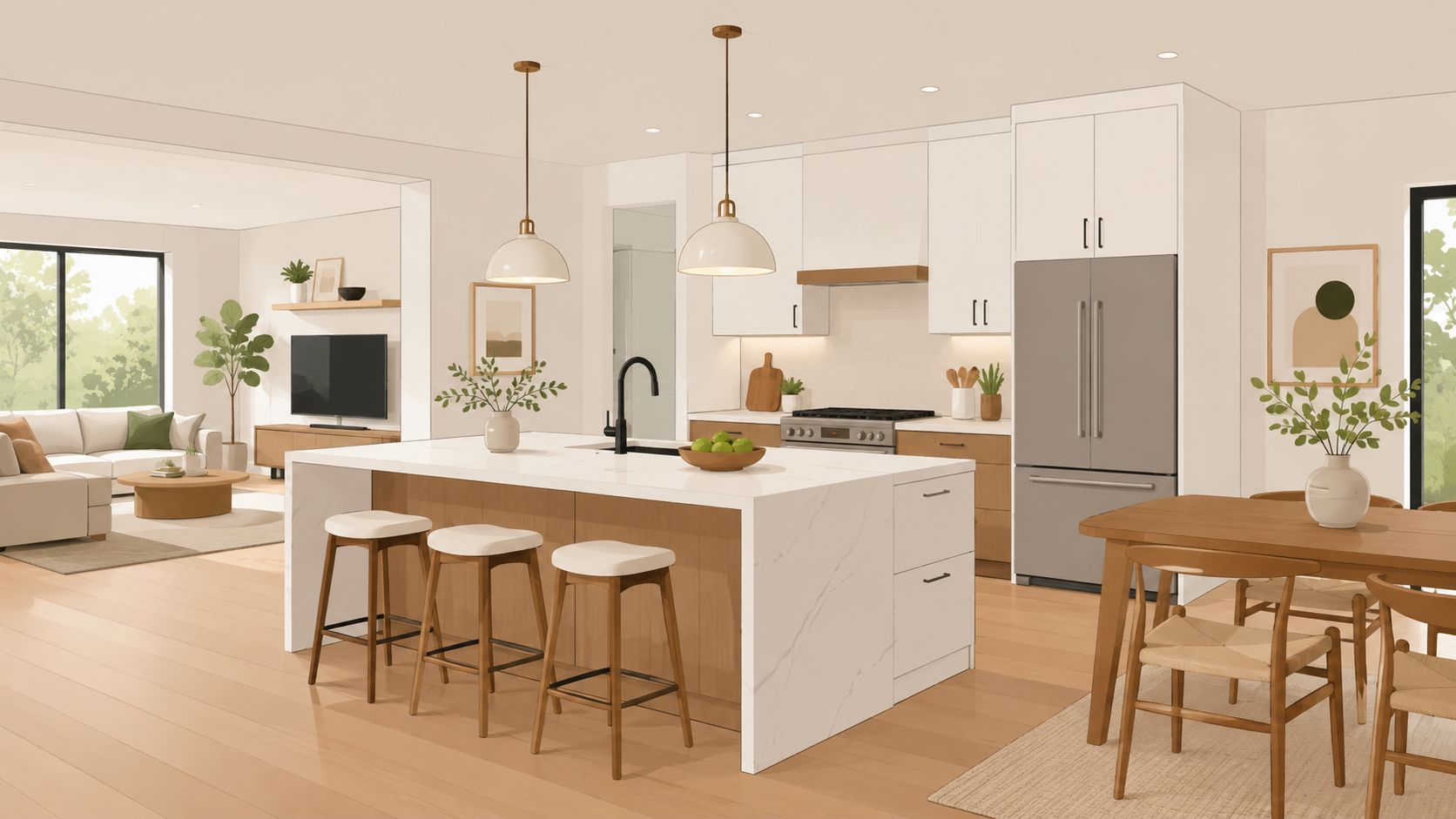
A lot of families in southeastern Connecticut start with a rug that's too small. The table fits, but the chairs slide off the edge every time someone sits down. That's when a dining area starts to feel fussy instead of comfortable.
Choose Size Before Style
For a standard 6-person table, an 8' x 10' rug is usually a strong starting point. That gives the chairs a better chance of staying on the rug when pulled out and helps the whole zone feel intentional rather than floating.
A few practical choices matter here:
- Use a rug pad: A non-slip pad keeps the rug from shifting in a high-traffic route between kitchen and living space.
- Favor forgiving patterns: Darker patterns or tonal designs hide crumbs and the occasional spill better than pale solids.
- Treat color as a connector: The rug can pull together cabinet tones, chair fabric, and living room accents in one move.
Practical rule: If the rug only fits the table and not the chairs in use, it's usually too small for an open concept dining area.
For homes with wood floors, texture also helps soften the room and cut some of the visual hardness that open plans can create. Families comparing materials can review rug options that work well on wood flooring before choosing something that looks good and behaves well day to day.
2. Use Statement Lighting as a Visual Ceiling
When walls disappear, the ceiling has to do more work. A chandelier or a row of pendants above the dining table acts like an invisible frame, giving the dining area its own identity while keeping the room fully open.
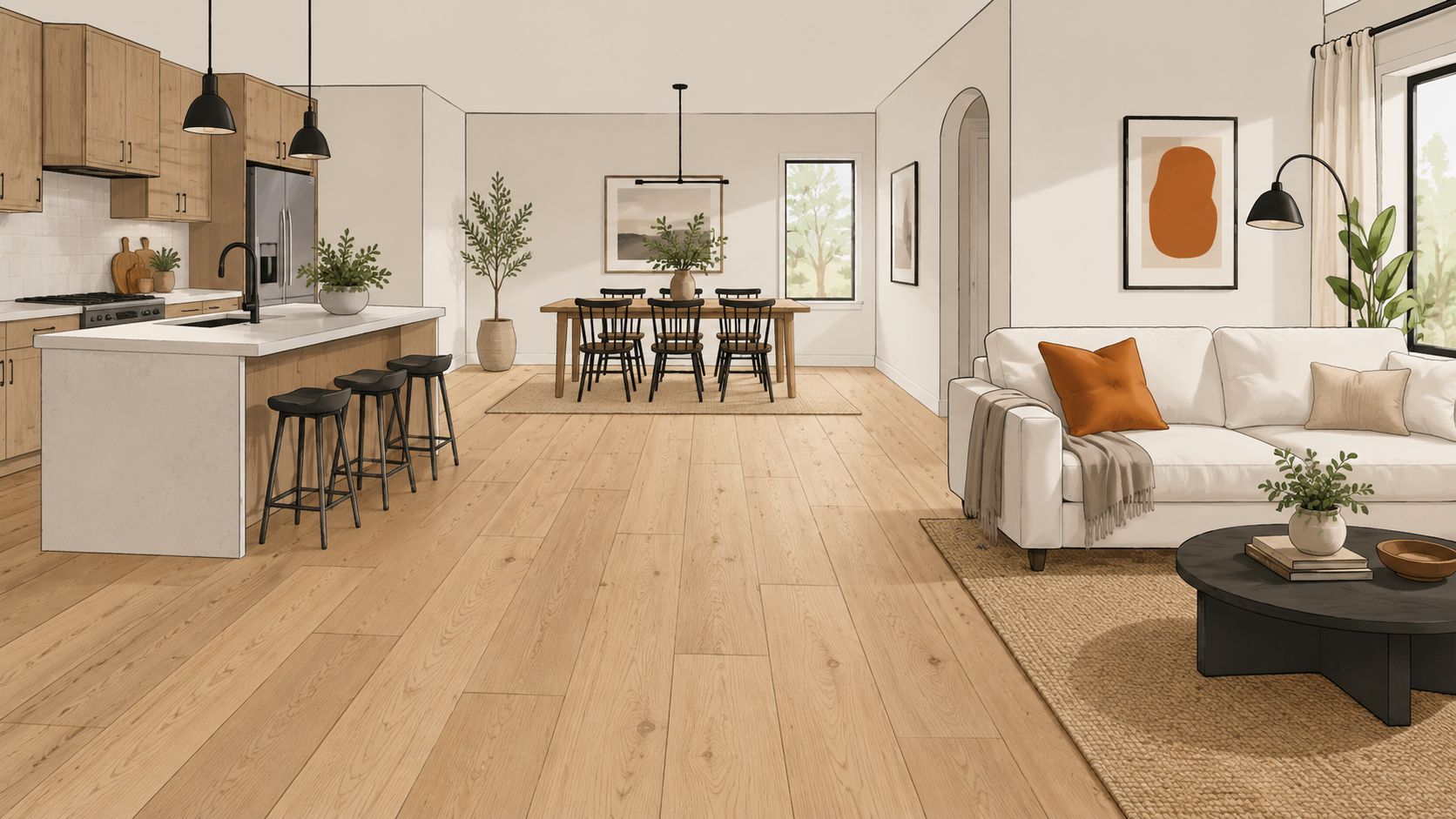
The easiest mistake is choosing a fixture for style only. It looks right from across the room, but once dinner starts, it throws glare onto the tabletop or leaves the surrounding zone dim.
Light for Comfort, Not Just Drama
A practical hanging range is about 30 to 36 inches above the tabletop. For scale, the fixture usually feels balanced when it's about one-half to two-thirds the width of the table. Those proportions help the light read as anchored instead of undersized or overwhelming.
Open-plan dining also has another challenge. Acoustics and lighting comfort often get less attention than style matching, even though large shared rooms can feel louder and visually harsher without enough softness. That gap is part of why upholstered seating, rounded shapes, and layered pendants keep showing up in current design conversations, as noted in this discussion of open-plan comfort and styling direction.
Good dining lighting should flatter people, light the meal, and leave the path around the table easy to read.
For Eastern CT homes with adjoining living rooms, repeated finishes help. A black metal pendant can relate to cabinet hardware, while warm brass can echo chair legs or nearby lamp bases. For more room-by-room coordination ideas, Gorins shares useful guidance in Put Your Living Room in the Best Light.
3. Create Harmony with a Unified Color Palette
Color has one job in an open plan. It keeps different zones from arguing with each other.
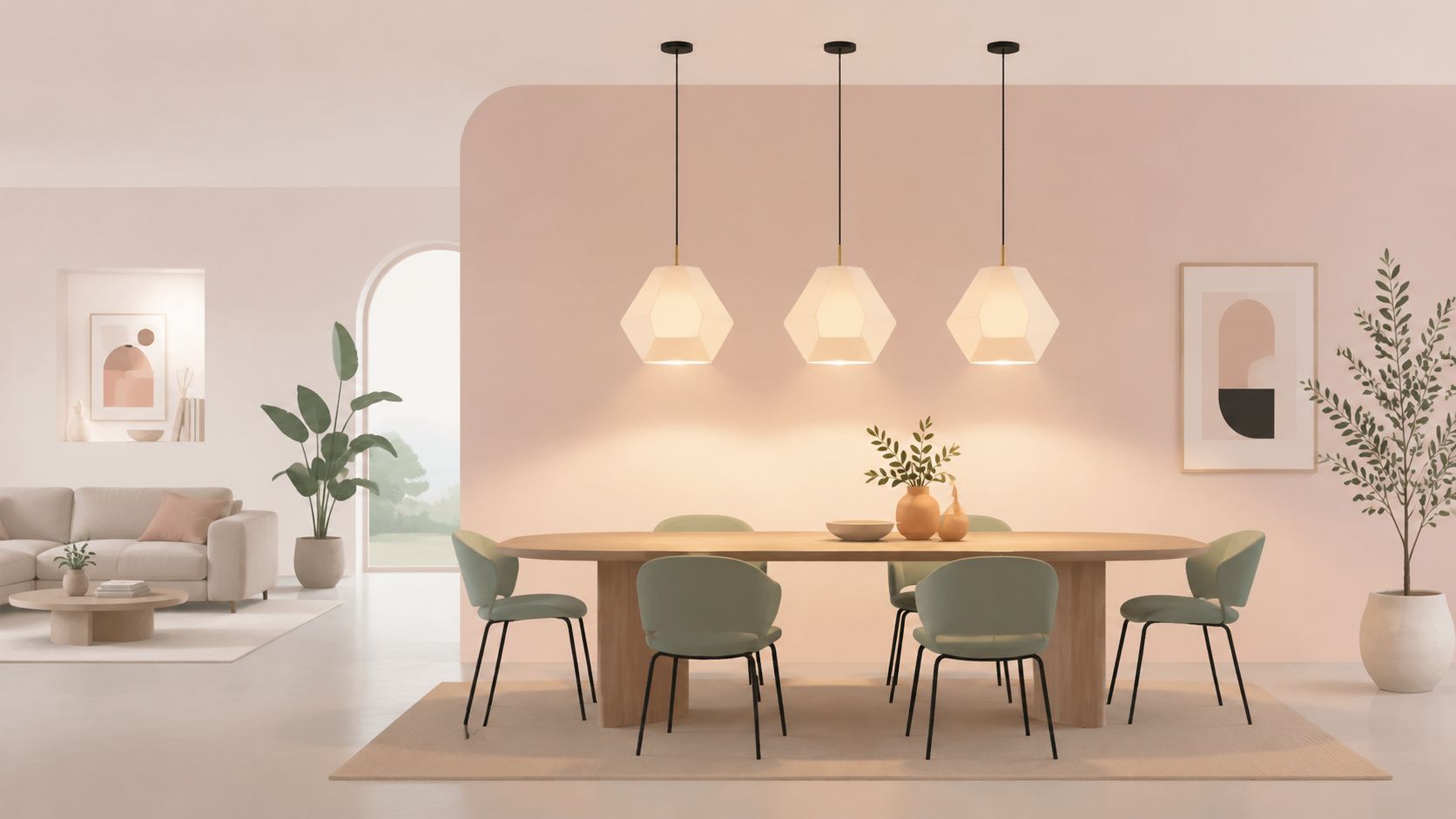
That doesn't mean every piece has to match. In fact, rooms usually feel flatter when the dining table, chairs, stools, sofa, and accents all sit in the same exact finish and tone. Better results come from repetition with variation.
Repeat Color Without Repeating Everything
A simple framework is a dominant color, a supporting color, and a smaller accent. In practice, that might look like warm oak and soft greige as the base, sage or navy in the upholstery, and black metal or aged brass as the accent. The kitchen can carry part of that mix through bar stools, runners, or artwork.
A strong custom dining program helps here. Canadel Custom Dining is especially useful for open concept dining room ideas because it allows families to tailor size, shape, finish, and fabric so the dining zone relates to nearby cabinetry and living room furniture instead of feeling like a separate purchase dropped into the room. With thousands of combinations available, it's one of the easiest ways to solve awkward “almost matching” problems.
Helpful ways to keep the palette steady include:
- Repeat one wood tone: Carry it from table to shelving, frames, or occasional furniture.
- Echo one fabric color: Dining chairs can pick up a color already used in toss pillows or window treatments.
- Mix texture on purpose: Linen, wood, metal, and upholstery keep a limited palette from looking flat.
Gorins also offers practical planning ideas in an expert's guide to the perfect color palette, which is useful when the dining area has to connect to two or three adjoining spaces at once.
4. Choose a Table with a Smart Footprint
The table is the hardest-working piece in the room. It handles meals, projects, conversations, and holiday overflow, but in an open layout it also has to respect the path people take through the house.
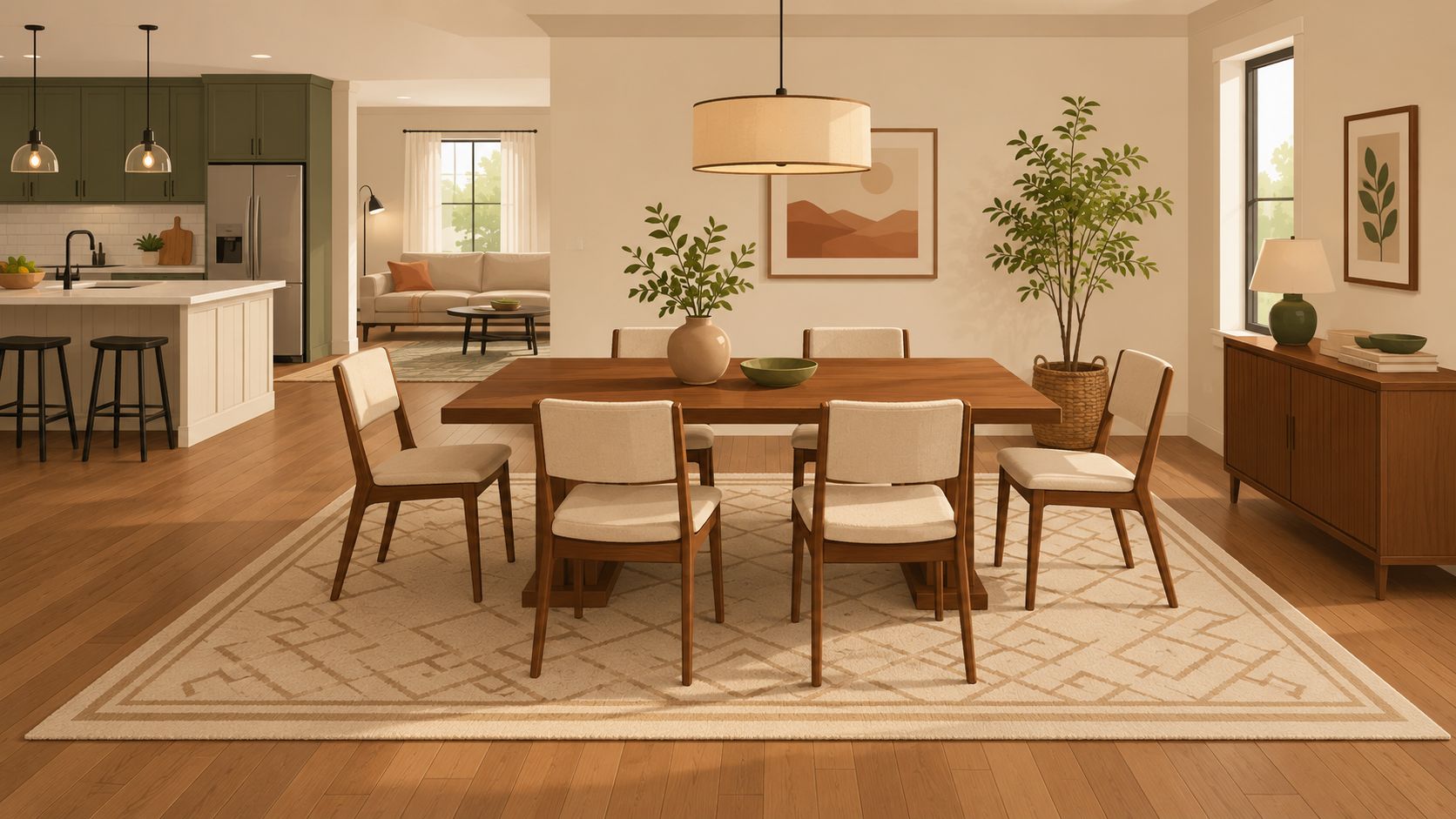
A bulky rectangle with corner legs can look impressive in the showroom and still be wrong for a pass-through space. Families notice that problem fast when chairs collide with the walking path from the kitchen to the sofa or slider door.
Match Shape to the Room's Traffic Pattern
Around the table, at least 36 inches of clearance is a sound baseline for movement. In rooms where the dining area doubles as a corridor, more breathing room often makes daily life easier. That practical side of planning often gets overlooked. As Houzz's article about defining open-plan dining space suggests indirectly, a lot of advice focuses on visual definition more than actual circulation, even though flow is what families feel every day.
Different table shapes solve different problems:
- Round tables: Good for conversation and often easier in tighter footprints.
- Narrow rectangular tables: Better for long, linear rooms where a wide table would choke the walkway.
- Pedestal or trestle bases: Easier for chair placement because legs don't interrupt every seat position.
- Extendable tables: Useful for households that want a compact everyday setup with room to expand.
A made-to-order Canadel table is a practical fit here because dimensions, shape, and base style can be chosen around the actual room, not guessed after the fact. Families measuring options can start with Gorins' dining table size guide.
5. Employ Low-Profile Seating to Maintain Sightlines
Open concept dining room ideas often focus on the table, but chair height changes the whole feel of the room. High, bulky chair backs can read like a short wall, especially when the dining area sits between the kitchen and the living room.
Low-profile chairs keep the room connected. Slat backs, spindle designs, or gently curved upholstered backs usually preserve sightlines better than oversized fully wrapped host chairs all the way around the table.
Where Benches Work Best
A bench can be one of the smartest choices in an open layout, especially on the side of the table closest to a wall or major walkway. It tucks in tightly, reduces visual clutter, and can make the room feel less formal without sacrificing function.
That said, benches aren't right for every household. Older adults often prefer the support and ease of individual chairs, and households that use the table for long meals may want padded seats with backs. A common compromise works well:
- Use chairs at the ends: Head chairs provide comfort and a finished look.
- Place a bench on one side: This saves space and keeps the profile low.
- Choose upholstered seats carefully: Soft seats add comfort, but thick backs can still block sightlines.
In many Norwich-area homes, this is also where the dining area starts feeling more social and less stiff. Casual seating makes sense because open plans are built for everyday living, not just formal occasions. That shift toward shared, multipurpose living-dining space is part of the broader market direction too. The global living-and-dining-room market is projected to grow from USD 191.5 billion in 2025 to USD 283.5 billion by 2035, with a 4.0% CAGR and Asia Pacific holding 45.8% share, according to Market.us coverage of the living and dining room market. In practical terms, retailers and shoppers increasingly treat dining as part of a bigger shared-room solution.
6. Use a Buffet or Sideboard as a Soft Boundary
Not every room divider needs to be tall. In fact, in an open concept, tall usually creates more problems than it solves.
A buffet or sideboard can separate the dining area from the living space without closing either one off. It gives the room a stopping point for the eye, while still letting natural light and conversation move across the space.
Storage That Earns Its Floor Space
This is one of the best upgrades for families who are tired of seeing placemats, chargers, candles, school papers, and serving pieces drift across the kitchen island. A dining storage piece gives all that supporting clutter a home.
A few placement rules help:
- Keep it lower than nearby seating backs: That preserves openness.
- Choose a finish that bridges rooms: The piece should relate to both dining and living furniture.
- Use the top intentionally: Lamps, a tray, art, or bowls work better than a crowded catchall surface.
For long-term value, well-built storage from brands such as Aspen Home and Flexsteel is worth considering, especially in a room that gets constant daily use. Families shopping this category can explore Gorins' dining room storage furniture for pieces that function as both storage and visual structure.
Design note: If a sideboard only adds decoration and no storage, it may not deserve the square footage in a hardworking open plan.
7. Layer Your Layout with Multi-Use Zones
The most successful open dining spaces rarely ask one table to do everything. A main dining table handles shared meals and guests, while a secondary perch handles the quick, messy, or in-between moments.
That second zone might be counter stools at the island, a compact breakfast spot by a window, or a pair of stools pulled to a console-height surface. It keeps the main dining area from turning into a permanent drop zone.
One Room, More Than One Job
This idea works especially well for households with kids, remote work, or staggered schedules. One person can eat breakfast at the island while someone else uses the main table for homework or a laptop. The room feels more useful because activities stop competing for one surface.
Gorins offers practical layout help in strategies for arranging furniture in an open concept living space, and the principle carries over directly to dining. Each zone needs a purpose, a clear edge, and enough room around it to move comfortably.
Some homes also pair the dining area with a casual entertaining corner. For readers considering that kind of setup, materials and planning ideas for a small beverage station can be adapted from this guide to building a home bar.
8. Embrace Continuous Flooring for Ultimate Flow
Flooring does quiet work. When the same surface runs through kitchen, dining, and living areas, the room immediately feels calmer and more unified.
That's one reason open-concept layouts became easier to pull off as homes became larger and more informal in how people used them. Today's open-plan dining area is often part of a larger social zone rather than a separate formal room, and uninterrupted flooring supports that feeling naturally.
Let Furniture Do the Zoning
Continuous flooring doesn't mean the room loses definition. It just means walls and material breaks no longer have to create it. Rugs, lighting, seating groups, and storage pieces can do that job more elegantly.
For practical everyday use, many families prefer surfaces that can handle dining spills and kitchen traffic without constant worry. Hardwood creates warmth, while luxury vinyl plank appeals to homes that want a wood look with easier maintenance around food prep and entry paths. Tile can also work, though it usually needs softer layers elsewhere in the room so the space doesn't feel cold or echo-heavy.
A common mistake is overcorrecting with too many transitions. Different flooring in each zone can make an open room look chopped up, even when the furniture is well chosen. In most cases, one consistent foundation gives far more flexibility later.
9. Use Open Shelving for an Airy, Architectural Feel
A large hutch can overwhelm an open room fast. Open shelving offers storage and display without the visual weight of another tall furniture block.
That makes it a strong choice for smaller dining walls, pass-through spaces, or homes where the dining area needs to feel light from every angle. Shelving also gives the dining zone a vertical feature, which can be useful when the furniture profile stays intentionally low.
Keep It Edited
Open shelves only work when they're curated. If every plate, serving bowl, mail pile, and water bottle ends up on display, the room starts looking busy in the worst way.
A cleaner approach usually includes a mix of use and restraint:
- Stack everyday pieces neatly: Plates, bowls, and glassware can look organized when grouped by type.
- Add a few decorative objects: A vase, framed art, or ceramic piece breaks up utility.
- Leave empty space: Breathing room matters just as much as what goes on the shelf.
This can be especially effective in apartments or compact homes around southeastern Connecticut where the dining area doesn't have enough wall depth for a full case piece. Shelving keeps the architecture feeling open and can make the dining zone look intentional even when square footage is tight.
10. Create a Before and After with a Real Family Plan
The easiest way to improve an open dining area is to stop treating the room as one giant problem. Break it into a few solvable parts. Most families don't need a total remodel. They need a better anchor, a clearer boundary, and fewer pieces fighting the walkway.
A familiar local scenario looks like this. The dining table is too small for the room, the light fixture is undersized, chairs stick into the main traffic path, and there's nowhere to store placemats or serving pieces. The room feels cluttered even though it doesn't contain that much furniture.
A Norwich-Friendly Upgrade Strategy
A better version usually starts with four moves. First, add a properly scaled rug. Second, choose a table with a footprint that fits the circulation pattern. Third, swap bulky seating for lower-profile chairs or a bench mix. Fourth, add a buffet for storage and structure.
That's where Gorins becomes useful in a practical way. A Canadel Custom Dining set lets families solve dimensions, finish, and seating style together instead of hunting for separate compromises. If the adjoining living area also needs balancing, the F9 Custom Sofa series can help tie the larger open room together with customized upholstery choices.
The U.S. living-and-dining-room market is forecast to rise from USD 23,109.2 million in 2025 to USD 29,740.3 million by 2033, according to Grand View Research's U.S. market outlook. That continued demand makes sense on the ground in Eastern CT. Families are still looking for furniture that helps shared rooms feel coordinated, useful, and comfortable for everyday life.
One practical advantage is that rooms can be built over time. A household might start with the table and chairs, then add storage, then address lighting and surrounding seating. Promotional Financing with equal monthly payments can make that phased approach easier for larger purchases.
Open-Concept Dining: 10-Point Comparison
| Strategy | Implementation complexity | Resource requirements | Expected outcomes | Ideal use cases | Key advantages |
|---|---|---|---|---|---|
| Define Your Zone with a Perfectly Placed Rug | Low | Rug, non-slip pad, cleaning supplies; budget varies | Anchors dining area, adds texture and sound absorption | Open-plan dining adjacent to living/kitchen, renters, families | Quick, non-permanent, introduces color and warmth |
| Use Statement Lighting as a Visual Ceiling | Medium | Light fixture, wiring, dimmer, possible electrician | Creates focal point, defines overhead “ceiling” for the zone | High ceilings, entertaining spaces, long tables | Strong visual anchor, adjustable ambience |
| Create Harmony with a Unified Color Palette | Low–Medium | Paint, textiles, upholstery, coordinated finishes | Cohesive flow across zones, perceived unity and calm | Open-concept remodels, small or busy spaces | Timeless cohesion, affordable broad impact |
| Choose a Table with a Smart Footprint | Medium | Appropriately sized table (pedestal/extendable), measurements | Improved traffic flow, flexible seating, visual lightness | Variable household sizes, narrow or long rooms | Functional flexibility, better circulation |
| Employ Low-Profile Seating to Maintain Sightlines | Low–Medium | Low-back chairs or bench, upholstery options | Unobstructed sightlines, airier feel, connected space | Small open plans, desire for visual openness | Preserves views, space-saving, comfortable options |
| Use a Buffet or Sideboard as a 'Soft' Boundary | Medium | Buffet/sideboard, anchoring hardware, coordinated finish | Subtle division, added storage and serving surface | Entertaining homes, storage needs, behind-sofa placement | Functional divider, storage + display, decorative surface |
| Layer Your Layout with Multi-Use Zones | Medium–High | Additional seating (stools, bistro set), planning, coordination | Flexible seating, supports simultaneous activities | Busy families, homes needing multi-function areas | Increases functionality, separates activities without walls |
| Embrace Continuous Flooring for Ultimate Flow | High | Flooring material (hardwood/LVP/tile), installer, higher budget | Seamless visual flow, perceived larger space, durable base | Full remodels, long-term cohesive design goals | Unifies space, timeless foundation, fewer visual breaks |
| Use Open Shelving for an Airy, Architectural Feel | Low–Medium | Floating shelves, mounts, curated styling items | Light storage/display, airy aesthetic, accessible items | Display-focused kitchens/dining, small spaces | Visual lightness, flexible styling, cost-effective |
| Create a Before & After: The Real-Life Example | Variable | Combination of selected interventions, design support | Tangible transformation, prioritized improvements, clearer vision | Homeowners planning staged upgrades or full redesign | Demonstrates impact, guides priorities, inspires confidence |
Your Perfect Dining Room Awaits in Norwich
Creating a functional open concept dining room comes down to a few disciplined choices. Define the zone clearly, protect the walkway, keep the palette connected, and choose pieces that earn their footprint every day. When those basics are in place, the room starts working better for weeknight dinners, guests, school projects, and everything in between.
For many Eastern CT homes, the table is the decision that changes everything. The wrong one crowds the room and interrupts traffic. The right one sets the scale, improves flow, and gives the dining area a real identity. That's one reason custom options matter so much in open layouts. Canadel Custom Dining gives shoppers thousands of combinations in size, shape, finish, and fabric, which is especially helpful when the dining zone needs to coordinate with nearby cabinetry, flooring, and living room furniture.
Storage and seating deserve the same attention. A well-placed buffet can act as a subtle boundary while hiding the items that make shared spaces look messy. Low-profile seating can keep sightlines open without sacrificing comfort. Layered lighting can make the dining area feel finished instead of dropped into the middle of a larger room. These aren't decorative extras. They're what turn an undefined area into a room people want to use.
Gorins Furniture & Mattress offers a practical place to sort through those choices in person. Shoppers in Norwich and surrounding communities can compare dining sets, storage pieces, upholstery, and customization options in one showroom, then work with knowledgeable associates in a low-pressure setting. For households furnishing more than one connected zone, that local guidance can save a lot of second-guessing.
Ready to create your after?
- Visit the showroom: See and compare Canadel, Flexsteel, Best Home Furnishings, and more in Norwich.
- Take the Style Quiz: A digital starting point can help narrow down finishes, shapes, and overall direction.
- Browse the Clearance section: It's a smart way to find value on quality pieces for a dining room refresh.
Promotional Financing can also help families phase a room together with equal monthly payments. Since 1936, Gorins Furniture & Mattress has helped Norwich and Eastern CT families create homes they love. From custom-designed Canadel dining sets to the latest in Tempur-Pedic, Serta, and Beautyrest comfort in the Sleep Gallery, the showroom combines selection with the personalized care of a local, family-owned business.
Visit Gorins Furniture & Mattress to explore custom dining options, take the Style Quiz, browse clearance values, or stop by the Norwich showroom for help building an open concept dining room that fits your home and your daily routine.