Headboard Styles for Every Bedroom: A Norwich Buyer’s Guide


A bare wall can make an otherwise finished bedroom feel oddly temporary. A Norwich homeowner may have fresh bedding, matching lamps, and a carefully chosen mattress, yet still stand at the foot of the bed wondering why the room lacks comfort and character. The answer often sits directly behind the pillows. Headboard styles affect how a bedroom looks, sounds, feels, and functions every night.
The right choice depends on more than colour. Room size, wall construction, sleeping habits, cleaning routines, tenancy rules, and the amount of support needed for reading all matter. This guide treats a headboard as a practical piece of bedroom furniture, not just a decorative finishing touch.
Why the Headboard Matters More Than You Think
The wall behind the pillow is the largest flat surface connected visually to the bed. That makes the headboard responsible for three everyday jobs: protecting the wall, influencing sound, and giving the bed the right scale within the room.
Pillows can mark plaster and paint over time, particularly when a sleeper reads or watches television in bed. A headboard creates a barrier between bedding and the wall, while also reducing the glare and visual clutter created by lamps placed close to the mattress. In older Norwich terrace houses, where plaster walls and hard flooring can make a room feel lively, the surface behind the bed also changes how sound travels. Modern apartments may present a similar issue when bare walls reflect household noise.
A solid wood panel gives the bed a crisp architectural outline. It feels cool and firm, and its visible grain can bring warmth without adding much softness. An upholstered headboard has a different character. Its padded face offers a more forgiving backrest and can soften the hard edges of a room.
Practical rule: A headboard should suit the way the bed gets used, not just the way the room looks in a photograph.
Three jobs worth checking
- Wall protection: The headboard takes the daily contact from pillows, bedding, and movement.
- Sound control: Soft surfaces absorb more reflected sound than hard surfaces, which can matter in compact rooms.
- Visual proportion: A low bed can look lost beneath a large wall, while an oversized design can crowd a small bedroom.
Headboards also have a long design history. They appeared in royal beds in Ancient Egypt, where precious metals such as gold and silver and luxurious woods such as ebony were used for display. In Ancient Greece, the headboard became part of a wooden bed platform and helped sleepers stay warmer in less insulated buildings. Later milestones included 13th-century canopy or tester beds, 15th-century four-poster beds, and a rise in upholstered headboards during the 17th century as comfort became more important. The historical shift from display toward support still guides sensible buying today. A useful starting point is this bed-accessory guide from Gorins, particularly for homeowners building a complete sleep setting.
The Seven Headboard Styles Every Buyer Should Know
A headboard should solve a bedroom problem before it follows a decorating trend. A compact room may need an open outline, a noisy flat may benefit from a softer surface, and a rental may call for a lighter design that is easy to live with. Start with how the room is used, then choose the style that fits.
Panel headboards
A panel headboard uses one or more flat rectangles, often made from plywood or MDF, fixed to a supporting frame. Its surface works like a framed wall panel behind the bed, giving contemporary, transitional, and minimalist rooms a calm backdrop.
The smooth face is easy to coordinate with changing bedding. It also suits a small bedroom where strong texture could make the wall feel busier. Check the panel's edges and finish if the bed will be moved regularly, since exposed corners can take knocks.
Tufted headboards
Tufting draws fabric or leather into a pattern with buttons, stitching, or both. Diamond tufting gives a traditional, refined feel, while straight channels look cleaner and more modern. The detail adds depth to a statement bedroom, but its recesses collect more dust than a flat upholstered surface.
This style suits someone who wants a decorative focal point as well as a padded backrest. Allergy-sensitive households may prefer simpler upholstery that can be vacuumed without working around deep buttons.
Sleigh headboards
A sleigh headboard has a curved or scrolled rail that turns inward around the sleeper. Its outline recalls antique American beds and sits naturally with traditional, rustic, or substantial furniture.
The shape brings warmth to a large bedroom, though it has visual weight. Leave enough space around the bed so the curves do not make a narrow room feel crowded. It is a furniture-led choice rather than a quiet background.
Canopy and four-poster headboards
Canopy and four-poster designs use tall posts or an upper frame to enclose the bed. Some contemporary versions use a ceiling-mounted structure instead of heavy posts, preserving height without filling the floor with bulky supports.
They create an architectural focal point for a statement bedroom. Before ordering, check ceiling height, curtain plans, lighting positions, and walking clearance. A beautiful frame can become awkward if a pendant light or door path conflicts with it.
Metal headboards
Metal headboards range from wrought-iron scrollwork and brass detailing to simple matte black steel frames. Open designs leave more wall visible, helping a compact bedroom feel less enclosed. Metal works with industrial, vintage, farmhouse, and modern schemes.
Its trade-off is comfort. A metal frame offers little cushioning for anyone who reads or watches television in bed, and hollow or loosely fixed parts may sound noisier against a wall.
Upholstered headboards
An upholstered headboard combines a rigid frame with foam and an outer fabric wrap. A typical build places plywood or MDF over a wood or metal frame, followed by high-density foam and textile. About 5 centimetres of foam can provide a functional minimum, while 7 to 10 centimetres offers greater comfort for extended reading.
This is often the practical choice for noisy apartments or anyone who leans against the bed nightly. It softens contact with the wall and feels warmer than a hard surface, but the fabric requires more careful cleaning than sealed wood or metal.
Reclaimed wood headboards
Reclaimed wood uses rough-sawn planks or barn-wood boards with visible knots, nail holes, and colour variation. Each piece has a more individual character than a manufactured panel, making it suitable for rustic and lived-in bedrooms.
Inspect the seal and surface closely. Rough timber can collect dust, snag bedding, and feel less comfortable behind pillows. A well-finished example keeps the character while making daily use easier.
Norwich showroom customers often ask about upholstered, panel, and wood designs because these families cover different comfort needs and decorating schemes. Metal and statement forms remain useful when a room needs an open outline or a stronger focal point.
Comparing Materials, Finishes, and Daily Maintenance
A headboard's material determines how much care it needs. A household with pets, children, seasonal heating, or allergy concerns should choose the surface first and the colour second.
| Material | Typical Cleaning | Scratch/Stain Risk | Best For |
|---|---|---|---|
| Solid hardwood | Dust with a soft cloth and follow the maker's finish guidance | Raw or open-grain surfaces can show spills and marks | Long-term investment and warm traditional rooms |
| Veneered MDF | Dust gently and wipe the sealed surface | Edges can be vulnerable to chips and moisture | Stable panel designs and coordinated finishes |
| Metal | Wipe with a dry or lightly damp cloth | Brass can tarnish, while polished finishes show marks | Open, lightweight looks and industrial rooms |
| Performance fabric | Vacuum with a suitable upholstery attachment and treat spills promptly | Lower everyday stain concern than loose natural fibres, but testing still matters | Families, pets, and frequent use |
| Leather or faux leather | Wipe with a soft cloth and use only approved care products | Leather can scratch, while faux leather can suffer from unsuitable cleaners | Renters and households wanting a wipeable face |
| Linen | Use a soft brush or upholstery attachment and remove marks quickly | Natural fibres can show staining and creasing | Relaxed, breathable-looking schemes |
| Reclaimed timber | Dust into joints and wipe only with a suitable cloth | Knots, rough grain, and unsealed areas can catch dust or absorb spills | Rustic interiors and character homes |
The care difference becomes obvious in ordinary situations. Pet hair lifts from linen with a roller but can cling to velvet's pile. Espresso may wipe away from a sealed lacquered finish almost instantly, yet it can darken raw oak. Brass can turn into a monthly polishing task, while matte black steel is more forgiving of fingerprints.
Renters and allergy households usually benefit from removable, wipeable surfaces. Tight-weave performance fabric, faux leather, or sealed timber is generally easier to manage than loose linen or heavily tufted upholstery. Deep buttons and narrow seams can collect dust, so a smooth panel may be the calmer choice for someone who wants a simple cleaning routine.
If an upholstered piece needs more than routine care, a professional cleaning service can help restore your furniture's beauty and freshness. Before ordering, a buyer should ask about removable covers, cleaning codes, and whether the fabric can tolerate the household's preferred cleaning method. Gorins' upholstery-material guide can also help narrow the fabric choice before a showroom visit.
How Upholstered and Hard-Surface Headboards Sound and Feel Different
In a Norwich terrace with plaster walls, hard flooring, and few soft furnishings, a fabric-covered headboard can make the bedroom feel calmer. Upholstery absorbs some reflected sound, while wood and metal return more sound to the room. One acoustic guide estimates roughly 35 to 50% sound absorption in the 500 to 2,000 Hz range for upholstered headboards, compared with nearly 90% of sound energy reflected by wood or metal in this headboard acoustics guide.
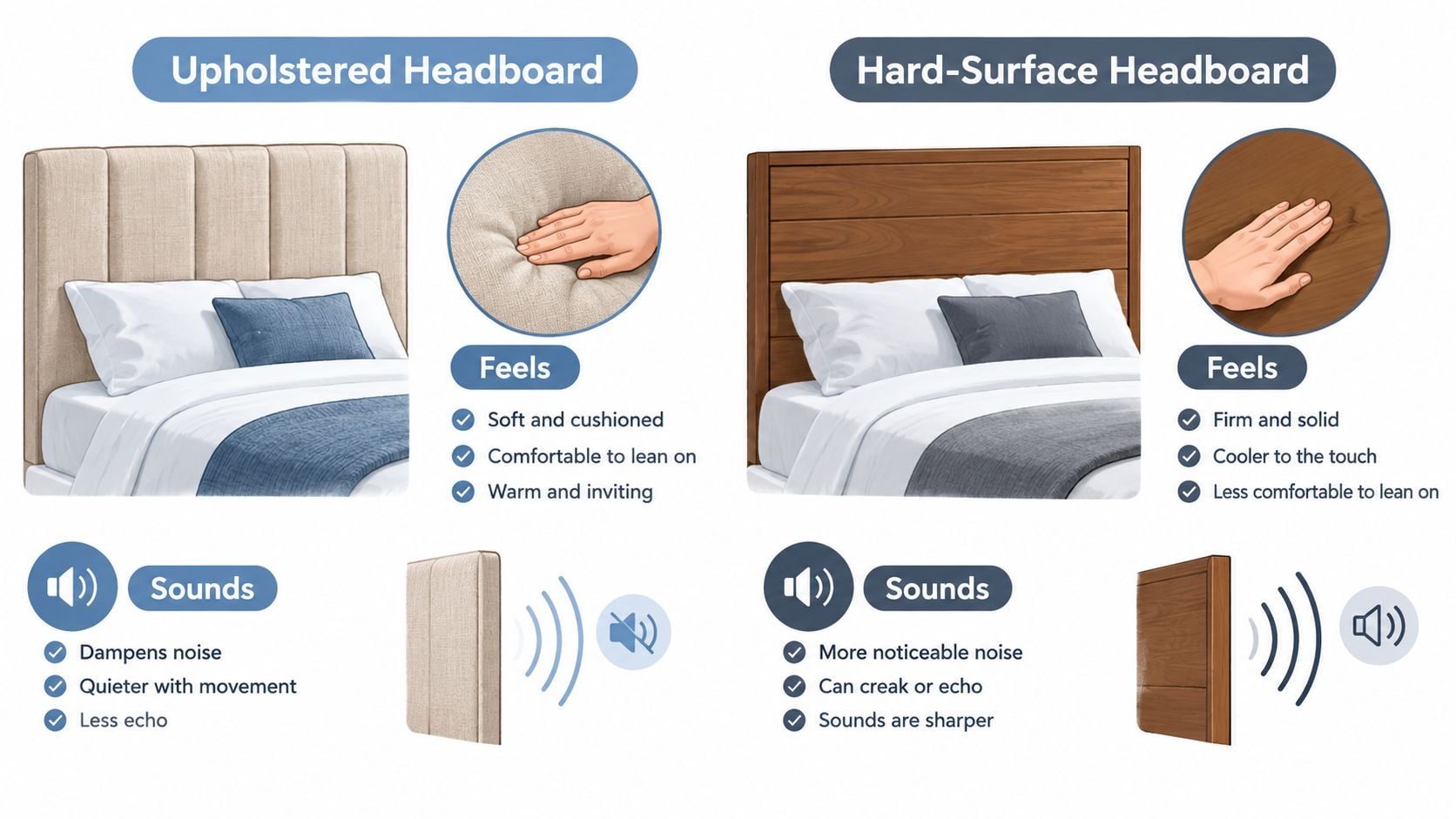
The difference may be less noticeable in a primary suite with carpet, curtains, and upholstered seating, because those furnishings already soften reflected sound. In a noisy flat, however, the extra fabric may make the space feel less stark, even though a headboard will not block outside noise like soundproofing.
Feel matters just as much. A padded headboard supports your back while reading or taking a morning phone call. Wood and metal feel firmer and cooler, which can suit a crisp, uncluttered room or feel pleasant against bare skin on a warm night. A rounded padded edge is generally more forgiving in a child's bedroom. Fabric choices can be narrowed with this guide to upholstery fabric types.
For a quieter, more cushioned result, technical guidance recommends a fabric-covered headboard with at least 2.5 inches of padding, denser backing layers, and coverage across the full bed width. That combination suits homeowners who read in bed or want to soften a lively room. Hard surfaces suit allergy households, rentals, or anyone who values quick wiping and a cooler touch. The best choice follows the room's noise, comfort, and maintenance demands rather than appearance alone.
Sizing, Height, and Mounting for Real Bedrooms
A headboard has to fit more than the bed. Check the frame, mattress, pillows, wall, windows, and ceiling together. Standard designs commonly sit 14 to 30 inches above the top of the mattress, while complete floor-to-top heights often fall between 40 and 58 inches.
| Bed Size | Headboard Width | Standard Height Range | Recommended Clearance Above Mattress |
|---|---|---|---|
| Twin | Match the frame width | 14 to 29 inches above mattress | 6 to 10 inches |
| Twin XL | Match the frame width | 14 to 29 inches above mattress | 6 to 10 inches |
| Full or Double | Match the frame width | 14 to 29 inches above mattress | 6 to 10 inches |
| Queen | Often 60 to 63 inches wide | 14 to 29 inches above mattress | 6 to 10 inches |
| King or California King | Often 76 to 79 inches wide | 14 to 29 inches above mattress | 6 to 10 inches |
Queen headboards commonly measure around 60 to 63 inches wide, while king designs often measure around 76 to 79 inches. Adjustable legs can provide roughly 1 to 3 inches of flexibility, useful when a mattress or frame sits higher than expected. Low-profile styles may begin around 24 inches, while canopy and statement designs can rise beyond 65 inches, depending on the ceiling and overall shape.
A compact bedroom may need a lower profile, especially beneath a window or shelf. A tall padded headboard can give a generous bedroom more presence, but it may crowd a low ceiling. Measure first, then choose the style that suits the room's usable wall space and maintenance needs.
Three mounting choices
- Wall-mounted: Z-clips or French cleats create a close, floating appearance and reduce gaps. The installer must locate suitable fixing points, which can be difficult on uneven plaster.
- Frame-mounted: Bolt-on brackets attach the headboard to the bed frame and provide stability, particularly for heavier upholstered pieces.
- Freestanding: Leg-mounted or floor-standing designs suit renters and anyone who cannot drill into the wall. They are also easier to reposition.
Before ordering, measure the mattress thickness, pillow stack height, skirting board, window position, crown moulding, and ceiling height. Allowing 6 to 10 inches above the mattress for visual breathing room can stop the headboard from looking squeezed beneath a window or shelf.
Older Norwich homes may have plaster walls that hide uneven surfaces. Confirming suitable fixing points matters before choosing a wall mount. The bed-size chart from Gorins offers a useful starting point, but the actual frame and room should determine the final measurement.
Matching a Headboard Style to Your Room Size and Decor
A practical match begins with the room's constraints. A headboard that feels elegant in a broad primary suite can overwhelm a compact bedroom, while an open metal frame may look lost against a tall wall.
Small bedrooms and apartments
For a small room, a slim panel, low-profile upholstered design, or open metal frame keeps the wall from feeling crowded. If the usable space behind the bed is especially tight, visual breathing room matters more than decorative detail. A pale panel can blend into the wall, while an open frame preserves more of the wall colour.
Apartments with bare walls often benefit from tufted or channel-stitched upholstery. The softened surface can reduce reflected sound where a wood panel would leave the room feeling sharper. A renter should prioritise bolt-on legs or a freestanding construction, then confirm that the headboard doesn't scrape the wall as the bed moves.
Family and allergy households
Leather, faux leather, treated performance fabric, and sealed reclaimed wood offer easier wipe-down routines than loose natural fibres. Deep button tufting can trap dust in its recesses, so a smooth or lightly channelled design may suit a household that wants fewer areas to clean.
A sensible family test: If a surface can't be cleaned in the way the household already cleans, it isn't the right surface, regardless of its colour or trend appeal.
Primary suites and statement rooms
Generous bedrooms with tall ceilings can carry a sleigh, wingback, canopy, or extra-tall upholstered frame. An oversized arched or channel-tufted design can anchor a statement bedroom, but simpler nightstands and restrained bedding help maintain balance. The same principle applies to a coordinated Norwich dining room. A substantial dining table needs surrounding space to feel intentional, and a substantial headboard needs clear margins around the bed.
Current market coverage shows headboards spanning upholstered, wood, metal, leather, mirrored, and platform-style designs, with one projection estimating a $4.8 billion market in 2025 and $7.6 billion by 2034, equivalent to 5.2% compound annual growth in this headboard design market overview. Another projection estimates $3.41 billion by 2025 at a 5.8% CAGR, so the figures differ by market definition, but both point to an active category rather than a niche accessory. The useful lesson for a homeowner is not to chase every look. It's to choose a form that fits the room and the way the bed gets used.
Custom Orders and the Norwich Showroom Advantage
Stock headboards work well when the bed, wall, and surrounding furniture follow standard proportions. Custom ordering becomes more useful when a room has an unusual mattress width, tall ceilings, angled walls, existing drapery, or bedding that needs a closely coordinated fabric.
A showroom consultation can address details that an online image can't answer. The buyer can compare fabric hand, padding firmness, seam placement, leg styles, and the relationship between headboard height and the actual mattress. Gorins' custom process includes in-store fabric selection, customer's own material acceptance, and choices involving height and leg style. Typical lead times are four to eight weeks, so the order should be placed with the bedroom schedule in mind.
What customisation can solve
- Unusual proportions: A made-to-order width can follow the frame and wall more accurately than a standard panel.
- Fabric coordination: Existing drapery or bedding can guide a practical colour and texture choice.
- Comfort preferences: Foam depth and upholstery construction can be discussed alongside the intended reading position.
- Rental limitations: Leg-mounted choices can avoid a wall installation when drilling isn't permitted.
Within the greater Norwich service area, the showroom consultation process can include an in-home visit, borrowed swatches, and a look at complete headboard vignettes in the bedroom gallery. Seeing three or four staged examples side by side helps reveal how a design behaves with nightstands, lamps, bedding, and wall colour. A buyer can learn how the custom-order process starts before booking a conversation.
Gorins Furniture & Mattress has operated as a locally owned, family-operated business since 1936, serving Norwich, New London, Plainfield, Waterford, and surrounding Eastern Connecticut and Rhode Island communities. Its custom dining partnership with Canadel Custom Dining and the F9 Custom Sofa series demonstrates the same made-to-order approach used across home furnishings, with thousands of combinations available in those programmes. Promotional Financing with equal monthly payments may help spread the cost of an investment-grade piece, subject to approval and current programme terms.
Headboard Questions Norwich Homeowners Ask Most
How can a renter mount a headboard without damaging the wall?
A freestanding headboard or a design with frame-to-headboard brackets avoids wall drilling altogether. Leg-mounted options are usually the simplest choice for a rental, especially where plaster, skirting boards, or tenancy rules make wall fixing uncertain. A Gorins showroom associate can confirm the fabric and mounting specifications before ordering.
How should velvet or linen upholstery be cleaned?
A weekly gentle brush or suitable upholstery attachment helps remove surface dust. Marks should receive immediate, careful spot treatment with an appropriate water-based cleaner, while a quarterly professional clean may suit heavily used pieces. The fabric's care code should be checked first with a Gorins showroom associate.
Are upholstered headboards suitable for allergy households?
They can be, but fabric construction matters. Tight-weave performance fabrics generally offer a more manageable surface than loose linen, and smooth upholstery is easier to vacuum than deep tufting. A Gorins associate can verify the available fabric performance ratings before an order is placed.
Are wingback and extra-tall headboards still current in 2025?
Yes, provided the scale follows the ceiling height and room proportions rather than a trend being copied blindly. A tall design can give a generous primary suite focus, but it may crowd a low-ceilinged or compact bedroom. A showroom associate can help check the final height, wall position, and fabric performance together.
Gorins Furniture & Mattress offers headboard styles, bedroom furniture guidance, custom-order options, and a Sleep Gallery featuring Tempur-Pedic, Serta, and Beautyrest for shoppers comparing comfort by feel and healthier sleep. Visit Gorins Furniture & Mattress in Norwich to compare upholstery, wood, metal, and custom options in person, take the online Style Quiz, or browse the Clearance section for value-driven savings, with Promotional Financing and equal monthly payments available on qualifying purchases.